
全球去美元化

Search documents
贵金属市场波动加大 长期多重上涨逻辑未变
Jing Ji Ri Bao· 2026-01-05 00:49
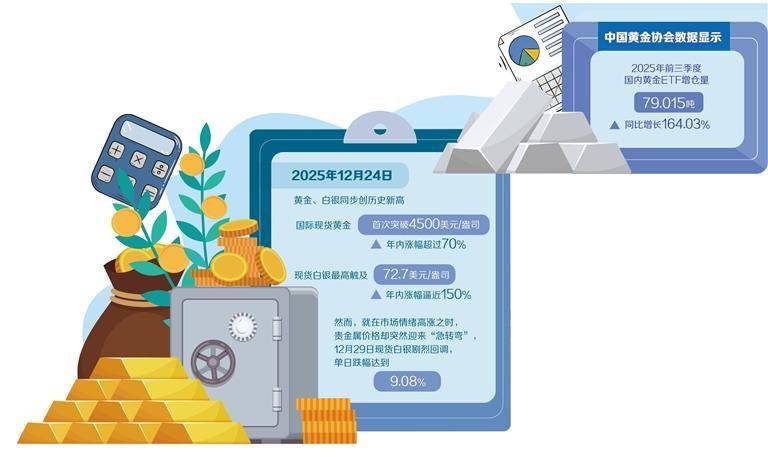
Core Insights - The precious metals market has gained significant attention, with gold and silver reaching historical highs in December 2025, driven by various macroeconomic factors and changes in industry dynamics [1][2]. Group 1: Market Performance - On December 24, 2025, international spot gold surpassed $4500 per ounce, while silver peaked at $72.7 per ounce, with annual increases of over 70% for gold and nearly 150% for silver [1]. - The overall trend for precious metals in 2025 was characterized by a volatile upward movement, influenced by heightened risk aversion and increased capital inflow into the sector [1][2]. Group 2: Catalysts for Price Movement - The expectation of interest rate cuts by the Federal Reserve emerged as a primary catalyst, with the U.S. unemployment rate reaching a recent high in November 2025 and core CPI falling below market expectations, reinforcing the outlook for monetary easing [2]. - Ongoing geopolitical risks have accelerated capital inflow into precious metals as a safe haven, further driving prices upward [2]. - Structural demand imbalances, particularly in industrial applications such as solar energy and AI servers, have significantly boosted silver consumption [2]. Group 3: Market Dynamics and Risks - Market sentiment and capital rotation have played crucial roles in the recent price surge, with speculative and trend-following funds entering the market, amplifying price increases [3]. - Central banks continued their gold purchasing trend, with a reported net purchase of 53 tons in October 2025, a 36% month-over-month increase, highlighting the strategic value of precious metals [3]. - Recent volatility in precious metals and industrial metal futures has prompted exchanges to raise margin requirements, indicating increased market risk [3]. Group 4: Future Outlook - Short-term volatility in precious metal prices is expected to persist, influenced by profit-taking and potential underperformance of monetary policy easing [4]. - Long-term prospects remain positive due to ongoing global monetary easing, continued central bank gold purchases, and persistent geopolitical risks, which support the investment value of precious metals [4]. - The complex factors influencing gold prices include Federal Reserve policies and U.S. inflation, while silver's price is closely tied to gold but exhibits greater volatility due to its industrial applications [4].
贵金属市场波动加大
Sou Hu Cai Jing· 2026-01-04 22:01
Group 1 - The precious metals market has regained investor attention, with gold and silver reaching historical highs in December 2025, driven by a surge in investment and geopolitical risks [2][3] - Gold prices surpassed $4500 per ounce and silver reached $72.7 per ounce, with annual increases of over 70% for gold and nearly 150% for silver [2] - The market experienced a significant correction on December 29, 2025, with silver prices dropping by 9.08% in a single day, highlighting the volatility and risks in the market [2] Group 2 - Key catalysts for the rise in precious metals include expectations of interest rate cuts by the Federal Reserve, driven by high unemployment rates and lower-than-expected core CPI, which weakened the dollar and reduced the opportunity cost of holding precious metals [3] - Ongoing geopolitical risks have accelerated capital inflows into the precious metals market as a safe haven, further supported by the asset rebalancing cycle at the end of 2025 [3] - Structural demand imbalances, particularly in silver due to increased industrial consumption from solar energy and AI server demand, have also bolstered prices [3] Group 3 - Market sentiment and capital rotation have played significant roles in the recent price surge, with speculative and trend-following funds entering the market, amplifying price increases [4] - Central banks have continued their gold purchasing trend, with a reported net purchase of 53 tons in October 2025, a 36% increase month-over-month, indicating a strategic value in precious metals [4] - The rapid price increases have led to heightened volatility, prompting exchanges to raise margin requirements for trading precious metals [4][5] Group 4 - Short-term volatility in precious metal prices is expected to persist due to profit-taking by investors and potential underperformance of monetary policy easing [5] - Long-term prospects for precious metals remain strong, supported by ongoing global monetary easing, central bank gold purchases, and persistent geopolitical risks [5] - The structural support for gold prices is reinforced by the clear direction of the Federal Reserve's interest rate cuts, which will lower the cost of holding precious metals [5] Group 5 - The complexity of factors influencing gold prices has increased, with U.S. monetary policy and inflation remaining key determinants [6] - Silver prices are closely correlated with gold but exhibit greater volatility due to its industrial applications, making it more sensitive to market fluctuations [6] - Investors are advised to approach precious metal investments with caution due to the inherent market volatility [6]

经济日报:贵金属价格为何波动加大?丨头条热评
Sou Hu Cai Jing· 2025-12-30 12:51
Group 1 - The precious metals market has regained investor attention, with gold and silver reaching historical highs on December 24, 2023, with gold surpassing $4500 per ounce and silver peaking at $72.7 per ounce, reflecting year-to-date increases of over 70% and nearly 150% respectively, significantly outperforming most global asset classes [1] - The primary catalyst for the surge in precious metal prices is the expectation of interest rate cuts by the Federal Reserve, driven by rising unemployment and lower-than-expected core CPI, which has strengthened the outlook for policy easing and weakened the dollar, thereby reducing the opportunity cost of holding precious metals [1] - Ongoing geopolitical risks have accelerated capital inflows into the precious metals market as a safe haven, while structural market dynamics due to imbalances in industrial supply and demand, particularly from the expansion of photovoltaic installations and surging AI server demand, have provided strong support for silver prices [1] Group 2 - In 2025, the precious metals market is expected to experience a further acceleration in capital allocation due to heightened risk aversion, with overall price trends showing a pattern of fluctuating increases [2] - Short-term risks include potential profit-taking by investors and the possibility of monetary policy easing falling short of expectations, which could exert downward pressure on prices [2] - Long-term prospects remain positive for precious metals, supported by the onset of global monetary easing, continued central bank gold purchases, and the deepening process of de-dollarization, alongside persistent geopolitical risks [2]

Moneta Markets 外汇:美元前景承压
Xin Lang Cai Jing· 2025-12-29 10:28
Group 1 - The core viewpoint is that the artificial intelligence industry is seen as a significant pillar for future economic growth, helping to support the resilience of the US economy in the short term and reducing recession risks [1][2] - The dollar index is expected to fluctuate between 98 and 102 by 2026, with short-term benefits from a relatively stable economic foundation, but the downward trend in interest rates is a key constraint [3][5] - The dollar index has fallen approximately 9% this year, even dipping below the 100 mark, while gold prices have risen over 65% and silver prices have increased by more than 100% in the past 12 months [4] Group 2 - The market anticipates a continued loose monetary environment, with large fiscal deficits limiting the sustainability of high interest rates, making it difficult for monetary policy to maintain a tight stance in the long term [4] - The ongoing diversification of global foreign exchange reserves and asset allocation is reflected in the sustained strength of gold and silver, indicating a rebalancing of global funds within the monetary system [4][5] - The dollar's performance is likely to exhibit "range-bound and weak" characteristics in the long term, with structural pressures from declining interest rates, fiscal constraints, and the global de-dollarization process, while the strategic value of precious metals and diversified currency allocations is expected to become more prominent [5]

“一早已经回收了30多千克银条”,昨夜贵金属集体狂飙创纪录,白银大涨10%
Sou Hu Cai Jing· 2025-12-27 05:25
Core Viewpoint - The precious metals market has experienced a significant surge, with gold, silver, and platinum reaching historical highs, driven by macroeconomic concerns and increased demand for physical assets [2][11]. Group 1: Market Performance - Spot gold rose by 1.19%, reaching a peak of $4549.96 per ounce [2] - Spot silver surged by 10.47%, surpassing $79 per ounce, with a weekly increase of 18.31% and a year-to-date increase of 174.62% [9][11] - Spot platinum increased by 10.39%, hitting a maximum of $2475 per ounce [2] Group 2: Investor Behavior - There has been a notable increase in transactions, with one jewelry store reporting over 30 kilograms of silver bought back in a single morning [3] - A customer reportedly made a profit of 20,000 yuan by trading silver within a week, highlighting the volatility and potential for quick gains in the current market [3] - The demand for silver is described as frenzied, with significant orders being placed and a shortage of immediate availability [6] Group 3: Future Outlook - Analysts predict that precious metals will maintain an upward trend due to factors such as the politicization of the Federal Reserve, declining dollar credibility, and a potential silver supply crisis [12] - The ongoing geopolitical uncertainties and inflation expectations are expected to support gold's value, while silver may outperform due to industrial demand and supply constraints [13] - The market is anticipated to experience higher volatility, with the need for careful timing in trading strategies [13]
涨疯了!2025金银双双刷新纪录,白银137%涨幅领跑,市场担忧利多耗尽?
Zhong Guo Neng Yuan Wang· 2025-12-23 07:37
Core Viewpoint - In 2025, both international gold and silver prices reached historical highs, with gold hitting $4500 per ounce and silver soaring to $69.81 per ounce, marking significant annual increases of 71% and 137% respectively, indicating a strong bull market for precious metals [1][4]. Group 1: Gold Price Dynamics - Gold prices surged due to several factors, including U.S. tariffs increasing demand for gold as a safe haven, ongoing geopolitical tensions from the Russia-Ukraine conflict, and continuous purchases by global central banks [2][3]. - The price of gold experienced a significant increase of 30% from January to mid-April, followed by a period of fluctuation until mid-August, where it entered a second upward trend driven by the Federal Reserve's interest rate cuts and renewed tariff disputes [3][4]. - A notable drop of $236 per ounce occurred on October 21, attributed to crowded long positions in the market, despite fundamental factors suggesting a potential resolution to geopolitical tensions [3]. Group 2: Silver Price Dynamics - Silver prices outperformed gold, with a year-to-date increase of 137%, driven by a combination of liquidity support, a shift in investment focus towards silver, and a recovery in industrial demand, particularly in the solar sector [4][5]. - The silver price saw a dramatic rise of 87% from July 1 to December 22, influenced by the return of investment demand and a tightening supply situation [5][6]. - Despite potential declines in commodity demand due to rising prices, historical trends suggest that silver will continue to follow gold's upward trajectory, benefiting from cyclical buying and its inherent monetary properties [8]. Group 3: Future Outlook for Precious Metals - The market anticipates that the bull market for precious metals will persist into 2026, driven by ongoing global monetary system restructuring, rising debt cycles, and geopolitical tensions [6][7]. - The expectation of continued fiscal and monetary easing in the U.S. is seen as a foundational support for gold prices, with potential fiscal deficits projected to rise significantly [6][7]. - Silver is expected to maintain its upward trend, with a higher likelihood of outperforming gold due to its cyclical demand and elastic supply characteristics, particularly in a re-inflationary environment [8].
金价突破前高!黄金基金ETF(518800)盘中领涨超1.6%,近20日净流入超3.6亿元
Sou Hu Cai Jing· 2025-12-23 01:48
3、地缘扰动加剧:美委对峙、泰柬冲突、中东问题等地缘风险频发,黄金避险属性凸显 金价突破前高!COMEX黄金突破4500美元/盎司,沪金突破1000元/克,黄金基金ETF(518800)盘中领 涨超1.6%,近20日净流入超3.6亿元 黄金的长逻辑没有改变:"美联储降息周期+海外不确定性加剧+全球去美元化趋势",以及央行和Tether 为代表的发行商的购金等 相关机构表示,本轮黄金自10月高点回调约10%后,由快跌转为震荡,并很快开始新一轮上涨趋势。 金价有三个经典买点:回撤10%,低波动率,破前高。近期黄金价格上涨,但波动率下降,走势相对平 稳。 近期金价上涨主要因素包括: 1、宏观不确定性落地:FOMC不那么鹰、就业恶化等;日央行如期加息,但表态不够鹰派;此外受美 联储换人影响,降息预期有所提升 2、贵金属的做多氛围浓厚:白银逼仓式上涨带动板块情绪 或可关注相关标的:直接投资实物黄金的 #黄金基金ETF(518800)和更具弹性的 #黄金股票ETF (517400)。 风险提示:指数等短期涨跌仅供参考,不代表其未来表现,亦不构成对基金业绩的承诺或保证。观点可 能随市场环境变化而调整,不构成投资建议或承诺。 ...
COMEX黄金突破4440美元,关注黄金基金ETF(518800)、黄金股票ETF(517400)
Mei Ri Jing Ji Xin Wen· 2025-12-23 01:12
Core Insights - The gold sector showed strong performance on December 22, with COMEX gold surpassing $4,440, marking a new high, while gold ETFs (518800) rose by 2.07% and gold stock ETFs (517400) increased by 3.7% [1] Economic Indicators - In the macroeconomic context, the U.S. non-farm payroll data for November showed a slight recovery, with an increase of 64,000 jobs, slightly better than market expectations. However, the unemployment rate unexpectedly rose to 4.6%, the highest since September 2021, indicating a cooling labor market [1] - The Bank of Japan raised its policy interest rate from 0.5% to 0.75% as expected, marking the first increase in nearly a year, but the tone was not hawkish, leading the market to trade on the assumption that negative impacts were already priced in [1] Market Outlook - With previous uncertainties resolved, macroeconomic uncertainties and safe-haven demand are expected to support gold prices, potentially leading to a renewed upward trend after a period of high-level fluctuations. The medium to long-term outlook suggests that factors such as a Federal Reserve rate cut cycle, increasing overseas uncertainties, and a global trend towards de-dollarization will continue to provide support for gold prices [1] - Investors are encouraged to keep an eye on investment opportunities in gold ETFs (518800) and gold stock ETFs (517400) [1]
金价突破前高,观察后续方向
Mei Ri Jing Ji Xin Wen· 2025-12-22 11:55
Core Viewpoint - The recent fluctuations in gold prices are influenced by macroeconomic uncertainties and geopolitical tensions, with expectations for a potential upward trend in gold prices supported by factors such as the Fed's interest rate policies and global de-dollarization trends [1][7]. Group 1: Economic Data - The U.S. non-farm employment data showed a slight increase of 64,000 jobs in November, but the unemployment rate unexpectedly rose to 4.6%, the highest since September 2021, indicating a cooling labor market [2]. - The November CPI year-on-year growth was 2.7%, down 0.3 percentage points from September and significantly below the market expectation of 3.1% [3]. Group 2: Federal Reserve and Interest Rates - There is a divergence in the Federal Reserve's stance on interest rate cuts, with some officials indicating no urgency for adjustments, while others see room for further rate cuts [4][5]. - Current real interest rates remain low, suggesting potential for further rate hikes in the future [5]. Group 3: Geopolitical Developments - U.S.-Ukraine talks may have made progress regarding post-war security guarantees, while tensions between Russia and Ukraine continue, with recent drone strikes reported [5]. - The U.S. has implemented a comprehensive blockade on Venezuela, further escalating tensions in the region [6]. Group 4: Gold Market Outlook - The macroeconomic uncertainties and demand for safe-haven assets are expected to support gold prices, with a potential challenge to previous highs in the near term [1][7]. - Long-term factors such as monetary expansion, fiscal deficits, and global geopolitical instability are likely to enhance the demand for gold as a safe asset [7].
黄金周报|金价突破前高,观察后续方向
Sou Hu Cai Jing· 2025-12-22 11:48
截至上周五(12月19日),伦敦现货黄金报收4341.06美元/盎司,自12月12日以来累计上涨41.77美元/ 盎司,涨幅0.97%。上周伦敦现货黄金价格延续高位震荡,周四金价最高上行至4375.17美元/盎司,逼 近前高4381.48美元/盎司。12月22日金价突破前高。 美联储内部对降息表态存在分歧。纽约联储主席威廉姆斯表示,货币政策已处于良好位置,可以进一步 收集信息,对于调整货币政策并无紧迫感;美联储理事沃勒认为,通胀不会重新加速上行,没有看到就 业市场出现断崖式下滑。美联储距离中性利率还有50-100BP的空间,但鉴于当前经济前景,没有必要 急于降息。 特朗普表示将会在未来几周公布美联储主席人选,目前还在面试三到四位候选人。美国财长贝森特猜测 美联储主席人选将于1月初公布。根据目前Polymarket的预测数据,哈塞特仍是目前最热门的下一任美 联储主席人选。哈塞特近期曾表示,美国核心通胀处于或低于目标水平,预计通胀数据将维持在当前水 平,使得美联储有充足的空间降息;同时也强调央行独立性非常重要,将根据美联储共识调整利率。 回顾上周以来海外主要市场动态:上周公布的非农和CPI数据显示美国就业市场仍未 ...