
市场风格切换

Search documents
银河证券:市场风格切换下食品饮料指数迎来修复 后续趋势有望延续
Zheng Quan Shi Bao Wang· 2025-10-21 00:29
Core Insights - The food and beverage index has shown recovery in early October due to a market style switch, with snacks, beer, and health products leading the gains [1] - The trend of style switching is expected to continue, with a focus on third-quarter earnings reports in late October [1] - Companies representing new consumption trends are anticipated to perform well, making them key stocks to watch [1] - For the fourth quarter of 2025, two key themes are suggested: 1) Year-end valuation switching focusing on new consumption companies with solid fundamentals; 2) Attention to cyclical stocks with low valuations and supply clearing as PPI improvements gradually transmit to CPI [1]

中国银河证券:市场风格切换下食品饮料指数迎来修复
Di Yi Cai Jing· 2025-10-21 00:10
Core Viewpoint - The market style switch in early October has led to a recovery in the food and beverage index, with snacks, beer, and health products showing significant gains. The trend of style switching is expected to continue [1] Group 1: Market Performance - In early October, the food and beverage index experienced a recovery due to a market style switch, with snacks, beer, and health products leading in gains [1] - The focus for the market in late October will be on the third-quarter earnings reports, particularly for companies representing the new consumption direction, which are expected to show strong performance [1] Group 2: Future Outlook - For the fourth quarter, two key themes are suggested for attention: 1) The year-end valuation switch, focusing on new consumption companies with solid fundamentals [1] 2) The expectation of PPI improvement gradually transmitting to CPI improvement, highlighting low-valuation and supply-clearing cyclical stocks [1]
煤炭股延续近期涨势 动力煤价格近期大涨 风偏下降背景下低位板块吸引力提升
Zhi Tong Cai Jing· 2025-10-20 06:23
Core Viewpoint - The coal stocks continue their recent upward trend, driven by a significant increase in thermal coal prices, with expectations for further price rises as the heating season approaches [1] Group 1: Stock Performance - Yanzhou Coal Mining Company (01171) rose by 4.18%, reaching HKD 11.47 [1] - Yancoal Australia (03668) increased by 2.5%, reaching HKD 28.7 [1] - China Coal Energy (01898) saw a rise of 2.41%, reaching HKD 11.06 [1] - China Shenhua Energy (01088) increased by 2.29%, reaching HKD 41.08 [1] Group 2: Price Trends - As of October 17, the Qinhuangdao Q5500 thermal coal closing price was RMB 748/ton, up by RMB 43/ton, a 6.1% increase [1] - Other port price indicators have reached around RMB 750/ton, nearing the expected coal-electricity profit-sharing price [1] - There is an expectation for prices to rise to the RMB 800-860 range due to the onset of the heating season and the peak demand for non-electric coal [1] Group 3: Market Sentiment - The industry fundamentals are improving due to positive changes on both the supply and demand sides, leading to coal price increases that exceed expectations [1] - The resurgence of trade conflicts may intensify market style shifts, enhancing the attractiveness of coal stocks due to their defensive dividend characteristics and clear fundamental turning points [1]

一线私募把脉A股 投资需精细平衡风险与收益
Zhong Guo Zheng Quan Bao· 2025-10-19 20:16
Core Insights - The A-share market has shown a "big opening and big closing" characteristic in October, with significant structural differentiation, where technology growth sectors are under pressure while low valuation high dividend sectors and policy-driven themes are alternatingly active [1][2][3] Market Performance - Private equity institutions believe that the overall market performance in October aligns with expectations, indicating a specific environment where economic expectations are uncertain but market risk appetite is rising [2] - Despite adjustments in previously strong sectors like the Sci-Tech Innovation Board and the Growth Enterprise Market, daily trading volume remains high, and major indices show strong resilience [2] Structural Characteristics - The market is experiencing a notable divergence between technology growth and low valuation sectors, reflecting complex and changing market sentiment [2][3] - The shift in market style from growth to "value + policy dividend sectors" is evident, with main funds flowing out of certain tech stocks while benefiting low valuation and policy-driven sectors [3][6] Investment Strategies - Institutions emphasize the importance of maintaining flexibility and balance in investment strategies, especially in light of the significant market gains accumulated this year and the potentially complex macro environment [4][6] - The focus is on identifying structural opportunities while being cautious of high valuation sectors, with an emphasis on fundamental stock selection [4][6] Market Sentiment and Opportunities - The crowdedness of technology growth and small-cap stocks is a key concern, with accurate judgment on this crowdedness being crucial for risk control [5][6] - Despite high valuations, sectors like artificial intelligence, robotics, semiconductors, and new energy are expected to remain in a favorable cycle, presenting medium to long-term investment opportunities [7]
超4700只个股下跌!上证指数创半年来最大跌幅,牛市信仰还在吗?
Hua Xia Shi Bao· 2025-10-17 12:13
Market Overview - On October 17, A-shares experienced a significant decline, with the Shanghai Composite Index dropping nearly 2%, marking its largest single-day drop in six months and falling below the 3900-point threshold [2][3] - The Shenzhen Component Index and the ChiNext Index both fell over 3%, with more than 4700 stocks in the market closing in the red, particularly in the semiconductor and battery sectors [2][3] Sector Performance - All 31 primary industry sectors saw declines, with the power equipment, electronics, and machinery sectors leading the losses, down 4.99%, 4.17%, and 3.69% respectively [3] - In contrast, bank stocks showed relative resilience, with Agricultural Bank of China achieving an 11-day consecutive rise, closing up 1.74% and reaching a historical high [6] Capital Flow - The top three sectors with net outflows were semiconductors, consumer electronics, and batteries, with outflows of 12.36 billion, 6.97 billion, and 5.57 billion respectively [4] - Conversely, the sectors with net inflows included precious metals, airport and shipping, and agriculture and forestry, with inflows of 702 million, 332 million, and 216 million respectively [4] Investment Sentiment - Analysts suggest that the current market adjustment is due to high valuations in technology stocks after significant gains, leading to a shift towards defensive sectors like banks and coal [7][9] - The market is expected to see a style switch in the fourth quarter, with traditional blue-chip stocks potentially rebounding while previously high-flying tech stocks may experience volatility [7][8] Economic Outlook - Despite the current market volatility, analysts believe that the macroeconomic environment remains stable, with low domestic interest rates and continued overseas liquidity supporting investment in Chinese equities [8][9] - The fundamental drivers for equity assets are expected to strengthen as policies aim to stabilize the economy and move away from deflation [8][9]


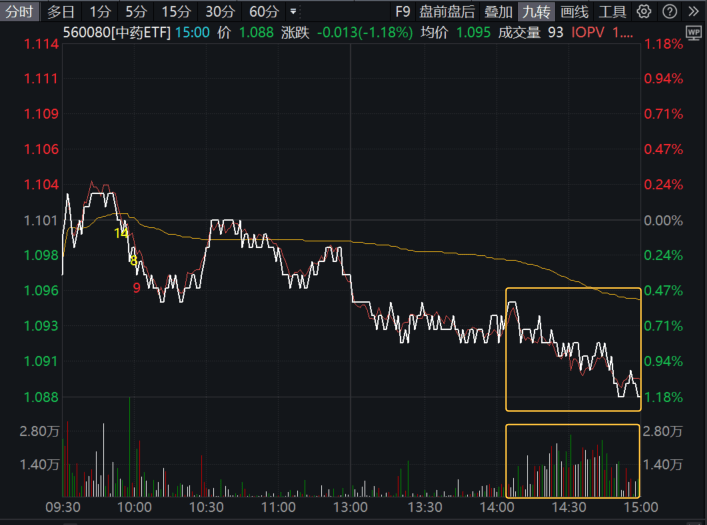
市场波动加剧,资金再度“高切低”?中药ETF(560080)三连阳后首次回调,尾盘放量溢价,资金连续12日净流入!片仔癀发布Q3经营数据
Sou Hu Cai Jing· 2025-10-17 10:13
Core Viewpoint - The Chinese medicine ETF (560080) has shown resilience amidst a broader market decline, with significant trading volume and a notable increase in net inflows, indicating strong investor interest in the sector [1][2][3]. Group 1: Market Performance - The overall market experienced a downward trend, while the consumer sector, particularly the Chinese medicine ETF (560080), demonstrated relative strength, only declining by 1% after three consecutive days of gains [1]. - The trading volume for the Chinese medicine ETF exceeded 170 million yuan, marking a 34% increase compared to the previous day, suggesting active investor engagement [1]. - The Chinese medicine ETF has attracted net inflows of over 240 million yuan in the last ten days, with its total fund size surpassing 2.7 billion yuan, leading its peers significantly [2]. Group 2: Fund and Leverage Insights - The financing balance for the Chinese medicine ETF has reached over 80 million yuan, maintaining a historical high, indicating continued interest from leveraged investors seeking value in the sector [3]. - The ETF's price-to-earnings ratio (TTM) stands at 25.12, which is at the 22.43% percentile over the past decade, suggesting that the index is currently cheaper than 77.57% of the time in the last ten years, enhancing its attractiveness [10]. Group 3: Company-Specific Developments - The company Pizhou Pharmaceutical reported a significant decline in its third-quarter revenue, down 26.28% year-on-year to 2.064 billion yuan, and a net profit drop of 28.82% to 687 million yuan, attributed to reduced sales in the pharmaceutical manufacturing sector and declining gross margins [4]. - The overall performance of the Chinese medicine index remains negative for the year, with a year-to-date decline of 2.26% and a drop of 8.13% in 2024, indicating ongoing challenges in the sector [5][7]. Group 4: Future Outlook - Analysts from Zheshang Securities anticipate an inflection point for the Chinese medicine sector, projecting improved revenue and net profit growth in the second half of 2025, driven by a reduction in cost pressures from declining raw material prices [11][12]. - The recent stabilization of flu data and the return to normal levels of flu-like cases in both northern and southern provinces may alleviate revenue growth pressures for the industry [9].

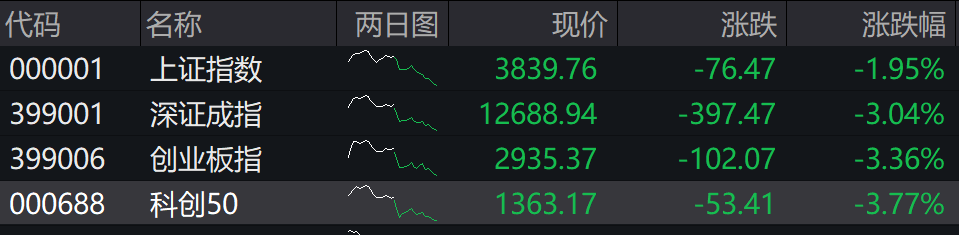
收盘丨深成指、创业板指均跌超3%,全市场近4800只个股下跌
Di Yi Cai Jing· 2025-10-17 07:13
Market Overview - The A-share market experienced a decline with the Shanghai Composite Index falling by 1.95%, the Shenzhen Component Index down by 3.04%, and the ChiNext Index decreasing by 3.36% [1][2] - The total trading volume in the Shanghai and Shenzhen markets reached 1.94 trillion yuan, an increase of 6.9 billion yuan compared to the previous trading day [1][2] Sector Performance - The sectors that saw significant declines include new energy, semiconductors, and electronics, while military, chemical, and automotive sectors also faced widespread losses [2] - Conversely, the Fujian and Hainan sectors showed resilience and performed well against the market trend [2] Capital Flow - There was a net inflow of capital into sectors such as precious metals, gas, and textiles, while sectors like diversified finance, tourism, and education experienced net outflows [4] - Specific stocks that attracted net inflows include Zhongji Xuchuang, N Daosheng, and Dongxin Ping with inflows of 1.714 billion yuan, 701 million yuan, and 644 million yuan respectively [4] - Stocks that faced significant net outflows include BYD, ZTE, and Sunshine Power with outflows of 1.970 billion yuan, 1.892 billion yuan, and 1.793 billion yuan respectively [4] Institutional Insights - Jianghai Securities noted a clear shift in capital flow and a gradual change in market style [4] - Guocheng Investment Advisory emphasized that defensive strategies are currently favored, and the logic behind the technology sector remains intact [4] - Dexun Securities pointed out a decrease in risk appetite for the fourth quarter, highlighting that bank stocks are showing characteristics of a temporary mainline [4]

进入四季度,险资再度对银行股开启“扫货”模式!都买了啥?
Mei Ri Jing Ji Xin Wen· 2025-10-17 02:33
Core Viewpoint - China Ping An Insurance (Group) Co., Ltd. has increased its holdings in Postal Savings Bank of China by 6.416 million H-shares, reflecting a trend of insurance capital frequently increasing their stakes in bank H-shares this year [1] Group 1: Investment Activity - China Ping An and its subsidiaries have shown a pattern of continuous accumulation in bank H-shares, particularly in listed banks such as China Merchants Bank, Postal Savings Bank, and Agricultural Bank [1] - The insurance capital's preference for bank stocks is attributed to the generally high dividend yields in both A-shares and H-shares, with the China Securities Bank ETF yielding 4.07% and the Hong Kong Stock Connect Financial ETF yielding 5.06% as of October 16 [1] Group 2: Market Conditions - The current low interest rate environment enhances the attractiveness of these assets, leading to sustained inflows from long-term funds such as insurance capital and social security [1] - A shift in market sentiment towards risk aversion has made these assets more appealing, indicating a potential strategy for similar investors to follow the lead of insurance capital [1]


博时市场点评10月16日:两市涨跌不一,成交不足2万亿
Xin Lang Ji Jin· 2025-10-16 08:09
Market Overview - The three major indices in the A-share market showed mixed performance, with the Shanghai Composite Index rising by 0.10% to 3916.23 points, while the Shenzhen Component Index fell by 0.25% to 13086.41 points [4] - Market sentiment is cautious, with trading volume decreasing to below 2 trillion yuan, indicating reduced investor activity [1] Financial Data - In September, new social financing amounted to 3.53 trillion yuan, a year-on-year decrease of 229.7 billion yuan, with a growth rate of 8.7% [2] - New RMB loans totaled 1.29 trillion yuan, down by 300 billion yuan year-on-year, with a growth rate of 6.6% [2] - The significant decrease in non-bank deposits is attributed to a high base from the previous year and the return of wealth management funds at the end of the quarter [1] Policy Initiatives - The National Development and Reform Commission, along with five other departments, issued a plan to double the service capacity of electric vehicle charging facilities by 2027, aiming to establish 28 million charging facilities nationwide [2][3] - This policy is seen as a crucial measure to boost electric vehicle consumption and address infrastructure shortcomings, potentially benefiting sectors related to charging equipment manufacturing, operation services, and the electric vehicle supply chain [3] Sector Performance - In the A-share market, coal, banking, and food and beverage sectors showed the highest gains, with increases of 2.35%, 1.35%, and 0.97% respectively [4] - Conversely, the steel, non-ferrous metals, and building materials sectors experienced the largest declines, with decreases of 2.14%, 2.06%, and 1.86% respectively [4] Capital Flow - The market's trading volume was recorded at 19,488.83 billion yuan, showing a decline from the previous trading day [5] - The margin financing balance increased to 24,494.21 billion yuan, indicating a slight rise in leveraged trading activity [5]
市场风格切换?食品饮料板块冲击三连阳,机构:珍惜当前低位布局机会
Ge Long Hui· 2025-10-16 05:04
Core Viewpoint - After the double festival, technology stocks experienced a significant correction, while liquor stocks rebounded, leading to discussions about style switching in the market [1] Group 1: Industry Dynamics - During the double festival, liquor sales overall declined by 20%-30%, with high-end liquor prices dropping, enhancing their cost-effectiveness [2] - Guizhou Moutai held a marketing seminar for its sauce-flavored liquor series on October 15, signaling a recovery in sales, with a noticeable month-on-month increase in terminal sales since September [2] - The upcoming sugar and liquor conference in Nanjing from October 16-18 is expected to show marginal improvements in the industry after the correction of the alcohol ban [2] - The M2-M1 gap in September reached a year-low of 1.2 percentage points, indicating a shift towards more liquid loans, which could benefit consumption and investment [2] - Domestic economic stability is anticipated to gradually improve, with cyclical industries like liquor expected to re-enter a high growth phase [2] Group 2: Investment Opportunities - Notable investment targets include the Food and Beverage ETF (515170), which has seen a net inflow of over 800 million yuan over four consecutive days, focusing on liquor, dairy, and seasoning products [3] - The Consumption 30 ETF (510630) covers a full industry chain including liquor, food, and beauty care, tracking the Shanghai Consumer Index with key stocks like Yili, Guizhou Moutai, and Shanxi Fenjiu [3]
