
直接融资

Search documents
中国信贷结构持续优化 前11个月社融增量33.39万亿
Chang Jiang Shang Bao· 2025-12-14 23:48
Group 1 - The core viewpoint of the articles highlights that China's financial indicators, including broad money supply (M2) and social financing scale, are maintaining high growth rates, creating a favorable monetary environment for economic recovery [1][2][3] - As of November, the total social financing increment for the first eleven months reached 33.39 trillion yuan, exceeding the total for the entire year of 2024, with a year-on-year increase of 3.99 trillion yuan [2][4] - The broad money supply (M2) stood at 336.99 trillion yuan at the end of November, reflecting an 8% year-on-year growth, while the social financing stock was 440.07 trillion yuan, showing an 8.5% increase compared to the previous year [1][2] Group 2 - The financing structure in China has shown positive changes, with direct financing playing a more significant role in the financial system, as evidenced by corporate bond net financing of 2.24 trillion yuan and non-financial corporate stock financing of 420.4 billion yuan [3][4] - The weighted average interest rate for newly issued loans in November was approximately 3.1%, which is about 30 basis points lower than the same period last year, indicating a low-interest environment that supports economic recovery [3][4] - The total amount of RMB loans increased by 15.36 trillion yuan in the first eleven months, with corporate loans accounting for 93.7% of the total loan increment, reflecting a stable long-term investment willingness among enterprises [4][5] Group 3 - Household loans increased by 533.3 billion yuan in the first eleven months, with short-term loans decreasing by 732.8 billion yuan and medium to long-term loans increasing by 1.27 trillion yuan, indicating a trend of net repayment of short-term debts by households [5] - The balance of household deposits reached 12.06 trillion yuan at the end of November, showing a year-on-year growth of 9.56%, which suggests a strong savings willingness among residents [5]
11月社融、M2增速维持高位
Bei Jing Shang Bao· 2025-12-14 15:39
新增信贷方面,数据显示,前11个月人民币贷款增加15.36万亿元。分部门看,住户贷款增加5333亿 元,其中,短期贷款减少7328亿元,中长期贷款增加1.27万亿元;企(事)业单位贷款增加14.4万亿 元,其中,短期贷款增加4.44万亿元,中长期贷款增加8.49万亿元,票据融资增加1.31万亿元;非银行 业金融机构贷款减少332亿元。 综合人民银行此前披露的数据,北京商报记者进一步统计发现,11月单月,人民币贷款增加3900亿元, 同比少增1883亿元。分项来看,11月企业贷款增加6100亿元,同比多增3600亿元,其中企业短期贷款增 加1000亿元,同比多增1100亿元,企业中长贷增加1700亿元,同比减少400亿元。 另在居民贷款方面,11月住户贷款减少2063亿元,同比多减4763亿元,环比增加1541亿元。其中,居民 短贷减少2158亿元,同比多减1788亿元,环比增加708亿元;居民中长贷增加100亿元,同比多减2900亿 元,环比增加800亿元。 11月金融数据出炉。12月12日,人民银行发布2025年11月金融统计数据报告。数据显示,2025年前11个 月,人民币贷款增加15.36万亿元;社会融 ...
11月金融数据解读:企业融资多渠道回暖
Guoxin Securities· 2025-12-13 13:19
Financial Data Overview - In November, China's new social financing (社融) reached 2.49 trillion yuan, exceeding the expected 2.02 trillion yuan[2] - New RMB loans amounted to 390 billion yuan, lower than the expected 504.3 billion yuan[2] - M2 growth year-on-year was 8.0%, slightly below the expected 8.2%[2] Economic Insights - The financial data indicates stabilization in total volume with structural differentiation, as social financing growth remained steady at 8.5% month-on-month[5] - Corporate loans showed marginal improvement, with non-standard and direct financing rebounding significantly, suggesting a potential bottoming out of manufacturing investment sentiment[5] - Government deposits decreased significantly year-on-year, indicating an acceleration in government spending, which is crucial for supporting the economy[5] Credit and Loan Analysis - Credit data remains weak, with five consecutive months of year-on-year declines, particularly in household loans, which decreased by 476.3 billion yuan[5][14] - New corporate loans increased by 610 billion yuan year-on-year, with short-term loans rising by 1 trillion yuan, indicating improved corporate financing demand[12] - Household loans showed a negative growth of 206.3 billion yuan, reflecting low consumer and housing demand[14] Financing Structure - Government bond financing increased by 1.2 trillion yuan, becoming the main source of social financing growth for the month[16] - Direct corporate financing reached 451.1 billion yuan, up 170.2 billion yuan year-on-year, with credit bonds contributing significantly[18] - The overall financing structure indicates a shift towards non-standard and direct financing, which has been more resilient compared to traditional bank loans[5][18] Monetary Indicators - Total deposits increased by 1.41 trillion yuan, but this was a decrease of 760 billion yuan year-on-year, with M2 growth continuing to decline[22] - M1 growth rate fell to 4.9%, reflecting limited changes in actual monetary circulation[22] - The widening gap between M2 and M1 growth rates indicates a potential liquidity issue in the economy[22]
前11个月社融增量超去年全年,M2增速维持高位释放货币政策宽松信号
Bei Jing Shang Bao· 2025-12-13 03:29
Core Viewpoint - The financial data for November 2025 indicates a continued trend of slowing loan growth, with a focus on optimizing credit structure while maintaining reasonable growth in total financing and broad money supply [1][4][5]. Loan Growth - In the first eleven months of 2025, RMB loans increased by 15.36 trillion yuan, with household loans rising by 533.3 billion yuan and corporate loans increasing by 14.4 trillion yuan [4][5]. - As of the end of November 2025, the total RMB loan balance reached 271 trillion yuan, reflecting a year-on-year growth of 6.4%, with a slight decrease in growth rate compared to the previous month [5][6]. - November saw a monthly increase of 390 billion yuan in RMB loans, which is 1,883 billion yuan less than the same month last year [4][5]. Social Financing Scale - The total social financing scale reached 440.07 trillion yuan by the end of November 2025, with a year-on-year growth of 8.5%, surpassing the total for the entire year of 2024 [1][8]. - In November alone, the new social financing amounted to 2.49 trillion yuan, which is 1.67 trillion yuan more than the previous month and 1,597 billion yuan more than the same month last year [8][9]. Direct Financing - Direct financing remains a strong support for social financing, with government bonds, corporate bonds, and RMB loans being the main contributors [9][10]. - Government bond net financing reached 13.15 trillion yuan in the first eleven months, accounting for 39.4% of the total social financing [10]. Monetary Policy - As of the end of November, the broad money supply (M2) stood at 336.99 trillion yuan, growing by 8% year-on-year, while the narrow money supply (M1) grew by 4.9% [11][12]. - The current monetary policy is characterized as moderately accommodative, with expectations for continued easing in 2026, including potential interest rate cuts and reserve requirement ratio reductions [14].

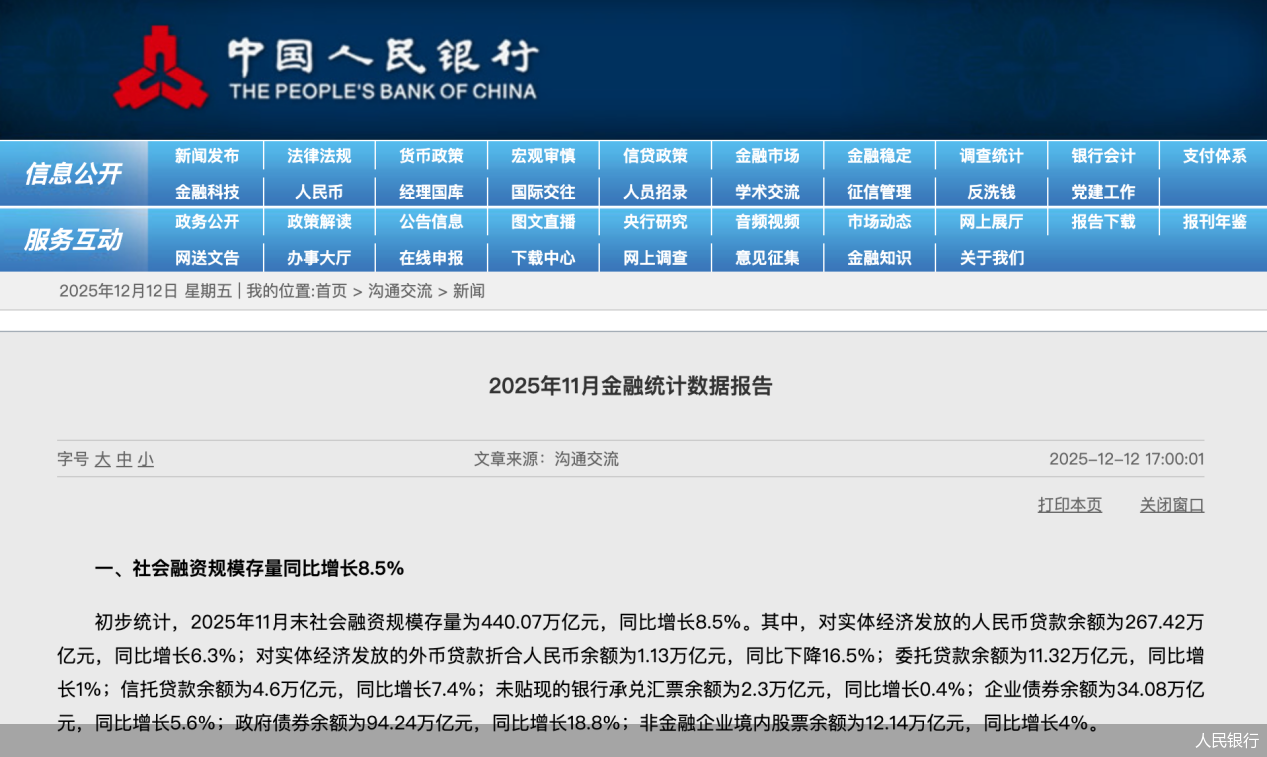
前11月社融增量超33万亿元 金融有力支持经济回升向好
Sou Hu Cai Jing· 2025-12-12 23:20
中国人民银行12月12日公布的11月金融统计数据报告显示,广义货币供应量(M_2)和社会融资规模增 速均保持在较高水平;贷款规模保持合理增长,信贷结构持续优化;贷款利率保持在历史低位水平。 "货币政策和财政政策的协调配合十分重要。今年央行继续综合施策维护资金面平稳,保持流动性充 裕,有力支持了政府债券的顺利发行。"田轩表示,今年以来,我国宏观政策逆周期调节力度加大,财 政政策积极发力,加力支持实体经济效果明显。 贷款量稳价降质效提升 11月末,人民币各项贷款余额271万亿元,同比增长6.4%。同时,贷款利率保持在历史低位水平:11月 份企业新发放贷款(本外币)加权平均利率约为3.1%,比上年同期低约30个基点;个人住房新发放贷 款(本外币)加权平均利率约为3.1%,比上年同期低约3个基点。 目前,社会融资规模、M_2增速保持在8%左右,相比之下贷款增速略低,既体现了多元化融资方式对 银行贷款的替代,也与地方化债和中小银行改革化险的下拉作用有关。有研究测算,去年以来,地方政 府发行4万亿元特殊再融资债券,其中约六到七成用于偿还银行贷款,对当前贷款增速的下拉影响超过1 个百分点。此外,今年金融机构贷款核销的规模也 ...
社会融资规模、M2保持较高增速 货币政策持续发力 营造适宜总量环境
Zhong Guo Zheng Quan Bao· 2025-12-12 20:22
Core Viewpoint - The People's Bank of China reported that by the end of November, the social financing scale grew by 8.5% year-on-year, and the broad money supply (M2) increased by 8%, indicating a moderately loose monetary policy that supports high-quality economic development [1] Group 1: Social Financing and Government Bonds - By the end of November, the total social financing stock reached 440.07 trillion yuan, with a year-on-year growth of 8.5%, which is 0.7 percentage points higher than the same period last year [2] - The cumulative increase in social financing for the first eleven months was 33.39 trillion yuan, which is 3.99 trillion yuan more than the previous year [2] - The contribution of government bonds to social financing has significantly increased, with new government debt totaling 11.86 trillion yuan this year, an increase of 2.9 trillion yuan from last year [2] Group 2: Direct Financing Channels - In addition to government bonds, corporate bonds and equity financing are also developing rapidly, with corporate bond financing amounting to 2.24 trillion yuan, which is 312.5 billion yuan more than the previous year [3] - Non-financial corporate domestic stock financing reached 420.4 billion yuan, an increase of 178.8 billion yuan year-on-year [3] - Direct financing is expected to play a more important role in the financial system, particularly in high-growth and R&D-intensive sectors [2] Group 3: Loan Growth and Structure - The balance of RMB loans was 271 trillion yuan by the end of November, with a year-on-year growth of 6.4%, slightly lower than the previous month [4] - The growth rate of loans has been affected by various factors, including the substitution of diversified financing methods for bank loans and the impact of local government debt [4] - The balance of inclusive small and micro loans was 35.88 trillion yuan, growing by 11.4%, while medium to long-term loans for the manufacturing sector reached 14.94 trillion yuan, growing by 7.7% [4] Group 4: Interest Rates and Financial Support - The weighted average interest rate for newly issued corporate loans was approximately 3.1%, down about 30 basis points from the previous year [5] - The low financing cost indicates that the financing needs of the real economy are being reasonably met, with an increase in credit allocation to key sectors [5] - Experts suggest that a comprehensive view of financial support for the real economy should consider social financing scale and money supply, rather than just loan growth [5] Group 5: Overall Financial Growth - Financial data for November is considered to be at a reasonable level, reflecting a stable financial environment that is significantly higher than the nominal economic growth rate [6] - Maintaining reasonable growth in financial totals is crucial for constructing a sound and robust monetary policy framework [6] - Experts emphasize the need for a multi-dimensional approach to optimize monetary policy and maintain financial stability [6][7]
货币政策持续发力 营造适宜总量环境
Zhong Guo Zheng Quan Bao· 2025-12-12 20:17
Core Viewpoint - The People's Bank of China reported that by the end of November, the social financing scale and M2 growth rates are significantly higher than the nominal GDP growth, indicating a moderately loose monetary policy that supports high-quality economic development [1][2]. Social Financing and Government Bonds - As of the end of November, the social financing scale reached 440.07 trillion yuan, with a year-on-year growth of 8.5%, which is 0.7 percentage points higher than the previous year [1]. - The cumulative increase in social financing for the first eleven months was 33.39 trillion yuan, exceeding the previous year's figure by 3.99 trillion yuan [1]. - The contribution of government bonds to social financing has notably increased, with new government debt totaling 11.86 trillion yuan this year, an increase of 2.9 trillion yuan from last year [1]. Direct Financing Channels - Other direct financing channels, such as corporate bonds and equity financing, are also developing rapidly, with corporate bond financing amounting to 2.24 trillion yuan, an increase of 3.125 billion yuan year-on-year [2]. - Non-financial corporate domestic stock financing reached 420.4 billion yuan, up 178.8 billion yuan compared to the same period last year [2]. Credit Structure Optimization - The balance of RMB loans stood at 271 trillion yuan at the end of November, with a year-on-year growth of 6.4%, slightly lower than the previous month [2][3]. - The growth rate of loans is influenced by various factors, including the substitution effect of diversified financing methods and the impact of local government debt [2][3]. - The balance of inclusive small and micro loans was 35.88 trillion yuan, growing by 11.4%, while medium to long-term loans in the manufacturing sector reached 14.94 trillion yuan, with a growth of 7.7% [3]. Interest Rates and Financial Support - The weighted average interest rate for newly issued corporate loans was approximately 3.1%, down about 30 basis points year-on-year [3]. - The low financing cost indicates that the financing needs of the real economy are being reasonably met, and the increase in credit allocation to key sectors reflects better alignment with high-quality economic development [4]. Overall Financial Stability - Financial data as of November indicates a reasonable level, with social financing scale, M2, and RMB loans all significantly above the nominal economic growth rate [4][5]. - Maintaining reasonable growth in financial totals is crucial for constructing a robust monetary policy framework, which should focus on optimizing the mechanisms for basic currency supply and enhancing the market-oriented interest rate system [5].
11月金融数据出炉
Di Yi Cai Jing Zi Xun· 2025-12-12 14:37
Group 1 - The central bank's latest data shows that M2 and social financing scale growth rates remain high, creating a favorable monetary environment for economic recovery [2][8] - As of the end of November, the broad money (M2) balance reached 336.99 trillion yuan, with a year-on-year growth of 8.0%, which is 0.9 percentage points higher than the same period last year [2] - The total social financing scale stood at 440.07 trillion yuan, growing by 8.5% year-on-year, which is 0.7 percentage points higher than the previous year [2] Group 2 - Government bond financing has significantly contributed to the growth of social financing, with net financing of government bonds reaching 13.15 trillion yuan, an increase of 3.61 trillion yuan year-on-year [3] - The total new government debt for the year is projected to be 11.86 trillion yuan, which is an increase of 2.9 trillion yuan compared to last year [3][4] - Direct financing through corporate bonds and equity financing is also accelerating, with corporate bond financing amounting to 2.24 trillion yuan, an increase of 312.5 billion yuan year-on-year [3] Group 3 - The growth rate of loans has shown a downward trend, with a total increase of 15.36 trillion yuan in RMB loans in the first eleven months [5][6] - The increase in loans to the real economy was 14.93 trillion yuan, which is 1.28 trillion yuan less than the previous year [6] - The decline in loan growth is attributed to various factors, including the replacement of loans by diversified financing methods and the impact of local government debt [6][7] Group 4 - The current social financing scale and M2 growth rates are approximately double the nominal GDP growth rate, indicating a moderately loose monetary policy environment [8] - The central bank has maintained a stable funding environment and supported the smooth issuance of government bonds through comprehensive measures [9] - Coordination between monetary and fiscal policies is emphasized as crucial for supporting economic stability and structural adjustments [9]

【新华解读】11月人民币信贷增约3900亿元 直接融资渠道加快多元发展
Xin Hua Cai Jing· 2025-12-12 12:33
Group 1 - The core viewpoint of the articles highlights the current state of China's monetary policy, indicating a moderately loose environment conducive to high-quality economic development, as evidenced by the growth rates of M2 and social financing outpacing nominal GDP growth [1][4]. - As of the end of November, the broad money supply (M2) and social financing scale grew by 8.0% and 8.5% year-on-year, respectively, with social financing increment totaling 33.39 trillion yuan for the first eleven months, an increase of 3.99 trillion yuan compared to the previous year [1][4]. - The increase in RMB loans for the first eleven months reached 15.36 trillion yuan, with a monthly increase of 390 billion yuan in November, while the loan balance stood at 271 trillion yuan, reflecting a year-on-year growth of 6.4% [2][3]. Group 2 - The decline in loan growth is attributed to various factors, including the substitution effect of diversified financing methods and the impact of local government debt and reforms in small and medium-sized banks [2][3]. - The average interest rate for newly issued loans in November was approximately 3.1%, down about 30 basis points from the same period last year, indicating a favorable financing environment for the real economy [3][4]. - Government bonds have significantly contributed to the growth of social financing, with new government debt totaling 11.86 trillion yuan this year, an increase of 2.9 trillion yuan from last year, enhancing the role of government bonds in the financing structure [4][5]. Group 3 - Direct financing channels, including corporate bonds and equity financing, are accelerating, with net financing from corporate bonds reaching 2.24 trillion yuan, an increase of 312.5 billion yuan year-on-year [5]. - The M2 balance reached 336.99 trillion yuan at the end of November, growing by 8% year-on-year, while the narrow money supply (M1) was 112.89 trillion yuan, reflecting a year-on-year growth of 4.9% [5][6]. - Overall, the financial data indicates a stable level of social financing, M2, and RMB loans, which are significantly higher than the nominal economic growth rate, demonstrating effective counter-cyclical and cross-cyclical adjustments [5].
前11月社融增量超33万亿元 信贷投放提质换挡
Zheng Quan Shi Bao Wang· 2025-12-12 12:28
Core Viewpoint - The People's Bank of China reported that the social financing scale increased by 33.39 trillion yuan in the first eleven months of 2025, reflecting a 3.99 trillion yuan increase compared to the same period last year, indicating a supportive monetary policy for high-quality economic development [1] Financial Statistics - As of the end of November, the year-on-year growth rate of social financing stock was 8.5%, unchanged from the previous month [1] - The growth rate of broad money (M2) was 8%, a decrease of 0.2 percentage points month-on-month [1] - The growth rate of narrow money (M1), which reflects the liquidity of funds, was 4.9%, down 1.3 percentage points month-on-month [1] Government Bonds and Direct Financing - Government bond net financing reached 13.15 trillion yuan in the first eleven months, accounting for nearly 40% of the increase in social financing [3] - The total new government debt for the year was set at 11.86 trillion yuan, an increase of 2.9 trillion yuan from last year, contributing to the growth of social financing [3] - Corporate bond financing was 2.24 trillion yuan, an increase of 3.125 billion yuan year-on-year, while non-financial corporate stock financing was 420.4 billion yuan, up 178.8 billion yuan year-on-year [3] Credit Quality Improvement - In the first eleven months, RMB loans increased by 15.36 trillion yuan, with a year-on-year growth rate of 6.4% as of the end of November [5] - Inclusive small and micro loans grew by 11.4%, and medium to long-term loans for manufacturing increased by 7.7%, both exceeding the overall loan growth rate [5] - The decline in loan growth is attributed to the replacement of loans by diversified financing methods and the impact of local government debt [5] Loan Pricing - The weighted average interest rate for newly issued loans in November was approximately 3.1%, down about 30 basis points year-on-year [6] - The weighted average interest rate for new personal housing loans was also around 3.1%, down about 3 basis points year-on-year [6] Price Trends and Economic Outlook - The Consumer Price Index (CPI) rose by 0.7% year-on-year in November, while the Producer Price Index (PPI) fell by 2.2% year-on-year but increased by 0.1% month-on-month [7] - Experts indicate that the long-term conditions for economic growth remain unchanged, and the monetary and financial conditions are relatively loose, supporting a return of prices to reasonable levels [7]