租购并举

Search documents
到2030年,当下的100万房子还能值多少?3大信号已经很明显
Sou Hu Cai Jing· 2025-08-25 00:50
Group 1: Monetary Policy and Economic Impact - The Federal Reserve has implemented three consecutive rate cuts from September to December 2024, reducing the federal funds rate from 5.25%-5.5% to 4.25%-4.5%, marking the most aggressive easing cycle since the pandemic in 2020 [1] - In response to the Fed's actions, the People's Bank of China has also lowered the reserve requirement ratio and reverse repo rates to manage capital inflow pressures and reduce financing costs, with the average interest rate on new corporate loans dropping to a historical low of 3.68% in the first half of 2025 [2] Group 2: Housing Market Trends - China's aging population is leading to a significant decline in first-time homebuyer demand, with the proportion of individuals aged 60 and above increasing from 18.7% in 2020 to 19.8% in 2024, and a projected 30% reduction in first-time homebuyer demand due to a record low birth rate of 8.5 million in 2024 [4][5] - Urbanization is slowing, with the urbanization rate expected to rise only 6.1 percentage points by 2030, resulting in a lower annual increase in urban population compared to previous years, which may lead to stagnant or declining housing prices in some areas [5] - Policy shifts are moving from stimulating home purchases to promoting rental markets, with new regulations increasing construction costs and encouraging developers to focus on quality rather than quantity [5] Group 3: Regional Market Dynamics - First-tier cities are showing resilience in property values, with new home prices in Shanghai and Shenzhen increasing by 0.5% and 0.2% respectively, supported by strong public resources and industrial clustering [7] - Second-tier cities are benefiting from policy incentives and industrial upgrades, with cities like Nanjing and Wuhan seeing significant increases in housing transactions due to new policies aimed at stimulating demand [7] - Third and fourth-tier cities are facing challenges from population outflows and economic pressures, with projected annual price declines of 5%-8% in some areas, as evidenced by significant price drops in cities like Yantai and Qinhuangdao [8] Group 4: Investment Strategies - First-time homebuyers are advised to take advantage of local subsidies in second-tier cities and monitor changes in public housing fund policies to reduce costs [8] - Investors should focus on core urban areas in first-tier cities and rental apartments along metro lines in second-tier cities, where rental yields can reach 4%-5% [9] - Property owners with multiple holdings should consider divesting from third and fourth-tier cities and reallocating assets to prime urban properties or long-term rental arrangements to stabilize returns [10]

2026年的房价,已有3大信号!业内人:买房或卖房,都要做好准备
Sou Hu Cai Jing· 2025-08-24 09:55
Group 1 - The core viewpoint emphasizes the need for a clear understanding of the real estate market signals, particularly in light of the government's long-term policy of "housing is for living, not for speculation" [1][3] - The first signal indicates that the government's policy direction will continue to suppress speculative investment while protecting genuine housing demand, suggesting that potential homebuyers should act when suitable opportunities arise [1][3] - The second signal highlights the increasing market differentiation, where housing demand is shifting towards core cities and urban areas with strong job opportunities, while weaker markets may face prolonged adjustments [3][5] Group 2 - The third signal points to an optimization in housing supply structure, with a growing variety of housing options such as rental housing and shared ownership, which will cater to the needs of younger individuals and low-income families [5][7] - The adjustment in housing supply is expected to rationalize market heat, indicating that not all properties will be easily sold, particularly those that are of poor quality or in less desirable locations [7] - The outlook for the real estate market by 2026 suggests a more stable and differentiated landscape, moving away from the previous notion that buying property is always profitable, urging a more rational approach to real estate decisions [7]

“住房要锦上添花,更要雪中送炭”,专家提议“中储房”破解存量难题,众房企热议“好房子”
Hua Xia Shi Bao· 2025-08-21 09:30
Core Viewpoint - The real estate market in China is currently facing significant inventory issues and pressure for housing prices to stabilize after a period of decline. Experts are discussing strategies for managing existing housing stock and improving market conditions through various initiatives, including the establishment of a national storage fund for housing [1][2][3]. Group 1: Inventory Management and Policy Recommendations - Liu Shijin proposed the establishment of a "Central Storage Housing" initiative and local special bonds to convert unsold housing into affordable housing, emphasizing the need for local governments to secure funding for these projects [2][3]. - Zhang Qiguang highlighted the importance of addressing existing real estate inventory, noting that as of July, the total area of unsold commercial housing reached 76,486 million square meters, indicating a long time needed to digest this stock at current market absorption rates [3]. - Zhang also pointed out that the current supply-demand imbalance in the real estate market is a major factor preventing price stabilization, suggesting that reducing housing supply while expanding demand is crucial [3]. Group 2: Rental Market and Institutional Changes - The introduction of the "Housing Rental Regulations" is seen as a transformative step for the rental market, promoting institutionalization and standardization in the rental sector, which has historically been dominated by individual landlords [4]. - Zhang emphasized the need for a national storage fund to alleviate the financial pressures on real estate companies, proposing that the fund could offer long-term financing at low costs to encourage participation in housing stock management [5]. Group 3: Quality of Housing and Market Trends - The concept of "Good Housing" has gained traction, with industry leaders discussing the need to enhance not only the physical attributes of housing but also the living environment and aesthetic considerations [6][8]. - Companies like China Resources and Longfor are focusing on product iteration and customer needs, recognizing that the market has shifted towards higher expectations for living experiences [6][7]. - The trend towards creating integrated living environments, where housing is complemented by amenities like cafes and cultural spaces, is becoming increasingly important in attracting buyers [9].
7月住宅平均租金环比下跌0.07%,同比下跌3.81%
3 6 Ke· 2025-08-11 02:12
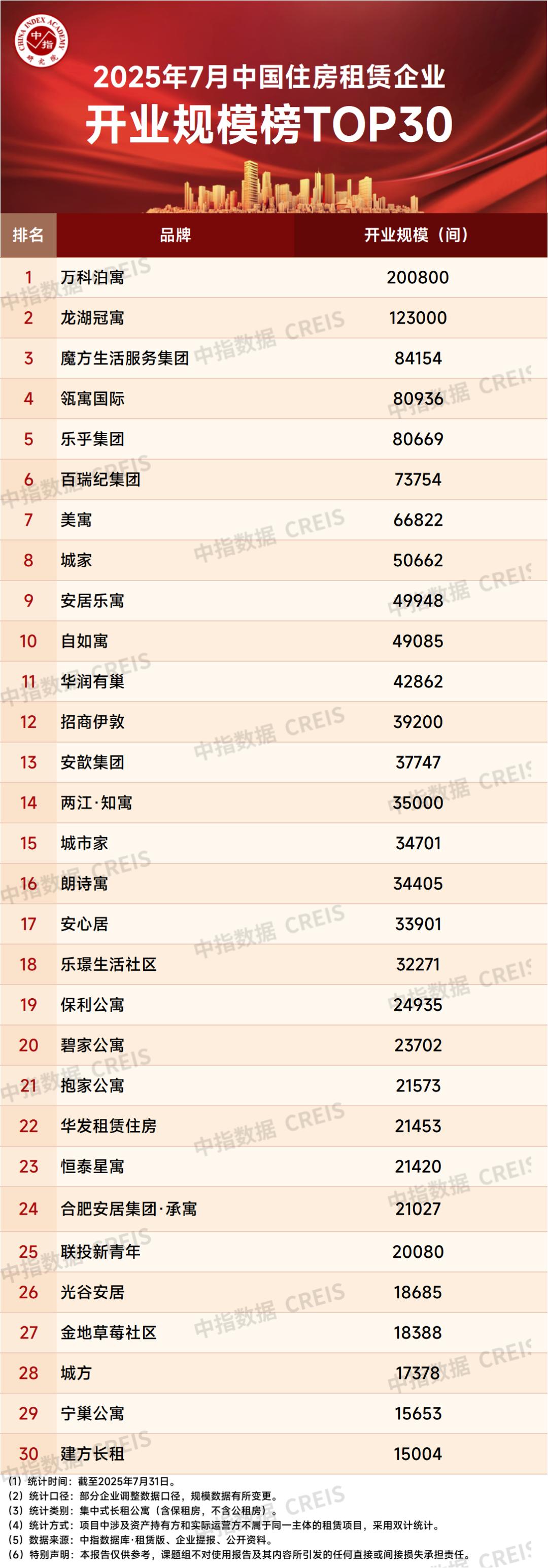
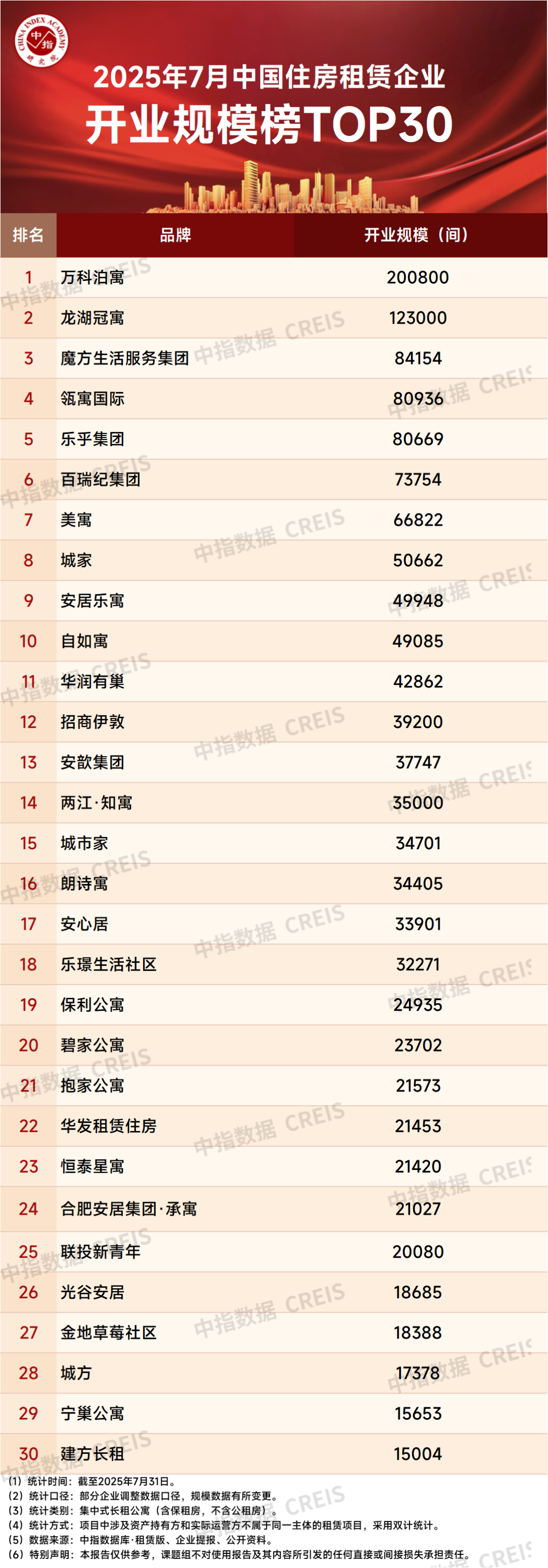
Core Insights - The report highlights the growth and ranking of housing rental enterprises in China as of July 2025, with a total of 138.9 million rental units opened by the top 30 companies, an increase of approximately 30,000 units from June 2025 [5][6] - The management scale of these enterprises reached 198.2 million units, reflecting a growth of about 24,000 units compared to the previous month [7][8] - The introduction of the "Housing Rental Regulations" by the State Council aims to standardize rental activities and promote high-quality development in the housing rental market, effective from September 15, 2025 [18][19] Opening Scale Rankings - The top three companies by opening scale are: 1. Vanke Boyu with 200,800 units 2. Longfor Guan Yu with 123,000 units 3. Mofang Living Service Group with 84,154 units [1][2] - The total number of rental units opened by the top 30 companies is 138.9 million, with various types of enterprises represented, including housing rental companies, local state-owned enterprises, startups, hotel groups, and intermediaries [5][6] Management Scale Rankings - The top three companies by management scale are: 1. Vanke Boyu with 276,000 units 2. Longfor Guan Yu with 164,000 units 3. Lian Yu International with 135,736 units [3][4] - The total management scale of the top 30 companies reached 198.2 million units, indicating a general increase across various enterprise categories [7][8] Business Dynamics - In July, several local platforms launched batch rental housing projects, including various community and talent apartment projects [9][10] - Major companies like JD.com are investing significantly in employee housing, with JD planning to invest 7 billion yuan to create nearly 5,000 fully furnished apartments for young talents [12][13] Financing Trends - Multiple housing rental enterprises are advancing financing efforts, with Guangzhou Anju Group planning to issue public REITs of no less than 800 million yuan [16][17] - The issuance of various asset-backed securities (ABS) and REITs indicates a growing interest in financing within the housing rental sector [16][17] Policy Developments - The "Housing Rental Regulations" introduced by the State Council aim to enhance the management framework of the housing rental market, emphasizing the need for standardized practices and the protection of legal rights for all parties involved [18][19] - Local governments are actively promoting the acquisition of existing properties for use as rental housing, with cities like Guilin and Zhengzhou leading initiatives to convert stock properties into affordable housing [21]
中指研究院:7月毕业季租住需求释放 重点城市住宅平均租金环比跌幅有所收窄
智通财经网· 2025-08-10 23:48
Core Insights - The report from the China Index Academy reveals the ranking of housing rental companies in China as of July 2025, indicating a significant increase in the scale of operations for various companies in the sector [1][7]. Scale Ranking - The threshold for entering the top 30 companies in terms of operational scale has been raised to over 15,000 units, with the total number of operational units among the top 30 reaching 1.389 million, an increase of approximately 30,000 units from June [7]. - The average rental price in 50 major cities is reported at 34.93 yuan per square meter per month, reflecting a month-on-month decrease of 0.07% and a year-on-year decrease of 3.81% [1]. Management Scale - The total management scale of the top 30 housing rental companies reached 1.982 million units, an increase of about 24,000 units compared to June [9]. - The management scale has seen growth across various categories, with local state-owned enterprises, housing rental companies, and hotel companies all reporting increases [9]. Company Dynamics - New projects for affordable rental housing are being launched, including several by local platforms and large enterprises, such as JD's investment of 7 billion yuan to create nearly 5,000 comfortable apartments for young talents in Beijing [11][14]. - The report highlights ongoing collaborations between rental companies and local governments or enterprises to enhance housing supply, such as the partnership between China Resources and local governments in Jiaxing [15] [16]. Financing Trends - Several housing rental companies are progressing with financing initiatives, including Guangzhou Anju Group's plan to issue public REITs with a scale of no less than 800 million yuan [17]. - The issuance of various asset-backed securities (ABS) and REITs is noted, indicating a robust interest in financing within the rental housing sector [17]. Policy Developments - The State Council has officially announced the "Housing Rental Regulations," which aim to standardize rental activities and protect the rights of parties involved, set to take effect on September 15, 2025 [20][21]. - The regulations provide a framework for the housing rental market, emphasizing the need for a balanced approach between market-driven and government-led initiatives [20][21]. Industry Standards - The China Real Estate Association has released the "Long-term Rental Apartment Management and Operation Standards," which will be implemented starting August 1, 2025, to enhance operational quality and standardization in the industry [23].
规范住房租赁活动 维护租赁双方合法权益
Jin Rong Shi Bao· 2025-08-08 07:57
Core Viewpoint - The newly announced Housing Rental Regulations aim to standardize housing rental activities, protect the legal rights of parties involved, stabilize rental relationships, and promote high-quality development in the housing rental market, with implementation set for September 15, 2025 [1][4]. Group 1: Market Recognition and Challenges - Rental housing has become an important part of housing supply and demand, especially in first and second-tier cities, where it is widely accepted as a living choice [2]. - Current issues in the housing rental market include a lack of market order, insufficient protection of legal rights for both parties, and inadequate development of market-oriented and professional institutional entities [2][3]. Group 2: Regulation and Rights Protection - The regulations provide a comprehensive framework to protect the rights of both landlords and tenants, addressing aspects such as living conditions, rental relationships, financial security, and dispute resolution [4]. - Specific provisions include compliance requirements for landlords regarding property legality and rental fees, as well as obligations for tenants to use properties responsibly [4][8]. Group 3: Government Oversight and Market Transparency - Local governments are required to establish rent monitoring mechanisms and regularly publish rental price information to enhance market transparency and stability [5][6]. - The establishment of a rent monitoring mechanism is expected to improve market transparency and provide reference points for both parties, promoting fair transactions [6]. Group 4: Development of Market-oriented Rental Enterprises - The regulations emphasize the need for market-oriented and professional housing rental enterprises, with a focus on improving the quality of rental products and services [7]. - As of June 2025, the top 30 housing rental enterprises in China had a total of 1.359 million rental units, indicating a relatively low market share and significant growth potential for professional rental companies [7][8]. Group 5: Future Policy Support - Future policies are expected to continue supporting the housing rental market from various angles, including financial, market cultivation, and optimizing supply-demand dynamics [8]. - The regulations encourage multiple channels for increasing rental housing supply and promote equal rights for renters and buyers [8].
关于房地产,政治局会议说了六点
Sou Hu Cai Jing· 2025-07-30 09:38
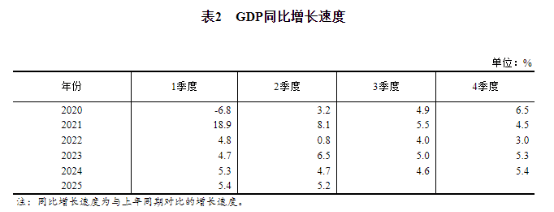
Core Insights - The anticipated policy changes have not materialized, leading to a cautious market outlook with no significant upward or downward movements expected in the near term [2][3] - The economic performance in the first half of the year shows a GDP growth of 5.3%, indicating some positive outcomes from prior policy implementations [6][12] - The real estate sector continues to face challenges, with significant declines in investment and sales figures, suggesting a prolonged period of adjustment [9][10][15] Economic Performance - The GDP for the first half of the year reached 66.05 trillion, with a year-on-year growth of 5.3% [6] - Trade values showed a total import and export value of 21.79 trillion, with exports at 13 trillion (up 7.2%) and imports at 8.27 trillion (down 2.7%) [7] - Retail sales of consumer goods totaled 24.55 trillion, reflecting a growth of 5.0%, with non-automotive retail sales increasing by 5.5% [8] Real Estate Sector - Real estate development investment fell to 4.67 trillion, a decrease of 11.2%, indicating a worsening trend [9] - New housing sales area dropped by 3.5%, with sales value declining by 5.5%, suggesting ongoing market difficulties [10] - The focus has shifted towards urban renewal and quality housing, with policies aimed at stabilizing the market rather than aggressive stimulus [14][18] Policy Outlook - Future policies are expected to encourage consumption and stabilize employment, with a focus on urban renewal rather than direct real estate market stimulation [9][12] - The government aims to implement a dual-track system for housing, balancing between market-driven and government-led initiatives [23][24] - The emphasis on "good housing" standards is set to increase, with new regulations expected to enhance housing quality [21][22]
长租市场格局有何变化
Jing Ji Ri Bao· 2025-07-27 21:57
Core Viewpoint - The newly implemented Housing Rental Regulations aim to standardize the long-term rental market in China, enhancing the quality of rental housing and addressing the diverse needs of urban residents, particularly the youth and new citizens [1][12]. Group 1: Market Changes and Trends - The long-term rental market in China is experiencing significant structural changes, with a shift towards a more diversified housing supply system to meet the needs of various demographic groups [1][5]. - The demand for rental housing is increasing, with nearly 260 million new citizens and youth expected to benefit from the planned 8.7 million rental units over five years [2][5]. - The rental market is becoming more competitive, with institutional operators gaining ground, although individual landlords still dominate the market, accounting for approximately 80% of rentals [2][6]. Group 2: Rental Demand and Supply Dynamics - The rental demand in first-tier cities is particularly strong, with a significant portion of the population, including young professionals and families, seeking rental options [3][4]. - The supply of small apartments is currently insufficient to meet the high demand, with one- and two-bedroom units in first-tier cities experiencing a demand-supply gap [3][4]. - The rental population in China has reached nearly 260 million, with first-tier cities housing around 40 million renters [3][5]. Group 3: Regulatory Impact - The introduction of the Housing Rental Regulations is expected to enhance the governance of the rental market, promoting a more stable and transparent environment for both landlords and tenants [1][12]. - The regulations encourage the use of private housing for rental purposes, aiming to improve the quality and availability of rental units [8][10]. - The government is focusing on providing affordable housing options and ensuring that the rental market can support the needs of essential workers and young talent [12][13]. Group 4: Quality and Management of Rental Housing - The quality of rental housing varies significantly, with institutional operators generally providing better services and living conditions compared to individual landlords [6][7]. - There is a growing need for professional management of dispersed rental units to address issues such as price hikes and maintenance responsibilities [9][10]. - The market is witnessing a trend towards the institutionalization of rental housing, which is expected to improve service quality and operational efficiency [10][11]. Group 5: Future Outlook - The long-term rental market is anticipated to continue evolving, with increasing participation from various stakeholders, including developers, financial institutions, and professional rental operators [6][10]. - The focus on enhancing the rental experience and meeting diverse tenant needs will drive innovation and competition within the market [7][11]. - The establishment of a collaborative governance model is essential for the sustainable development of the rental market, ensuring that it meets the demands of urban populations effectively [12][13].
房地产行业周报:上海徐汇拍出全国地王,租赁住房条例正式出台-20250727
SINOLINK SECURITIES· 2025-07-27 06:49
Investment Rating - The report indicates a positive investment outlook for the real estate sector, suggesting a potential rebound in the market due to upcoming policy support and low valuations in the sector [6]. Core Insights - The A-share real estate sector saw a weekly increase of +4.1%, ranking 7th among various sectors, while the Hong Kong real estate sector increased by +4.2%, ranking 6th [2][16]. - The average premium rate for land transactions in 300 cities was reported at 15%, with a total land area sold of 667 million square meters, reflecting a 10% week-on-week increase but a 34% year-on-year decrease [2][27]. - The newly implemented Housing Rental Regulations aim to enhance rental rights and improve the rental market by regulating rental activities and promoting equal rights for renters [5][15]. Summary by Sections Market Performance - The report highlights that 47 cities sold a total of 291 million square meters of commercial housing, with a week-on-week increase of 15% and a year-on-year increase of 2% [3][33]. - In June, new home prices decreased by 0.3% month-on-month and 3.7% year-on-year, indicating a slight expansion in the decline [3][33]. Land Transactions - The report notes that the recent land auction in Shanghai resulted in the highest floor price for residential land in the country, with a floor price of 200,257 yuan per square meter for the Xujiahui plot [4][13]. - The top five companies in terms of land acquisition amounts include China Overseas, Greentown China, Poly Developments, Jianfa Real Estate, and Binjiang Group, with respective acquisition amounts of 54.2 billion, 52.8 billion, 41.4 billion, 35.6 billion, and 34.7 billion yuan [27][30]. Rental Market Regulations - The newly established Housing Rental Regulations consist of 7 chapters and 50 articles, focusing on standardizing rental activities and enhancing the rights of renters [5][15]. - The regulations support the revitalization of old factories and commercial properties for rental purposes and establish a monitoring mechanism for rental prices [5][15]. Investment Recommendations - The report suggests focusing on real estate stocks that are well-positioned to benefit from potential policy support, particularly developers with strong positions in core first- and second-tier cities [6]. - Recommended companies include Jianfa International Group, Greentown China, and China Overseas Development, which are expected to perform well due to their ongoing land acquisition capabilities [6].



租房新规来了!住房租赁市场“好房子”标准出台,提灯定损、群租隔断等乱象将成历史
Hua Xia Shi Bao· 2025-07-24 06:34
Core Viewpoint - The introduction of the Housing Rental Regulations marks a significant step towards the legalization and standardization of China's housing rental market, aiming to protect the rights of both landlords and tenants while promoting high-quality market development [2][7]. Group 1: Regulation Overview - The Housing Rental Regulations consist of 7 chapters and 50 articles, focusing on standardizing rental activities, regulating rental enterprises, and enhancing supervision and accountability [2]. - The regulations prohibit landlords from deducting deposits without valid reasons beyond what is stipulated in the rental contract [2][5]. Group 2: Housing Standards - The final version of the regulations includes detailed requirements for rental housing, ensuring compliance with building, fire safety, gas, and interior decoration standards [3][4]. - Non-residential spaces such as kitchens, bathrooms, balconies, and garages are prohibited from being rented out for residential purposes [4]. Group 3: Deposit and Financial Management - The regulations require landlords to specify the amount and return timeline of deposits in rental contracts, along with conditions for any deductions [5]. - A regulatory account for rental funds must be established by rental enterprises engaged in subleasing, ensuring transparency in financial transactions [5][6]. Group 4: Contract Registration and Market Transparency - Landlords are required to register rental contracts with local property management departments, enhancing market transparency and data support for future policy-making [6]. - The implementation of contract registration is expected to better protect the rights of both landlords and tenants [6]. Group 5: Market Dynamics and Challenges - The housing rental market is evolving, with a growing recognition of rental as a viable living option, especially in first- and second-tier cities [7]. - The regulations may lead to the exit of non-compliant rental properties from the market, potentially increasing rental prices and reducing options for low-income groups [8]. Group 6: Supply and Policy Recommendations - There is a need for increased supply of affordable rental housing and supportive policies to address the challenges posed by the new regulations [8][9]. - The ongoing efforts to repurpose non-residential properties for rental use face challenges such as high renovation costs and regulatory hurdles [9].