
降准

Search documents
12月份MLF延续净投放,分析称不排除一季度实施降准的可能
Xin Lang Cai Jing· 2025-12-24 22:52
Core Viewpoint - The People's Bank of China (PBOC) is conducting a 400 billion MLF operation with a one-year term, resulting in a net liquidity injection of 100 billion, marking the tenth consecutive month of increased MLF operations [1] Group 1: MLF Operations - In December, the PBOC will conduct a 400 billion MLF operation, with 300 billion MLF maturing, leading to a net injection of 100 billion [1] - This operation represents the PBOC's continuous effort to maintain liquidity in the market, with a total of 300 billion net liquidity injection in December [1] Group 2: Market Analysis - The reduction in net liquidity injection from 600 billion in previous months to 300 billion in December may be attributed to a decrease in government bond net financing [1] - Analysts suggest that there is a possibility of the PBOC implementing a reserve requirement ratio (RRR) cut in Q1 2026 to inject larger amounts of long-term liquidity into the market [1] Group 3: Future Expectations - Despite the reduction in net liquidity injection, the PBOC's stance on maintaining a moderately loose liquidity environment remains unchanged [1] - There is a potential for the PBOC to increase the scale of government bond purchases to counter seasonal liquidity fluctuations at the end of the month [1]
降息与地缘共振,贵金属延续强势
Hua Tai Qi Huo· 2025-12-23 02:51
1. Report Industry Investment Rating - The overall rating for commodities and stock index futures is neutral [4] 2. Core View of the Report - Amid the resonance of interest rate cuts and geopolitical factors, precious metals continue to be strong. The current inflation - expectation game stage focuses on non - ferrous metals and precious metals with high certainty. While the market sentiment is still high, there are risks of policy expectation reversals at home and abroad. It is necessary to track the sentiment - driven market trends and also prepare risk plans for potential adjustments [1][3] 3. Summary by Relevant Catalogs Market Analysis - **Policy Expectations in China**: The Politburo meeting on December 8 emphasized "continuing to implement a more proactive fiscal policy and a moderately loose monetary policy" and "increasing counter - cyclical and cross - cyclical adjustment efforts". The Central Economic Work Conference on December 11 focused on boosting consumption and "anti - involution". Multiple ministries responded: the central bank will use reserve - requirement ratio and interest rate cuts; the NDRC will boost consumption and promote new growth drivers; the Ministry of Finance will use government bonds and issue ultra - long - term special treasury bonds. China's November foreign trade growth rebounded significantly (exports +5.9% and imports +1.9% year - on - year in US dollars), but the economic data was still under pressure, and the LPR remained unchanged for the seventh consecutive month (5 - year above LPR at 3.5%, 1 - year LPR at 3%) [1] - **US Federal Reserve**: The Fed's December meeting announced the purchase of $40 billion in short - term bonds in the next 30 days and a 25 - basis - point interest rate cut as expected. The median of the dot - plot maintains the expectation of one interest rate cut each in the next two years. The Fed may pause rate cuts again. The US employment and PMI data are weak. The slowdown of the Fed's rate - cut pace and the Bank of Japan's rate hike in December have led to a currently positive market driven by sentiment, but risks need to be watched [2] - **Bank of Japan**: The Bank of Japan raised interest rates by 25 basis points on December 19 as expected. The impact of the rate hike is limited as the proportion of overseas holders of Japanese government bonds is low and the net long position of the US dollar against the yen has not increased significantly. On December 22, Japanese long - term bonds tumbled [3] - **Commodity Market**: In the current inflation - expectation game, focus on non - ferrous metals and precious metals. The non - ferrous metal sector has high certainty due to long - term supply constraints. In the energy sector, some countries have submitted additional production - cut plans, and the EU will stop importing Russian natural gas by 2027. In the chemical sector, there is "anti - involution" space for some products. In the agricultural products sector, pay attention to China's procurement plan for US goods. For precious metals, look for buying opportunities on dips, but short - term silver risks have risen [3] Strategy - The overall strategy for commodities and stock index futures is neutral [4] To - do News - The market trended strongly with the Shanghai Composite Index back above 3900 and the ChiNext Index up more than 2%. Over 2900 stocks in the Shanghai, Shenzhen, and Beijing stock markets rose, with trading volume exceeding 1.88 trillion yuan. The Shanghai Composite Index rose 0.69%, the Shenzhen Component Index rose 1.47%, and the ChiNext Index rose 2.23% [5] - China's LPR remained unchanged for the seventh consecutive month (5 - year above LPR at 3.5%, 1 - year LPR at 3%) [5] - Japanese government bond yields rose, with the 2 - year yield at 1.105% (the highest since 1997), the 5 - year yield up 3.5 basis points to 1.52%, and the 20 - year yield up 3 basis points to 3% [5] - The US intercepted a tanker in international waters near Venezuela. The tanker was under US sanctions [5] - The US dollar against the yen fell about 20 points, and the Japanese finance minister warned speculators [5] - Spot gold hit a record high, spot silver rose more than 3% above $69 per ounce, LME copper prices neared a record high, and spot platinum rose above $2000 per ounce for the first time since 2008 [5]
唉!2025年最后一个月,lpr还是没降…
Sou Hu Cai Jing· 2025-12-22 07:19
Group 1 - The core viewpoint indicates that the LPR (Loan Prime Rate) is expected to be frequently adjusted downward before early 2025, influenced by the "prepayment wave" and global interest rate trends [3] - The LPR has remained unchanged for seven consecutive months since May, despite high expectations for a reduction [3] - There is a strong anticipation for a rate cut in the domestic market, aligning with global trends, especially following the recent 25 basis point cut by the Federal Reserve, bringing the target range to 3.75%-4% [3] Group 2 - A potential wave of interest rate cuts or reserve requirement ratio reductions is anticipated before the upcoming "Two Sessions" in 2024, aimed at boosting confidence in the economy [5] - The primary task for the government is to stabilize the economy, as indicated by high-level directives [5] - Borrowers with mortgages are encouraged to maintain faith in the eventual arrival of interest rate cuts, despite the current stagnation in LPR adjustments [5]

房贷利率触底3%?央行最新信号释放,明年或再降息!
Sou Hu Cai Jing· 2025-12-22 06:10
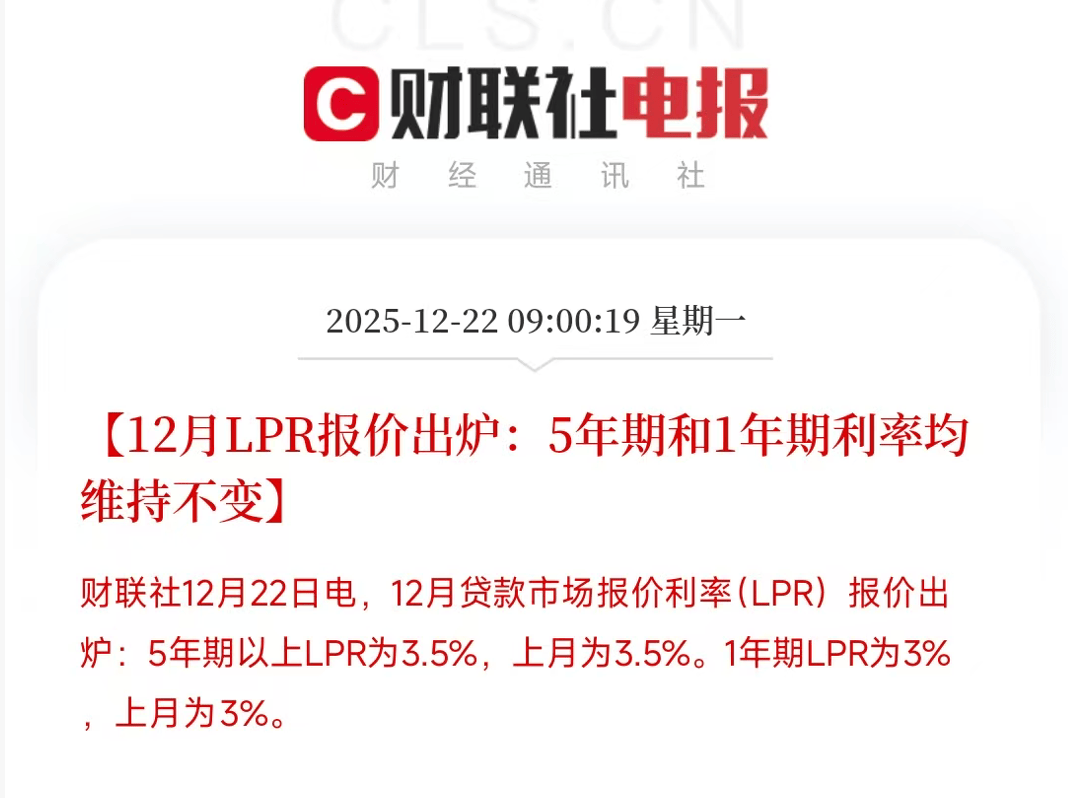
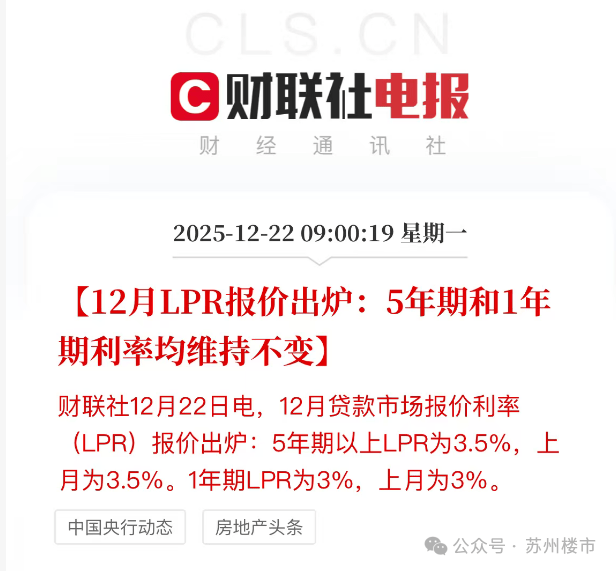
Group 1 - The 1-year LPR remains at 3.0% and the 5-year LPR at 3.5%, indicating a stable interest rate environment for now, but signals suggest that a rate cut may occur as early as January next year [1] - In Suzhou, the mainstream banks are offering a first home loan interest rate of 3.0%, which is seen as the "invisible lower limit" for mortgage rates, with banks likely to maintain this level even if the LPR is reduced [2][3] - The recent Central Economic Work Conference confirmed the continuation of a moderately loose monetary policy into 2026, emphasizing the flexible use of various policy tools such as rate cuts and reserve requirement ratio adjustments [4] Group 2 - Market predictions indicate at least one interest rate cut and one reserve requirement ratio reduction in the coming year, with the potential for more if necessary, reflecting an increased monetary policy space compared to the past two years [5] - The Federal Reserve's recent rate cuts have provided greater flexibility for China's monetary policy operations, with a cumulative reduction of 175 basis points in the current cycle [6] - A new policy from the central bank allows individuals to repair their credit records for overdue payments under certain conditions, which could facilitate future home loan approvals [6]
瑞达期货铝类产业日报-20251218
Rui Da Qi Huo· 2025-12-18 08:43
| 数据指标 项目类别 | | 最新 | 环比 数据指标 | 最新 | 环比 | | --- | --- | --- | --- | --- | --- | | 沪铝主力合约收盘价(日,元/吨) | | 21,955.00 | +40.00↑ 氧化铝期货主力合约收盘价(日,元/吨) | 2,553.00 | -5.00↓ | | | 主力-连二合约价差:沪铝(日,元/吨) 主力合约持仓量:沪铝(日,手) | -105.00 294,165.00 | -10.00↓ 主力-连二合约价差:氧化铝(日,元/吨) +175.00↑ 主力合约持仓量:氧化铝(日,手) | -128.00 170,112.00 | -10.00↓ -10314.00↓ | | | LME铝注销仓单(日,吨) | 73,675.00 | 0.00 库存:氧化铝:合计(周,万吨) | 258,836.00 | -1119.00↓ | | 期货市场 | LME电解铝三个月报价(日,美元/吨) 沪铝前20名净持仓(日,手) | 2,905.50 -99.00 | +23.00↑ LME铝库存(日,吨) +467.00↑ 沪伦比值 | 519,60 ...

风口智库|呵护年底流动性,央行时隔近三个月重启14天期逆回购操作
Sou Hu Cai Jing· 2025-12-18 05:42
Core Viewpoint - The People's Bank of China (PBOC) has initiated a total of 1,883 billion yuan in reverse repos, including 883 billion yuan for a 7-day term and 1,000 billion yuan for a 14-day term, to stabilize market liquidity as year-end financial pressures mount [1][2][4]. Group 1: Reverse Repo Operations - The PBOC conducted a 7-day reverse repo operation of 883 billion yuan at an interest rate of 1.40% [1]. - The 14-day reverse repo operation, reintroduced after nearly three months, amounts to 1,000 billion yuan, which is slightly above the average level for the same period in previous years [2][4]. - The 14-day reverse repo serves as a tool for short-term liquidity adjustment, allowing financial institutions to access funds while providing collateral in the form of government bonds [3]. Group 2: Market Impact and Strategy - The timing of the 14-day reverse repo aligns with year-end practices, as financial institutions face increased liquidity demands due to year-end assessments and potential cash withdrawals by residents [4]. - The operations aim to smooth out year-end liquidity fluctuations, ensuring that market liquidity remains ample and preventing spikes in interest rates [4]. - The PBOC's approach is characterized as a measured response to actual funding needs, balancing liquidity support without excessive market flooding [4]. Group 3: Future Monetary Policy Outlook - The central economic work conference emphasized the continuation of a moderately loose monetary policy, focusing on stable economic growth and reasonable price recovery [5]. - The PBOC is expected to utilize a combination of short-term and medium-term tools to manage liquidity effectively, including potential further reverse repos and MLF operations [6]. - A possible reserve requirement ratio (RRR) cut is anticipated in January 2026, which could inject approximately 1 trillion yuan into the market, supporting lending and signaling a commitment to economic stability [6].
新世纪期货交易提示(2025-12-18)-20251218
Xin Shi Ji Qi Huo· 2025-12-18 02:50
Report Summary 1. Investment Ratings by Industry - **Black Industry**: Iron ore, coal coke, rolled steel, and glass all show a "rebound" trend; Shanghai Stock Exchange 50 shows an "oscillation" trend [2] - **Financial Sector**: CSI 300, 2 - year Treasury, and 5 - year Treasury show an "oscillation" trend; CSI 500, CSI 1000 show a "rebound" trend; 10 - year Treasury is in "consolidation"; gold and silver show an "oscillation - strong" trend [4] - **Light Industry**: Logs show "bottom - oscillation"; pulp shows "oscillation"; double - offset paper shows "weak - oscillation" [5] - **Oilseeds and Oils**: Soybean oil, palm oil, and rapeseed oil show a "rebound" trend; soybean meal, rapeseed meal, soybean No. 2, and soybean No. 1 show an "oscillation - bearish" trend [6] - **Agricultural Products**: Pigs show a "strong" trend; rubber shows an "oscillation" trend [8] - **Polyester**: PX, PTA, and MEG show an "oscillation" trend; PR and PF are in a "wait - and - see" state [9] 2. Core Views - **Black Industry**: The iron ore market is characterized by "loose supply, low demand, and port inventory accumulation". The implementation of the steel export license management system is a negative factor for raw materials. For coal coke, short - term factors such as capacity review and safety inspection boost the market, but the change in export policy may have a negative impact. The overall black sector rebounds due to short - term fundamental improvement and policy support [2] - **Financial Sector**: The market shows short - term oscillation and consolidation, with a continued medium - term upward trend. The high - tech industry continues to grow. The pricing mechanism of gold is shifting, and factors such as central bank gold purchases, geopolitical risks, and the Fed's interest - rate policy affect its price [4] - **Light Industry**: The log market is in a state of weak supply - demand balance, with prices expected to oscillate at the bottom. The pulp market is affected by cost and demand factors, and the price may return to an oscillatory state after the digestion of positive factors. The double - offset paper market is under supply pressure and is expected to show weak oscillation [5] - **Oilseeds and Oils**: The oil market rebounds in the short term due to the support of crude oil prices, but the demand outlook is uncertain. The meal market is under pressure due to factors such as abundant supply and the expected high yield of South American soybeans [6] - **Agricultural Products**: The pig market may see a slight increase in prices in the future due to factors such as increased consumption and stable supply. The rubber market is affected by supply and demand factors, with prices expected to oscillate [8] - **Polyester**: The polyester market is affected by factors such as oil prices, supply, and demand. The prices of various products are expected to show oscillatory or wait - and - see trends [9] 3. Summary by Category 3.1 Black Industry - **Iron Ore**: In 2026, global mines will add 64 - 65 million tons, with a growth rate far exceeding that of crude steel. Current iron - water production is decreasing, steel - mill maintenance expectations are increasing, and real - world demand is weak. The implementation of the steel export license management system is a negative factor. Short - term rebounds due to restocking and macro - sentiment are opportunities to enter short positions [2] - **Coal Coke**: Capacity review, safety inspections, and anti - involution policies boost market sentiment, but the change in export policy may lead to a shift in market expectations from supply - side positives to demand - side negatives [2] - **Rolled Steel and Glass**: The government's emphasis on expanding domestic demand and short - term improvement in the steel fundamentals boost the black sector. The implementation of the steel export license management system requires a downward adjustment of next year's steel export expectations. Glass rebounds due to factors such as price decline, macro - sentiment fermentation, and production - line cold - repair [2] 3.2 Financial Sector - **Stock Index Futures/Options**: The previous trading day saw gains in the CSI 300, SSE 50, CSI 500, and CSI 1000. The market is expected to maintain short - term oscillation and a medium - term upward trend [4] - **Treasury Bonds**: The yield of the 10 - year Treasury bond decreased by 1bp, and the market shows a slight rebound. The central bank conducted reverse - repurchase operations, resulting in a net withdrawal of funds [4] - **Precious Metals**: The pricing mechanism of gold is changing, and factors such as central bank gold purchases, geopolitical risks, and the Fed's interest - rate policy support its price in the medium and long term [4][5] 3.3 Light Industry - **Logs**: Last week, the average daily port shipment of logs decreased, and the import volume from New Zealand and China decreased. This week, the expected arrival volume increased significantly. The spot - market price is stable, and the price is expected to oscillate at the bottom [5] - **Pulp**: The spot - market price of pulp is differentiated, and the increase in external - market prices strengthens cost support. However, due to the low profitability of the paper industry and high inventory pressure, demand is weak, and the price may return to an oscillatory state [5] - **Double - Offset Paper**: The spot - market price is stable, and the supply pressure remains. The demand from publication orders provides support, but social - order demand is average, and the price is expected to show weak oscillation [5] 3.4 Oilseeds and Oils - **Oils**: The U.S. soybean crushing is at a high level, and the export of Malaysian palm oil is weak with high inventory. The domestic oil supply is abundant, and the consumption recovery is weak. The oil price rebounds in the short term due to the support of crude oil prices [6] - **Meals**: The global soybean inventory is relatively loose, and the market has a strong expectation of a high yield of South American soybeans. The domestic soybean meal supply is abundant, and the price is expected to show an oscillatory - bearish trend [6] 3.5 Agricultural Products - **Pigs**: The average trading weight of pigs decreases slightly, and the demand for pork increases due to the drop in temperature. The slaughter - enterprise settlement price may increase, and the market supply is stable. The profit of self - breeding and self - fattening decreases, while that of piglet fattening increases [8] - **Rubber**: The rubber production in domestic and foreign regions is affected by weather conditions. The demand side shows an increase in production - capacity utilization, but the inventory shows a slight accumulation trend. The price is expected to oscillate [8] 3.6 Polyester - **PX**: The supply of PX is at a high level, and the downstream polyester load decreases. The PX price is affected by oil prices [9] - **PTA**: The cost of PTA fluctuates due to oil - price changes, and the short - term supply - demand situation improves, but the long - term situation may deteriorate [9] - **MEG**: There is a long - term inventory - accumulation pressure, and the near - month situation improves due to supply reduction. The price oscillates in the short term [9] - **PR and PF**: PR has strong raw - material support but weak downstream demand; PF has low inventory and is expected to have a warm price adjustment [9]
每日投行/机构观点梳理(2025-12-17)
Jin Shi Shu Ju· 2025-12-17 14:27
Group 1 - If the AI hype continues to fade, the Chinese stock market may outperform the US stock market [1] - Concerns about US tech stocks have resurfaced, with the S&P 500 index down nearly 2% from its recent peak [1] Group 2 - Goldman Sachs predicts that the Federal Reserve may be more willing to cut interest rates next year than previously assumed [2] - The upcoming employment reports will be crucial in determining whether the Fed will resume easing policies, with a focus on the unemployment rate rather than overall non-farm payroll growth [2] - Goldman expects the easing cycle to extend into 2026, with the federal funds target rate potentially dropping to 3% or lower [2] Group 3 - Morgan Stanley forecasts that the price increase of gold will slow down by 2026 due to reduced purchases by central banks and ETFs [3] - By Q4 2026, gold prices are expected to reach $4,800 per ounce, driven by stronger retail demand in China and increased central bank buying [3] - Silver is anticipated to underperform gold, with a peak shortage expected in 2025 due to declining solar equipment installations [3] Group 4 - A Bank of America survey indicates that 53% of investors believe the dollar is overvalued, up from 45% in November [4] - Investors are currently underweight in the dollar compared to historical levels, with short positions in the dollar considered the third most crowded trade [4] Group 5 - Concerns about the AI bubble have eased slightly but remain high, with 38% of investors identifying it as the biggest tail risk [5] - Private credit has emerged as a new risk factor, with 14% of fund managers considering it the largest tail risk for the coming year [5] Group 6 - The likelihood of a rate hike by the Bank of Japan has increased due to strong export performance, but the governor is not expected to signal a hawkish stance [6] - November exports grew for the third consecutive month, indicating a recovery from previous economic contraction [6] Group 7 - The Canadian Imperial Bank of Commerce notes that softening US employment data may prompt the Fed to consider earlier rate cuts in 2026 [8] - The labor market's cooling is expected to weaken the Fed's resolve to maintain current rates, increasing the likelihood of policy easing [8] Group 8 - China International Capital Corporation remains optimistic about bank stocks' absolute and relative performance, highlighting their high dividend yields and quality development phase [9] - The focus is on dividend yield and certainty, which depend on valuation and profit growth [9] Group 9 - Tianfeng Securities anticipates a more pronounced credit front-loading trend in 2026, with a positive outlook for early-year loans [10] - The bank sector may face challenges from high-interest term deposits and stock market fluctuations impacting general deposits [10] Group 10 - Tianfeng Securities expects a non-symmetric principle for deposit rate cuts in 2026, with a higher probability of implementation in the second quarter [11] - The report suggests a potential need for a rate cut before the Spring Festival, with a range of 25-50 basis points [11] Group 11 - China Galaxy Securities indicates that leading real estate companies are demonstrating strong operational management capabilities, which may enhance their market share [12]
摩根大通:内银股仍有绝对上升空间,预期明年首季将降准50个基点
Ge Long Hui· 2025-12-17 05:12
Core Insights - The central economic work conference indicates that under a stable macro environment, there is still absolute upside potential for bank stock prices [1] - The performance of yield stocks relative to the banking index may weaken next year due to more cautious policy support and stable bond yields, which limit dividend spread [1] Interest Rate and Monetary Policy - JPMorgan expects the People's Bank of China to cut interest rates by 10 basis points in both the first and second halves of next year, and to lower the reserve requirement ratio (RRR) by 50 basis points in Q1 2026 to alleviate liquidity pressure and support bank profit margins [1] - The market anticipates a nearly 20 basis point reduction in the one-year Loan Prime Rate (LPR) by 2026 [1] Regulatory Environment and Risk Management - Financial regulatory agencies will continue to focus on risk prevention, which helps reduce the likelihood of tail risk events [1] - The anti-involution movement is expected to encourage banks to strengthen pricing discipline, supporting the outlook for net interest margins [1] Sector Support and Competitive Advantage - There will be increased support for consumption and technology finance, with some joint-stock banks having competitive advantages in these areas [1]
连续四个月加量续作,央行今日开展6000亿元买断式逆回购
Hua Xia Shi Bao· 2025-12-15 08:16
Group 1 - The central bank will conduct a 600 billion yuan reverse repurchase operation on December 15, 2025, to maintain ample liquidity in the banking system, marking the fourth consecutive month of increased reverse repos [1] - The operation will be for a term of 6 months (182 days), with a total of 10 trillion yuan in 3-month reverse repos conducted on December 5, indicating an equal rollover of the same amount [1] - The total increase in reverse repos for December is 200 billion yuan, which is a decrease of 300 billion yuan compared to the previous month, representing the lowest level since August [1] Group 2 - Analysts suggest that the decrease in net financing of government bonds at year-end and the potential for a new round of reserve requirement ratio (RRR) cuts by the central bank early next year are contributing factors to the liquidity situation [2] - The Central Economic Work Conference emphasized the need for a moderately loose monetary policy in 2026, focusing on promoting stable economic growth and reasonable price recovery [2] - There is an expectation for the central bank to inject a significant amount of long-term liquidity, which may lead to a contraction in the net supply of medium-term liquidity in the short term [2]