硬科技

Search documents
银行理财开辟“新战场”:掘金IPO打新,偏爱“硬科技”
2 1 Shi Ji Jing Ji Bao Dao· 2025-11-28 12:45
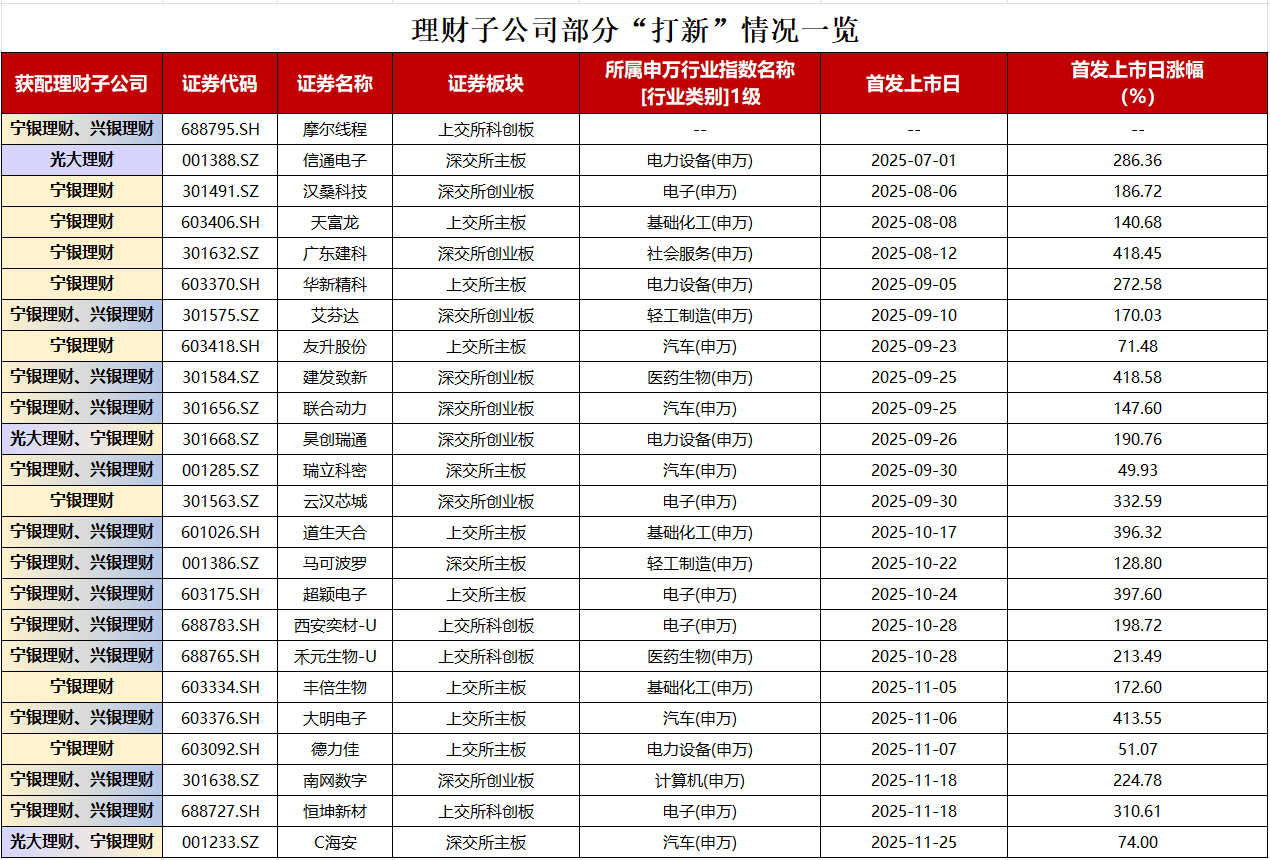
Core Insights - The article highlights the increasing participation of bank wealth management subsidiaries in IPOs, particularly in the context of the new policy allowing them to act as A-class investors in offline subscriptions starting January 2025 [2][3][4]. Group 1: Investment Activities - Bank wealth management subsidiaries, such as Ningyin Wealth Management and Xingyin Wealth Management, have actively participated in the IPO of the domestic GPU leader, Moer Thread, with Ningyin securing the highest allocation among wealth management companies at approximately 393,000 yuan [2][3]. - Ningyin Wealth Management has participated in 25 new stock subscriptions this year, achieving a success rate of 96% with a total allocation exceeding 1 million yuan [3][4]. - The wealth management sector is increasingly focusing on equity investments, with a notable shift from fixed-income assets to a more diversified asset allocation strategy [13][14]. Group 2: Market Trends - The IPO of Moer Thread, priced at 114.28 yuan per share and raising a total of 8 billion yuan, is noted as the largest IPO on the Sci-Tech Innovation Board in 2025 [2][3]. - The article mentions that the average first-day price increase for the 24 IPOs tracked is over 200%, with some stocks experiencing gains as high as 418.58% [9][11]. - The focus on technology sectors, particularly in high-tech and hard technology fields, is emphasized, with many new stocks coming from industries such as semiconductors and electric vehicles [6][8]. Group 3: Performance Metrics - Wealth management products participating in IPOs have shown significant returns, with some products achieving annualized returns exceeding 20% [11][12]. - For instance, the Ningyin Wealth Management product "Ningying Individual Stock Selection Mixed Open-End Wealth Management Product No. 1" reported an annualized return of 23.55% [11]. - The performance of these products is attributed to the successful participation in high-growth IPOs, which enhances overall product performance and investor appeal [14]. Group 4: Strategic Implications - The shift towards equity investments and participation in IPOs is seen as a strategic move to enhance the competitiveness of wealth management firms in a low-yield environment [14]. - The article suggests that this transformation will not only reshape the development path of bank wealth management but also facilitate deeper integration of financial resources into the real economy, particularly in supporting technological innovation [14].

长钱持续涌入市场,创投行业迎来阶段性拐点
Di Yi Cai Jing· 2025-11-28 11:23
Group 1 - The venture capital industry is entering a new cycle, with a predicted turning point in 2025 where sentiment and data will improve simultaneously, leading to optimism for 2026 [1] - In the first three quarters of 2025, the newly established venture capital fund size reached 1.78 trillion, a year-on-year increase of 10.25%, while investment event scale reached 912 billion, up 19.98% [1] - The exit scale for investments was approximately 583.5 billion, more than doubling year-on-year, largely due to strong performance in the secondary market [1] Group 2 - State-owned capital has become the most significant funding force in the market, accounting for 75%-80% of the total, acting as a stabilizing force [1] - The participation of Asset Investment Companies (AIC) has been increasing, with five AICs cumulatively investing tens of thousands of billions, becoming crucial for supporting the real economy [2] - AICs are focusing on hard technology, artificial intelligence, and new energy sectors, with 22 investments recorded from November 2024 to November 2025, primarily in semiconductors, new materials, aerospace, and biomedicine [2] Group 3 - There is a growing influx of long-term capital into the market, shifting the focus from where the funds come from to where they should be invested [3] - The industry is facing a new challenge of determining suitable investment targets, as the availability of funds is no longer the primary concern [3] - The macroeconomic policy, external environment, and technological innovation are expected to drive growth, particularly in smart manufacturing and industrial upgrades, enhancing the potential for returns in the Chinese stock market [3]
投资界募资月报 | 美元基金回来了
Sou Hu Cai Jing· 2025-11-28 10:09
Fundraising Activities - Source Code Capital has completed a new growth fund raising of $600 million, focusing on "AI+" and "Global+" investment directions, with a total asset management scale of approximately $7 billion [1] - Monolith has raised a total of $4.88 million (approximately 3.5 billion RMB) for its new dual-currency fund, bringing its total asset management scale to over 10 billion RMB [2][3] - Hangzhou Runmiao Fund has been established with an initial scale of 2 billion RMB, focusing on early-stage investments [4] - The Xinke Industry Investment Fund, initiated by Wuhan High-tech Group, has a total scale of 5 billion RMB, aimed at enhancing local industrial development [5] - CapitaLand Investment has raised over $650 million for its CLARA II fund, which will primarily invest in data centers and new economic infrastructure in the Asia-Pacific region [6] - Shenzhen Investment Control and Bank of Communications have signed a cooperation agreement for a new fund with a total scale of 2 billion RMB, focusing on hard technology enterprises [7][8] - Chip Union Capital has completed a fundraising of 1.25 billion RMB for its first main fund, targeting hard technology sectors [9] - Cainiao and China Life have established a logistics investment fund with a total asset scale of over 1.7 billion RMB [11] - Lenovo has launched a Shanghai fund with an initial scale of 1 billion RMB, focusing on cutting-edge technology and future industries [12] - The Henan Lihua Angel Technology Innovation Fund has been established with a total scale of 177 million RMB, focusing on strategic emerging industries [13] - Polar Light Venture Capital has set up a QFLP fund in Tianjin, marking its entry into the investment landscape [14] - China Rare Earth has established a private equity fund management company in Shenzhen with a registered capital of 30 million RMB [15] - The Hubei Zhongying Changjiang Fund has been established with a target scale of 10 billion RMB, focusing on high-end equipment manufacturing and emerging industries [16] - The Wuxi Baiwang Artificial Intelligence Investment Fund has been successfully registered, focusing on AI and data intelligence [17] - Shanghai Jiao Tong University has launched a new fund with a total scale of 100 million RMB, targeting strategic emerging industries [18] - Yida Capital is planning to establish a cross-border investment fund to support Guangzhou enterprises in the Middle East market [19]
荣泰健康20251127
2025-11-28 01:42
Summary of Rongtai Health Conference Call Company Overview - **Company**: Rongtai Health - **Industry**: Health and Wellness Equipment Key Points Financial Performance and Outlook - In Q3 2025, Rongtai Health's overall revenue remained stable compared to the previous year, but net profit decreased [3] - Domestic market performance was strong, driven by national subsidy policies, with an expected annual growth of 20% to 30% in domestic sales [3] - Overseas revenue is projected to decline slightly in double digits due to tariffs and consumer downgrading in the U.S. and Russia [3] - For 2026, the company aims for significant revenue and profit growth through product structure adjustments and enhanced overseas cooperation, targeting double-digit growth [2][20] Product Development and New Initiatives - The single-arm therapy robot project in collaboration with Meituan is in pilot testing in Shanghai, with the first store expected to operate by the end of 2025 [2][4] - The automotive seat business launched in early November 2025, with current monthly shipments around 10,000 units, expected to ramp up gradually [2][7] - The new massage chair model RT909,000 is planned for launch in the U.S. market in 2026, with a phased introduction in the domestic market [2][9] Market Strategy - The company plans to maintain a balance of high-end and mid-to-low-end products to compete effectively on e-commerce platforms [10] - Focus on the main brand while maintaining the current scale of the sub-brand "Meme Da," which has seen a decline in revenue [12] - The company is exploring partnerships and potential joint ventures to enhance market presence and operational efficiency [4][5] Investment and Financial Strategy - Rongtai Health has completed the conversion of its convertible bonds, resulting in a strong cash position without interest payment obligations [14] - The company is pursuing small equity investments and acquisitions, particularly in hard technology and domestic alternatives, to find a second growth curve [15][16] - Significant investments are planned for 2026, including the wood project and ongoing R&D for robotics and automotive seats [18] Challenges and Risks - The potential impact of the withdrawal of national subsidies on sales and competition dynamics is acknowledged, but the company remains optimistic about maintaining growth [13] - The company faces pressure to reduce costs from automotive manufacturers, which may affect profit margins as order volumes increase [8] Future Goals - Rongtai Health aims for double-digit growth in both revenue and profit in 2026, driven by new business segments and improved performance in core operations [20]

港股IPO规模登顶全球!上市券商投行业务前三季度净收入252亿元,2026年行业又将押注哪些热点赛道?
Mei Ri Jing Ji Xin Wen· 2025-11-28 00:38
Core Insights - The investment banking business of securities firms is experiencing a recovery, with net income reaching 252 billion yuan in the first three quarters of 2025, a year-on-year increase of 24% [1][2] - The IPO market is rebounding, with A-share and H-share IPOs growing by 61% and 237% respectively, while Hong Kong's IPO scale ranks first globally [1][2] - The industry is characterized by a "stable top tier and emerging mid-tier" dynamic, with the market share of the top five firms (CR5) increasing to 52% [2][3] Industry Performance - In the first three quarters of 2025, listed securities firms achieved a total investment banking net income of 251.5 billion yuan, a 23.5% increase year-on-year [2] - Major firms like CITIC Securities and CICC reported significant growth in net income, with increases ranging from 23.4% to 46.2% [2] - The concentration of investment banking business is rising, benefiting top firms more than smaller ones, with the CR5 market share up by 8 percentage points compared to 2024 [2] Future Outlook - The investment banking sector is expected to focus on hard technology, mergers and acquisitions, and green finance as key areas of growth in 2026 [1][3][4] - The A-share market is anticipated to maintain a steady expansion, particularly in the hard technology sector, due to ongoing reforms and increased IPO opportunities [3][4] - The Hong Kong market is expected to see continued high demand for listings from Chinese companies, supported by the A+H listing model [5][6] Strategic Initiatives - Firms are enhancing their organizational structures to improve collaboration and efficiency, focusing on sectors like hard technology and renewable energy [6][7] - Investment banks are actively expanding their presence in the Hong Kong IPO market, with firms like Huatai and Guolian Minsheng aiming to strengthen their competitive advantages through talent development and cross-border integration [7][8][9] - The implementation of supportive policies such as the "Six Merger Rules" and "Eight Science and Technology Innovation Board Rules" is driving market vitality and creating opportunities for investment banks [5][6]



首批科创创业机器人ETF集体上报
Sou Hu Cai Jing· 2025-11-27 23:11
Core Viewpoint - The recent collective application for the first batch of Sci-Tech Innovation and Entrepreneurship Robot ETFs by seven fund companies marks a significant move towards focusing on hard technology sectors, particularly in robotics, chips, and artificial intelligence, in response to supportive policies and industry upgrades [3][4][5]. Group 1: ETF Applications and Market Focus - Seven fund companies, including Huaxia Fund and E Fund, have collectively submitted applications for the first batch of Sci-Tech Innovation and Entrepreneurship Robot ETFs, which are the first index funds in China focusing on the robotics theme in the Sci-Tech Innovation Board and the Growth Enterprise Market [3][4]. - The underlying index for these ETFs, the "CSI Sci-Tech Innovation and Entrepreneurship Robot Index," selects 40 companies from the Sci-Tech Innovation Board and the Growth Enterprise Market that provide essential software and hardware for intelligent robotics [4]. - The index emphasizes "hard technology" attributes, with constituent stocks concentrated in semiconductor, artificial intelligence algorithms, and precision manufacturing sectors [4]. Group 2: Policy Support and Strategic Alignment - The concentrated application for the Sci-Tech Innovation and Entrepreneurship Robot ETFs aligns with the recent approval of multiple hard technology-themed ETFs, reflecting a strong policy response to guide funds towards key sectors like chips, robotics, and artificial intelligence [5]. - The "14th Five-Year Plan" and "15th Five-Year Plan" emphasize the importance of advancing core technologies and implementing "Artificial Intelligence+" initiatives, aiming to foster new economic growth points [5]. - Local governments are also providing substantial support, such as subsidies for integrated circuit policy revisions and rewards for high-quality artificial intelligence products, creating a collaborative support framework between central and local authorities [5]. Group 3: Technological Advancements and Market Potential - Significant technological breakthroughs and accelerated commercialization are catalyzing growth in the robotics sector, with international companies like Tesla planning to launch mass production models, which could expand industry growth [6]. - Domestic companies are also achieving core technological advancements, with substantial investments being made to promote the deployment of intelligent robotics [6]. - The explosive growth of AI technology is providing strong momentum for the robotics industry, with AI application processing volumes increasing by 5-10 times compared to last year, indicating a robust demand for computational power [6]. Group 4: Institutional Outlook on Hard Technology - Fund companies involved in the ETF applications are optimistic about the long-term development opportunities in the hard technology sector, citing strong resilience in the technology growth segment [7]. - The recovery trend observed in sci-tech enterprises post-2025 Q3 reports indicates a potential for continued support for the technology growth style, backed by improving volume and price indicators [7]. - The robotics industry is seen as forming a "golden triangle" of strong policy support, technological breakthroughs, and valuation potential, suggesting a favorable investment landscape [7].


上市券商投行业务前三季度净收入251.5亿元 2026年又将押注哪些热点赛道?
Mei Ri Jing Ji Xin Wen· 2025-11-27 13:29
Core Insights - The investment banking sector is experiencing a recovery with significant growth in net income and IPO activities, particularly in A-shares and H-shares [1][2][3] Group 1: Market Performance - In the first three quarters of 2025, listed brokers achieved a net investment banking income of 251.5 billion yuan, a year-on-year increase of 24% [1][2] - A-shares and H-shares IPO scales grew by 61% and 237% respectively, with Hong Kong IPOs ranking first globally [1][2] - The top five companies in the investment banking sector accounted for 52% of the market share, with several mid-sized brokers experiencing growth rates exceeding 50% [1][3] Group 2: Future Outlook - The investment banking industry anticipates that hard technology, mergers and acquisitions, and green finance will be core hotspots in 2026 [1][4] - The deepening of the registration system and the demand for cross-border financing are expected to drive market expansion [1][3] Group 3: Strategic Initiatives - Companies are enhancing their organizational mechanisms and focusing on industry-specific strategies to improve service efficiency and client support [5][6] - Investment banks are actively responding to policy changes, such as the "Eight Articles of the Sci-Tech Innovation Board" and "Six Articles of Mergers and Acquisitions," to capitalize on market opportunities [5][6] - Firms are building comprehensive platforms for merger opportunities and establishing dedicated departments to streamline merger and acquisition processes [6][8] Group 4: Cross-Border Expansion - Major investment banks are strengthening their presence in the Hong Kong market, leveraging cross-border integration advantages to enhance service capabilities [7][8] - Companies like Huatai have completed numerous Hong Kong IPO projects, positioning themselves among the top in the market [7]



市值超20万亿赛道,哪家公司最具投资价值?
和讯· 2025-11-27 08:27
Core Insights - The A-share information technology sector, including semiconductors, hardware equipment, and software services, has shown significant positive performance since 2025, characterized by "high growth, high trading volume, and high valuation" [2] - As of November 27, the information technology sector has increased by 37.93%, with a total market capitalization exceeding 20 trillion yuan, accounting for 19.92% of the total A-share market capitalization [2] - The three core sub-sectors have displayed distinct performance, with hardware equipment leading at a 48.60% increase, followed by semiconductors at 36.74%, and software services at 17.76% [2] - The report identifies high-value companies in the hard technology sector based on their performance in R&D innovation, profitability, growth potential, and market performance [2] Sub-sector Analysis Semiconductor Sector - The top companies in the semiconductor sub-sector include Haiguang Information, Cambricon, and Zhongwei Company, focusing on high-end processors, intelligent chips, and semiconductor manufacturing equipment [5][13] - The semiconductor sector is characterized by a concentration of companies involved in critical areas such as chip design and manufacturing equipment [26] Hardware Equipment Sector - Leading companies in the hardware equipment sub-sector include NewEase, Hikvision, and ZTE, specializing in optical modules, intelligent IoT solutions, and comprehensive information and communication technology solutions [20][21] - This sector is noted for its scale advantages and engineering capabilities, contributing significantly to the overall growth of the hard technology industry [26] Software Services Sector - Key players in the software services sub-sector include Kingsoft Office, Tonghuashun, and Runze Technology, focusing on office software, financial information services, and data center services [22][23] - The software services sector is undergoing structural reorganization and innovation, reflecting a shift in market dynamics [26] Value Assessment Framework - The report presents a value assessment framework for hard technology companies, evaluating 1,089 A-share information technology firms based on R&D innovation, financial health, growth potential, and market performance [36] - The analysis reveals a significant disparity in technological strength, operational quality, and growth potential among companies, with only 3% classified as "top-tier" [26] - A total of 268 companies fall into the "dual excellence" quadrant, indicating high capabilities in both R&D innovation and financial health, representing the backbone of the hard technology industry [31]
A股三大指数集体上涨,A500ETF易方达(159361)、沪深300ETF易方达(510310)助力布局A股核心资产
Mei Ri Jing Ji Xin Wen· 2025-11-27 05:22
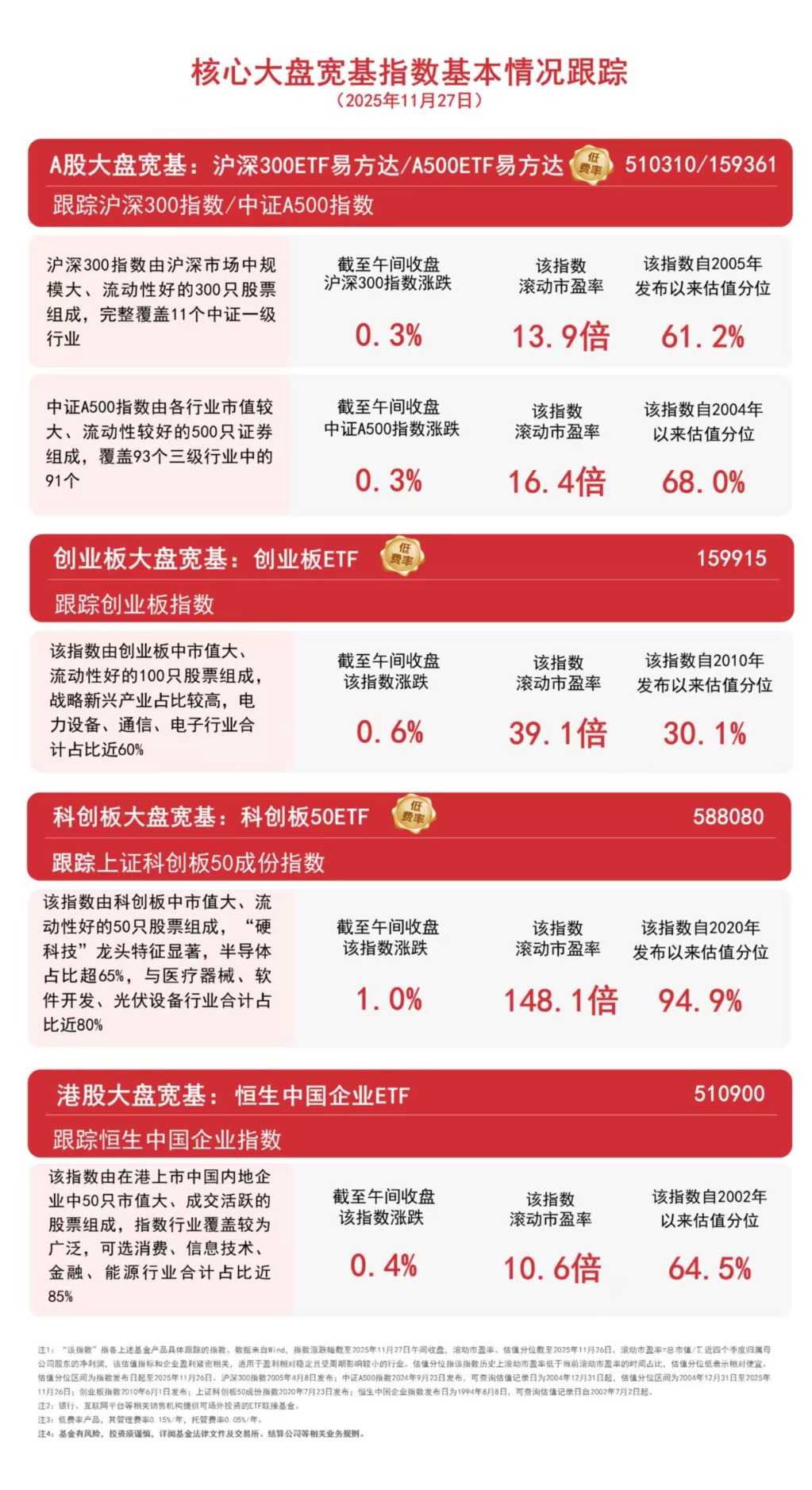
Market Overview - A-shares experienced a collective rise in the morning session, with the Shanghai Composite Index increasing by 0.5% and over 3,300 stocks in the market rising [1] - The Hong Kong stock market showed a fluctuating upward trend, with notable gains in durable consumer goods, paper, and hardware equipment sectors [1] Index Performance - The CSI 300 Index rose by 0.3%, with a rolling P/E ratio of 13.9 times, placing it in the 61.2% valuation percentile since its inception in 2005 [2] - The CSI A500 Index also increased by 0.3%, with a rolling P/E ratio of 16.4 times, corresponding to a 68.0% valuation percentile since its launch in 2004 [2] - The ChiNext Index saw a rise of 0.6%, with a rolling P/E ratio of 39.1 times, which is in the 30.1% valuation percentile since its establishment in 2010 [2] - The STAR Market 50 Index increased by 1.0%, with a rolling P/E ratio of 148.1 times, placing it in the 94.9% valuation percentile since its launch in 2020 [2] Sector Analysis - The Hang Seng China Enterprises Index rose by 0.4%, with a rolling P/E ratio of 10.6 times, and it has a valuation percentile of 64.5% since its inception in 2002 [3]
先进封装、CPO等硬科技板块走强,科创板50ETF(588080)、科创综指ETF易方达(589800)等助力布局“硬科技”龙头
Sou Hu Cai Jing· 2025-11-27 05:17
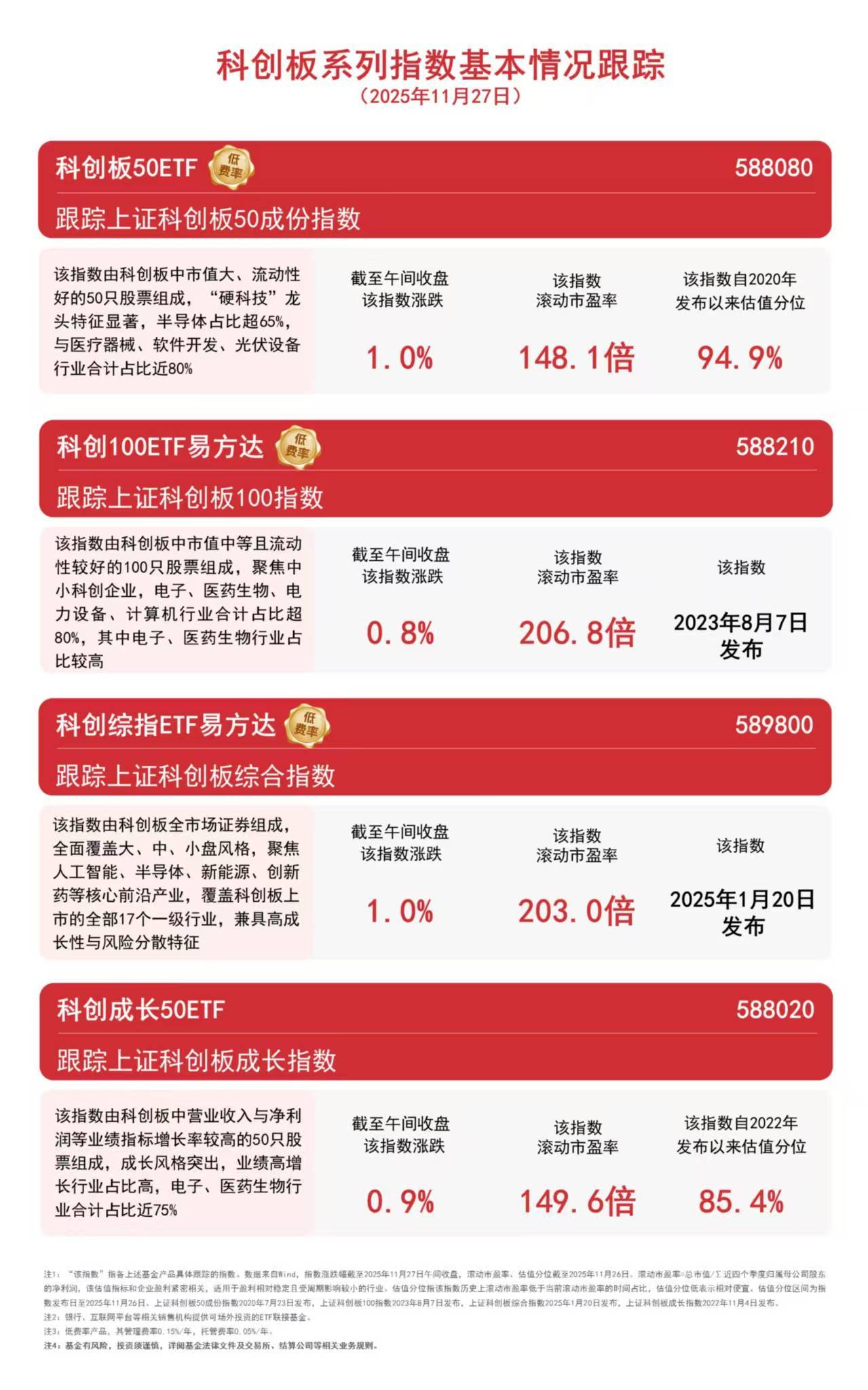
Group 1 - The core index tracks 50 stocks from the Sci-Tech Innovation Board with high growth rates in revenue and net profit, emphasizing a growth style [3] - The electronic and pharmaceutical industries account for nearly 75% of the index, indicating a strong concentration in high-growth sectors [3] - As of the latest trading session, the index has seen a 0.9% increase, with a rolling price-to-earnings ratio of 149.6 times [3] Group 2 - The rolling price-to-earnings ratio is calculated as total market value divided by net profit, making it relevant for industries with stable earnings and minimal tax impact [4] - The index was first published on July 23, 2020, and has undergone various updates, including the comprehensive index launched on January 20, 2025 [4] - The fund products related to this index have low management fees of 0.15% per year and custody fees of 0.05% per year [4]