滞胀

Search documents
上周国际金价小幅下跌美国多家科技巨头将公布财报
Sou Hu Cai Jing· 2025-04-28 00:12
【#上周国际金价小幅下跌##美国多家科技巨头将公布财报#】首先来回顾资本市场的情况。上周,随着 特朗普在关税政策上态度缓和,也不再威胁解职美联储主席鲍威尔,市场风险偏好得到提振,美国三大 股指上周集体上涨。其中道指上涨2.48%,纳指上涨6.73%,标普500指数上涨4.59%。 上周国际油价下跌 原油市场方面,"欧佩克+"主要产油国计划在6月再次增产,原油供应可能大幅增加,叠加贸易紧张局势 下的需求不确定性,以及美元走强等多个因素令油价承压。上周,美油累计下跌2.57%,布油累计下跌 1.60%。 (总台央视记者 渠莎莎) 本周将公布美国和欧元区一季度GDP数据 再来看本周,数据面上,美国和欧元区一季度GDP数据将于当地时间本周三公布。多家机构预测,美国 2025年一季度实际GDP增长数据低于0.5%,较上一季度的2.4%大幅萎缩。彭博社的调查显示,经济学 家普遍预计今年前三个季度,美国GDP增速都将低于1%。另外,欧元区本周将迎来一系列GDP、通胀 和消费者信心数据,市场也将以此评估关税政策对欧洲经济造成的冲击。 本周将公布美国4月非农就业数据和3月核心PCE价格指数 当地时间本周五,美国重磅非农就业数据 ...


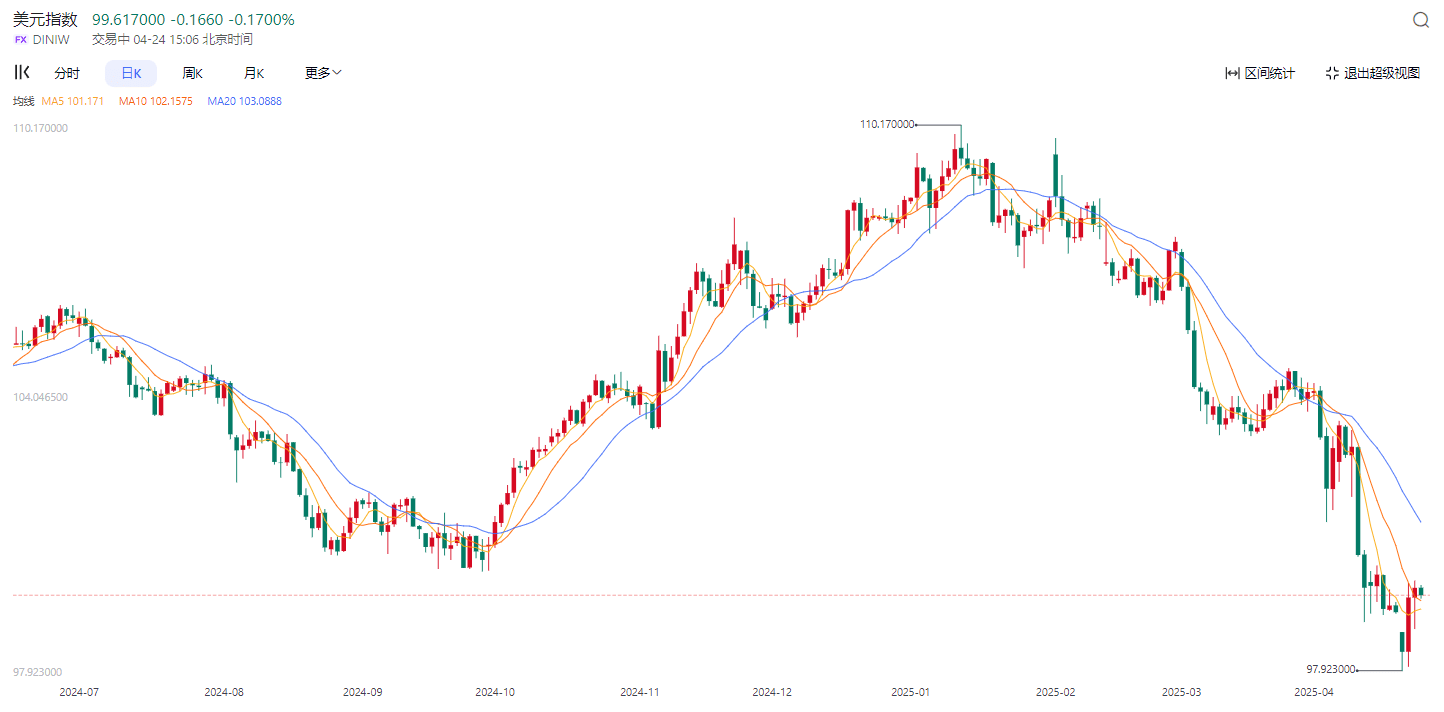
美元指数跌破98!这不是数字,是全球资本流向的转折点!
Sou Hu Cai Jing· 2025-04-27 17:00
Group 1: Dollar Index and Economic Context - The dollar index (DXY) fell sharply by 100 points, breaking below the 98 mark, reaching a new low since March 2022, indicating a structural change in the global monetary system [1] - The U.S. trade deficit expanded to $130.7 billion in Q1 2025, the highest since 1992, exacerbated by the "reciprocal tariff" policy of the Trump administration [3] - Concerns over "stagflation" are rising, with Q1 2025 GDP growth dropping to 1.2% and unemployment rising to 5.1%, while March CPI remained at 3.5% [5] Group 2: U.S. Economic Challenges - The U.S. faces a "fourfold dilemma" with increasing stagflation risks, a national debt exceeding $36.2 trillion, and a debt-to-GDP ratio of 124% [5] - The Federal Reserve's interest rate policies are conflicting, with expectations of multiple rate cuts in 2025, further suppressing dollar demand [6] - Political polarization and a crisis of institutional credibility are evident, with Trump's policies undermining the dollar's status as a reserve currency [7] Group 3: Global De-dollarization Trends - Central banks globally are increasing gold purchases, with a net acquisition of 1,045 tons in 2024, and China's gold reserves rising to 73.7 million ounces [8] - The share of the dollar in global foreign exchange reserves has decreased from 59% in 2020 to 52% in 2025, the lowest since the Bretton Woods system [8] - Capital is flowing out of dollar assets, with institutions like Norway's sovereign fund shifting towards euros, yen, and emerging market currencies [8] Group 4: Renminbi Dynamics - The renminbi has faced depreciation pressure, with a year-to-date decline of 3.2%, driven by a negative interest rate differential with the U.S. [9] - China's Q1 2025 GDP grew by 5.4%, with industrial output increasing by 6.5%, indicating economic resilience [10] - The potential for long-term appreciation of the renminbi exists as the Fed's policy shifts and China's competitiveness in digital economy and green energy improves [11] Group 5: Gold Market Insights - Gold prices reached a historic high of $3,395 per ounce on April 21, 2025, driven by geopolitical tensions and inflation expectations [12][14] - The demand for gold is influenced by ongoing geopolitical conflicts and expectations of rising inflation due to tariff policies [14] - The supply of gold is tightening, with global mine production expected to decrease by 2% in 2025, while central bank demand rises to 110 tons per month [16] Group 6: Future Economic Order - The breaking of the dollar index below 98 signals a potential shift in the global economic order, with both risks and opportunities for the renminbi [17] - Investors are advised to focus on macroeconomic fundamentals and adjust asset allocations to mitigate risks associated with the evolving economic landscape [18]

申万宏观·周度研究成果(4.19-4.26)
赵伟宏观探索· 2025-04-27 15:48
以下文章来源于申万宏源宏观 ,作者宏观团队 申万宏源宏观 . 申万宏源证券研究所 | 宏观研究部 4 . 1 9 - 4 . 2 6 周度研究成果 2 0 2 5 申 万 宏 源 宏 观 研 究 团 队 目录 深度专题 1、坚定不移办好自己的事——4月政治局会议精神学习理解 热点思考 1、 美元:"巴别塔"的倒塌?——"汇率"观察双周报系列之一 2、 美国经济:关税冲击与"滞胀"踪迹——关税"压力测试"系列之三 3、 财政"续力"正当时 4、 "关税冲击"的行业脉络? 高频跟踪 电话会议 1、"周见"系列会议第28期 《服务消费"画像"》 2、"洞见"系列会议第56期 《美元:" 巴别塔 "倒塌?"汇率"观察双周报系列之一》 3、"洞见"系列会议第57期 《美国经济:关税冲击与"滞涨"踪迹——关税"压力测试"系列之三》 深度专题 1 坚定不移办好自己的事——4月政治局会议精神学习理解 深度研究 2025.4.25 《坚定不移办好自己的事——4月政治局会议精神学习理解》 "坚定不移办好自己的事","根据形势变化及时推出增量储备政策" 1、 海外高频 | 特朗普关税态度软化,3月美国零售反弹 2、 政策跟踪 | ...
“抛售美国”潮出现,特朗普解雇鲍威尔风波暂停
Di Yi Cai Jing· 2025-04-27 12:40
Group 1 - The financial markets experienced a significant sell-off, termed "Sell America," due to President Trump's threats to dismiss Federal Reserve Chairman Jerome Powell, leading to investor disappointment and uncertainty [1][10]. - The period of "Sell America" occurred from April 4 to April 22, coinciding with Powell's remarks about the potential negative impact of Trump's tariff policies on the U.S. economy [1][10]. - The S&P 500 index formed a "death cross" for the first time in three years on April 14, indicating potential further declines in the market [10][11]. Group 2 - Economic indicators show a mixed outlook, with March's core Consumer Price Index (CPI) rising only 2.8%, below expectations, suggesting a cautious stance from the Federal Reserve [2][4]. - Consumer spending is declining across various income levels, with households cutting back on non-essential purchases, indicating economic strain [3][4]. - Economists predict a 40% chance of a recession in the next 12 months, with concerns that rising tariffs could exacerbate inflation and hinder economic growth [4][5]. Group 3 - Trump's administration has created uncertainty regarding trade policies, which has negatively affected business sentiment and consumer confidence [3][7]. - The potential dismissal of Powell raises questions about the independence of the Federal Reserve, which is crucial for maintaining market stability [9][8]. - The recent turmoil in financial markets reflects a broader loss of confidence in U.S. economic policies and the safety of American financial assets [10][11].
黄金再创新高,基本金属、黑色系板块领涨,航运板块领跌
2 1 Shi Ji Jing Ji Bao Dao· 2025-04-27 09:40
周内(4月21日至4月25日),大宗商品涨跌不一,基本金属、黑色系板块领涨,航运板块领跌。 就国内期货市场具体来看,能源化工板块,燃油周上涨1.51%、原油上涨1.10%,碳酸锂下跌2.85%;黑 色系板块,铁矿石周上涨1.43%、焦煤上涨0.37%;基本金属板块,沪镍周上涨0.05%、沪锌上涨 3.17%、沪铜上涨1.71%;农产品板块,棕榈油周上涨3.00%、豆粕上涨0.33%、生猪下跌2.18%。航运板 块,集运欧线周下跌10.95%。交易行情热点 热点一:美联储独立性受影响,黄金收出高位十字星 黄金本周盘中价格创出新高,COMEX黄金一度突破3500美元盎司关口,随后快速回落,COMEX黄金 和伦敦金周线均收出十字星。具体来看,COMEX黄金下跌0.33%,报3330.2美元/盎司;伦敦金下跌 0.17%,报3318.62美元/盎司。 据南华期货(603093)统计:长线基金持仓看,上周SPDR黄金ETF持仓周减6吨至946.3;iShares白银 ETF持仓周减164.1吨至13956吨。短线基金持仓看,根据截至4月22日的CFTC持仓报告,黄金非商业净 多头寸周减26832张至175378张,其中 ...
高频数据扫描:贸易摩擦将迎关键数据
Bank of China Securities· 2025-04-27 08:18
Report Industry Investment Rating - No industry investment rating is provided in the report. Core Viewpoints of the Report - In recent weeks, the performance of major global market assets generally aligns with the scenario assumption that the US will fall into "stagflation." The US stock, bond, and foreign exchange markets are under pressure, while the A-share market shows resilience, and the gold price hits new highs. The significant tariff hikes by the US will impact the supply chain and have a negative impact on its economic growth. It is also highly likely to push up inflation in the short term. Whether tariff-induced inflation will turn into persistent stagflation is the key to determining the intensity and duration of trade frictions. If persistent stagflation occurs, the situation of a triple sell-off in US stocks, bonds, and foreign exchange will continue, increasing the difficulty for the Trump administration to persist in trade frictions [2][10]. - The consumption rigidity of US residents is crucial for the realization of the stagflation scenario. The retail data of US goods in the second quarter is particularly important. If US residents' consumption is rigid, the tariff hikes will mainly be passed on to commodity prices, and workers may demand higher wages, forming a new "wage - price spiral," increasing the probability of persistent stagflation. The nominal growth rate of US commodity retail sales in April is an important indicator. If it significantly exceeds the previous fluctuation range, it is more in line with the stagflation scenario assumption; otherwise, it is necessary to consider whether the current style of major asset classes has reached the extreme. The CPI data for April also has indicative value, but retail data reflects both price and quantity [2][11]. - Another factor determining whether the stagflation scenario can be realized is the policy choice of the Federal Reserve. Even if tariffs are regarded as consumption taxes, their inflationary effects may not be long - lasting. If the Trump administration forces the Federal Reserve to loosen monetary policy, the stagflation scenario is more likely to be realized. However, if the Trump administration only wants to blame the possible economic recession on the Federal Reserve, the situation may be different [2][14]. Summary According to the Directory High - Frequency Data Panoramic Scan - The performance of major global market assets in recent weeks is in line with the scenario assumption of US stagflation. The US stock, bond, and foreign exchange markets are under pressure, while the A - share market shows resilience, and the gold price hits new highs. The tariff hikes by the US will impact the supply chain and push up inflation in the short term. Whether it turns into persistent stagflation is the key to trade frictions [10]. - The consumption rigidity of US residents is crucial for stagflation. The second - quarter US commodity retail data is important. In April, the US imposed so - called "reciprocal tariffs." If the nominal growth rate of retail sales significantly exceeds the previous range, it is in line with the stagflation scenario; otherwise, it is necessary to re - evaluate the asset style. The April CPI data also has indicative value [11]. - The policy choice of the Federal Reserve is another factor for stagflation. The inflationary effect of tariffs may not be long - lasting. Forcing the Federal Reserve to loosen monetary policy may lead to stagflation, but if it's just for blame - shifting, the situation may vary [14]. - In the week from April 21 to April 26, 2025, the average wholesale price of pork increased by 0.65% week - on - week and 1.64% year - on - year; the Shandong vegetable wholesale price index decreased by 2.07% week - on - week and 9.83% year - on - year. On April 18, the edible agricultural product price index decreased by 0.30% week - on - week, and the year - on - year decline narrowed to 3.61%. Brent and WTI crude oil futures prices increased by 1.23% and 0.74% week - on - week respectively. LME copper and aluminum spot prices increased by 2.72% and 2.27% week - on - week respectively, and the copper - gold ratio increased by 0.91% week - on - week. The domestic cement price index decreased by 0.48% week - on - week; the Nanhua iron ore index increased by 1.43% week - on - week; the operating rate of coking enterprises with a capacity of over 2 million tons increased by 2.54% week - on - week; the rebar inventory decreased by 4.58% week - on - week; the rebar price index increased by 1.37% week - on - week. On April 18, the producer price index decreased by 0.30% week - on - week and 7.27% year - on - year. From April 1 to 24, the average daily trading area of commercial housing in 30 large and medium - sized cities was about 203,000 square meters [2]. Comparison of High - Frequency Data and Important Macroeconomic Indicators' Trends - Multiple charts show the relationship between high - frequency data and important macroeconomic indicators, such as the relationship between the RJ/CRB price index year - on - year and export amount year - on - year, the relationship between the producer price index year - on - year and PPI industrial year - on - year, etc. [22][25][31] Important US High - Frequency Indicators - Multiple charts show important US high - frequency indicators, including the implied prospects of interest rate hikes/cuts in US federal funds futures, the relationship between US same - store sales growth and PCE year - on - year, the relationship between US weekly economic indicators and actual economic growth rates, and the relationship between the number of first - time unemployment claims in the US and the unemployment rate [89][96][99] Seasonal Trends of High - Frequency Data - Multiple charts show the seasonal trends of high - frequency data, including the seasonal trends of the average daily output of crude steel (decadal), the producer price index, the total index of the China Commodity Price Index, etc. [100][104][109] High - Frequency Traffic Data in Beijing, Shanghai, Guangzhou, and Shenzhen - Multiple charts show the year - on - year changes in subway passenger volume in Beijing, Shanghai, Guangzhou, and Shenzhen [154][156]
美股,拉响警报!外国投资者3月初以来抛售630亿美元!知名机构发声:逢高卖出
Mei Ri Jing Ji Xin Wen· 2025-04-27 03:51
Group 1 - The U.S. stock market experienced a rebound this week, with the Dow Jones up 2.48%, S&P 500 rising over 4.5%, and Nasdaq increasing by 6.73% [1] - Despite the rebound, some Wall Street institutions remain pessimistic about the market's future [1][2] - Bank of America warns that the recent stock market rally will be temporary, advising investors to sell during the rebound [4] Group 2 - Goldman Sachs reported that foreign investors have withdrawn $63 billion from the U.S. stock market since early March, with Europe being the largest seller [3] - A survey by JPMorgan indicates that U.S. stocks will see the most significant capital outflow this year, while cash is viewed as the most favorable asset class [3] - Analysts expect continued market volatility, with upcoming earnings reports from tech giants being crucial for market direction [5] Group 3 - The U.S. economy faces multiple challenges, including long-term growth imbalances, significant wealth gaps, and over $36 trillion in national debt [6] - The International Monetary Fund (IMF) forecasts a slowdown in U.S. economic growth to 1.8% by 2025, marking the largest downward revision among developed economies [6] - Wall Street anticipates a substantial slowdown in U.S. GDP growth for the first quarter, with Goldman Sachs predicting a growth rate of only 0.1% [6] Group 4 - Concerns over "stagflation" have heightened, leading to increased volatility in U.S. markets, with simultaneous declines in U.S. stocks and bonds [7] - The U.S. government's debt burden is rising, with increased financing costs due to high inflation and interest rates, raising concerns about potential defaults [7] - Market expectations for the Federal Reserve to implement "recession-style" rate cuts are growing, reflecting deteriorating economic fundamentals [7]



申万宏观·周度研究成果(4.19-4.26)
申万宏源宏观· 2025-04-26 07:58
4 . 1 9 - 4 . 2 6 周度研究成果 2 0 2 5 申 万 宏 源 宏 观 研 究 团 队 目录 深度专题 1、坚定不移办好自己的事——4月政治局会议精神学习理解 热点思考 1、 美元:"巴别塔"的倒塌?——"汇率"观察双周报系列之一 2、 美国经济:关税冲击与"滞胀"踪迹——关税"压力测试"系列之三 3、 财政"续力"正当时 4、 "关税冲击"的行业脉络? 高频跟踪 电话会议 1、"周见"系列会议第28期 《服务消费"画像"》 2、"洞见"系列会议第56期 《美元:" 巴别塔 "倒塌?"汇率"观察双周报系列之一》 3、"洞见"系列会议第57期 《美国经济:关税冲击与"滞涨"踪迹——关税"压力测试"系列之三》 深度专题 1 坚定不移办好自己的事——4月政治局会议精神学习理解 深度研究 2025.4.25 《坚定不移办好自己的事——4月政治局会议精神学习理解》 "坚定不移办好自己的事","根据形势变化及时推出增量储备政策" 1、 海外高频 | 特朗普关税态度软化,3月美国零售反弹 2、 政策跟踪 | 推动各方面政策措施早出手、快出手 3、 国内高频 | 港口货物吞吐量涨幅较大 4、 Top Cha ...
大宗商品,走向
2025-04-25 02:44
Summary of Conference Call Records Industry Overview - The records discuss the **commodities market**, highlighting the current trends and historical comparisons to the 1970s and 1930s [1][2][3]. Key Points and Arguments 1. **Globalization and Economic Trends**: - Increasing trade frictions are exacerbating the trend of de-globalization, resembling the 1930s and 1970s, with the current situation more akin to the 1970s stagflation environment [1][2]. - The current asset price structure reflects a stagflation bull market, with significant increases in gold and copper prices, while the dollar and U.S. stock markets are declining [1][4]. 2. **Supply Shocks**: - Supply shocks are a natural outcome of the de-globalization trend, with resource-rich countries implementing export bans on commodities like nickel, bismuth, cobalt, and tin [1][5]. - Historical parallels are drawn to the 1978 weather extremes and Middle Eastern geopolitical uncertainties that caused supply shocks [5]. 3. **Demand Dynamics**: - Despite economic downturns, the apparent consumption of industrial metals like copper and aluminum has not significantly decreased, indicating structural demand stability [8]. - Strategic reserve policies, similar to the 1979 U.S. mineral reserve amendments, are driving commodity demand upward [8][9]. 4. **Geopolitical Influences**: - The current geopolitical landscape, including the Russia-Ukraine conflict, has led to increased inventory levels across industries, with countries like China, the U.S., and Europe boosting resource strategic reserves [9]. 5. **Dollar Supply and Inflation**: - The oversupply of dollars, driven by fiscal expansion, has historically led to rising resource prices, a trend that is currently being observed due to extensive fiscal stimulus measures [10][11]. - The current U.S. national debt exceeds 120% of GDP, significantly impacting interest expenses and indicating a more severe dollar crisis compared to the 1980s [14]. 6. **Comparison with Historical Context**: - The current situation is contrasted with the 1970s, where the latter part of that decade saw a commodity bull market followed by a prolonged downturn, while the present may mark the beginning of a long-term commodity bull market [13][16]. 7. **Investment Recommendations**: - It is advised to invest in dollar-denominated short-duration assets like gold and copper, as their pricing is expected to rise due to the weakening dollar [17]. - Long-duration assets priced in RMB are also recommended, anticipating an increase in the value of future cash flows due to China's rising power and currency appreciation [17]. Other Important Insights - The long-term impact of tariffs imposed by the Trump administration could lead to a 1-2% increase in U.S. CPI, affecting inflation dynamics beyond his term [16]. - The transition of certain metals from industrial to financial assets due to the depreciation of the dollar index has increased their market demand [12].
关税冲击下首份美联储《褐皮书》:107次提及关税,淡化通胀影响
Sou Hu Cai Jing· 2025-04-24 12:11
Group 1: Trade Policy Impact - The tariff policies have significantly affected key industries such as steel, aluminum, and automotive parts, forcing companies to shorten pricing cycles and implement daily price adjustments to transfer cost pressures [2] - Consumer behavior has shifted, with a surge in demand for durable goods before tariffs took effect, while non-durable goods consumption has declined, indicating concerns over future price increases [2] - Companies in regions like Atlanta and St. Louis have paused capital expenditures due to policy uncertainty, with some manufacturers stating that the environment is too chaotic for investment [2] Group 2: Inflation and Wage Dynamics - The Beige Book reveals signs of stagflation, with most regions reporting accelerated wage growth, contradicting signs of layoffs in manufacturing [3] - The healthcare sector continues to expand, driving up labor costs, while low-skilled jobs are shrinking due to industry shifts [3] - Input cost pressures are expected to rise further, with companies anticipating increased costs over the next six months, leading to a situation where consumers will ultimately bear these costs [3] Group 3: Federal Reserve Policy Dilemma - The Federal Reserve faces a dilemma between slowing economic growth and persistent inflation, with expectations of a rate cut in June despite inflation remaining above target [4][5] - Core PCE inflation expectations have been raised to 2.8%, while GDP growth forecasts have been downgraded from 2.1% to 1.7% [5] - The Fed's attempt to slow down balance sheet reduction has been interpreted as a dovish signal, reinforcing expectations for rate cuts [5] Group 4: Global Supply Chain Restructuring - The tariff situation is accelerating the restructuring of global supply chains, with companies facing challenges such as skyrocketing costs and order uncertainties [6][7] - For instance, U.S. agricultural exporters have been severely impacted, with the cost of soybeans rising from 4,000 yuan/ton to 7,000 yuan/ton, leading buyers to shift to South American markets [7] - Companies are adopting varied strategies to mitigate risks, including short-term measures to expedite shipments and long-term strategies like localizing supply chains [7] Group 5: Political and Market Pressures - The Trump administration's pressure on the Federal Reserve has reached new heights, with public calls for immediate rate cuts impacting market dynamics [8] - Despite the Fed's emphasis on policy independence, the acknowledgment of deteriorating economic prospects suggests that monetary policy is influenced by political factors [8] - Market reactions have been mixed, with Bitcoin rebounding and tech stocks performing well, while concerns over economic recession are reflected in deepening yield curve inversions [8]