
新消费

Search documents
小米集团公布最新财报,机构称汽车业务加速增长,毛利率喜人
Mei Ri Jing Ji Xin Wen· 2025-08-20 02:10
Group 1 - The core viewpoint of the news highlights the performance of Xiaomi Group, which reported a revenue of 227.25 billion RMB for the first half of the year, marking a year-on-year growth of 38.2% and an adjusted net profit of 21.51 billion RMB, up 69.8% [1] - In Q2, Xiaomi achieved a revenue of 115.96 billion RMB, reflecting a year-on-year increase of 30.5%, with an adjusted net profit of 10.83 billion RMB, which is a 75.4% increase compared to the previous year [1] - The automotive segment of Xiaomi delivered 81,300 new vehicles in Q2, with a cumulative delivery of 300,000 vehicles, generating revenue of 21.3 billion RMB and a gross margin of 26.4%, which improved by 3.2% quarter-on-quarter [2] Group 2 - The inflow of southbound funds into Hong Kong stocks has reached nearly 960 billion HKD this year, primarily directed towards artificial intelligence and new consumption sectors, indicating a trend towards emerging industries [2] - The Hang Seng Technology Index ETF (513180) includes 30 leading Hong Kong tech stocks, focusing on the AI industry chain, with major companies like Alibaba, Tencent, Xiaomi, Meituan, SMIC, and BYD potentially becoming the "seven giants" of Chinese tech stocks [2] - Investors without a Hong Kong Stock Connect account can access Chinese AI core assets through the Hang Seng Technology Index ETF (513180) for a simplified investment approach [2]

0819港股日评:恒生指数高开低走,港股通纺织服装领涨-20250820
Changjiang Securities· 2025-08-19 23:30
Core Insights - The Hong Kong stock market experienced a trading volume of HKD 278.22 billion on August 19, 2025, with net inflows from southbound funds amounting to HKD 18.573 billion. The market showed a pattern of opening high and closing low, influenced by market sentiment fluctuations and sector rotation effects [2][9]. - The textile and apparel sector saw a rise of 3.31%, driven by the government's commitment to hosting international sports events during the 14th Five-Year Plan, which is expected to positively impact the industry. The food and beverage sector also benefited from measures aimed at stabilizing the real estate market, leading to a 1.66% increase [5][9]. - The steel sector gained 2.26% due to the U.S. government's expansion of tariffs on steel and aluminum products, which may favor domestic special steel enterprises with import substitution capabilities [2][9]. Market Performance - The Hang Seng Index fell by 0.21% to 25,122.9, while the Hang Seng Technology Index and the Hang Seng China Enterprises Index decreased by 0.67% and 0.30%, respectively. In the A-share market, the Shanghai Composite Index and the CSI 300 also experienced slight declines [5][9]. - Among the sectors, textiles and apparel, steel, and food and beverage led the gains, while defense and military, electronics, and power equipment and new energy sectors faced declines [5][9]. Future Outlook - The report anticipates three core directions for the Hong Kong stock market to reach new highs: 1) AI technology and new consumption are expected to have significant growth potential, driving market increases; 2) Continued inflows from southbound funds will enhance pricing power; 3) The transition from loose monetary policy to loose credit, along with potential U.S. interest rate cuts, will support further market growth [9].
2025年中国消费市场趋势洞察报告v1.0-灵智数科
Sou Hu Cai Jing· 2025-08-19 14:09
Core Insights - The report highlights the transformation of the Chinese consumer market, emphasizing that new consumption is centered around fulfilling consumer task needs rather than brand narratives [1][5] - The consumer demographic is experiencing "dual growth," with Generation Z focusing on individuality and social recognition, while lower-tier markets emphasize value-for-money [1][6] - The report indicates a significant upgrade in consumption structure, with a deepening integration of online and offline channels, and the rise of instant retail and social e-commerce [1][6][34] Group 1: Traditional Consumption Logic Decline - Traditional commercial strategies have focused heavily on first and second-tier cities, leading to a structural imbalance in resource allocation, neglecting the potential of lower-tier markets [17] - The consumer market in lower-tier areas has reached a scale of 20 trillion yuan, accounting for 59% of total consumption, with a growth rate of 17.6%, significantly outpacing first and second-tier cities [17] - Traditional brands have failed to meet the core demand for fair consumption in lower-tier markets, creating opportunities for new consumption brands to connect directly with consumers [17][18] Group 2: New Consumption Brand Emergence - New consumption brands are evolving from product providers to solution providers for consumer life tasks, focusing on specific scenarios to meet unmet needs [24] - Brands like Pinduoduo and Luckin Coffee have successfully tapped into lower-tier markets and social recognition tasks, respectively, demonstrating the shift towards user-driven consumption [24][25] - The report outlines a matrix of new consumption brands that effectively address consumer tasks, showcasing their performance metrics and target demographics [24] Group 3: Economic and Technological Drivers - The Chinese economy is transitioning, with consumption becoming a key growth engine, supported by government policies aimed at upgrading consumption infrastructure [34] - The rise of digital technology has expanded consumption scenarios from offline to online, with significant growth in e-commerce and instant retail, indicating a shift in consumer behavior [37] - The report notes that the application of big data and AI in the consumer sector has enhanced personalization and efficiency, leading to increased sales and market penetration [37] Group 4: Cultural and Social Changes - The younger generations (90s and 00s) are driving a shift in consumption values from materialism to self-expression and emotional value, favoring experiences and cultural resonance [40] - The rise of domestic brands reflects a growing cultural confidence among consumers, with significant increases in the sales of "new Chinese-style" products and traditional elements [40] - The report emphasizes that consumer choices are increasingly influenced by personal identity and social connections, marking a departure from traditional consumption patterns [40]





灵智数科:2025年中国消费市场趋势洞察报告v1.0
Sou Hu Cai Jing· 2025-08-19 07:30
Core Insights - The report emphasizes that the transformation of the Chinese consumer market is not merely a shift from "old to new consumption," but a value reconstruction centered around users' "task needs" [1][3] - The core of new consumption lies in the precise decoding of user tasks, where brands must identify unmet needs in segmented scenarios [1][3] Group 1: Market Changes - The traditional "80/20 rule" is being disrupted, with the rise of lower-tier markets becoming a key growth driver, as county-level consumers express an 82% satisfaction rate with "quality-price ratio" [2][19] - Consumer demographics are experiencing growth at both ends: younger generations in lower-tier markets favor domestic products, while the aging population is driving emotional consumption such as pet ownership [2][19] - The restructuring of business logic is evident in various dimensions, including channel and supply chain innovation, personalized services, and the rise of the "small employment" model [2][19] Group 2: Brand Strategies - Brands need to focus on "equality, intelligence, and humanity" to build barriers through scene adaptability, enabling long-term growth in a competitive market [3][10] - Successful brands like Pop Mart and Luckin Coffee illustrate how understanding user tasks can lead to innovative solutions that resonate with consumers [2][27] - The report highlights the importance of local culture in brand expansion, with companies like Huaxizi and Chayan Yuesheng integrating Eastern aesthetics into their products [2][9] Group 3: Future Trends - The future consumer market will be characterized by a "user-defined demand" dynamic, where brands must adapt to the evolving needs of consumers [3][10] - The report suggests that the essence of new consumption is a "democratization of consumption," where technology reduces information gaps and consumers seek to affirm their social status through purchases [9][10] - The shift from "brand-defined demand" to "user-employing brands" signifies a fundamental change in the relationship between consumers and brands [10][11]

南向资金年内净流入超9400亿,恒生科技指数ETF(513180)规模再创新高
Mei Ri Jing Ji Xin Wen· 2025-08-19 05:43
平安证券指出,当前港股市场仍具有:较低估值以及"赚钱效应"下的交易渐趋活跃等优势,中长期走势 仍可保持较为乐观展望。8月初港股股指继续震荡上扬,南下资金仍保持规模净流入,已累计净流入735 亿港元。以中国资产为核心的港股配置价值仍然凸显,建议继续关注:1、人工智能、机器人、工业软 件等新质生产力等科技板块;2政策加力支持的婴幼消费、体育服饰及IP影视动漫等新消费板块;3、仍 属较低估值和较高股息的各细分行业的央国企龙头公司板块;4)受益于"人工智能+"赋能的科网板块及 各行业龙头公司。 南向资金年内净流入超9400亿港元,主要流向人工智能和新消费等核心资产。AI、新消费这两大赛道 体现出新兴产业的发展趋势和一定的稀缺性,有望进一步吸引资金加码,助推港股行情持续向好。公开 信息显示,恒生科技指数ETF(513180)标的指数囊括30家港股科技龙头,软硬科技兼备,成分股深度 聚焦AI产业链的上中下游,其中阿里、腾讯、美团、中芯国际、比亚迪等有望成为中国科技股"七巨 头"。没有港股通账户的投资者或可通过恒生科技指数ETF(513180)一键布局中国AI核心资产。(场 外联接A/C:013402/013403)。 8 ...

上市首日交投活跃,港股通科技ETF嘉实(520670)盘中涨近1%
Sou Hu Cai Jing· 2025-08-19 05:30
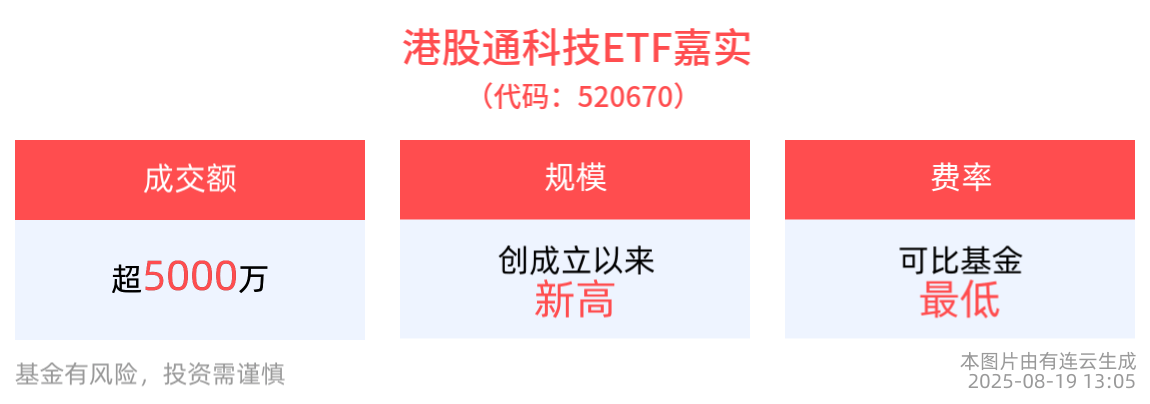
截至2025年8月19日 13:05,港股通科技ETF嘉实(520670)上涨0.99%,成分股东方甄选涨超11%,迈富时涨超8%,心动公司、中国软件国际等跟涨。 流动性方面,港股通科技ETF嘉实盘中换手23.04%,成交5796.79万元,市场交投活跃。 港股通科技ETF嘉实紧密跟踪恒生港股通科技主题指数,恒生港股通科技主题指数(「HSSCITI」)旨在反映能通过港股通买卖,业务与科技主题相关的香 港上市公司之表现。 消息面上,8月13日盘后,腾讯控股发布2025年中期及第二季度业绩报告,腾讯控股第二季度收入同比增长15%至1845亿元,超出市场预估的1789.4亿元; 净利润556.3亿元,同比增长17%。 国泰海通指出,展望下半年,港股牛途继续向上。尽管6月末以来港股表现偏弱,但美联储降息或临近,港币汇率持续承压现状或有望扭转,汇率对港股的 压制作用也将弱化。借鉴历史上港股占优行情,本轮港股强劲源于港股资产更具稀缺性,吸引增量资金不断流入。港股科技、消费类资产与当前AI应用、 新消费等产业趋势相关度更高,且基本面更优,相较A股而言仍具有稀缺性,有望吸引南向资金继续流入。AI应用加速落地中,充分受益AI周 ...
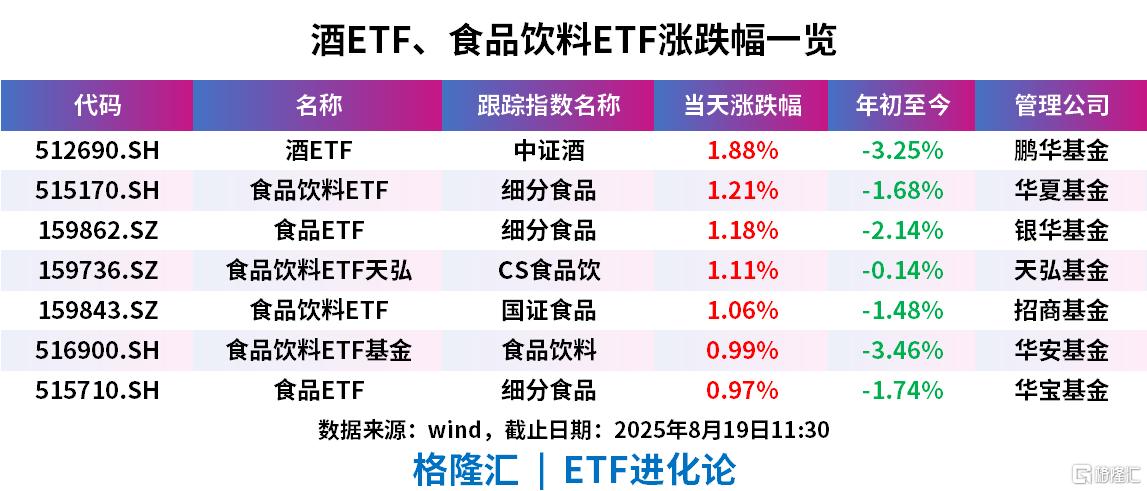
白酒股全线上涨,酒ETF、食品饮料ETF、食品ETF、食品饮料ETF天弘涨超1%
Ge Long Hui A P P· 2025-08-19 05:14
Market Overview - The three major A-share indices collectively rose, with the Shanghai Composite Index up 0.3% to 3739.26 points, the Shenzhen Component Index up 0.3%, and the ChiNext Index up 0.39% [1] - The North China 50 Index increased by 3.16%, reaching a new historical high during the session [1] - The total trading volume in the Shanghai and Shenzhen markets was 16,781 billion yuan, a decrease of 686 billion yuan from the previous day, with over 3,200 stocks rising [1] Sector Performance - The liquor sector saw a comprehensive increase, with stocks like JiuGuiJiu hitting the daily limit and SheDe JiuYe rising over 7% [1] - Various ETFs related to liquor and food and beverage sectors also experienced gains, with the liquor ETF tracking the CSI Liquor Index rising by 1.88% [3][4] Company Financials - Yanghe Brewery reported a 35.32% year-on-year decline in revenue for the first half of 2025, totaling 14.796 billion yuan, with a net profit drop of 45.34% to 4.344 billion yuan [4] - Kweichow Moutai's revenue for the first half of 2025 was 89.389 billion yuan, a 9% increase year-on-year, with a net profit of 45.403 billion yuan, also up 9% [4] Industry Trends - The liquor industry is currently undergoing a destocking cycle, facing multiple pressures from pricing, demand, and policy [5] - Despite challenges, Moutai's pricing has stabilized, and the company is expected to achieve its annual revenue targets through refined marketing strategies [5] Consumer Goods Insights - The consumer goods sector is entering a period of intensive mid-year report disclosures, with companies like Anqi Yeast and Weilong achieving revenue growth of 10% and 19% respectively in the first half of 2025 [5] - The industry is witnessing a shift towards new retail formats and consumer preferences for health and convenience, presenting growth opportunities in categories like snacks and low-alcohol beverages [6]


港股午评:恒指涨0.19%科指涨0.1%!AI概念股拉升,粉笔涨18%知乎涨17%,平安好医生涨超3%,布鲁可跌超8%
Sou Hu Cai Jing· 2025-08-19 04:52
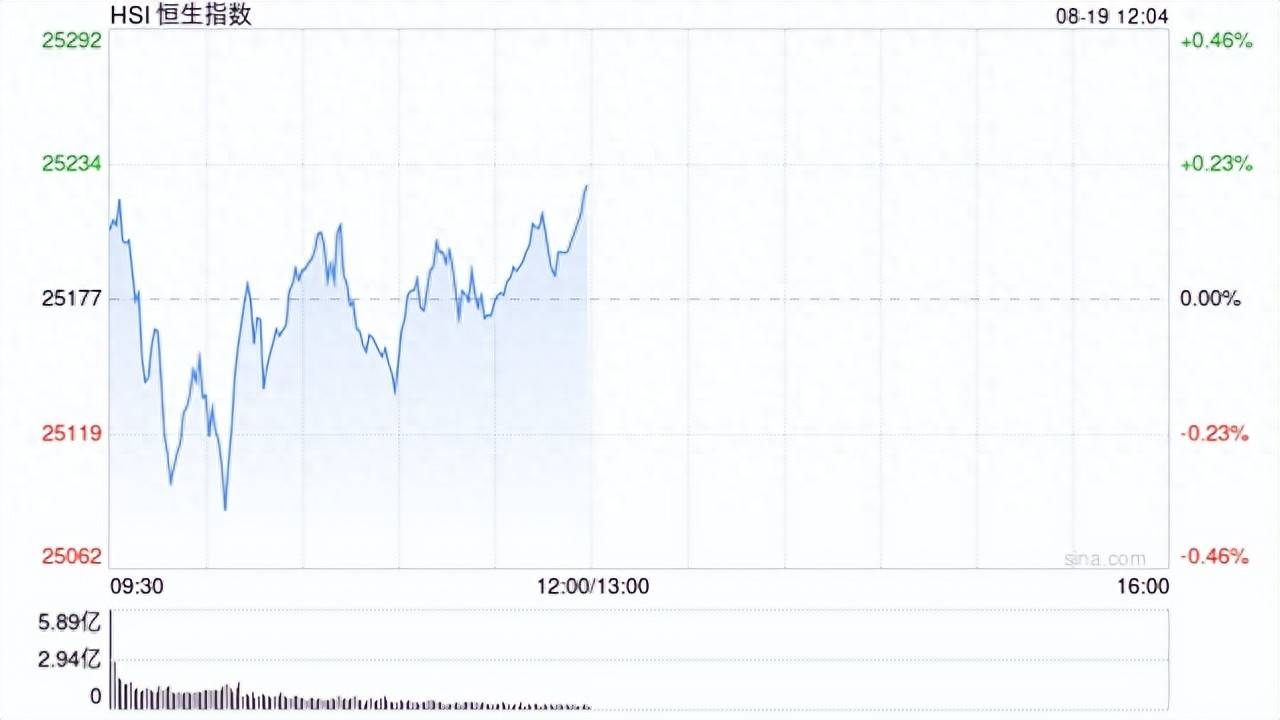
Market Overview - The Hong Kong stock market indices collectively rose, with the Hang Seng Index up by 0.19% to 25,224.97 points, the Hang Seng Tech Index up by 0.10%, and the National Enterprises Index up by 0.13% [2][3] Gaming and Gambling Sector - Casino and gambling stocks led the gains, with Wynn Macau rising over 3%. Multiple institutions have released reports optimistic about the gaming industry's outlook, with Morgan Stanley predicting a continuous increase in Macau's gaming revenue from 2025 to 2027 [3][4] Real Estate Sector - The real estate sector showed strength, with China Fortune Land Development rising over 5%. The Chinese government is taking strong measures to stabilize the real estate market, emphasizing urban renewal and the renovation of old housing [5][6] AI Sector - AI concept stocks saw significant increases, with Fenbi rising over 18% and Zhihu over 17%. Analysts believe the AI industry is entering a phase of substantial development, transitioning from speculation to real growth, driven by favorable policies, technology, and capital [6][7] Internet Healthcare Sector - Internet healthcare stocks experienced some gains, with Ping An Good Doctor rising over 3%. The sector is benefiting from multiple favorable developments, including policy support and technological innovation [7][8] New Consumption Sector - The new consumption sector experienced a pullback, with Blukoo falling over 8%. Analysts suggest that the structural benefits of new consumption will continue, but the market has adjusted its earnings expectations for high-growth stocks [8][9]


需求高景气叠加中报季窗口期,新消费个股业绩端将迎来释放,聚焦港股消费ETF(513230)布局窗口
Mei Ri Jing Ji Xin Wen· 2025-08-19 03:59
Group 1 - The core viewpoint of the articles highlights the positive performance of the Hong Kong stock market, particularly in the consumer sector, with major indices showing slight increases on August 19 [1][2] - Pop Mart is expected to announce its interim results for the period ending June 30, 2025, with projected revenue growth of no less than 200% and net profit growth of no less than 350% for the first half of the year [1] - The consumer ETF (513230) tracks the consumption theme index and includes leading companies in both new consumption and internet e-commerce sectors, indicating a strong representation of the consumer market [2] Group 2 - The sports and entertainment category saw a year-on-year growth of 13.7% in July, with a 4.2 percentage point increase compared to the previous month, reflecting a sustained high demand for emotional consumer goods [2] - The search volume for "summer vacation" increased by 47% year-on-year, indicating a rising demand for travel during the summer season [2] - New tea beverage brands benefited from investments from major platforms in July, maintaining rapid growth in GMV, suggesting a favorable outlook for the new consumption sector [2]
机构称恒生科技指数ETF(513180)标的指数有望迎来补涨,创业板指和恒科存在交替轮动关系
Mei Ri Jing Ji Xin Wen· 2025-08-19 02:32
南向资金年内净流入已超9400亿港元。AI、新消费两大赛道体现出新兴产业的发展趋势和一定的稀缺 性,有望进一步吸引资金加码,助推港股行情持续向好。公开信息显示,恒生科技指数ETF(513180) 标的指数囊括30家港股科技龙头,软硬科技兼备,成分股深度聚焦AI产业链的上中下游,其中阿里、 腾讯、美团、中芯国际、比亚迪等有望成为中国科技股"七巨头"。没有港股通账户的投资者或可通过恒 生科技指数ETF(513180)一键布局中国AI核心资产。(场外联接A/C:013402/013403)。 8月19日早盘,港股三大指数高开低走,恒生科技指数一度跌近1%。A股同赛道规模最大的恒生科技指 数ETF(513180)跟随指数下跌,持仓股跌多涨少,比亚迪电子、小鹏汽车、蔚来、金蝶国际、理想汽 车、中芯国际等跌幅居前。 国投证券林荣雄团队在研报《港股科技会跟上》中指出,从60日滚动收益率差值来看,历史上创业板指 和恒生科技两者存在明确交替轮动关系,当创业板指涨幅领先恒生科技20pct时,多数意味着恒生科技 相对收将迎来补涨(例外情况是2021年机构极致抱团行情,由于新能源导致产业基本面相差太大导致收 益率差值扩大至30pct ...
