
服务消费

Search documents
政策“组合拳”发力 激发服务消费增长潜能
Jin Rong Shi Bao· 2025-08-20 01:09
Core Viewpoint - The development of service consumption is essential for enhancing people's well-being and is a crucial strategy for boosting overall consumption in China. The service sector's contribution to economic growth is significant, with a steady increase in its share of the national economy. From 2020 to 2024, per capita service consumption expenditure in China is expected to grow at an annual rate of 9.6% [1][2]. Group 1: Growth Potential of Service Consumption - There is substantial growth potential in service consumption in China, as indicated by the shift in consumer behavior from goods to services, similar to trends observed in developed economies like the U.S. and Japan. In 2024, the share of per capita service consumption expenditure in China is projected to be 46% [2][3]. - The service sector's retail sales increased by 5.3% year-on-year in the first half of the year, outpacing the growth rate of goods retail sales. The value added by the service industry grew by 5.5%, contributing 60.2% to economic growth [2][3]. Group 2: Demand and Supply Dynamics - Service consumption encompasses various sectors, including dining, accommodation, childcare, and entertainment, with increasing demand in areas like elderly care and childcare. For instance, from January to July, retail sales in tourism, transportation, and leisure services showed double-digit growth [3][4]. - Despite strong demand, there are significant supply shortages in service consumption, particularly in areas like elderly care and childcare, where the enrollment rate for children under three is below 10%, compared to an OECD average of about 36% [4][5]. Group 3: Policy Measures to Stimulate Consumption - Recent policy initiatives, including the establishment of service consumption and elderly care re-loan tools by the People's Bank of China, aim to enhance consumer spending and stabilize domestic demand. A series of financial support measures have been introduced to promote consumption [5][6]. - The implementation of personal consumption loan interest subsidies and service industry loan interest subsidies is designed to lower the cost of consumer credit, thereby encouraging residents to utilize financial leverage to increase consumption [6][7]. Group 4: Financial Policy Directions - Future financial policies should focus on maintaining liquidity and reducing financing costs to create a favorable environment for consumption. This includes enhancing structural monetary policy tools and increasing financial support for key service consumption sectors [7]. - Expanding financing channels and reinforcing policy coordination among fiscal, employment, and social security policies are essential to improve residents' consumption capacity and willingness [7].
加快释放内需潜力
Jing Ji Ri Bao· 2025-08-19 22:04
Core Viewpoint - The Chinese government emphasizes the need to effectively unleash domestic demand potential to support economic growth, focusing on expanding consumption and investment while promoting a unified national market [1][6]. Domestic Demand and Consumption - In the first half of the year, domestic demand contributed 68.8% to GDP growth, with final consumption expenditure accounting for 52% [2]. - The government has implemented policies such as the trade-in program for consumer goods, with 690 billion yuan allocated to stimulate consumption, leading to significant retail sales growth in various categories [2]. - There is a shift in focus towards service consumption and improving living standards, with new policies aimed at personal consumption loans and childcare subsidies [2][3]. - Service consumption has been growing rapidly, with projections indicating that by 2024, it will account for 46.1% of per capita consumption expenditure, contributing 63% to the growth of consumer spending [3]. Investment Expansion - The National Development and Reform Commission reported that 800 billion yuan for "two heavy" construction projects has been fully allocated, with 735 billion yuan in central budget investments also nearly disbursed [4]. - Infrastructure investment has seen significant growth, particularly in water management and information transmission sectors, with manufacturing investment rising by 6.2% in the first seven months [4][5]. - There is a strong emphasis on optimizing investment structure to meet changing demands, particularly in education, healthcare, and quality housing [5]. Reform and Policy Measures - The government aims to enhance economic growth by addressing insufficient domestic demand through targeted policies that focus on effective resource allocation and quality investments [6][7]. - Future policies will focus on deepening reforms to stimulate consumption and expand effective investment, particularly in sectors like transportation, energy, and water resources [7].
25Q2货政报告:信贷重结构,资金防空转
2025-08-19 14:44
Summary of Key Points from the Conference Call Industry Overview - The conference call primarily discusses the monetary policy of the central bank, focusing on credit structure and financial stability within the broader economic context. Core Insights and Arguments - The central bank's monetary policy has shifted from "structural wide credit" to "structural stable credit," emphasizing the importance of stabilizing credit support rather than merely increasing credit volume [3][4] - The report highlights the need to optimize the credit structure, particularly focusing on technological innovation and expanding consumption, with a special emphasis on the growth potential of service consumption [4][6] - There is a renewed emphasis on preventing fund diversion and improving fund utilization efficiency, indicating a heightened concern for financial stability [6][8] - The central bank has reintroduced the concept of financial stability re-lending after five years, signaling a strong awareness of potential risks in the current economic environment [6][7] - The interest rate policy remains focused on enhancing execution supervision and conducting on-site evaluations of financial institutions to improve their pricing capabilities, rather than relying on interest rate cuts [9][10] Important but Overlooked Content - The central bank's stricter stance on exchange rates includes three firm commitments to correct pro-cyclical market behaviors, address market disruptions, and prevent excessive currency depreciation [10] - The report indicates a shift in focus from capital markets to the real economy, with less emphasis on structural tools for the capital market, reflecting a broader strategic adjustment [12][13] - The current monetary policy is expected to have minimal direct impact on the stock market due to ample liquidity, while the bond market may experience increased volatility due to the transition from structural wide credit to structural stable credit [14]
国务院会议:加快培育壮大服务消费、新型消费等新增长点
Zhong Guo Jing Ying Bao· 2025-08-19 14:07
Group 1 - The State Council's ninth plenary meeting emphasized the need to consolidate and expand the economic recovery, focusing on key areas such as consumption stimulation, effective investment, and real estate stability [1][2] - The meeting highlighted the importance of "continuously stimulating consumption potential," with plans to systematically remove restrictive measures in the consumption sector and promote new growth points in service and new consumption [1][2] - Effective investment expansion was addressed, with a call to increase investment in human resources and services for people's livelihoods, while actively promoting private investment [2][3] Group 2 - Real estate market stability remains a key focus, with measures proposed to consolidate the market's recovery and promote urban renewal projects [2][3] - The meeting's language regarding "strong measures" indicates a more proactive policy approach compared to previous meetings, suggesting an increased intensity of policy implementation [3] - The overall real estate market has shown signs of stabilization, with improvements in transaction volumes and a narrowing decline in new housing sales, indicating a positive trend towards market recovery [3]
瑞达期货沪镍产业日报-20250819
Rui Da Qi Huo· 2025-08-19 09:02
1. Report Industry Investment Rating - Not provided in the content 2. Core View of the Report - The Indonesian government's PNBP policy restricts issuance, increasing the cost of nickel resource supply, and the premium of domestic trade ore remains stable; the supply of nickel ore from the Philippines has recovered, but the domestic nickel ore port inventory has decreased, and the raw materials are in a tight situation [3]. - In July, the production rhythm of leading enterprises remained stable, the output of a few smelters increased, and new production capacity is still planned to be put into operation, driving a slight increase in the overall refined nickel output [3]. - On the demand side, the profits of stainless - steel plants have improved, and the plants have increased production; the production and sales of new - energy vehicles continue to rise, but the demand for ternary batteries is limited. Recently, the nickel price has declined, but the downstream procurement demand is still weak, the spot premium has slightly decreased, and the domestic inventory has increased; the overseas LME inventory has increased [3]. - Technically, the price has fallen with an increase in positions, indicating a divergence between long and short positions. It is expected that the price will fluctuate widely in a range. It is recommended to wait and see for the time being or conduct range - bound operations, with a reference range of 119,500 - 124,000 yuan/ton [3]. 3. Summary According to Relevant Catalogs 3.1 Futures Market - The closing price of the main futures contract of Shanghai nickel is 120,330 yuan/ton, a decrease of 10 yuan; the price difference between the September - October contracts of Shanghai nickel is - 120 yuan/ton, unchanged [3]. - The price of LME 3 - month nickel is 15,170 US dollars/ton, a decrease of 25 US dollars; the position of the main contract of Shanghai nickel is 55,967 lots, a decrease of 6,540 lots [3]. - The net long position of the top 20 futures holders of Shanghai nickel is - 30,724 lots, a decrease of 200 lots; the LME nickel inventory is 210,414 tons, a decrease of 1,248 tons [3]. - The inventory of nickel in the Shanghai Futures Exchange is 26,962 tons, an increase of 768 tons; the total cancelled warrants of LME nickel is 11,094 tons, a decrease of 1,248 tons [3]. - The warehouse receipt quantity of Shanghai nickel is 22,841 tons, a decrease of 210 tons [3]. 3.2现货市场 - The spot price of SMM 1 nickel is 121,650 yuan/ton, unchanged; the average spot price of 1 nickel plate in Yangtze River Non - ferrous Metals is 121,750 yuan/ton, an increase of 200 yuan [3]. - The CIF (bill of lading) price of Shanghai electrolytic nickel is 85 US dollars/ton, unchanged; the bonded warehouse (warehouse receipt) price of Shanghai electrolytic nickel is 85 US dollars/ton, unchanged [3]. - The average price of battery - grade nickel sulfate is 27,900 yuan/ton, unchanged; the basis of the main NI contract is 1,320 yuan/ton, an increase of 10 yuan [3]. - The LME nickel (spot/3 - month) premium is - 194.65 US dollars/ton, an increase of 13.23 US dollars [3]. 3.3 Upstream Situation - The monthly import volume of nickel ore is 434.66 million tons, an increase of 41.94 million tons; the total port inventory of nickel ore is 1,095.16 million tons, an increase of 61.82 million tons [3]. - The average monthly import unit price of nickel ore is 65.84 US dollars/ton, a decrease of 7.57 US dollars; the tax - included price of Indonesian laterite nickel ore with 1.8% Ni is 41.71 US dollars/wet ton, unchanged [3]. 3.4产业情况 - The monthly output of electrolytic nickel is 29,430 tons, an increase of 1,120 tons; the total monthly output of nickel iron is 22,200 metal tons, a decrease of 400 metal tons [3]. - The monthly import volume of refined nickel and alloys is 17,215.27 tons, a decrease of 472.3 tons; the monthly import volume of nickel iron is 1.0414 billion tons, an increase of 193,200 tons [3]. 3.5下游情况 - The monthly output of 300 - series stainless steel is 1.6981 billion tons, a decrease of 459,000 tons; the total weekly inventory of 300 - series stainless steel is 582,700 tons, a decrease of 10,200 tons [3].

(经济观察)中国消费扩大态势未变
Zhong Guo Xin Wen Wang· 2025-08-19 06:25
Group 1 - Consumption is the main driver of China's economic growth in the first half of the year, contributing over 50% to GDP growth [1] - In July, China's retail sales of consumer goods grew by 3.7% year-on-year, a decrease of 1.1 percentage points from the previous month, but the overall consumption trend remains stable [1] - The service retail sector showed resilience, with a 5.2% year-on-year growth from January to July, consistent with the previous six months [1] Group 2 - Policies to stimulate consumption are being implemented, including a significant increase in the "old-for-new" consumption policy, which has led to substantial growth in retail sales of home appliances and other categories [2] - The National Development and Reform Commission has allocated 69 billion yuan in special bonds to support the "old-for-new" consumption initiative, with plans for additional funding in October [2] - The performance of the service retail sector has opened up greater opportunities for consumption growth, with significant increases in tourism and entertainment-related spending during the summer [2] Group 3 - The demand for digital and online entertainment services is growing, with retail sales in the telecommunications and information services sector increasing by over 10% year-on-year [3] - Deutsche Bank's chief economist in China noted that the government is intensifying support for service consumption, particularly in cultural tourism, healthcare, and domestic services, which are expected to drive economic growth [3] - With the implementation of new policies to support personal consumption loans and the upcoming holiday season, there is optimism for a rebound in consumption growth in the latter half of the year [3]
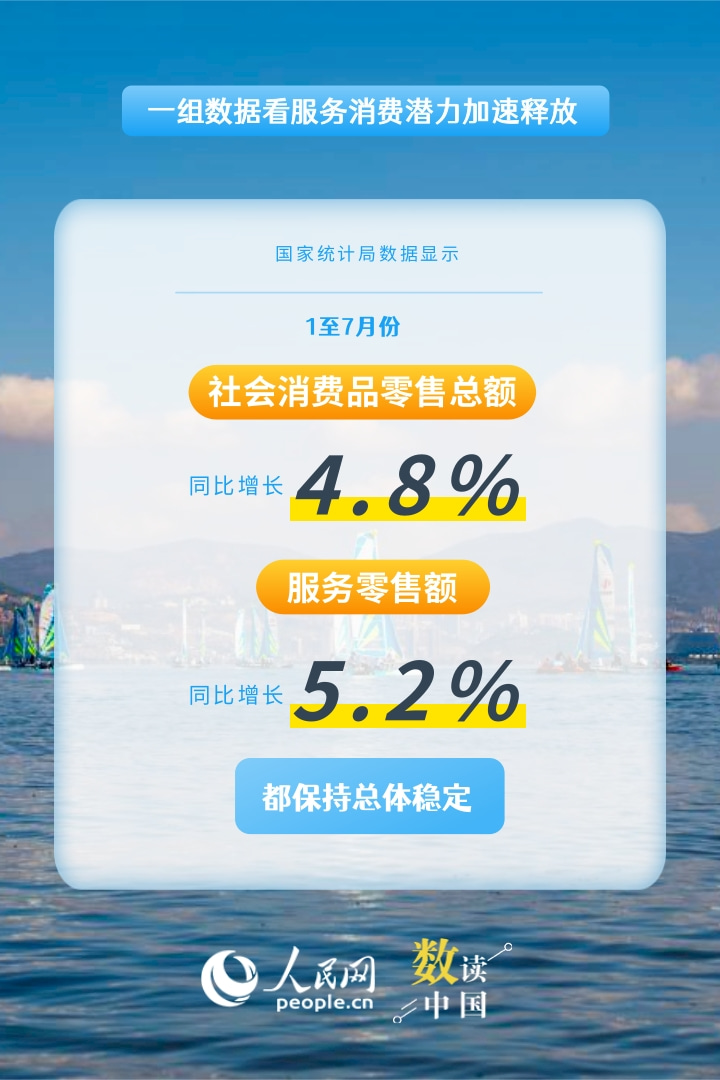
数读中国 一组数据看服务消费潜力加速释放
Ren Min Wang· 2025-08-19 05:47
Core Viewpoint - The expansion of service consumption is crucial for both the economy and people's livelihoods, with significant potential for growth as household spending on services surpasses that on goods [1] Group 1: Service Consumption Growth - In the first seven months of the year, retail sales in tourism consulting, transportation services, and cultural and recreational services maintained double-digit growth [3][4] - Retail sales in communication and information services grew by over 10%, with an acceleration of 0.2 percentage points compared to the first half of the year [5] - From 2020 to 2024, China's service consumption has shown rapid growth, with per capita service consumption expenditure increasing by 9.46% annually [6] Group 2: Contribution to Overall Consumption - By 2024, per capita service consumption expenditure is expected to account for 46.1% of total per capita consumption expenditure [8] - The contribution rate of service consumption to the growth of household consumption expenditure is significant [9] Group 3: Employment Impact - In 2024, the service industry is projected to play a unique role in job creation, with service sector employment accounting for 3,896 million of the total workforce [11] - Employment in sectors such as resident services, catering, accommodation, and cultural entertainment has shown notable growth compared to the previous year [11] Group 4: Financial Support for Service Consumption - The People's Bank of China has established a 500 billion yuan loan for service consumption and elderly care, encouraging financial institutions to increase credit supply in the consumption sector [13] - The balance of household consumption loans, excluding personal housing loans, reached 2.2 trillion yuan [14] - The loan balance for key service consumption sectors, including accommodation, catering, cultural entertainment, education, and resident services, stands at 8 trillion yuan [15]

提振消费政策持续显效
Ren Min Ri Bao Hai Wai Ban· 2025-08-19 05:35
Core Insights - The overall retail sales of consumer goods in China reached 28.4238 trillion yuan from January to July, with a growth rate of 4.8% [1] - In July alone, retail sales totaled 387.8 billion yuan, showing a year-on-year increase of 3.7% [1] - The consumption market remains stable, with positive trends in basic and upgraded goods sales, and a notable increase in online consumption [1][6] Retail Sales Performance - Retail sales growth in July decreased by 1.1 percentage points compared to June but remained above the average growth rate of the same period over the past three years by 1.1 percentage points [2] - Urban retail sales reached 33.62 billion yuan in July, growing by 3.6%, while rural retail sales were 5.16 billion yuan, with a growth of 3.9% [2] - The county and rural markets accounted for 38.8% of total retail sales, driven by improved logistics and consumption potential [2] Service Consumption Growth - Service retail sales increased by 5.2% from January to July, outpacing the growth of goods retail sales by 0.3 percentage points [2] - The cultural and tourism sectors saw significant growth, with double-digit increases in retail sales for leisure services, tourism consulting, and transportation services [3] Upgrading Consumption Policies - In July, retail sales of basic and upgraded goods showed positive trends, with overall retail sales increasing by 4.0% [4] - Over 70% of retail categories in large-scale units experienced growth, with notable increases in sports and entertainment goods (13.7%), jewelry (8.2%), and daily necessities (8.2%) [4] - The "trade-in for new" policy has led to substantial growth in home appliances and audio-visual equipment sales, which rose by 28.7% year-on-year [4][5] Online Consumption Trends - Online retail sales reached 868.35 billion yuan from January to July, marking a 9.2% increase, with physical goods online sales growing by 6.3% [6] - Online retail accounted for 24.9% of total retail sales, with significant growth in instant retail and live-streaming e-commerce [6] Innovations in Physical Retail - Physical retail enterprises are innovating their business models and enhancing shopping experiences, with retail sales in large-scale units growing by 4.2% from January to July [7] - Membership warehouse stores saw growth rates exceeding 30%, while shopping centers grew by 6.4% [7] - The consumption market is expected to maintain stable growth, supported by ongoing policy reforms and improvements in consumption mechanisms [7]
锐财经丨提振消费政策持续显效
Ren Min Ri Bao Hai Wai Ban· 2025-08-19 02:13
Group 1: Overall Consumption Trends - In the first seven months, the total retail sales of consumer goods reached 28,423.8 billion yuan, growing by 4.8% year-on-year; in July alone, the retail sales totaled 3,878 billion yuan, with a year-on-year growth of 3.7% [1] - The consumption market shows a stable development trend, with basic living and upgraded goods sales improving, and the "old-for-new" policy contributing to the growth of certain products [4][5] Group 2: Service Consumption Growth - The service retail sales increased by 5.2% year-on-year in the first seven months, outpacing the growth of goods retail sales by 0.3 percentage points [2] - The rural market's sales growth outpaced urban areas, with rural retail sales reaching 516 billion yuan, growing by 3.9% [2] Group 3: Specific Product Categories - In July, retail sales of basic living and upgraded goods showed positive trends, with over 70% of product categories in large retail units experiencing growth; categories like sports and entertainment goods grew by 13.7%, jewelry by 8.2%, and daily necessities by 8.2% [4] - The "old-for-new" policy has led to significant growth in home appliances and audio-visual equipment retail sales, which increased by 28.7% year-on-year [4][5] Group 4: Online Consumption Dynamics - Online retail sales reached 86,835 billion yuan in the first seven months, with a year-on-year growth of 9.2%; physical goods online retail sales grew by 6.3%, accounting for 24.9% of total retail sales [6] - New consumption models such as live-streaming e-commerce are maturing, contributing to the growth of the silver economy and first-release economy [7] Group 5: Future Outlook - The overall consumption market is expected to maintain stability, with ongoing implementation of macro policies aimed at boosting consumption and improving the consumption environment [7]
1—7月份,社会消费品零售总额超28.4万亿元,增长4.8%——提振消费政策持续显效
Ren Min Ri Bao Hai Wai Ban· 2025-08-19 01:52
Group 1: Overall Consumption Trends - In the first seven months, the total retail sales of consumer goods reached 28,423.8 billion yuan, growing by 4.8% year-on-year; in July alone, the retail sales totaled 3,878 billion yuan, with a year-on-year growth of 3.7% [1] - The consumption market maintained a stable development trend, with basic living and upgraded goods showing positive sales momentum, and new consumption vitality enhancing, particularly in online consumption [1][2] Group 2: Service Consumption Growth - The service consumption market experienced rapid growth, with service retail sales increasing by 5.2% year-on-year in the first seven months, outpacing the growth rate of goods retail sales by 0.3 percentage points [2] - Urban consumption retail sales in July reached 33,620 billion yuan, growing by 3.6%, while rural consumption retail sales were 5,160 billion yuan, with a growth of 3.9% [2] Group 3: Upgrading Consumption and Policy Impact - The "old-for-new" policy continued to show effectiveness, with retail sales of household appliances and audio-visual equipment increasing by 28.7% year-on-year in July, and furniture sales growing by 20.6% [4][5] - Over 70% of retail categories in large-scale units saw sales growth, with significant increases in sports and entertainment goods (13.7%), gold and jewelry (8.2%), and daily necessities (8.2%) [4] Group 4: Online and Physical Retail Dynamics - Online retail sales reached 86,835 billion yuan in the first seven months, growing by 9.2% year-on-year, with physical goods online retail sales at 70,790 billion yuan, a growth of 6.3% [6] - The retail sales of physical stores in large-scale units increased by 4.2% year-on-year, with warehouse membership stores seeing growth rates exceeding 30% [7]