
产业结构升级

Search documents
国家统计局:2025年9月份核心CPI同比涨幅持续扩大 PPI同比降幅继续收窄
Yang Shi Wang· 2025-10-15 01:43
9月份,消费市场运行总体平稳,居民消费价格指数(CPI)环比上涨0.1%,同比下降0.3%,扣除 食品和能源价格的核心CPI同比上涨1.0%,涨幅连续第5个月扩大。全国统一大市场建设纵深推进,市 场竞争秩序持续优化,工业生产者出厂价格指数(PPI)环比继续持平;同比下降2.3%,降幅比上月收 窄0.6个百分点。 央视网消息:国家统计局城市司首席统计师董莉娟解读2025年9月份CPI和PPI数据。 CPI同比下降0.3%,降幅比上月收窄0.1个百分点。CPI同比下降,主要是翘尾影响所致。本月CPI-0.3% 的同比变动中,翘尾影响约为-0.8个百分点,今年价格变动的新影响约为0.5个百分点。分类别看,食品 和能源价格下降。其中,食品价格下降4.4%,降幅比上月扩大0.1个百分点,影响CPI同比下降约0.83个 百分点,是影响CPI同比下降的主要因素。食品中,猪肉、鲜菜、鸡蛋和鲜果价格分别下降17.0%、 13.7%、13.5%和4.2%,合计影响CPI同比下降约0.78个百分点;牛肉和羊肉价格分别上涨4.6%和0.8%, 其中羊肉价格为连续下降44个月后首次转涨。能源价格下降2.7%,影响CPI同比下降约0.2 ...
国家统计局解读2025年9月份CPI和PPI数据
Guo Jia Tong Ji Ju· 2025-10-15 01:42
Group 1: CPI Analysis - The Consumer Price Index (CPI) increased by 0.1% month-on-month in September, reversing from a flat performance in the previous month [2] - Year-on-year, the CPI decreased by 0.3%, with the decline narrowing by 0.1 percentage points compared to the previous month [3] - Core CPI, excluding food and energy, rose by 1.0% year-on-year, marking the fifth consecutive month of growth [3] Group 2: Food and Energy Prices - Food prices increased by 0.7% month-on-month, contributing approximately 0.13 percentage points to the CPI increase, with seasonal price rises observed in fresh vegetables, eggs, fresh fruits, lamb, and beef [2] - Year-on-year, food prices fell by 4.4%, primarily driven by significant declines in pork, fresh vegetables, eggs, and fresh fruits [3] - Energy prices decreased by 2.7% year-on-year, impacting the CPI by approximately 0.20 percentage points [3] Group 3: PPI Analysis - The Producer Price Index (PPI) remained flat month-on-month for two consecutive months, with a year-on-year decline of 2.3%, narrowing by 0.6 percentage points from the previous month [4][6] - Improvements in supply-demand structures have stabilized prices in certain industries, such as coal processing and black metal smelting, which saw price increases [4] - The decline in PPI is influenced by external factors, including falling international oil prices, which affected domestic oil-related industry prices [5] Group 4: Industry-Specific Insights - The construction of a unified national market has led to a reduction in the year-on-year price decline across various industries, with notable improvements in coal processing, black metal smelting, and photovoltaic equipment manufacturing [6] - Upgrading industrial structures and releasing consumer potential have contributed to price increases in specific sectors, such as aircraft manufacturing and electronic materials [6] - The demand for quality and upgraded consumption has led to significant price increases in artisanal and ceremonial goods, as well as sports equipment [6]
港股打新千倍认购背后有三重逻辑
Zheng Quan Ri Bao· 2025-10-12 15:56
Core Insights - The Hong Kong IPO market has seen significant activity in 2023, with 69 new listings and an average first-day return of approximately 38%, indicating a robust market environment [1][3] - The total amount raised through IPOs in Hong Kong reached HKD 187.24 billion, a year-on-year increase of 227.72%, reflecting a diverse industry structure and strong investor interest [3][4] Group 1: Market Performance - Over 70% of new stocks listed this year experienced a first-day price increase, with a notable 23% of new stocks facing a price drop on their debut [1] - The average return for new stocks has significantly improved compared to the same period last year, with cumulative earnings for full participation in IPOs reaching HKD 123,700 [1] Group 2: Investor Participation - Nearly 7.45 million individuals participated in IPOs this year, with an average of 108,000 applicants per new stock, indicating high demand for quality listings [3] - The popular stock "Zijin Gold International" attracted 350,000 applicants, resulting in a low winning rate of 0.42% [3] Group 3: Structural Changes - Recent regulatory reforms, including a requirement for investors to prepay at least 10% of the subscription amount, have contributed to a more stable IPO environment [4] - The Hong Kong Stock Exchange has optimized the IPO pricing process, allowing for more flexible subscription mechanisms, which enhances pricing efficiency [4] Group 4: Global Capital Trends - The surge in IPO activity reflects a broader trend of global capital increasing its allocation to Chinese assets, with Hong Kong serving as a key link between mainland China and international markets [5] - The ongoing reforms in the Hong Kong IPO system, including lowering market capitalization thresholds for tech companies, have created a favorable environment for long-term investments [5]
未来十年超半数人口或将集中在这几个城市群,房价走势令人担忧
Sou Hu Cai Jing· 2025-09-12 15:42
Core Insights - By 2025, China's urbanization rate is projected to reach 65.7%, a significant increase of 5.3 percentage points since 2020, reflecting a massive population shift towards major cities [1] - The Chinese government aims to cultivate five world-class city clusters, which contribute 56.8% of the national GDP and attract 43.5% of the population, despite occupying only 10.2% of the country's land area [1] Group 1: Population Movement Trends - In 2024, over 12 million people migrated to the five major city clusters, with the Guangdong-Hong Kong-Macau Greater Bay Area leading with a net inflow of 3.8 million [2] - The Greater Bay Area's resident population reached 86 million by mid-2025, increasing by 11 million over five years, with 42.3% of new residents being highly educated [4] - The Yangtze River Delta city cluster is characterized by a "1 5 9" urban structure, with Shanghai at its core, indicating a deepening integration and collaboration among cities [6] Group 2: Economic and Industrial Dynamics - The Chengdu-Chongqing city cluster is experiencing rapid growth, with both cities' GDP growth rates exceeding 7% in the first half of 2025, benefiting from improved transportation links [6] - The Central Yangtze River city cluster, centered around Wuhan, has seen a 30% reduction in cross-province commuting times, with high-tech industries contributing 25.7% to its GDP [6][9] Group 3: Real Estate Market Observations - Despite a nationwide downturn in the real estate market, core cities within the five city clusters have shown resilience, with new residential prices rising over 3% in the first half of 2025, and Shenzhen experiencing a 5.7% increase [9] - The disparity in housing prices is widening, with core cities' price increases being 2.3 times that of surrounding areas, indicating a strong correlation between population influx and real estate demand [9] Group 4: Policy Responses and Future Outlook - The government is implementing measures to manage real estate markets, including increasing land supply in major cities and promoting balanced urban development [11] - Experts suggest enhancing transportation integration within urban clusters and accelerating the development of affordable housing to address population concentration challenges [11] - The ongoing population migration is seen as both an opportunity for economic growth and a challenge for equitable resource distribution, necessitating strategic planning [11]


顺鑫农业上半年实现营业收入45.93亿元
Zheng Quan Ri Bao Zhi Sheng· 2025-08-28 12:36
Core Insights - Shunxin Agriculture reported a revenue of 4.593 billion yuan and a net profit of 173 million yuan for the first half of 2025 [1] - The company focused on product innovation, marketing model transformation, and cultural tourism integration, with the liquor segment generating 3.606 billion yuan in revenue, a year-on-year decrease of 23.25% [1] - The pork segment achieved a revenue of 889 million yuan, with slaughtering business sales at 782 million yuan and breeding sales at 107 million yuan [1] - Shunxin Agriculture is implementing a development strategy focused on brand building, enhancing the front end of the industry chain with "breeding sales," and improving the back end with "deep processing and cooked food" [1] Financial Performance - Total revenue for the first half of 2025 was 4.593 billion yuan [1] - Net profit attributable to shareholders was 173 million yuan [1] - Revenue from the liquor segment was 3.606 billion yuan, reflecting a 23.25% decline year-on-year [1] Segment Analysis - The liquor industry segment's revenue decreased significantly, indicating potential challenges in this area [1] - The pork industry segment showed a total revenue of 889 million yuan, with the slaughtering business being the primary contributor [1] - The company is focusing on upgrading its industry structure and enhancing asset value through strategic initiatives [1]

超百亿资金,大笔买入
Zheng Quan Shi Bao· 2025-08-27 07:53
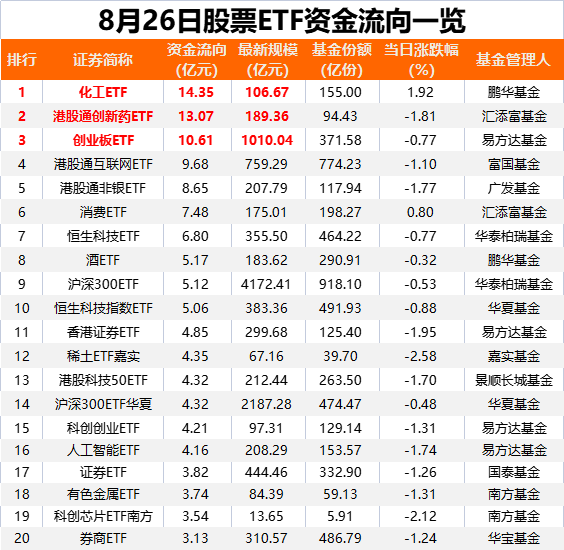
Core Insights - The A-share market experienced a divergence in performance on August 26, ending a streak of gains, with stock ETFs seeing a net inflow of approximately 13.5 billion yuan [1][2]. ETF Market Overview - As of August 26, the total scale of stock ETFs reached 4.21 trillion yuan, with a single-day net inflow of about 13.5 billion yuan. The trading volume decreased by nearly 30% compared to the previous day, totaling 221.4 billion yuan [2]. - Industry-themed ETFs and Hong Kong market ETFs led the net inflows, with 9.68 billion yuan and 6.8 billion yuan respectively, while broad-based ETFs experienced significant outflows [2][6]. Sector Performance - Over the past five days, the securities company index saw inflows exceeding 8.4 billion yuan, while the chemical sector index attracted over 5.4 billion yuan [3]. - The AI sector showed strong performance, with the AI ETF in the Sci-Tech sector rising by 25.63% since August, leading among nine ETFs tracking the same index [3]. Fund Flows - Top-performing ETFs included the Chemical ETF with a net inflow of 1.4 billion yuan, followed by the Hong Kong Innovation Drug ETF and the ChiNext ETF, both exceeding 1 billion yuan in net inflows [4]. - Conversely, the CSI 500 ETF experienced the largest outflow, with 1.8 billion yuan, followed by the ChiNext 50 ETF and the NOJ ETF, each with outflows exceeding 500 million yuan [6][8]. Fund Company Performance - Leading fund companies like E Fund and Huaxia Fund reported significant net inflows in their ETFs, with E Fund's total ETF scale reaching 759.51 billion yuan, an increase of 158.86 billion yuan this year [5]. - Huaxia Fund's ETFs, particularly the Hang Seng Technology Index ETF and the CSI 300 ETF, also saw substantial net inflows, indicating strong investor interest [5]. Market Outlook - Analysts suggest that the current market may have entered a stabilization phase in the credit cycle, with expectations of improved investment sentiment driven by structural upgrades and high-quality development [7][9].
珠海,45年的进化
2 1 Shi Ji Jing Ji Bao Dao· 2025-08-26 06:39
Core Viewpoint - Zhuhai, a coastal city in southern China, has transformed from a small fishing village into a modern city with a robust economy and advanced industrial structure over the past 45 years, showcasing significant economic growth and innovation [1][2][4]. Economic Growth - In 1978, Zhuhai's GDP was only 261 million yuan, which has surged to 447.9 billion yuan in 2024, representing an increase of over 1,700 times [3][4]. - The average annual growth rate exceeds 15%, making Zhuhai's economic leap one of the rare cases globally [5]. Industrial Structure - Over 45 years, Zhuhai's industrial structure has fundamentally changed, evolving into a modern city with a leading industrial framework, focusing on seven major industries, including electronic information [6][7]. - In 2024, the seven pillar industries contributed an industrial added value of 134.809 billion yuan, accounting for 81.8% of the city's industrial added value [9]. Technological Innovation - Zhuhai ranked 12th among 288 cities in China for its technological innovation development index in 2024, and second among prefecture-level cities [12]. - The city has implemented numerous reform and innovation projects, with 78 projects in 2024 and 112 planned for 2025, enhancing its R&D investment to 4.06% of GDP [12]. Talent Attraction - Zhuhai is recognized as a talent-friendly city, with a net inflow of talent ranking among the top three in the province, attracting approximately 70,000 new talents in 2024 [13]. - The city has established a comprehensive housing guarantee system for young talents, planning to reserve at least 36,000 specialized housing units within three years [14].
激发县域经济高质量发展动力
Xin Hua Wang· 2025-08-12 06:26
Core Viewpoint - The development and upgrading of county towns are crucial for promoting high-quality economic growth and new urbanization in China, serving as a key support for urban-rural integration and county economic development [1][2][3] Group 1: Importance of County Towns - County towns are essential components of China's urban system, acting as hubs connecting cities and serving rural areas [1] - By the end of 2021, approximately 160 million people resided in county towns, accounting for nearly 30% of the national urban population [2] - The development of county towns has become a bottleneck for high-quality economic growth, as industrialization and urbanization have not sufficiently progressed [2][3] Group 2: Challenges in County Economic Development - Key issues include lagging municipal infrastructure, insufficient industrial characteristics, low efficiency of industrial platforms, inadequate public services, and a need for improved government governance [4] - Many county towns lack strong characteristic industries, making it difficult to leverage local resources for economic development [4] Group 3: Strategies for Improvement - The recent issuance of guidelines emphasizes the need for counties to enhance infrastructure, focusing on upgrading municipal facilities and improving the capacity to absorb agricultural migrants [5] - Identifying and developing local characteristic industries is crucial for invigorating county economies, with a focus on creating entrepreneurial platforms [6] - Attracting talent is essential, with strategies to create favorable conditions for returning talent and improving living environments [6] - Enhancing public services, including education and healthcare, is vital for improving the quality of life in county towns [7] - Optimizing the business environment is a key strategy for promoting high-quality economic development in counties [7]
154家A股公司“中考”交卷 超七成实现净利润增长
Zheng Quan Ri Bao· 2025-08-08 16:43
Core Viewpoint - The current technology industry is experiencing a high prosperity cycle, with explosive growth in specific sectors, creating a favorable development environment for related companies [1] Group 1: Company Performance - As of August 8, 154 A-share companies have released mid-term performance reports, with 72 companies reporting net profits exceeding 100 million yuan, and 109 companies showing year-on-year net profit growth, accounting for over 70% [1] - WuXi AppTec's mid-term report shows a total profit increase of 96.20% and a net profit increase of 101.92% year-on-year, driven by a focus on the CRDMO business model and improved operational efficiency [2] - Dongguan Dingtong Precision Technology's mid-term report indicates a net profit of 115.397 million yuan, a year-on-year increase of 134.06%, attributed to its comprehensive service capabilities in precision mold design and manufacturing [2] Group 2: Industry Trends - The impressive performance of some hard technology companies reflects the upgrading of China's industrial structure, supported by continuous policy backing for emerging industries [3] - Chinese hard technology companies are accelerating their global layout and supply chain integration, enhancing their competitiveness and influence in the international market [3] Group 3: R&D and Investor Returns - A notable commonality among the companies is the emphasis on R&D and shareholder returns, with Dingtong Technology increasing R&D investment by 36.47% year-on-year [4] - WuXi AppTec plans to distribute a cash dividend of 3.5 yuan per 10 shares, while Dingtong Technology plans to distribute 2.00 yuan per 10 shares, indicating a commitment to shareholder returns [5] - Implementing dividends is seen as a sign of a robust financial structure and sustainable profitability, enhancing company valuation and investor confidence [5]
理解城市|河北唐山:49年的重建与思念
Xin Lang Cai Jing· 2025-07-28 09:36
Group 1 - The article highlights the emotional significance of the Tangshan Earthquake memorial, where citizens gather to pay tribute to the victims, reflecting on the weight of lost lives and the long process of healing [1][2][3] - The Tangshan Earthquake, which occurred 49 years ago, had a magnitude of 7.8 and resulted in over 240,000 fatalities, leaving a profound impact on the city's collective memory [3][11] - The establishment of the Tangshan Earthquake Memorial Park in 2008 serves as a public space for residents to seek solace and commemorate their losses, symbolizing the enduring pain and resilience of the Tangshan people [4][6] Group 2 - The rebuilding of Tangshan after the earthquake was a monumental task, with 96% of housing destroyed, leading to a decision for reconstruction on the same site, emphasizing self-reliance and hard work [13][14] - The reconstruction efforts involved over 100,000 construction workers and 200 cranes, showcasing a massive mobilization of resources and manpower to restore the city [15][16] - By 1986, Tangshan had constructed 20.9 million square meters of various buildings, including 12.18 million square meters of residential housing, marking significant progress in urban recovery [28] Group 3 - The economic revival of Tangshan was driven by key industries such as steel, chemicals, coal, and construction materials, with the city achieving the highest GDP in the province for an extended period [38] - Tangshan's port, particularly the Caofeidian area, has become a crucial hub for industrial development, facilitating the growth of a modern port city with extensive shipping routes [42][44] - The city has been actively optimizing its industrial structure, focusing on high-end manufacturing and modern logistics, which has led to the establishment of over 100 robot-related enterprises in the high-tech zone [46][52] Group 4 - Recent tourism statistics indicate a significant increase in visitors to Tangshan, with 480.27 million tourists during the Spring Festival, reflecting the city's growing appeal as a travel destination [53] - The integration of cultural and tourism activities has transformed Tangshan's image, allowing it to carve out a unique niche in the tourism sector within the Beijing-Tianjin-Hebei region [56][55] - The new generation is increasingly recognizing the achievements of Tangshan over the past 49 years, blending the city's painful history with its current successes [56][57]
