套息交易

Search documents
央行“轮流砸盘”,美联储砸完日央行砸!日本12月会加息吗?
Sou Hu Cai Jing· 2025-12-02 00:33
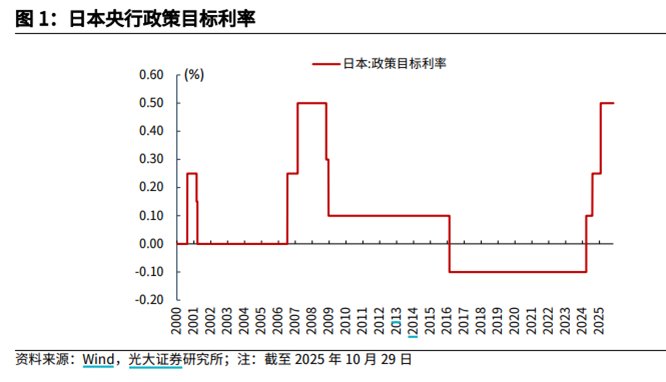
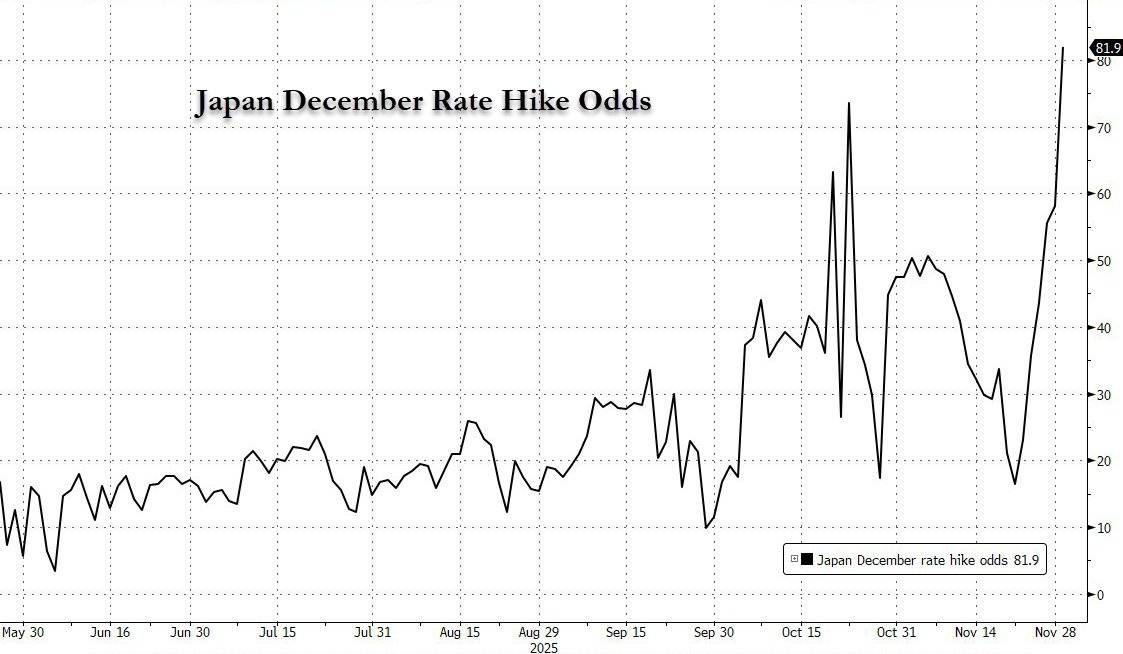
Core Viewpoint - The Japanese central bank's recent communication has significantly increased market expectations for a potential interest rate hike in December, following comments from Governor Kazuo Ueda that suggest a decision will be made during the upcoming monetary policy meeting [1][4]. Group 1: Market Reactions - Market pricing for a December rate hike surged from 20% to 80% following Ueda's remarks, indicating a strong shift in investor sentiment [1]. - The yield on Japanese government bonds has risen to recent highs, and the USD/JPY exchange rate has declined due to narrowing interest rate differentials [2]. - Bitcoin prices experienced a sharp decline, reflecting concerns over potential market volatility similar to that seen in December 2022 [2][9]. Group 2: Diverging Views on Rate Hike - Morgan Stanley has shifted its stance to view a December rate hike as the baseline scenario, citing Ueda's unusual direct mention of the upcoming meeting [3][6]. - Goldman Sachs remains cautious, suggesting that the Bank of Japan may wait for more corporate wage data before making a decision, with a January hike being more likely [3][7]. Group 3: Ueda's Statements - Ueda's comments during a meeting with business leaders highlighted the importance of gathering information on corporate wage positions ahead of the December meeting [4]. - He expressed optimism about wage growth, noting that major labor unions are targeting salary increases of 5% or more, and that corporate surveys indicate many companies plan to maintain or exceed this year's wage increases [5]. Group 4: Risks of Rate Hike - The potential for a surprise rate hike in December raises concerns about market stability, particularly given the historical context of the December 2022 market turmoil [8][9]. - The current market environment shows a disconnect between central bank communication and market expectations, heightening vulnerability to sudden policy changes [8].

深夜,新一轮暴跌开始了
凤凰网财经· 2025-12-01 23:52
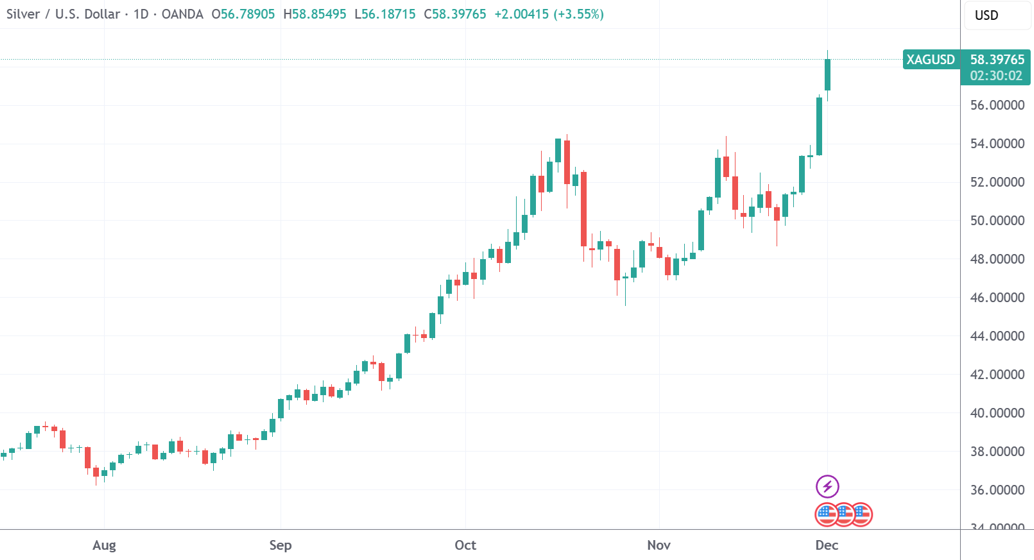
Market Overview - The three major U.S. stock indices closed down on December 1, ending a five-day winning streak, with the Dow Jones Industrial Average down 0.9%, the S&P 500 down 0.53%, and the Nasdaq Composite down 0.38% [1] Technology Stocks Performance - Popular tech stocks showed mixed results, with Broadcom down over 4%, Google, Microsoft, Intel, and TSMC down over 1%, while Nvidia, Apple, AMD, and Micron Technology rose over 1%, and Synopsys surged nearly 5% [2] Chinese Stocks - The Nasdaq Golden Dragon China Index rose by 0.87%, with notable gains from NetEase (up 5%), Alibaba (up over 4%), and New Oriental (up over 3%), while Xpeng Motors, Li Auto, iQIYI, and NIO saw declines of over 2% [2] Cryptocurrency Market - The cryptocurrency market faced a significant sell-off, with Bitcoin dropping over 5% and falling below $84,000, while Ethereum, XRP, and HYPE plummeted over 7%. Over 260,000 traders were liquidated, totaling nearly $1 billion in losses [2][5] Silver Market Dynamics - Silver prices reached a historical high of $58.8 per ounce, with a year-to-date increase exceeding 100%, significantly outpacing gold's 60% rise. The surge in silver prices is attributed to supply tightness, speculative short squeezes, and increased demand for value storage amid macroeconomic uncertainties [6][9] Factors Behind Cryptocurrency Decline - The recent cryptocurrency decline is driven by a combination of macroeconomic tightening, structural market weaknesses, and negative sentiment. The Federal Reserve's delayed rate cuts and a $200 billion liquidity withdrawal due to government shutdowns have exacerbated funding costs [3][4] Future Outlook for Bitcoin Market - Hotcoin Research suggests that by 2026, the Bitcoin market will be more mature and rational, with institutional funds playing a larger role, leading to price movements driven more by fundamentals and data rather than short-term sentiment [4]

深夜,白银迭创新高,黄金也突破近6周高点
Feng Huang Wang· 2025-12-01 22:37
Core Viewpoint - The recent surge in spot silver prices, reaching a historical high of $58.8 per ounce, has been driven by multiple factors including supply tightness, speculative short squeezes, and macroeconomic conditions prompting demand for value storage [1][2][6]. Group 1: Price Movements - Spot silver has achieved a historical high of $58.8 per ounce, with a year-to-date increase exceeding 100%, significantly outpacing gold's 60% rise [2]. - Spot gold also reached a six-week high of $4245 per ounce, following its historical peak in mid-October [4]. Group 2: Market Dynamics - The recent price increase in silver is attributed to supply constraints, speculative trading, and macroeconomic factors that have heightened the demand for precious metals as a store of value [6]. - Silver's inventory at the Shanghai Futures Exchange has dropped to its lowest level in nearly a decade, exacerbating supply issues [6]. - The silver-to-gold ratio has approached 70, indicating a significant shift in market dynamics, with the ratio hitting its lowest point since August 2021 [7]. Group 3: Speculative Activity - The cost differential between bullish and bearish silver options has surged to its highest level since 2022, indicating increased speculative interest in rising silver prices [9]. - Expectations of a potential interest rate cut by the Federal Reserve have further fueled speculative trading in precious metals, with an 85% probability of a rate cut indicated by market tools [9]. Group 4: Global Economic Influences - Concerns over macroeconomic risks from Japan, including potential interest rate hikes by the Bank of Japan, have contributed to market volatility and influenced precious metal prices [11]. - The anticipated nomination of Kevin Hassett as the next Federal Reserve Chair, who is viewed as a "dove," has also impacted market sentiment regarding interest rates and precious metals [9][11].
日元贬值风暴或引发12月突然加息
Guo Ji Jin Rong Bao· 2025-11-26 09:12
Group 1: Currency Depreciation and Economic Impact - The Japanese yen has weakened significantly against the US dollar, dropping below 157.9, marking a 10-month low, with a nominal effective exchange rate reaching 71.4, close to intervention levels from July 2024 [1] - Since the election of Prime Minister Sanae Takaichi, the yen has depreciated approximately 6% [1] - The depreciation of the yen is linked to rising government bond yields, with the 10-year yield reaching 1.825%, the highest since the 2008 financial crisis, and the 20-year and 40-year yields hitting 2.853% and 3.747%, respectively [1] Group 2: Fiscal Policy and Debt Concerns - The Japanese cabinet approved a supplementary budget of 21.3 trillion yen for fiscal year 2025, the highest since the COVID-19 pandemic, raising concerns about increasing government debt and its sustainability [2] - Japan's government debt as a percentage of GDP has exceeded international warning levels, and the stimulus plan will require additional bond issuance, further inflating the debt burden [2] - Japan's GDP contracted by 0.4% in Q3, marking the first economic shrinkage in six quarters, which raises doubts about the yen's strength [2] Group 3: Inflation and Monetary Policy Signals - The depreciation of the yen has led to increased import prices, contributing to domestic inflation, with the core CPI rising 3.0% in October, remaining above the 2% target for 50 consecutive months [3] - Despite the inflationary pressures, the Bank of Japan has maintained a policy interest rate of 0.5%, citing economic weakness as a constraint on rate hikes [3] - Recent comments from Bank of Japan officials indicate a shift towards a more hawkish stance, suggesting that discussions on the feasibility and timing of interest rate hikes are forthcoming [4][5] Group 4: Global Financial Implications - The significant depreciation of the yen may negatively impact global liquidity, as the yen has been used as a funding currency for investments in higher-yielding assets like US Treasuries and equities [2] - The potential for a rate hike by the Bank of Japan is influenced by the Federal Reserve's decisions, with a stable or rising US interest rate potentially exacerbating yen depreciation [5]
金融市场上演“卖出日本”交易,或对全球流动性产生威胁
Xin Lang Cai Jing· 2025-11-26 01:50
智通财经记者 | 刘婷 分析人士指出,日元资产大跌可能会对全球流动性产生潜在不利影响。由于长期低利率环境,日元成为 全球融资货币,投资者利用日本的低利率,借入日元投资于美债、美股等高收益资产,进行套息交易, 而日债收益率上行可能触发日元套利交易平仓。 徐嘉琦表示,日债收益率的持续上行,可能导致套息交易减少,促使日本投资者资本回流,平仓海外头 寸并减少美元资产敞口,从而放大美股、美债等资产的下行风险,加剧全球金融市场波动。 "同时,日债暴跌打破了投资者对日本国债安全资产的预期,考虑到美国等其他发达经济体也面临债务 和通胀压力,日本债市波动和政府债务风险的相互强化可能会传染至其他发达经济体,推升这些国家长 期国债的期限溢价,进而催化全球长期国债收益率上行风险。"她表示。 易峘指出,此次补充预算规模21.3万亿日元,超过市场之前预期的17万亿-20万亿日元,补充预算占 2025财年日本GDP的2.8%,比2024财年提高0.4个百分点。往前看,对财政可持续性的担忧或推升日本 长端国债的风险溢价,导致长端国债的流动性进一步恶化。 "高市早苗刚上台时,市场对她还是有一个比较正向的预期的,对日本市场也是偏乐观,但是近期发 ...
投资者担心政府支出计划 长期日债周二继续被抛售
Zhong Guo Jin Rong Xin Xi Wang· 2025-11-18 12:27
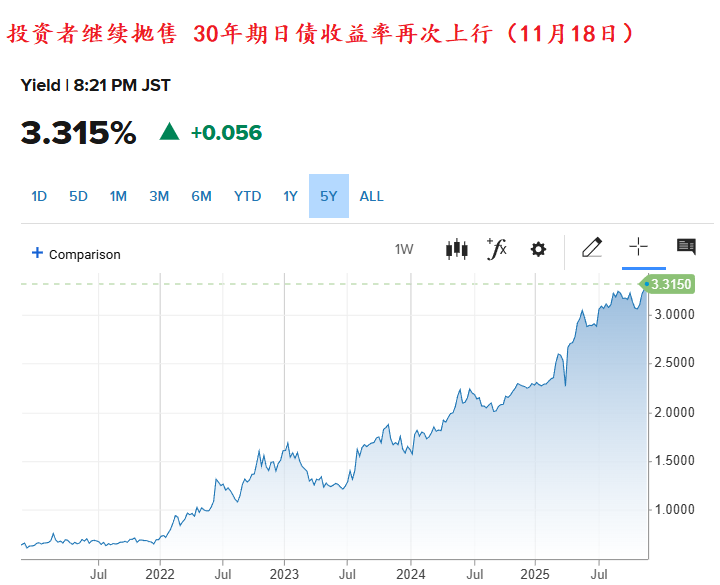
转自:新华财经 新华财经北京11月18日电 由于担心日本首相高市早苗不断膨胀的支出计划,长期日债连续第二日遭投 资者抛售,与此同时,日经指数周二(18日)大幅下跌,这是三周以来首次跌破5万大关。该指数收盘 于48,702点,比周一收盘时下跌了3%以上。而在日本股市下跌之前,投资者对美联储下月降息的预期 降低,隔夜纽约股市出现了更广泛的抛售。 当天盘中及盘后交易,中短债日债收益率下行,长期日债收益率上行,截至发稿时,2年期日债收益率 跌1BP至0.925%,10年期日债收益率涨2.1BPs至1.75%,20年期日债收益率涨4.6BPs至2.791%,30年期 日债收益率涨5.6BPs至3.315%。 "通常情况下,当这些避险事件发生时,都是由美联储发起的,并因对日本的担忧而延续,"法国兴业银 行首席美国股市和多资产策略师马尼什·卡布拉表示。 市场参与者还预计,日本央行12月召开的政策会议将不会加息。 日本央行行长植田和男周二表示,他告诉首相,央行正在逐步提高利率,以引导通胀平稳地向2%的目 标迈进,这番言论让市场继续猜测加息的时机。 分析人士表示,投资者迫切希望了解高市经济措施的规模,以及她计划如何为这些措施提 ...
当心踩踏!资管巨头警告:新兴市场热门交易已过度拥挤
智通财经网· 2025-11-17 01:40
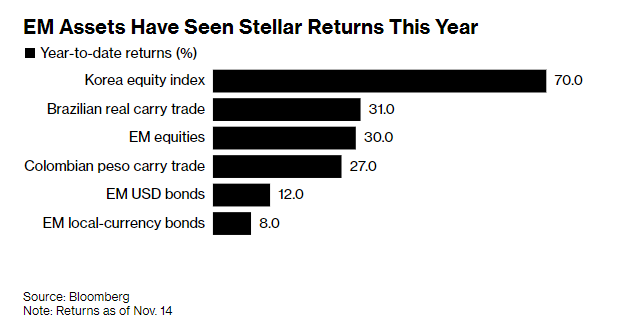
Core Insights - Emerging market trades, particularly long positions in Brazilian real and AI-related stocks, are raising concerns due to overcrowding risks [1][3] - Asset management firms are warning that valuations of Latin American currencies have deviated from fundamentals, indicating potential risks [1][6] - The MSCI Emerging Markets Index has seen a nearly 30% increase this year, marking its best performance since 2017, but past trends suggest a possible significant downturn could follow [3][4] Group 1: Emerging Market Concerns - Many emerging market sectors are showing signs of overheating, driven by factors such as Fed rate cuts and a softening dollar [3] - A recent HSBC survey indicated that 61% of investors are overweight in emerging market local currency bonds, a significant shift from a net underweight in June [3] - The potential for profit-taking as the year ends may lead to increased volatility in the foreign exchange market [3][4] Group 2: Specific Market Risks - Asian stock investors experienced risks associated with high valuations and crowded trades, particularly in AI stocks [4] - The Korean Composite Stock Price Index (Kospi) saw a significant drop despite a previous surge, highlighting the risks of concentrated positions in AI-related trades [4] - Lazard Asset Management's portfolio manager expressed caution after the tech stock sell-off, noting that low-quality companies have been outperforming high-quality ones, which historically does not last [5] Group 3: Currency and Bond Market Dynamics - Brazilian real has been a standout asset for carry trades, but recent indicators suggest a shift towards bearish sentiment [6] - Other Latin American currencies, such as Chilean, Mexican, and Colombian pesos, are also showing signs of overvaluation [6] - Frontier market bonds have benefited from a trend of investors moving away from U.S. assets, but concerns about liquidity in markets like Egypt and Ghana are emerging [7]

日元政策困局 日本央行如何平衡低息通胀?
Jin Tou Wang· 2025-11-14 13:20
Core Viewpoint - The USD/JPY exchange rate is influenced by the divergence in monetary policies between the US and Japan, supported by government bond yield differentials and technical factors, leading to uncertainty in the currency's direction [1][2] Group 1: Monetary Policy and Economic Indicators - The Bank of Japan, under Governor Ueda, maintains an accommodative stance to support recovery, while the new Prime Minister, Sanna Takagi, continues "Abenomics," reducing expectations for interest rate hikes by year-end [1] - The policy interest rate in Japan is 0.5%, with a differential of over 300 basis points compared to the US Federal Funds Rate, attracting funds for carry trades that support the exchange rate [1] - Despite weaker data in October raising the probability of a Fed rate cut to 60%, the resolution of the government shutdown has improved risk appetite, diminishing the safe-haven demand for the yen [1] Group 2: Technical Analysis - The current exchange rate is in a consolidation phase, with the 154 level being crucial for both bulls and bears; after hitting a low of 152.80 on November 7, the rate rebounded to 154.49 on the 14th, indicating solid support [2] - Technical indicators show bullish signals, with the RSI remaining above 50, and the 20-day moving average around 152.52 providing dual support; a pullback to this level may attract buyers [2] - Resistance levels are identified at 154.48 and 154.83; a breakthrough above 154.83 could target the 155 level, with some institutions predicting a potential rise to 160 by year-end [2]
又一个特朗普2.0时代的惨案!近40年最大日元多头头寸瓦解
Jin Shi Shu Ju· 2025-11-13 12:53
Core Viewpoint - Investors had previously bet on a record scale that the Japanese yen would appreciate, anticipating profits from Japan's long-awaited economic recovery, while also betting on a slowdown in the U.S. economy. However, the yen has fallen to its lowest level in nine months, leading speculators to withdraw from their largest long positions in nearly 40 years. The unexpected resilience of the U.S. economy and the new Japanese government's preference for a slower pace of interest rate hikes are key reasons for this miscalculation [1]. Group 1 - The yen's depreciation is largely attributed to the Bank of Japan's cautious stance on interest rate hikes, which is a response to uncertainties stemming from U.S. tariff policies [2]. - The new Prime Minister, Sanna Kishi, has increased political pressure by opting for increased spending to boost growth while maintaining low interest rates, which is detrimental to the yen [2]. - Market expectations for future U.S. rate cuts and Japanese rate hikes have been lowered, resulting in a policy interest rate differential of over 300 basis points, posing further depreciation risks for the yen [2]. Group 2 - There is a prevailing sentiment that the dollar-yen exchange rate may rise further, with some strategists betting that the yen will fall below the 155 mark in the coming weeks [3]. - As of the end of September, data indicates that long positions in the yen have been reduced by more than half since reaching record highs in April, reflecting a shift in market sentiment [4]. - The implied volatility of three-month dollar-yen options has dropped to its lowest level in over a year, indicating low demand for hedging against yen appreciation [5]. Group 3 - The current market environment suggests that many investors are focusing on carry trades, which typically involve selling the yen [5]. - The year-end forecast for the dollar-yen exchange rate remains at 155, but the risk of it rising to 160 by the fourth quarter of 2025 has increased [6].
日本投资者抛售外国股票债券,日元升值存在支撑
Huan Qiu Wang· 2025-11-08 01:20
Group 1 - Japanese investors net sold 581.1 billion yen in foreign stocks, 354.4 billion yen in long-term bonds, and 798.7 billion yen in short-term bonds last week [1] - Foreign investors have net bought 690.1 billion yen in Japanese stocks for five consecutive weeks [1] - Japan's government is focusing on "responsible active fiscal" policies to support strategic industries such as semiconductors, AI, defense, and green industries, which have a more immediate impact compared to previous policies aimed at long-term growth [1] Group 2 - The Japanese yen has potential for upward fluctuations due to the normalization of the Bank of Japan's monetary policy and the ongoing interest rate cuts by the Federal Reserve [4] - The Nikkei 225 index has risen 31.4% year-to-date, with about half of this increase driven by policy expectations related to "expansionary fiscal policy and a weak yen" [4] - Future market sentiment is expected to become more rational by 2026, with the sustainability of future gains depending on the effectiveness of policy implementation [4] - Japan's export growth may be supported by the diversification of trade partners and the competitiveness of its advantageous industries, despite the narrowing of the US-Japan interest rate differential [4] - Domestic demand may improve if inflation recedes smoothly and real income levels rise, enhancing consumer confidence and corporate profitability through a "wage-inflation" spiral [4]