
汇率波动

Search documents
股市必读:新宝股份(002705)12月29日董秘有最新回复
Sou Hu Cai Jing· 2025-12-29 18:47
Core Viewpoint - The company Xinbao Co., Ltd. (002705) is experiencing a decline in stock price and is facing challenges due to the rapid appreciation of the RMB, which affects its export business that is primarily settled in USD [1] Group 1: Company Performance - As of December 29, 2025, Xinbao's stock closed at 14.17 yuan, down 0.98%, with a turnover rate of 0.53% and a trading volume of 42,800 shares, resulting in a transaction amount of 61.0482 million yuan [1] - On the same day, the net outflow of main funds was 6.3407 million yuan, indicating a cautious attitude from major investors [1] Group 2: Currency Impact - Approximately 75% of the company's business is export-oriented and primarily settled in USD, making it sensitive to fluctuations in the RMB exchange rate [1] - The company is actively monitoring macroeconomic conditions and exchange rate trends, implementing measures such as foreign exchange derivatives to hedge against currency risk [1] Group 3: Investor Communication - The company emphasizes its commitment to enhancing core competitiveness to improve market pricing power and maintain stable operations in the long term [1] - Investors are advised to be aware of investment risks, reflecting the company's proactive approach to risk management [1]

新宝股份(002705.SZ):出口业务占比75%左右,主要以美元结算
Ge Long Hui· 2025-12-29 07:20
格隆汇12月29日丨新宝股份(002705.SZ)在互动平台表示,公司出口业务占比75%左右,主要以美元结 算。人民币短期内快速升值对公司出口业务会产生一定的影响。公司会持续关注宏观经济及汇率走势, 加强外汇风险管理,通过外汇衍生品对冲、择机安排结汇等措施来降低汇率波动风险。长期来看,公司 将通过核心竞争力的提升,不断提高公司产品的市场议价能力,保持持续稳健的经营。 ...
太意外!美GDP远超预期,中美差距扩大,中国未破20万亿
Sou Hu Cai Jing· 2025-12-26 19:00
2023年的全球经济舞台,仿佛一出跌宕起伏的悬疑剧,而美国,无疑是聚光灯下最受瞩目的主角。当全世界都屏住呼吸,猜测高利率这把利剑是否会将美国 经济刺穿时,一份令人瞠目结舌的"王炸"成绩单横空出世,瞬间击碎了所有悲观论调。 当我们把目光转向东方,感受到的却是与大洋彼岸截然不同的经济温度。今年,中国经济同样交出了一份令人满意的答卷。前三季度5.2%的同比增长,在 全球主要经济体中堪称翘楚。但未能突破20万亿美元GDP总量的"一步之遥",却让不少人心生遗憾。这不仅仅是一个数字,更是一个象征意义上的里程碑。 更有趣的是,我们所面临的挑战,与美国恰恰相反。他们为高企的物价、失控的通胀而焦头烂额,而我们却正经历着物价相对稳定的时期。超市里日用品价 格的稳定,电商平台促销的力度,都传递着一种"淡定"的信号。这种低通胀环境固然有利于提升民众的实际购买力,但从宏观经济角度而言,却在以美元计 价GDP时,让我们的增长显得不那么"壮实"。此消彼长,两国之间的差距也因此被微妙地拉大。 然而,在这场看似辉煌的经济"秀"背后,隐藏着怎样的玄机?作为一名对数字敏感的观察者,我更愿意将这份成绩单拆解开来,深入探究其真实成色。 先说那备受瞩目 ...


美元大跌10%,人民币破7背后,这是美国谋划的金融迷局?
Sou Hu Cai Jing· 2025-12-26 17:58
Group 1 - The recent appreciation of the Renminbi (RMB) against the US dollar is largely attributed to the weakening of the dollar due to the Federal Reserve's interest rate cuts, rather than a strong performance of the RMB itself [1][4] - The RMB has appreciated approximately 4.5% to 6% since the beginning of the year, while the US dollar index has declined nearly 10%, indicating a relative weakness of the dollar [1][4] - The appreciation of the RMB has mixed implications for different sectors; it benefits importers and students studying abroad by reducing costs, while it poses challenges for export-oriented businesses facing reduced competitiveness [6][9] Group 2 - Export-oriented companies are experiencing pressure as the appreciation of the RMB makes their products more expensive in international markets, potentially leading to a loss of orders and profit margins [6][10] - The end-of-year "settlement tide" drives demand for RMB as export companies convert their dollar earnings into RMB for year-end payments, contributing to the RMB's appreciation [12][10] - Despite the RMB's appreciation against the dollar, it has depreciated against a basket of other currencies, which helps maintain price competitiveness for exports to regions like Europe and Japan [14][10] Group 3 - Market sentiment can amplify the RMB's appreciation, leading to self-reinforcing cycles of investment based on expectations of further appreciation, which could create volatility [15][16] - Financial authorities emphasize the importance of stability in the RMB exchange rate, implementing measures to prevent excessive fluctuations that could disrupt business operations and personal financial plans [15][16] - Experts recommend that businesses and individuals focus on their core operations and manage currency risk through financial instruments, rather than speculating on currency movements [18][19]
离岸人民币兑美元升破7.0大关!对普通人有哪些影响?一文读懂
Sou Hu Cai Jing· 2025-12-26 02:12
离岸人民币兑美元汇率一举升破7.0关口,创下2024年9月以来新高。这一变化不仅刷屏财经圈,更与每个普通人的钱包息息相关。人民币为何大幅升值?未 来走势如何?普通人该如何应对?一文说清! 美元走弱成主因 美联储降息预期升温,美元指数跌破100,带动非美货币普遍升值。市场对2026年美联储继续降息的押注,进一步削弱美元吸引力。 中国经济韧性支撑 出口超预期增长、贸易顺差扩大至1万亿美元,叠加资本市场对国际资本的吸引力增强,为人民币提供基本面支撑。 年末结汇潮推波助澜 外贸企业年底集中将美元收入兑换成人民币,短期需求激增加速汇率上行。 1. 换汇成本大降,留学生家庭迎来利好 2. 美元存款"倒亏钱",理财需谨慎 留学、旅游更省钱:当前换10万美元比6月节省约1.7万元,赴美留学、旅游开支显著降低。 海淘党狂喜:进口商品价格下降,电子产品、奢侈品性价比提升。 杭州张凯年初存8400美元,到期后人民币计价反亏1033元;购买美国国债的收益也被汇率波动吞噬。 建议:持有美元资产者可考虑分批换回人民币,或配置黄金、A股等对冲风险。 人民币购买力提升,核心城市房产、黄金等抗通胀资产可能吸引更多资金流入。 注意:央行强调"房 ...
国际金融市场早知道:12月26日
Zhong Guo Jin Rong Xin Xi Wang· 2025-12-25 23:58
Group 1 - Japan's Prime Minister Fumio Kishida announced the initial budget for the fiscal year 2026, totaling 122.3 trillion yen, a 6.3% increase year-on-year, setting a new historical record [1][4] - To cover the fiscal gap, the government plans to issue approximately 29.6 trillion yen in government bonds [1][4] - The Bank of Japan's Governor Kazuo Ueda indicated that there is still room for interest rate hikes as confidence in achieving sustainable inflation targets grows [1][4] Group 2 - The Japanese government raised its GDP growth forecast for fiscal year 2025 from 0.7% to 1.1% and expects further growth to 1.3% in fiscal year 2026, reflecting optimism about economic recovery [1][4] - The Bank of Korea stated in its 2026 monetary policy statement that it does not rule out further interest rate cuts while emphasizing the need to monitor potential threats to financial stability from the depreciation of the Korean won and rising housing prices [1][4] - The Central Bank of Egypt significantly cut its benchmark interest rate by 100 basis points, adjusting overnight loan and deposit rates to 21% and 20% respectively, in response to the easing of high inflation pressures [1][4]
每日机构分析:12月25日
Xin Hua Cai Jing· 2025-12-25 09:00
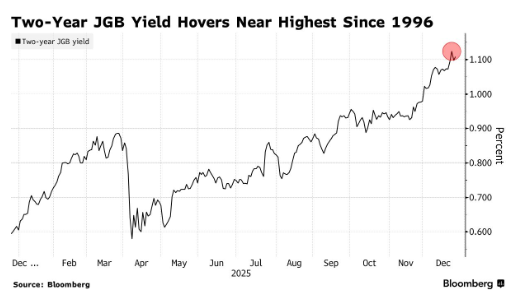
Group 1: Currency and Economic Outlook - The offshore RMB appreciation is increasing the attractiveness of the domestic capital market to foreign investment, but companies are advised not to bet on a one-sided currency trend and to utilize foreign exchange derivatives to manage risks [1] - The Russian Ruble has appreciated by 45% this year, reaching approximately 78 Rubles per USD, which poses new risks to the Russian economy as it undermines its competitive edge as an energy powerhouse [2] - Canada's GDP fell by 0.3% in October, with only a slight expected recovery of 0.1% in November, indicating a need for further monetary support through interest rate cuts [3] Group 2: Interest Rate Projections - BlackRock analysts predict that the Federal Reserve will implement limited interest rate cuts in 2026, with the current cycle having already seen a reduction of 175 basis points [1] - Galaxy Securities notes that there is still room for about three interest rate cuts in the U.S. in 2026, despite the marginal weakening of employment trends [2] - The Bank of Korea is keeping the option for further rate cuts open while remaining vigilant about financial stability risks due to a weak Korean Won and rising housing prices [5] Group 3: Bond Market and Inflation Expectations - Japan's two-year government bond auction saw demand fall below the 12-month average, indicating market speculation about the need for larger interest rate hikes to control inflation [4] - The yield on Japan's two-year bonds has reached its highest level since 1996, reflecting heightened inflation expectations as measured by the 10-year breakeven inflation rate, which is at its highest since 2004 [4]
日本两年期国债拍卖遇冷、收益率应声上扬 市场押注央行加大加息力度
Zhi Tong Cai Jing· 2025-12-25 07:39
Group 1 - The demand for Japan's two-year government bonds is weak, leading to an increase in yields for this maturity, with the auction bid-to-cover ratio recorded at 3.26, lower than the previous 3.53 and the 12-month average of 3.65 [1] - The two-year government bond yield rose by 1 basis point to 1.11%, while the ten-year government bond futures opened high but subsequently declined [1] - The Bank of Japan recently raised its policy interest rate to the highest level in 30 years, but the governor did not provide clear guidance on future rate paths, contributing to a weaker yen and rising bond yields [1] Group 2 - The two-year government bond yield reached its highest level since 1996 earlier this week, while the ten-year breakeven inflation rate hit a record high since 2004 [3] - Japan's Finance Minister warned that the government has the freedom to take decisive measures against exchange rate fluctuations that do not align with economic fundamentals, which has somewhat eased the yen's depreciation and rising yield trend [3] - Investors are closely monitoring the bond issuance plan related to the fiscal year 2026 budget, which is expected to be approved by the cabinet soon, with suggestions to increase the issuance of two-year, five-year, and ten-year bonds while reducing the issuance of ultra-long-term bonds [3]
加快结汇、优化结算方式,外贸企业积极应对汇率波动
Sou Hu Cai Jing· 2025-12-24 15:38
Group 1 - The core viewpoint of the articles highlights the impact of the rising RMB to USD exchange rate on export companies, prompting them to adopt measures to mitigate the effects [1] - Many export companies are accelerating their foreign exchange settlements to cope with short-term fluctuations in the exchange rate [1][8] - Companies are also optimizing their settlement methods and enhancing their core competitiveness to increase resilience against exchange rate volatility [8][10] Group 2 - A specific egg production company in Jiangsu Nantong has exported nearly 100 tons of egg powder to the European market since the fourth quarter, receiving approximately 700,000 USD in foreign exchange [3] - The chairman of the egg company stated that they are promptly settling every foreign exchange received, which has effectively reduced losses by about 1% [5] - Another foreign trade company in Zhejiang Haining is using a combination of cross-border RMB, USD, and EUR to manage exchange rate risks, primarily through forecasting and locking in rates [7]

央行博弈下镑美短线反弹
Jin Tou Wang· 2025-12-24 02:38
Group 1 - The British pound stabilized around 1.3405 against the US dollar after a three-day decline, indicating a balance between bullish and bearish factors [1] - The Bank of England announced a 25 basis point rate cut to 3.75%, marking the lowest level in nearly three years, with a 5:4 voting result [1] - The Bank of England's decision reflects a cautious approach, emphasizing data dependency for future rate changes, suggesting the current easing cycle may be nearing its end [1] Group 2 - Market sentiment remains cautious ahead of the UK Q3 GDP data release, with investors reducing directional bets to avoid volatility [2] - Technical analysis shows the GBP/USD pair has established support around 1.3300, with resistance levels between 1.3420 and 1.3450 [2] - The divergence in monetary policy between the Bank of England and the Federal Reserve is expected to be a key driver for the exchange rate in the short term [2]