
港股市场

Search documents
今日视点:香港新股市场领跑全球具备三大战略支点
Zheng Quan Ri Bao· 2025-11-06 23:14
Core Insights - The Hong Kong stock market has achieved the highest new stock financing amount globally in the first three quarters of 2025, totaling HKD 188.3 billion, which is more than three times that of the same period last year [1] - The significant growth in new stock financing is attributed to the continuous expansion of the listing reserve, highlighting Hong Kong's strategic value as a core hub for capturing growth opportunities amid global economic uncertainties [1] Group 1: Market Dynamics - The Hong Kong stock market has optimized its listing system, creating differentiated listing rules and efficient approval mechanisms that facilitate the listing of technology companies, thereby strengthening the institutional foundation for quality asset aggregation [2] - Special listing chapters have been established to break traditional profit threshold limitations, providing a "green channel" for technology companies, which includes innovative evaluation systems that replace single profit assessment standards [2] Group 2: Capital Flow and Connectivity - The Hong Kong stock market serves as a financial hub connecting domestic and international capital, creating a diversified funding supply system that continuously injects liquidity into the market [3] - The Stock Connect mechanism exemplifies this dual-channel role, allowing foreign investors to invest in A-shares through the Northbound Stock Connect while domestic investors can allocate global assets through the Southbound Stock Connect [3] Group 3: Value Creation Ecosystem - The Hong Kong stock market is not just a financing platform but also a value creation ecosystem that empowers companies for sustainable growth, supported by top global investment banks and long-term funds [3] - Professional institutions adhere to international governance and service standards, helping companies gain global capital trust and linking them to global resources to enhance international competitiveness [3]

买盘强劲!港股互联网ETF(513770)溢价涨逾1%,连续吸金逾5亿元,阿里巴巴涨超3%
Xin Lang Ji Jin· 2025-11-06 05:24
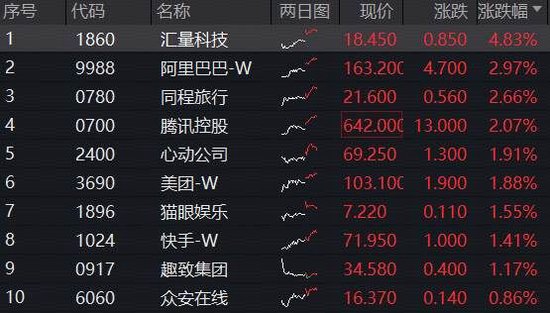
Core Viewpoint - The Hong Kong stock market experienced a rebound on November 6, with significant gains in leading tech companies, particularly Alibaba and Tencent, indicating a positive market sentiment and potential investment opportunities in the tech sector [1]. Group 1: Market Performance - The Hong Kong stock market saw a notable rebound, with Alibaba-W rising over 3% at one point and closing up 2.97%, while Tencent Holdings increased by over 2% [1]. - The Hong Kong Internet ETF (513770) also showed positive performance, rising 1.38% with a premium rate of 0.45%, reflecting strong buying interest [2]. Group 2: Fund Inflows and Economic Outlook - Recent data from the Shanghai Stock Exchange indicated that the Hong Kong Internet ETF has attracted a net inflow of 507 million yuan over the past five days, showcasing investor confidence [3]. - According to Fangzheng Securities, the current economic fundamentals in China are stable and improving, with continuous policy support boosting market confidence. Additionally, southbound capital is accelerating its inflow into the Hong Kong market, benefiting from the anticipated easing of liquidity conditions due to the Federal Reserve's interest rate cuts [5]. Group 3: Valuation and Investment Opportunities - The analysis suggests that the improvement in fundamentals is expected to drive further market performance in 2026, with AI industry catalysts likely enhancing the return on equity (ROE) for related sectors represented by the Hang Seng Tech Index [5]. - The current price-to-earnings (PE) ratio for the CSI Hong Kong Internet Index is 24.44 times, which is significantly lower than the NASDAQ 100 (36.95 times) and the ChiNext Index (41.11 times), indicating potential undervaluation in the Hong Kong tech sector [5][6]. - The Hong Kong Internet ETF holds major positions in leading companies such as Alibaba, Tencent, and Xiaomi, which collectively account for over 73% of the top ten holdings, emphasizing their dominance in the AI sector [6]. Group 4: ETF Performance and Liquidity - The Hong Kong Internet ETF has a current scale exceeding 11.4 billion yuan, with an average daily trading volume of over 600 million yuan, indicating strong liquidity and support for intraday trading [8].


南向资金与上市公司回购给力 港股仍有上行空间
Zhong Guo Zheng Quan Bao· 2025-11-04 20:17
Core Insights - Southbound capital has significantly increased its holdings in the Hong Kong stock market, marking it as the largest source of incremental funds this year, with a cumulative net inflow exceeding 1.27 trillion HKD, a historical high [1][4] - The Hong Kong stock market has performed well this year, with the Hang Seng Index and Hang Seng Tech Index rising over 29% and 30% respectively as of November 4 [1][6] - Despite recent market fluctuations, analysts believe that the Hong Kong market is primarily driven by liquidity, with potential for substantial upward movement in the medium to long term [1][7] Southbound Capital Inflows - As of November 4, 2023, southbound capital has recorded a cumulative net inflow of 12,753.21 billion HKD this year, more than double the amount from the same period in 2024, with a single-day record inflow of 358.76 billion HKD on August 15 [1][4] - In 198 trading days this year, there were net inflow days on 166 occasions, accounting for over 80% [1] - Monthly net inflows have consistently exceeded 110 billion HKD in several months, including January through April, July, August, and September [1] Holdings and Sector Preferences - As of November 3, 2023, southbound capital held 5,525.19 billion shares, an increase of 867.34 billion shares since the beginning of 2025, with a market value of 6.29 trillion HKD, up 2.71 trillion HKD [2] - The financial, information technology, and consumer discretionary sectors have the highest holdings, valued at 15,135.25 billion HKD, 13,086.04 billion HKD, and 8,918.34 billion HKD respectively [2] - Major stock holdings include Tencent Holdings over 650 billion HKD, Alibaba-W over 360 billion HKD, and several banks and energy companies exceeding 200 billion HKD [2] Recent Buying Trends - The most significant increases in holdings this year have been in China Construction Bank, Bank of China, and other major banks, with increases of 68.96 billion shares, 52.02 billion shares, and 50.27 billion shares respectively [3] - In the past month, the financial, energy, and communication services sectors saw the highest net buying amounts, with 255.73 billion HKD, 112.20 billion HKD, and 95.67 billion HKD respectively [4] Company Buybacks - As of November 3, 2023, Hong Kong-listed companies have repurchased over 1,460 billion HKD worth of shares, with 239 companies participating in buybacks this year [5] - Tencent Holdings leads in buyback scale with 609.65 billion HKD, followed by HSBC and AIA with 302.57 billion HKD and 176.93 billion HKD respectively [5] - The buyback trend is particularly strong in the technology and financial sectors, with notable increases in consumer companies as well [5] Market Performance and Outlook - The Hong Kong stock market has shown strong performance this year, with all industry sectors experiencing gains, particularly materials, healthcare, and information technology [6] - The Hang Seng Index's rolling P/E ratio has increased from 8.96 to 11.89, indicating a potential for valuation recovery [6] - Analysts suggest that the market may continue to experience fluctuations in the short term but has significant upward potential in the medium to long term due to favorable liquidity conditions and ongoing capital inflows [7]




港股市场速览:价格整体回调,业绩平稳上修
Guoxin Securities· 2025-11-02 08:47
Investment Rating - The report maintains an "Outperform" rating for the Hong Kong stock market [4] Core Insights - The overall market experienced a price correction, but earnings expectations have been revised upwards for most sectors [1][3] - The Hang Seng Index and Hang Seng Composite Index both saw a decline of 1.0% this week, with small-cap stocks performing better than large-cap and mid-cap stocks [1] - Nine sectors recorded gains while 21 sectors faced declines, with notable increases in power equipment and new energy (+2.6%) and non-ferrous metals (+2.4%) [1] Summary by Sections Market Performance - The Hang Seng Index's valuation decreased by 1.8% to 11.9x, while the Hang Seng Composite Index also fell by 1.7% to 11.9x [2] - The valuation of the Hang Seng Biotechnology Index increased slightly by 0.1% to 27.3x, while the Hang Seng Consumer Index dropped by 3.7% to 14.2x [2] Earnings Expectations - The EPS for the Hang Seng Index increased by 0.7% compared to last week, while the Hang Seng Composite Index's EPS rose by 0.8% [3] - A total of 26 sectors saw upward revisions in EPS, with construction (+3.2%) and coal (+3.1%) leading the increases [3]
A股10月收官,沪指一度站上4000点,关注A500ETF易方达(159361)、沪深300ETF易方达(510310)等投资价值
Mei Ri Jing Ji Xin Wen· 2025-10-31 16:15
Market Overview - The A-share market closed in October with the Shanghai Composite Index rising by 1.85%, briefly surpassing 4000 points, marking a nearly 10-year high [1] - Weekly market performance showed a mixed trend, with sectors such as energy metals, solid-state batteries, photovoltaic equipment, medical services, and cloud office leading in gains, while semiconductor, insurance, and banking sectors faced declines [1] Index Performance - The CSI 300 Index decreased by 0.4%, the CSI A500 Index fell by 0.05%, the ChiNext Index increased by 0.5%, the STAR Market 50 Index dropped by 3.2%, and the Hang Seng China Enterprises Index declined by 2.1% [1][3] - The rolling price-to-earnings (P/E) ratios for the indices are as follows: CSI 300 at 14.5x, CSI A500 at 17.0x, ChiNext at 42.4x, STAR Market 50 at 160.6x, and Hang Seng China Enterprises at 10.9x [3] Sector Analysis - The CSI A500 Index covers 500 securities from various industries, representing 91 out of 93 three-level industries, indicating broad market coverage [4] - The ChiNext Index consists of 100 stocks with high market capitalization and liquidity, heavily weighted towards strategic emerging industries, particularly in power equipment, communications, and electronics, which together account for nearly 60% [4] - The STAR Market 50 Index is characterized by "hard technology" leaders, with semiconductors making up over 50% and combined with medical devices and photovoltaic equipment, accounting for nearly 75% [4] Historical Performance - Over the past month, the CSI 300 Index has shown a cumulative change of -0.0%, while the ChiNext Index has seen a -1.6% change [7] - Year-to-date performance indicates the CSI 300 Index has increased by 17.9%, and the ChiNext Index has risen by 48.8% [7] - The Hang Seng China Enterprises Index has experienced a cumulative increase of 25.8% this year [7]

每日投资策略-20251030
Guodu Securities Hongkong· 2025-10-30 01:49
Group 1: Market Overview - The Hong Kong stock market showed mixed performance, with the Hang Seng Index closing at 26,346.14, down 87 points or 0.33%, while maintaining above the 20-day moving average [3] - The trading volume for the day was 242.7 billion HKD, with 30 blue-chip stocks rising and 57 falling [3] - The market is expected to open higher after the Federal Reserve's decision to cut interest rates by 0.25% [2] Group 2: Economic Indicators - The Mandatory Provident Fund (MPF) reported an average loss of 821 HKD per member in October, with total losses amounting to approximately 3.9 billion HKD [5] - Year-to-date returns for the MPF remain strong at over 30%, despite a potential monthly loss in October [5][6] - The property price index in Hong Kong rose by 1.3% in September, marking four consecutive months of increases [7] Group 3: Company News - HSBC's credit loss expectations for Q3 are stable at 1 billion USD, with signs of recovery in the commercial real estate sector [9] - Joyson Electronics is set to raise over 3.66 billion HKD through its IPO, with a share price not exceeding 23.6 HKD [10] - China Southern Airlines reported a 20.26% year-on-year increase in Q3 profit, amounting to 3.84 billion RMB [11]
港股收评:三大指数齐跌,恒指跌0.33%,黄金股下挫
Ge Long Hui· 2025-10-28 08:36
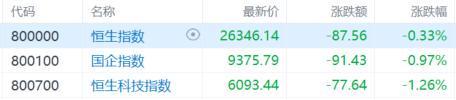
Market Overview - The Hong Kong stock market experienced a collective decline in the afternoon, halting a three-day rally, with the Hang Seng Index down 0.33% to 26,346 points, the Hang Seng China Enterprises Index down 0.97% to 9,375 points, and the Hang Seng Tech Index down 1.26% to just above 6,000 points [1][2]. Sector Performance - Major technology stocks led the market decline, with notable drops including SMIC down over 3%, and other companies like Trip.com, SenseTime, Li Auto, NetEase, and Midea Group falling more than 2% [4][5]. - Gold stocks also faced significant losses, with China Silver Group down over 10%, and other mining companies like Zijin Mining and Lingbao Gold down over 7% [6]. - Cryptocurrency-related stocks saw sharp declines, with Huajian Medical down over 12% and other firms like Blueport Interactive and Big Brother International dropping more than 6% [7][8]. - Sportswear stocks fell broadly, with Anta Sports and 361 Degrees down over 4%, and other brands like Li Ning and Yue Yuen Industrial also declining [9][10]. - Water utility stocks performed well, with China Water Affairs Group up over 18%, and other companies like Guangdong Investment and Tianjin Chuangye Environmental Protection rising more than 3% [11]. - Dairy stocks rebounded after previous declines, with Yurun Dairy up over 3% and China Feihe up over 2% [12]. - Banking stocks showed resilience, with Standard Chartered and HSBC both rising over 3% [13]. Investment Trends - Southbound funds recorded a net inflow of HKD 2.258 billion, indicating continued interest in Hong Kong stocks [13]. - Analysts from Xiangcai Securities predict that the Hong Kong market will follow the US market's upward trend, driven by expected interest rate cuts and favorable currency movements [15].
上证指数时隔十年再上4000点,成交额仍待放量
第一财经· 2025-10-28 05:04
Core Viewpoint - The A-share market is experiencing a positive sentiment with the Shanghai Composite Index breaking the 4000-point mark, driven by improved market conditions and regulatory support, although caution is advised regarding potential profit-taking in high-valuation sectors [3][4][5]. Market Performance - On October 28, the Shanghai Composite Index briefly surpassed 4000 points before retreating, ultimately closing at 4005 points with a 0.21% increase. The trading volume in Shanghai, Shenzhen, and Beijing reached 1.36 trillion yuan, a decrease of 216.5 billion yuan compared to the previous day [3]. - Analysts suggest that the index's breakthrough is a reflection of enhanced market sentiment and investor confidence, with the potential for continued upward movement if it can maintain this level [5]. Regulatory Environment - The China Securities Regulatory Commission (CSRC) has introduced measures to optimize the Qualified Foreign Institutional Investor (QFII) system, aiming to provide a more transparent and efficient environment for foreign investors. This includes streamlined approval processes and a green channel for foreign capital [4]. - The CSRC is also planning to launch a refinancing framework to support mergers and acquisitions, urging listed companies to improve governance and increase shareholder returns through dividends and buybacks [4]. Economic Context - Recent developments in U.S.-China trade negotiations have alleviated market concerns, contributing to a recovery in risk appetite. The expectation of a potential interest rate cut by the Federal Reserve and the continued appreciation of the yuan are also factors supporting foreign capital inflow [4][6]. - Market analysts predict that the A-share market will likely maintain a "slow bull" trend with increased volatility, emphasizing the importance of focusing on fundamentally strong companies while avoiding speculative investments [5][6]. Sector Analysis - The technology sector is expected to continue its momentum, while healthcare and consumer sectors are identified as key areas for long-term investment [5]. - Analysts caution that high valuations in certain sectors, particularly technology and semiconductors, may lead to profit-taking and increased market fluctuations as the year-end approaches [4][5].

银河证券:海内外不确定因素增 预期港股宽幅震荡
智通财经网· 2025-10-27 00:13
Core Viewpoint - The overall valuation of the Hong Kong stock market is at a historically high level, with expectations of wide fluctuations in the future. The report suggests focusing on certain sectors due to rising market risk aversion and changing market styles [1]. Market Performance - During the week of October 20 to October 24, major global stock indices mostly rose, with the Hang Seng Index increasing by 3.62%, the Hang Seng Tech Index by 5.20%, and the Hang Seng China Enterprises Index by 3.91% [2]. - Among the primary industries, nine sectors rose while two fell. The energy, information technology, and consumer discretionary sectors saw the highest gains, increasing by 5.26%, 4.83%, and 4.15% respectively [2]. - In terms of liquidity, the average daily trading volume on the Hong Kong Stock Exchange was HKD 240.846 billion, a decrease of HKD 118.507 billion from the previous week [2]. Valuation and Risk Appetite - As of October 24, the PE and PB ratios for the Hang Seng Index were 12.04 and 1.23, reflecting increases of 3.84% and 3.80% respectively, placing them at the 86% and 89% percentile levels since 2019 [3]. - The risk premium for the Hang Seng Index was calculated at 4.29%, which is significantly below the historical average, indicating a low risk appetite among investors [3]. Investment Outlook - The U.S. CPI rose by 3% year-on-year in September, the highest since January, but below market expectations, leading to increased expectations for interest rate cuts by the Federal Reserve [4]. - China's GDP grew by 5.2% year-on-year in the first three quarters, with a slight decline in growth rate in the third quarter [4]. - The 20th Central Committee's Fourth Plenary Session highlighted key economic goals for the 14th Five-Year Plan, emphasizing high-quality development and technological self-reliance [4].
华泰证券:港股周期和科技依然高景气
Xin Lang Cai Jing· 2025-10-26 23:33
Core Viewpoint - The Hong Kong stock market experienced overall fluctuations last week, with a prevailing wait-and-see sentiment. Southbound capital inflow has exceeded 500 billion HKD since the second half of the year, but the momentum for future inflows may slow down as the year-end assessment period approaches. [1] Market Overview - Southbound capital inflow has accumulated over 500 billion HKD since the second half of the year, indicating strong interest from mainland investors [1] - The sentiment indicators have returned to neutral, suggesting that the recent cooling in southbound capital is a new trend [1] - The current market presents a balanced risk profile, allowing high-risk tolerance investors to gradually build positions, although significant accumulation opportunities may still need to be awaited [1] Industry Insights - The upcoming third-quarter earnings reports are expected to be released, but not all Hong Kong stocks will disclose their third-quarter results [1] - Current cycles in sectors such as metals, materials, and energy remain high in sentiment, while previously low sentiment sectors like consumer goods (textiles, food, social services) and high-dividend sectors (finance and cyclical dividends) are showing signs of bottoming out or upward revisions [1]
