结构性行情

Search documents
午评:沪指窄幅震荡,保险板块强势拉升,半导体等板块走低
Zheng Quan Shi Bao Wang· 2025-12-15 05:14
15日早盘,沪指盘中窄幅震荡,创业板指、科创50指数等走势疲弱。 截至午间收盘,沪指跌0.11%报3884.93点,上证50指数涨0.26%,深证成指跌0.71%,创业板指、科创50 指数均跌超1%,沪深北三市合计成交11985亿元。 盘面上看,保险板块强势拉升,食品饮料、零售、酿酒、钢铁、煤炭等板块上扬,商业航天、军贸概念 等活跃;半导体、传媒、医药等板块疲弱。 (文章来源:证券时报网) 中信建投证券表示,从9月初至12月初,AH两地市场经历了较长时间的调整,投资者情绪趋于谨慎,而 近期,多项关键事件与数据相继公布,整体基调符合或略好于市场预期。牛市底层逻辑仍在,主要由结 构性行情和资本市场改革政策推动。目前市场已经基本完成调整,叠加基金排名基本落地,跨年有望迎 来新一波行情。中期行业配置方面,重点关注具有一定景气催化的有色金属和AI算力,主题上以商业 航天为主,可控核聚变和人形机器人为辅;港股也具有投资机会,潜在热点板块主要有互联网巨头、创 新药。 ...
午评:沪指跌0.11% 乳业、保险板块走强
Zhong Guo Jin Rong Xin Xi Wang· 2025-12-15 04:03
Market Overview - The market experienced a morning surge followed by a decline, with the ChiNext Index dropping over 1%, leading the three major indices [1] - As of the midday close, the Shanghai Composite Index was at 3884.93 points, down 0.11%, with a trading volume of 509.9 billion yuan; the Shenzhen Component Index was at 13164.03 points, down 0.71%, with a trading volume of 674.3 billion yuan; the ChiNext Index was at 3153.07 points, down 1.29%, with a trading volume of 315.4 billion yuan [1] - The total trading volume for the Shanghai and Shenzhen markets was 1.18 trillion yuan, a decrease of 52.9 billion yuan compared to the previous trading day [1] Sector Performance - The insurance sector saw significant gains, with China Ping An rising nearly 5%, reaching a four-year high [2] - The consumer sector showed strength, particularly in dairy, with Sunshine Dairy hitting the daily limit; the liquor sector was also active, with Huangtai Liquor reaching the daily limit; retail stocks performed strongly, with Baida Group achieving three consecutive trading limits [2] - Conversely, the computing hardware sector experienced a collective decline, with Changfei Optical Fiber hitting the daily limit down [2] Institutional Insights - Guotai Junan expressed a more optimistic outlook for the market compared to consensus, highlighting the central economic work conference's focus on stabilizing economic growth and promoting investment recovery [3] - The conference emphasized the importance of a good start for the 14th Five-Year Plan, with expectations for policy adjustments to support economic activity [3] - The firm noted that the current market environment presents a crucial opportunity for positioning ahead of the spring market, with a focus on large-cap growth stocks benefiting from insurance capital allocations [3] Economic Data - The National Bureau of Statistics reported that in November, the total retail sales of consumer goods reached 43,898 billion yuan, a year-on-year increase of 1.3% [6] - Excluding automobiles, retail sales amounted to 39,444 billion yuan, growing by 2.5% [6] - From January to November, total retail sales reached 456,067 billion yuan, with a growth rate of 4.0% [6] Real Estate Market - In November, new residential sales prices in first-tier cities fell by 0.4% month-on-month, with the decline in major cities like Beijing and Shenzhen being more pronounced [7] - The report indicated that second-hand residential prices in first-tier cities also saw a month-on-month decline of 1.1% [7] Technology Developments - China Mobile released a white paper on 6G transmission technology and a prototype system, marking a significant step from theoretical research to practical validation [7] - The white paper outlines the vision, architectural design, and key technological directions for 6G transmission networks, emphasizing capabilities such as intelligent connection driven by business perception and distributed dynamic channel control [7]
中信建投:牛市底层逻辑仍在 跨年有望迎来新一波行情
Zheng Quan Shi Bao Wang· 2025-12-14 12:46
Core Viewpoint - The report from CITIC Securities indicates that the A-share and H-share markets have undergone a prolonged adjustment period from early September to early December, with investor sentiment becoming cautious. However, recent key events and data releases have met or slightly exceeded market expectations, suggesting that the underlying logic for a bull market remains intact, driven by structural trends and capital market reform policies [1] Market Adjustment and Outlook - The market has largely completed its adjustment phase, and with fund rankings being finalized, there is potential for a new wave of market activity as the year-end approaches [1] Sector Focus - Mid-term industry allocation should focus on sectors with certain growth catalysts, particularly non-ferrous metals and AI computing power. Thematic investments should prioritize commercial aerospace, with additional attention to controllable nuclear fusion and humanoid robots [1] Investment Opportunities - The Hong Kong stock market also presents investment opportunities, with potential hot sectors including internet giants and innovative pharmaceuticals. Key areas of focus include non-ferrous metals, commercial aerospace, AI, humanoid robots, controllable nuclear fusion, innovative pharmaceuticals, and non-bank financials [1]

中信建投:跨年行情蓄势待发
Xin Lang Cai Jing· 2025-12-14 12:27
Core Viewpoint - The underlying logic of the bull market remains intact, driven by structural trends and capital market reform policies. The market has largely completed its adjustment, and a new wave of market activity is expected as year-end approaches [1][2][34]. Market Overview - From early September to early December, the AH markets experienced a prolonged adjustment period, with investor sentiment becoming cautious. Most funds remained in a wait-and-see mode, anticipating the outcomes of significant domestic and international events by year-end [4][33]. - Recent key events and data releases have provided important decision-making guidance for the market, with the overall tone aligning with or slightly exceeding market expectations [4][34]. Policy Environment - The Central Political Bureau meeting has maintained a loose monetary policy and emphasized the importance of boosting the artificial intelligence industry. The macroeconomic policy will continue to be stable and expansionary, focusing on "continuously expanding domestic demand" as a primary task [5][34]. - Fiscal policy will remain proactive, with necessary spending levels maintained while emphasizing fiscal discipline and sustainability. Monetary policy will continue to be moderately loose, utilizing tools like reserve requirement ratio cuts and interest rate reductions to promote reasonable price recovery [5][35]. Economic Data - Economic data shows a slow recovery trend, with November CPI rising to 0.7% year-on-year, while PPI slightly decreased to -2.2% year-on-year. The recovery in CPI and PPI is gradually being anticipated by the market, although internal demand recovery remains insufficient [7][36][38]. - Retail sales in October fell to a year-on-year growth of 2.9%, and the manufacturing PMI for November recorded 49.2, indicating weak manufacturing demand and structural economic issues [9][38]. Investment Opportunities - Mid-term industry allocation should focus on sectors with certain catalytic prospects, such as non-ferrous metals and AI computing power, with themes centered on commercial aerospace, controllable nuclear fusion, and humanoid robots. The Hong Kong stock market also presents investment opportunities, particularly in internet giants and innovative pharmaceuticals [2][20][28]. - The commercial aerospace sector is supported by policy backing and industrial breakthroughs, showing potential for long-term growth. Recent performance in satellite computing has been notable, with leading stocks experiencing significant gains [26][55]. Market Sentiment - The market is currently characterized by a "weak recovery, strong policy" dynamic, necessitating continued loose policies to support economic stability. The market's expectations for fundamentals are already low, limiting further downside potential [9][38]. - The recent adjustments in the AI computing sector, combined with policy support and technological breakthroughs, provide a basis for potential upward momentum in this area [20][49][51]. Conclusion - The market is poised for a new phase of activity as it transitions from a period of adjustment, with key sectors identified for potential growth. The overall policy environment remains conducive to stabilizing market expectations and fostering structural trends [1][2][34].


收益率超200%!公募再现“两倍基”
证券时报· 2025-12-14 09:05
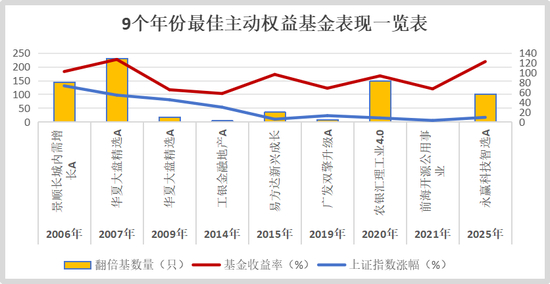
Core Insights - The article highlights the remarkable performance of actively managed equity funds in 2025, with nearly 60 funds achieving over 100% returns and the first fund since 2008 reaching over 200% returns [1][2][9] - The potential for the highest annual return in public fund history is noted, with a specific fund needing to exceed 7.84% in remaining trading days to surpass the previous record [1][5] Performance Analysis - As of December 12, 2025, the top-performing fund, Yongying Technology Smart Selection A, achieved a return of 218.40%, significantly ahead of the second-place fund [5] - Historical comparisons show that while 2025 has seen a resurgence in fund performance, previous years like 2006 and 2007 also had high returns, but no "two-fold funds" appeared in the years following 2019 [6][7] Market Trends - The article discusses the changing nature of the A-share market, with a shift from broad market rallies to more structured market conditions, leading to fewer high-performing funds in recent years [9][10] - The concentration of holdings in successful funds is emphasized, with many funds heavily invested in specific sectors like technology and high-end manufacturing, which have shown strong performance [10][13] Fund Management Insights - The return of active management capabilities is attributed to both market conditions and improved research capabilities within fund management teams [10][11] - The article notes that the current talent pool in fund management is more stable and capable of delivering consistent research output compared to previous years [14][15] Risks and Considerations - The article warns of the risks associated with high concentration in fund holdings, which can lead to significant performance declines during market corrections [13] - It also highlights the importance of avoiding past mistakes and maintaining a balanced approach to fund management, especially in light of the recent performance surge [12][15]

收益率超200%!时隔17年,公募再现“两倍基”
Xin Lang Cai Jing· 2025-12-14 07:25
Core Insights - The active equity funds in the public offering sector have shown remarkable performance in 2025, with nearly 60 funds achieving "doubling" returns and the first fund since 2008 reaching over 200% returns [1][15] - If the leading fund maintains a cumulative return exceeding 7.84% in the remaining trading days of 2025, it will set a record for the highest annual return in public fund history [1][18] - The resurgence of active management capabilities is attributed to both market structural changes and advancements in research capabilities within public funds [1][9] Performance Highlights - As of December 12, 2025, the top-performing fund, Yongying Technology Smart Selection A, achieved a return of 218.40%, significantly outperforming the second-place fund by over 50 percentage points [4][18] - The number of funds with returns exceeding 100% reached 57, with 19 of those exceeding 120% [8][21] - Historical comparisons show that the highest number of "doubling" funds occurred in 2007, with 129 funds, while the current year has seen a resurgence in high-performing funds [21] Market Trends - The performance of active equity funds has been particularly strong in 2025, with a notable concentration in technology, high-end manufacturing, and innovative pharmaceutical sectors [9][22] - The market has shifted towards structural trends, with significant returns linked to concentrated holdings in popular stocks [9][24] - The current market environment is characterized by a longer duration and larger scale of structural trends compared to previous years [25] Industry Dynamics - The active management capabilities of public funds are being reaffirmed, with a shift away from short-term behaviors towards a focus on investor interests and research-driven strategies [13][26] - The talent pool within public funds has improved, ensuring stable output and continuity in research capabilities [11][25] - The industry is experiencing a cultural shift towards prioritizing long-term investment strategies over short-term gains, which has alleviated some pressures on fund managers [13][26]
美联储降息靴子落地 A股为何“先跌为敬”
Sou Hu Cai Jing· 2025-12-11 06:20
别光骂市场不给力,这波下跌藏着三个关键真相!首先是降息分歧炸锅——9票支持3票反对,创下六年 最大分歧,明年降息预期直接降温,资金不敢盲目跟风;其次是前期热点获利了结,之前涨疯的部分板 家人们懵不懵?美联储年内第三次降息落地,一次性降25基点还释放400亿美元流动性,结果A股直 接"先跌为敬",超4000只个股飘绿,你手里的票有没有躺枪?评论区说说你的盈亏! 数据说话:北向资金已净流入超120亿元,创业板逆势微涨,光模块、新能源等新质生产力赛道逆势走 强,成交超1100亿元!说白了,不是降息没用,是资金只认"有政策+有业绩"的硬逻辑。 你觉得这波下跌是抄底机会还是陷阱?接下来该盯科技成长还是消费蓝筹?评论区聊聊你的布局,关注 我,带你精准拿捏结构性行情! 块,借着利好套现离场;更核心的是A股"内部分化",资金全往确定性赛道跑! ...

“科技牛”独领风骚
Bei Jing Shang Bao· 2025-12-10 12:00
20255年科技成长板块独领风骚的结构性行情已筑牢基础,而随着政策红利持续释放、经济基本面稳步 修复,市场共识逐步凝聚,本轮牛市将从局部领涨走向全域共振,演绎更具包容性的全面上涨行情。 40000点之后,不少券商预计将会有更多的板块轮动起来,出现轮番上涨。也就是说,20266年有望从结 构性牛市转向全面牛市。 ...
指数普跌VS消费独秀:逆周期板块成资金避风港?
Sou Hu Cai Jing· 2025-12-10 05:02
Group 1 - The mainstream financial markets in Europe and the US are on an upward trend, while the Hong Kong Hang Seng Index is approaching a new low for September, and A-shares are showing a "difficult to rise" pattern [1] - The current market situation is characterized by indices rising while individual stocks are declining, indicating a challenging environment for investors [1] - The food and beverage sector is expected to perform well by 2026, driven by three key factors: the realization of dividend attributes, faster recovery in B-end and business scenarios, and innovations in health and digital supply chains [1] Group 2 - The retail sector is showing strong performance, with several stocks hitting the limit up, and the National Retail Innovation Development Conference is set to take place in Beijing [3] - The retail industry is being positioned as a key focus for developing a complete domestic demand system and enhancing domestic circulation during the 14th Five-Year Plan period [3] - The Hainan Free Trade Zone is entering a new phase of operation, with policies aimed at promoting free trade and economic development [4] Group 3 - The Shanghai Composite Index opened lower and showed a clear downward trend, with significant capital outflows observed [6] - The market is in a state of waiting and observation, with no major changes expected to alter the current oscillating trend of the indices [6] - The ChiNext Index also opened lower and experienced a decline, with over 4,000 stocks falling, reflecting a weak market sentiment [6] Group 4 - The overall market trend is weak, with no significant new capital entering the market, leading to a lack of profitable opportunities [8] - The distribution of stock price changes shows a significant number of stocks declining compared to those increasing, indicating a bearish market sentiment [9]

未来半个月A股或重演2020行情!政策资金齐发力,历史会惊人相似?
Sou Hu Cai Jing· 2025-12-09 09:08
未来半个月A股或重演2020行情!政策资金齐发力,历史会惊人相似? 2025年A股的年底收官战太有看头了!最近不少老股民翻出2020年的K线图直呼" deja vu "——同样是年 底政策密集加码,同样是资金疯狂涌入,连板块轮动的节奏都像复制粘贴。距离2025年收官只剩半个 月,难道当年那波从3000点一路冲到3400点的行情,真要在A股再次上演? 政策"复刻"2020:4%赤字率+降准降息,宽松力度超预期 2020年牛市的核心推手是"政策放水",而2025年的政策力度只能用"有过之而无不及"来形容。2025年3 月政府工作报告明确,赤字率拟按4%安排,比上年提高1个百分点,还发行4.4万亿元地方政府专项 债、1.3万亿元超长期特别国债,新增政府债务总规模达11.86万亿元(来源:中国政府网),这可是实 打实的财政"真金白银"托底。 货币政策更是直接"抄作业"2020年的宽松套路:2025年5月央行一口气降准0.5个百分点,释放长期流动 性约1万亿元,还下调再贷款利率、公积金贷款利率,7天期逆回购操作利率降至1.4%(来源:光明 网)。更关键的是,央行专门设立8000亿元额度支持资本市场,金融监管总局还调降保 ...