适度宽松的货币政策

Search documents
全线跳水!存款利率,还要降?
Sou Hu Cai Jing· 2025-06-20 05:01
Core Viewpoint - The report from Rong360 Digital Technology Research Institute indicates a significant decline in bank deposit rates, with medium to long-term rates entering the "1 era," reflecting a broader trend of interest rate cuts aimed at stimulating economic growth and reducing corporate financing costs [1][4]. Group 1: Deposit Rate Trends - In May, the average interest rates for various term deposits showed a downward trend, with the 3-month average rate at 1.004%, 6-month at 1.212%, and 1-year, 2-year, 3-year, and 5-year rates at 1.339%, 1.428%, 1.711%, and 1.573% respectively [3]. - Compared to the previous month, the 3-month rate decreased by 24.3 basis points, while the 5-year rate was notably lower than the 3-year rate by 0.14 percentage points [3]. - This marks the first large-scale interest rate adjustment since 2025, with state-owned banks leading the way in reducing deposit rates, resulting in most 1-year fixed deposit rates falling below 1% [3]. Group 2: Monetary Policy and Economic Context - Analysts suggest that the central bank will continue to implement a moderately loose monetary policy to lower corporate financing costs and stimulate market activity, which may lead to further declines in deposit rates [4]. - The ongoing decline in deposit rates is seen as a strategy to maintain reasonable net interest margins for banks while ensuring the stability of the banking system [4]. Group 3: Impact on Banking Operations - The decline in deposit rates has led to a noticeable drop in the sales volume of fixed deposits, prompting banks to adopt aggressive strategies to attract deposits, including promotional activities [6][7]. - Regulatory bodies have issued warnings against chaotic deposit-raising practices, emphasizing the need for banks to focus on stable growth rather than merely increasing market share [8]. - Analysts highlight that the pressure from various financial products is driving banks to innovate in their customer engagement strategies, aiming to create a comprehensive financial service ecosystem [8].
利率进入“1字头”,银行存款“大搬家”
21世纪经济报道· 2025-06-20 04:48
Core Viewpoint - The article discusses the phenomenon of "deposit migration" in the context of declining deposit interest rates in China, highlighting the significant increase in non-bank deposits and the shifting investment preferences of individuals and businesses towards financial products and equity markets. Group 1: Deposit Trends - As of the end of May, the total RMB deposit balance reached 316.96 trillion yuan, a year-on-year increase of 8.1%, with nearly 2.2 trillion yuan added in that month, which is 500 billion yuan more than the same period last year [2][5] - Non-bank deposits saw a monthly increase of nearly 1.2 trillion yuan, marking a 300 billion yuan year-on-year increase, the highest for the same period in nearly a decade [5][11] - The decline in deposit interest rates has led to a significant "deposit migration" effect, with many financial institutions reducing rates, causing a shift in funds towards non-bank financial products [5][6] Group 2: Interest Rate Changes - The average interest rates for various term deposits have dropped significantly, with 1-year and shorter-term rates falling below 1%, and some medium to long-term rates dropping to around 2% [6][7] - Major state-owned banks initiated a large-scale reduction in deposit rates on May 20, marking the first significant adjustment since 2025, with all medium to long-term deposit rates entering the "1 era" [6][7] - The average interest rate for 3-month deposits was 1.004%, while the 5-year rate was lower than the 3-year rate by 0.14 percentage points, indicating severe rate inversion [6][7] Group 3: Investment Shifts - The "deposit migration" phenomenon has been observed in two phases: the first phase involved a shift towards wealth management and funds as bond yields rose and deposit rates fell; the second phase saw funds moving into the stock market as it began to recover [9][10] - Current fund flows are primarily directed towards three areas: public fund products, competitive money market funds, and equity markets as risk appetites increase among residents and businesses [10][11] - The growth in bank wealth management products, which increased by 340 billion yuan to 31.6 trillion yuan by the end of May, is a strong indicator of the "deposit migration" effect [11]


最新LPR发布,如何理解
Jin Rong Shi Bao· 2025-06-20 03:35
Group 1 - The latest LPR quotes remain unchanged, with the 1-year rate at 3.0% and the 5-year rate at 3.5%, aligning with market expectations after a previous decrease in May [1][2] - Analysts suggest that the stability in LPR is due to the unchanged 7-day reverse repurchase rate at 1.40%, indicating limited room for further declines in LPR [1][2] - The overall economic environment shows slight improvements in both supply and demand, with consumer demand being a highlight, suggesting that the necessity for further policy easing is low [2][3] Group 2 - Current loan rates for enterprises and personal housing are at historical lows, with average rates around 3.2% and 3.1% respectively, down approximately 50 and 55 basis points year-on-year [3] - The external economic landscape, particularly the U.S. monetary policy, is influencing the decision to maintain LPR levels, as rapid decreases could widen the interest rate differential with the U.S. and increase volatility in the RMB exchange rate [3][4] - Future strategies to lower overall financing costs should focus on reducing non-interest costs, such as collateral and intermediary service fees, rather than solely relying on LPR adjustments [4]
智库策论 | 王宇:实施好适度宽松的货币政策 积极应对国内外经济挑战
Sou Hu Cai Jing· 2025-06-20 01:02
Core Viewpoint - The article emphasizes the need for a proactive macroeconomic policy, particularly through the implementation of moderately loose monetary policy, to address the uncertainties arising from the changing external environment and to ensure high-quality economic development [1]. PART.01: Reasons for Implementing Moderately Loose Monetary Policy - Global economic growth is slowing, with increased uncertainty due to rising trade protectionism. The IMF has revised the global economic growth forecast for 2025 from 3.3% to 2.8%, and the WTO has cut the global trade growth forecast from 3.2% to 1.7% [2]. - The slowdown in global trade is primarily attributed to the U.S. government's tariff and trade policies, which have raised trade costs and inflation pressures, leading to reduced investment and economic growth [2]. - China's economy is highly integrated into the global market, with a trade dependence of 72.4% as of April 2025, and external shocks from global trade slowdowns are impacting China's foreign trade growth [2]. PART.02: Understanding Moderately Loose Monetary Policy - Monetary policy focuses on total demand management and counter-cyclical adjustments. It aims to restore balance between total demand and supply, ensuring price stability and economic growth [6]. - Moderately loose monetary policy involves dynamic adjustments based on macroeconomic and financial market changes, utilizing various tools to lower financing costs and stimulate demand [7]. - The policy framework includes five stances: loose, moderately loose, stable, moderately tight, and tight, with adjustments made according to economic conditions [8]. PART.03: Implementing Moderately Loose Monetary Policy - The implementation of moderately loose monetary policy has shown effectiveness in promoting economic growth and managing total demand [10]. - Key measures include lowering policy interest rates and maintaining reasonable growth in money and credit, with significant reductions in loan rates for enterprises and individuals [11]. - The People's Bank of China has introduced ten monetary policy measures to enhance support for the real economy, focusing on total, price, and structural aspects to ensure effective policy transmission and support for key sectors [12][13].
5月存款利率全线跳水
第一财经· 2025-06-19 05:20
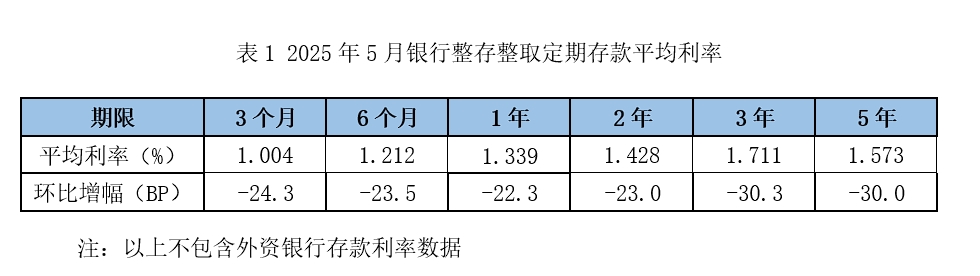
Core Viewpoint - The report from融360 Digital Technology Research Institute indicates a significant decline in bank deposit rates in May, with medium to long-term rates entering the "1 era" and severe inversion in rates between 3-year and 5-year deposits [1][3]. Group 1: Deposit Rate Trends - In May, the average interest rates for fixed-term deposits across various durations showed a downward trend, with 3-month, 6-month, 1-year, 2-year, 3-year, and 5-year rates at 1.004%, 1.212%, 1.339%, 1.428%, 1.711%, and 1.573% respectively [1]. - Compared to the previous month, the average rates for 3-month, 6-month, 1-year, 2-year, 3-year, and 5-year deposits decreased by 24.3 basis points, 23.5 basis points, 22.3 basis points, 23.0 basis points, 30.3 basis points, and 30.0 basis points respectively [1]. - The average interest rate for 5-year deposits is 0.14 percentage points lower than that for 3-year deposits, indicating a significant inversion [1]. Group 2: Large Certificate of Deposit (CD) Trends - The average interest rates for large CDs also declined across all terms, with 3-month, 6-month, 1-year, 2-year, 3-year, and 5-year rates decreasing by 10.24 basis points, 11.26 basis points, 12.25 basis points, 13.75 basis points, 8.81 basis points, and 28.33 basis points respectively [2]. - The average interest rate for 3-month large CDs is 1.239%, while the 5-year rate is significantly lower at 1.700% [2]. Group 3: Structured Deposit Trends - The average expected middle yield for RMB structured deposits in May was 1.85%, a decrease of 6 basis points from the previous month, while the average expected maximum yield was 2.25%, down by 10 basis points [2]. - Different types of banks showed varying trends in structured deposit yields, with state-owned banks having an average maximum yield of 2.18%, down 15 basis points, while foreign banks had a higher average maximum yield of 4.35%, down 16 basis points [2]. Group 4: Market Response and Future Outlook - A significant adjustment in the deposit rate structure occurred in May, initiated by major state-owned banks, marking the first large-scale rate adjustment since 2025 and the seventh rate cut since October 2024 [3]. - Following the major banks, smaller banks also adjusted their deposit rates downward, reflecting a general trend across the banking sector [3]. - Analysts suggest that the central bank will continue to implement moderately loose monetary policies to lower corporate financing costs and stimulate economic recovery, indicating a likely continued downward trend in deposit rates [4].






存款利率全线跳水:5年期大额存单“超速”俯冲,中长期限倒挂严重
Di Yi Cai Jing· 2025-06-19 04:54
Core Viewpoint - The report from Rong360 Digital Technology Research Institute indicates a significant decline in bank deposit rates, with medium to long-term rates entering the "1 era" for the first time since 2025, following a series of rate cuts by major banks [5][6]. Group 1: Deposit Rate Trends - The average interest rates for fixed-term deposits in May were reported as follows: 3-month at 1.004%, 6-month at 1.212%, 1-year at 1.339%, 2-year at 1.428%, 3-year at 1.711%, and 5-year at 1.573% [1][3]. - Month-on-month changes showed a decline in average rates across all terms, with the 3-month rate down by 24.3 basis points (BP), 6-month by 23.5 BP, 1-year by 22.3 BP, 2-year by 23.0 BP, 3-year by 30.3 BP, and 5-year by 30.0 BP [3][4]. - Notably, the 5-year average rate is 0.14 percentage points lower than the 3-year rate, indicating a severe inversion in rates [3]. Group 2: Large Denomination Certificates of Deposit (CDs) - The average interest rates for large denomination CDs also decreased, with 3-month at 1.239%, 6-month at 1.459%, 1-year at 1.561%, 2-year at 1.648%, 3-year at 2.069%, and 5-year at 1.700% [4]. - The month-on-month declines for large denomination CDs were 10.24 BP for 3-month, 11.26 BP for 6-month, 12.25 BP for 1-year, 13.75 BP for 2-year, 8.81 BP for 3-year, and 28.33 BP for 5-year [4]. Group 3: Structured Deposits - The average term for RMB structured deposits in May was 90 days, unchanged from the previous month but shortened by 12 days compared to the same period last year, with an average expected middle yield of 1.85% [4]. - The average expected maximum yield for structured deposits varied by bank type, with state-owned banks at 2.18%, joint-stock banks at 2.23%, city commercial banks at 2.25%, and foreign banks at 4.35% [4]. Group 4: Market Response and Future Outlook - Major state-owned banks initiated a significant reduction in deposit rates on May 20, marking the first large-scale adjustment since 2025 and the seventh rate cut since October 2024 [5]. - Analysts suggest that the central bank will continue to implement a moderately loose monetary policy to lower corporate financing costs and stimulate economic recovery, indicating a continued downward trend in deposit rates [6].
2025下半年配置策略展望:漫长“再通胀”之路与商品策略二三年
Guo Tai Jun An Qi Huo· 2025-06-18 09:47
Report Industry Investment Rating No information provided regarding the report industry investment rating. Core Viewpoints of the Report - The overall view is that it's not the right time to over - allocate commodities, and patience is needed. The 10 - year Chinese Treasury bond interest rate is expected to be in the range of 1.6 - 1.8%, and Treasury bond futures should be bought on dips. The stock index has a ceiling and a floor [2][3]. - In 2025, the US economy faces "stagflation" or "recession" risks, while China is on a long "re - inflation" path. Based on these economic judgments, there are corresponding trading opportunities and asset - allocation suggestions in the second half of 2025 [8][25][37]. Summary According to the Directory 1. Review of the First Half of 2025 - **Differentiation of Sino - US Commodities**: In the first half of 2025, US commodities first rose and then fell, while Chinese commodities were weak. Overseas, Trump's tariff policy and the trend of rising initial jobless claims and slowing new employment in the US affected commodity prices. The US had obvious inventory - replenishing imports, with imports from January to March reaching $1.2 trillion, a year - on - year increase of 23%, and retail and food service sales from January to March at $2.1 trillion, a year - on - year increase of 4.6%. Domestically, from March to April, the sales of commercial housing weakened, and the domestic demand was still weak. In May, China's PPI was - 3.3% and continued to decline. Exports were supported by the rush - to - export factor, but overall, under the high - interest - rate environment of the Fed, prices were under pressure [5][6]. 2. Outlook for the Second Half of 2025 2.1 The US: Risk of Economic "Soft Landing" to "Recession" - **Risk of "Stagflation" or "Recession"**: The US government's debt support for residents' income and consumption is difficult to sustain. The US government faces the pressure of reducing fiscal deficits (the fiscal deficit/GDP in 2024 - 25 was still as high as 6.8%). In April 2025, the US fiscal expenditure was $591.8 billion, and the 12 - month Rollsum was $7.09 trillion, a year - on - year increase of 11.8%; the fiscal revenue was $850.2 billion, and the 12 - month Rollsum was $5.06 trillion, a year - on - year increase of 7.4%. The annual deficit in April 2025 was $2.03 trillion, accounting for 6.8% of the US GDP in Q1 2025 [8][9]. - **Economic Slowdown**: The real GDP growth rate in the first quarter of 2025 was - 0.2% on a quarter - on - quarter annualized basis, indicating an obvious economic slowdown. It is expected that the real GDP growth rate in 2025 will be between 1.6% - 2.3%, depending on the Fed's interest - rate cut speed and the realization of stable tax - cut policy expectations. Trump's policies have both positive and negative impacts on the US economy [19]. - **High Inflation and Interest - Rate Expectations**: Inflation may remain above the 2% target, forcing the Fed to maintain the policy interest rate above 3.5%. It is expected that by the end of 2025, the US federal funds rate will drop to 3.75%, and the first interest - rate cut in the second half of 2025 is expected to be in October [23]. 2.2 China: A Long "Re - inflation" Road - **Difficulty in PPI Recovery**: In May 2025, China's PPI was - 3.3% year - on - year, and CPI was - 0.1% year - on - year. Under the background of de - globalization and the reconstruction of the Chinese real - estate model, the path for China's PPI to turn positive is long and difficult. The slow recovery of commercial housing sales and M1, as well as the decline in US imports, will lead to a slow recovery of China's PPI [25]. - **Challenges in Inflation Upturn**: China's inflation upturn faces challenges, including the Fed's high - interest - rate policy, the difficulty of the real - estate price recovery, and over - capacity in some industries. To get out of deflation, China can observe three groups of variables: the continuous expansion of base money and stock money, the continuous resilience of external demand exports, and the maintenance of an "active fiscal policy" [25][31][33]. - **Monetary Policy Stance**: Monetary policy will maintain a supportive stance and strengthen the amplitude of reserve - requirement ratio cuts and interest - rate cuts. It is expected that in 2025, China's policy interest rate will be cut by 30 - 40BP in two installments, and the deposit - reserve ratio will be cut by 50 - 100BP in two installments [36]. 3. Allocation Outlook for the Second Half of 2025 - **US Economic Situation and Asset Allocation**: It is expected that in the second half of 2025, the resilience of the US economy will decline, consumption and imports will fall, and private investment will be under pressure. The yield of US Treasury bonds will oscillate at a high level with a risk of decline; the US dollar will oscillate with a risk of further weakening; gold can still be bought on dips, but trading opportunities are not obvious. The 10 - year US Treasury bond yield will oscillate between 3.8% - 4.5% and is expected to decline; the US dollar is expected to oscillate between 95 - 100 and tend to decline [37][38]. - **China's Economic Situation and Asset Allocation**: The active fiscal policy will support the Chinese economy, and the currency will be further loosened. It is expected that inflation will still be under pressure in the second half of 2025. There is still an expectation of a 30 - 40BP interest - rate cut in the monetary - policy end. With the support of liquidity, the A - share market will maintain active trading, and the yield of Treasury bonds will further decline. Before the policy supports the improvement of the fundamentals, commodity prices will still be suppressed by insufficient demand. The CSI 300 index is expected to be between 3400 - 4400 points; the yield of 10 - year Chinese Treasury bonds is expected to be between 1.6 - 1.8%; commodities are expected to oscillate weakly in the second half of 2025, and attention should be paid to the market opportunities in the third quarter of 2025 [37][38][39].
一揽子金融支持措施落地显效 前5月人民币贷款增加10.68万亿元
Ren Min Ri Bao· 2025-06-13 21:40
据初步统计,前5个月,我国社会融资规模增量累计为18.63万亿元,比上年同期多3.83万亿元,其中, 对实体经济发放的人民币贷款增加10.38万亿元,同比多1123亿元。截至2025年5月末,我国社会融资规 模存量为426.16万亿元,同比增长8.7%。其中,对实体经济发放的人民币贷款余额为262.86万亿元,同 比增长7%。 在存款方面,前5个月,我国人民币存款增加14.73万亿元。其中,住户存款增加8.3万亿元,财政性存款 增加2.07万亿元,非银行业金融机构存款增加3.07万亿元。截至5月末,本外币存款余额324.08万亿元, 同比增长8.3%,人民币存款余额316.96万亿元,同比增长8.1%。 在货币供应量方面,截至5月末,我国广义货币余额325.78万亿元,同比增长7.9%;狭义货币余额 108.91万亿元,同比增长2.3%;流通中货币余额13.13万亿元,同比增长12.1%。前5个月净投放现金 3064亿元。 中国人民银行数据显示:今年前5月,我国人民币贷款增加10.68万亿元。截至5月末,本外币贷款余额 270.2万亿元,同比增长6.7%,人民币贷款余额266.32万亿元,同比增长7.1%。 ...
千万资金池激活消费新引擎
Jin Rong Shi Bao· 2025-06-10 03:18
Group 1 - The consumption market in Linyi City, Shandong Province, is experiencing unprecedented growth opportunities driven by initiatives like "Shopping in Linyi Mall" and "Beautifying the Yihe River" [1] - As of the end of Q1, the total consumer loan balance in Linyi reached 338.9 billion yuan, accounting for 29.9% of all loans [1] Group 2 - The People's Bank of China in Linyi has integrated into the automobile trade-in policy, promoting favorable auto loan terms and facilitating a total of 8.24 billion yuan in auto installment and consumption loans in Q1 [2] - The average interest rate for new housing loans in Linyi was 3.13% in Q1, a decrease of 0.76 percentage points year-on-year [2] Group 3 - A financial subsidy pool of 20 million yuan was established to stimulate consumption through a collaborative model involving policy, finance, and consumer scenarios [3] - In Q1, banks in Linyi provided over 2.4 million yuan in consumer finance benefits, driving consumption by over 28 million yuan [3] Group 4 - The People's Bank of China in Linyi is actively involved in key consumption sectors such as e-commerce, culture and tourism, and automotive, with a focus on creating a service system that combines policy, scenario integration, and financial empowerment [4] - In Q1, the Agricultural Bank of China in Linyi issued 1.26 billion yuan in loans focused on the cultural tourism sector [4] Group 5 - The implementation of fee reduction policies has led to a total of 1.43 billion yuan in payment fee reductions for 938,800 market entities, effectively lowering their payment costs [5]
传递稳市场稳预期的明确信号(国际论道)
Ren Min Ri Bao Hai Wai Ban· 2025-06-08 22:50
Core Points - The People's Bank of China has lowered the one-year Loan Prime Rate (LPR) to 3.0% and the five-year LPR to 3.5%, marking the first decrease in 2023, which is expected to reduce financing costs for businesses and households [2][3][4] - A series of financial policies have been introduced to stabilize the market and promote economic growth, including lowering the reserve requirement ratio and interest rates for various loans [4][5] - The measures aim to boost credit demand, enhance consumer spending, and support key sectors such as technology innovation and real estate [6][7][8] Financial Policy Measures - The recent interest rate cuts are part of a broader financial policy package that includes a 0.5 percentage point reduction in the reserve requirement ratio and a 0.1 percentage point cut in policy rates [4][6] - The central bank has increased the re-lending quota for technology innovation and transformation from 500 billion to 800 billion yuan, indicating a strong focus on supporting technological advancements [7] - The financial policies are designed to ensure liquidity in the market and maintain stability in the financial system, with a particular emphasis on consumer spending and real estate financing [8][9] Market Impact - The reduction in LPR is expected to stimulate credit demand, thereby unlocking investment potential for businesses and increasing consumer spending [3][4] - Analysts believe that the financial measures will enhance market confidence and support stock market performance, with positive implications for regional markets influenced by Chinese demand [4][5] - The overall trade performance of China remains resilient, with a reported 2.4% year-on-year increase in total trade value from January to April 2023, indicating effective policy support for external trade [8][9]