
人工智能(AI)

Search documents
国家安全部:一份给您的“智能生活安全说明书”
Yang Shi Wang· 2025-12-25 23:00
Core Insights - The rapid development of AI models is transforming various industries and daily life, creating new job opportunities while also presenting challenges related to data privacy and algorithmic bias [3][4]. Group 1: AI Integration in Daily Life - AI is being utilized in education, allowing teachers to generate lesson plans in five minutes, significantly reducing preparation time from two hours [1]. - Elderly individuals are finding companionship and assistance through AI devices, which can remind them of medication and important dates [1]. - New job roles, such as prompt engineers, are emerging as individuals adapt to working with AI technologies [1]. Group 2: Challenges and Risks - The use of open-source frameworks for AI models has led to security vulnerabilities, allowing unauthorized access to sensitive data [4]. - Deepfake technology poses risks by enabling the creation of misleading content that can threaten personal rights and national security [4]. - Algorithmic bias is a concern, as AI models may reflect societal prejudices present in their training data, leading to skewed outputs based on language and cultural context [4]. Group 3: Safety Guidelines - Establishing clear boundaries for AI usage is essential, including minimizing permissions and avoiding the processing of sensitive data [7]. - Regularly reviewing digital footprints and being cautious about sharing personal information with AI systems is recommended [7]. - Encouraging critical thinking when interacting with AI, especially on sensitive topics, is vital to avoid misinformation [7]. Group 4: National Security Perspective - The importance of understanding and safely using technology is emphasized as a means to harness AI's potential for societal progress [8]. - Users are encouraged to report any suspicious activities related to AI models that may compromise personal data security [8].


美联储主席即将换人背景下,2026年全球资产如何走? 每经专访加拿大皇家银行BlueBay资管公司首席投资官马克·道丁
Sou Hu Cai Jing· 2025-12-25 14:45
Group 1 - The core focus of the upcoming transition in the Federal Reserve leadership is not just personnel but also the potential direction of future monetary policy, especially in light of past criticisms from Trump regarding Powell's interest rate decisions [1][5] - Mark Dowding, CIO of RBC BlueBay Asset Management, believes that the Federal Reserve will not lower interest rates before Powell's term ends in May 2026, with rates expected to remain unchanged for the next six months [2] - There is a clear distinction being made within the White House from the aggressive rate cut views of Fed Governor Stephen Milan, as inflation remains a concern, currently at 3% and projected to rise to 3.5% by mid-2026 [3][4] Group 2 - The new Federal Reserve chair is unlikely to simply cater to Trump's preferences for rate cuts, as economic fundamentals will dictate any potential rate adjustments [5] - The nomination process for Federal Reserve officials requires Senate approval, ensuring that appointees are credible and capable, which mitigates concerns about the Fed becoming a political tool [7] - Dowding suggests that while Powell maintains respect among colleagues, the Fed may increasingly focus on economic growth targets rather than solely on inflation control, which could raise concerns for market participants [7] Group 3 - The U.S. stock market is approaching a bubble, particularly in the technology and AI sectors, with concerns that overvalued companies may face significant corrections if growth slows [9] - Dowding predicts that the first half of 2026 may see strong performance in U.S. equities, but the second half could be challenging as questions arise about the sustainability of AI spending growth [11] - The dollar is expected to strengthen in the first half of 2026, although this outlook is not definitive due to inherent uncertainties in the currency markets [12] Group 4 - The outlook for the euro and pound is weak due to prolonged economic underperformance and low interest rates, which supports the expectation of a stronger dollar in the coming months [13] - There is a structural trend towards diversification in global foreign exchange reserves, with funds flowing into precious metals, which may benefit commodities overall [13] - Gold prices are anticipated to have potential upside in 2026, driven by inflation concerns and the Fed's interest rate decisions, although a repeat of the strong gains seen in 2025 is unlikely [13][15]

景顺:看好2026年亚洲股票 AI仍是亚洲市场的结构性增长主题
Zhi Tong Cai Jing· 2025-12-25 06:07
Group 1 - The core view of the report is that Asian stocks are expected to perform robustly in 2025, driven by favorable policies, strong domestic demand, and AI-driven innovations [1] - The report anticipates a continued decline in the US dollar, which historically benefits Asian stocks, and a globally accommodative monetary policy environment that may lead investors to shift from the US market to more attractively valued Asian economies [1] - The outlook for 2026 is positive for Asian stocks due to improved earnings prospects, favorable liquidity conditions, and ongoing structural reforms, presenting attractive investment opportunities for global investors [1] Group 2 - The next phase of growth in Asia will be driven by the real-world application of AI, with accelerated adoption in healthcare, finance, manufacturing, and e-commerce expected to unlock more earnings and boost productivity [2] - Asia's competitive advantage lies in its vast data ecosystem, cost-effective talent pool, and government-supported digital strategies, which will facilitate scalable AI solutions [2] - The report emphasizes a preference for companies with clear monetization paths, proprietary technologies, and integration capabilities that can incorporate AI into their overall business deployment [2] Group 3 - In China, the report maintains an optimistic outlook supported by structural growth drivers and clear policy focus, with domestic consumption expected to contribute approximately 60% to economic growth from 2021 to 2024 [2] - The "14th Five-Year Plan" highlights China's commitment to breakthroughs in core technologies and the development of advanced manufacturing and emerging industries, such as semiconductors and green energy, to reduce reliance on foreign supply chains [2] - The report notes that industry consolidation is alleviating overcapacity issues in manufacturing, allowing leading companies to achieve sustained growth through advanced technologies and resources [2] Group 4 - In India, despite a lag in stock market performance compared to Asia and global peers in 2025, a turning point is expected in 2026, supported by stable consumption and investment trends [3] - Recent government measures, including reductions in the Goods and Services Tax (GST) and personal income tax, are anticipated to ease household tax burdens and stimulate consumption, particularly benefiting sectors like consumer goods [3] - South Korea and Taiwan are expected to benefit from the ongoing technology cycle, especially in high-frequency storage and semiconductors, with long-term capacity growth anticipated due to rising AI application demand [3] Group 5 - ASEAN markets present attractive investment opportunities, although political uncertainties in some countries should be noted [4] - Singapore is highlighted for its stable economic outlook, supported by favorable policies and abundant liquidity, while Malaysia continues to attract global semiconductor and tech hardware companies [4] - The Philippines is expected to benefit from urbanization, a young population, and remittances, contributing to a solid foundation for long-term economic growth [4] - Overall, despite short-term uncertainties, Asia's large domestic market and evolving innovation ecosystem reinforce sustainable growth, with structural drivers continuing to support resilience in the region [4]
强冲击之下,2025年这个万亿市场是至暗时刻,更是涅槃重生
Sou Hu Cai Jing· 2025-12-25 06:00
Core Viewpoint - The consumer finance industry is undergoing significant changes due to new regulations, leading to a compression of profit margins. This situation raises the question of whether the industry is entering a "darkest hour" or if it is a necessary purification and return to value [2][3]. Group 1: Industry Changes and Regulations - The implementation of the "Commercial Banks Internet Lending Business Management Measures" on October 1 requires banks to include all guarantee service fees in the comprehensive financing cost, capping the annual interest rate at 24% [3]. - This new regulation disrupts the existing profit logic of many consumer finance institutions, which relied on high-interest rates to cover risks and operational costs [3][4]. - The cost structure for consumer finance institutions is estimated to include funding costs of approximately 3%-5%, traffic costs of 4%-5%, risk costs of 7%-9%, and operational costs of 4%-6% [3]. Group 2: Industry Response and Adaptation - Amidst collective anxiety, some institutions are positively responding by shedding high-risk and non-compliant businesses, while others are forming localized service ecosystems through partnerships with local banks and consumption scenarios [4]. - The industry is experiencing a wave of layoffs, salary reductions, and business contractions as institutions adapt to the new regulatory environment [3][4]. - The long-term survival of the industry will depend on institutions that proactively adapt and adhere to the essence of financial services [2][5]. Group 3: Historical Context and Future Outlook - The consumer finance industry has evolved over the past decade from disorder to order, with significant regulatory guidance leading to the elimination of non-compliant entities [5][6]. - The industry has seen explosive growth since around 2015, driven by a combination of consumer upgrading and internet trends, but has also faced challenges such as P2P platform expansion and compliance issues [6][7]. - The next decade will focus on the integration of "self-operated + technology" as a core strategy for institutions to thrive in a low-interest environment [10][11]. Group 4: Technological Integration and Competitive Landscape - The combination of self-operated capabilities and technology is essential for addressing challenges such as high costs and risk management in the consumer finance sector [11][12]. - Institutions that have invested in technology and built self-operated customer bases are better positioned to navigate economic cycles and regulatory pressures [11][12]. - The competition in the next decade will shift from scale and interest margin to the comprehensive capabilities of "self-operated + technology," with those lacking in these areas likely to be eliminated from the market [12].

AI在广西,读懂未来
Xin Lang Cai Jing· 2025-12-25 05:03
Group 1 - The core theme of the event is the integration of AI into various industries, showcasing how AI can enhance everyday life and business operations [1] - The "AI Empowering Thousands of Industries Super League" (referred to as "A Super") features 20 competition tracks with participation from 10,447 teams across 31 provinces in China and 11 ASEAN countries, including 604 teams from ASEAN [1] - The event highlights successful collaborations between companies and ASEAN partners, aiming to expand market opportunities [1] Group 2 - The "A Super Night" event is scheduled to take place on December 26 at Guangxi University, where the impact of AI on local communities and lifestyles will be showcased [1] - Various innovative applications of AI are presented, such as precision dispatching in 10 seconds and AI-driven customer service for cross-border e-commerce [1]

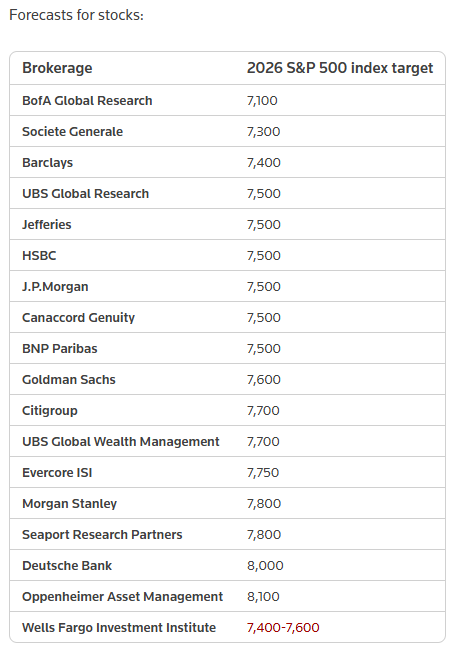
华尔街齐声唱多2026年美股!AI与降息共振下有望四年连涨 但高度共识或成隐忧
Zhi Tong Cai Jing· 2025-12-25 02:09
| Brokerage | 2026 S&P 500 index target | | --- | --- | | BofA Global Research | 7,100 | | Societe Generale | 7,300 | | Barclays | 7,400 | | UBS Global Research | 7,500 | | Jefferies | 7,500 | | HSBC | 7,500 | | J.P.Morgan | 7,500 | | Canaccord Genuity | 7,500 | | BNP Paribas | 7,500 | | Goldman Sachs | 7,600 | | Citigroup | 7,700 | | UBS Global Wealth Management | 7,700 | | Evercore ISI | 7,750 | | Morgan Stanley | 7,800 | | Seaport Research Partners | 7,800 | | Deutsche Bank | 8,000 | | Oppenheimer Asset ...
格林大华期货早盘提示-20251225
Ge Lin Qi Huo· 2025-12-25 00:10
| 板块 | 品种 | 多(空) | 推荐理由 | | --- | --- | --- | --- | | | | | 【行情复盘】 周三成长类指数带动市场走强,市场人气逐步恢复,航天卫星板块涨幅居前。两市 | | | | | 成交额 1.88 万亿元,基本无变化。中证 500 指数收 7352 点,涨 95 点,涨幅 1.31%; | | | | | 中证 1000 指数收 7506 点,涨 113 点,涨幅 1.54%;沪深 300 指数收 4634 点,涨 | | | | 13 | 点,涨幅 0.29%;上证 50 指数收 3025 点,跌 2 点,跌幅-0.08%。行业与主题 ETF | | | | | 中涨幅居前的是卫星产业 ETF、通用航空 ETF 南方、航天 ETF、科创材料 ETF、高端 | | | | | 装备 ETF,跌幅居前的是畜牧 ETF、养殖 ETF、农业 ETF。两市板块指数中涨幅居前 | | | | | 的是航天装备、玻璃玻纤、元器件、商业航天、大飞机指数,跌幅居前的是养殖业、 | | | | | 贵金属、煤炭开采、饲料、游戏指数。中证 500、中证 1000、沪深 300、上证 ...
NVIDIA 年底反弹在望!2026运势紧盯2大 OpenAI 进展
Jing Ji Ri Bao· 2025-12-24 23:51
Group 1 - The S&P 500 index has reached a new closing high, indicating a potential year-end rally, with Nvidia leading the charge [1][2] - Fundstrat's technical strategist Newton predicts a rebound in the market, with Nvidia expected to perform well in the coming weeks, which is significant for the U.S. stock market [2] - Nvidia's stock price has shown a notable increase, breaking through a downward trend line, suggesting a bullish outlook for the tech sector [2][3] Group 2 - Nvidia's next technical resistance levels are identified at $196 and $212, with a potential rise towards $220 if it closes above $212 [2] - The S&P 500 index has broken through the critical level of 6,903 points, suggesting a possible year-end close above 7,000 points [3] - The market is advised to remain bullish, with any minor pullbacks seen as buying opportunities [3] Group 3 - Argent Capital's manager expects continued demand for computing power, citing supply chain shortages and conservative capacity expansion by TSMC as key factors [4] - The anticipated release of OpenAI's new GPT model in early 2026, trained on Nvidia's latest Blackwell chips, could significantly impact Nvidia's market position [4] - Gabelli Funds' manager emphasizes the importance of the new GPT model's performance for Nvidia, comparing it to the recent success of Google's Gemini 3 model [4] Group 4 - Concerns about competition from Google's Gemini 3 model are noted, but it is suggested that the real competition lies in the rivalry between OpenAI and Google rather than a direct threat to Nvidia [5][6] - Custom chips developed by other companies are not expected to pose a significant threat to Nvidia, as Nvidia's Blackwell chips are versatile and support various data centers [6] - The market will closely monitor the progress of OpenAI's Stargate data centers and its recurring revenue targets, which will help alleviate investor concerns regarding Nvidia's competitive advantage [6]
「AI教母」李飞飞最新采访:我最恐惧的,是人类在AI面前的放弃
3 6 Ke· 2025-12-24 23:45
"我信仰的是人,不是 AI。" 在最近一场与钛媒体的对话中,这句看似简单却极不妥协的话,是李飞飞反复强调的核心立场:技术再先进,也不能替代人类自身的价值和责任。 李飞飞提出,当前 AI 的发展不能仅停留在语言和感知层面,它必须迈向更深层的空间智能——让机器能够理解、推理并与三维世界互动,而不是停留在 二维符号处理的表层。 她认为,这种能力的突破不是简单的技术堆叠,而是让 AI 能够真正"理解世界"的基本能力。 李飞飞不会回避 AI 的优势,但更担忧公众对技术的误读和过激叙事。 在她看来,当下围绕 AI 的讨论中存在从"末日论"到"乌托邦论"的极端观点,这既可能误导公众认知,也让有意义、务实的讨论变得更加困难。 对她而言,技术进步带来的,不仅是效率提升和产业变迁,更是对教育体系、社会结构乃至人类潜力的深刻挑战。 这正是她如此关注教育变革的原因。在她看来,传统的教育方法已经无法应对 AI 时代学生真正需要培养的能力——好奇心、批判性思维、创造力和空间 想象力。 "AI就是工具,工具就是双刃剑……我们对其他工具的期待,永远不是说让这个工具去 figure out (弄明白)要做什么,这是人类的责任。" 这不仅是对 ...

美银筛出2026年六大芯片股,看好半导体行业销售额突破1万亿美元
Feng Huang Wang· 2025-12-24 22:34
Arya 依然保持乐观,认为当前的投入既具有"进攻性",也具有"防御性"。换言之,科技巨头别无选 择,必须投资以守住他们现有的商业帝国。 Arya特别提到,英伟达就像是在"另一个星系"中运营。年初至今,英伟达股价已累计上涨超40%,过高 的估值令部分投资者"望而却步"。 12月25日,美国银行分析师Vivek Arya表示,人工智能(AI)热潮并未降温,反而正在进一步扩大。 尽管一些AI怀疑论者认为过高的估值是回避该板块的理由,但Arya认为,这一行业仍处在为期十年的 结构性变革"中点",而这场变革是由英伟达和博通引领的。 Arya在题为《2026年展望:颠簸但仍充满希望》的报告中预计,明年全球半导体销售额将同比增长 30%,这将最终推动该行业首次突破具有里程碑意义的1万亿美元年销售额。 Arya指出,他尤其看好那些"护城河可以通过利润率结构量化"的公司。除英伟达和博通外,他还将泛林 集团、科磊、亚德诺以及铿腾电子列为2026年的首选标的。 "我经常说,投资半导体其实很简单,"Arya在12月19日电话会议上表示,"你根本不需要卖方分析师。 只要把所有公司按毛利率排序,买前五名,基本不会错得太离谱。" 美银预 ...

