无人驾驶

Search documents
长城汽车跌2.01%,成交额4.17亿元,主力资金净流出2938.79万元
Xin Lang Cai Jing· 2025-09-18 06:47
Core Viewpoint - Great Wall Motors' stock price has experienced a decline of 4.02% year-to-date, with a recent drop of 3.01% over the last five trading days, despite a notable increase of 18.97% over the past 60 days [2] Financial Performance - For the first half of 2025, Great Wall Motors achieved a revenue of 92.335 billion yuan, reflecting a year-on-year growth of 0.99%. However, the net profit attributable to shareholders decreased by 10.48% to 6.337 billion yuan [2] - Cumulatively, since its A-share listing, Great Wall Motors has distributed a total of 34.696 billion yuan in dividends, with 8.95 billion yuan distributed over the last three years [3] Stock Market Activity - On September 18, Great Wall Motors' stock price fell by 2.01%, trading at 24.84 yuan per share, with a total transaction volume of 417 million yuan and a turnover rate of 0.27%. The company's total market capitalization stands at 212.578 billion yuan [1] - The net outflow of main funds amounted to 29.3879 million yuan, with large orders showing a buy of 67.6615 million yuan and a sell of 91.1915 million yuan [1] Shareholder Structure - As of June 30, 2025, Great Wall Motors had 178,500 shareholders, an increase of 18.73% from the previous period. The average circulating shares per person remained at 0 [2] - The top three circulating shareholders include China Securities Finance Corporation with 197 million shares, Hong Kong Central Clearing Limited with 85.5192 million shares (a decrease of 1.9369 million shares), and E Fund Consumption Industry Stock with 51.0764 million shares [3]

中集车辆跌2.05%,成交额1.04亿元,主力资金净流出1274.01万元
Xin Lang Cai Jing· 2025-09-18 06:00
Company Overview - CIMC Vehicles (Group) Co., Ltd. was established on August 29, 1996, and listed on July 8, 2021. The company is located at 40/F, Daxin Financial Center, 248 Queen's Road East, Wan Chai, Hong Kong, and at 2 Haibin Avenue, Shekou, Nanshan District, Shenzhen, Guangdong Province [2] - The main business involves the production of semi-trailers, special vehicle superstructures, and refrigerated truck bodies. The revenue composition is as follows: 80.61% from global semi-trailers, 17.14% from superstructures, chassis, and tractors, and 2.25% from other sources [2] Financial Performance - As of June 30, 2025, CIMC Vehicles reported a revenue of 9.753 billion yuan, a year-on-year decrease of 8.85%, and a net profit attributable to shareholders of 403 million yuan, down 28.48% year-on-year [2] - The company has distributed a total of 2.664 billion yuan in dividends since its A-share listing, with 1.655 billion yuan distributed over the past three years [3] Stock Performance - The stock price of CIMC Vehicles has increased by 3.65% year-to-date, with a decline of 3.81% over the last five trading days, a rise of 2.13% over the last 20 days, and an increase of 12.08% over the last 60 days [2] - As of September 18, 2023, the stock was trading at 9.09 yuan per share, with a market capitalization of 17.036 billion yuan [1] Shareholder Information - As of June 30, 2025, the number of shareholders was 35,500, a decrease of 2.95% from the previous period, with an average of 40,937 circulating shares per shareholder, an increase of 3.04% [2] - Dazheng Gaoxin Stock A (000628) is the sixth largest circulating shareholder, holding 30.0867 million shares, an increase of 5.286 million shares from the previous period [3] Market Activity - On September 18, 2023, the main funds experienced a net outflow of 12.7401 million yuan, with large orders buying 9.7831 million yuan (9.42% of total) and selling 18.3057 million yuan (17.63% of total) [1]
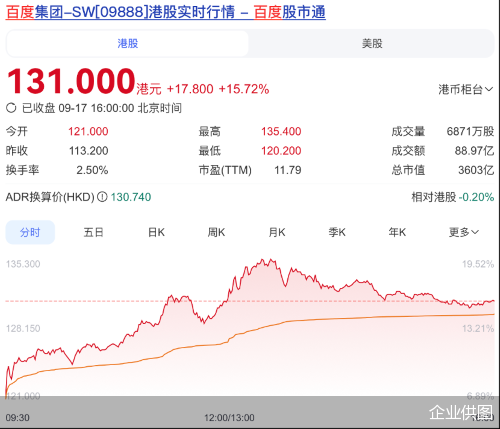
百度港股单日暴涨16%:萝卜快跑领先Waymo,竞逐万亿自动驾驶赛道 百度股价创近两年新高:无人驾驶成为新增长引擎
Bei Jing Shang Bao· 2025-09-18 05:58
Group 1 - Baidu's stock price surged 16% on September 17, closing at HKD 131.4, with a total market capitalization approaching HKD 400 billion, marking a year-to-date increase of over 59% [1] - The strong market sentiment is driven by Baidu's robust development in the autonomous driving sector, with its "Luobo Kuaipao" service making significant strides in the global trillion-dollar market [3] - Baidu's Q2 financial report indicates that "Luobo Kuaipao" has expanded to 16 cities globally, providing over 14 million autonomous rides and achieving a safe driving mileage of over 200 million kilometers, surpassing Waymo's 150 million kilometers [3] Group 2 - The global autonomous driving market is highly competitive, with "Luobo Kuaipao," Waymo, and Tesla being the three major players, leading to intensified competition [5] - Waymo, while currently lacking competition in the U.S., faces significant competition from "Luobo Kuaipao" on a global scale, despite its advanced vehicle deployment in major U.S. cities [5] - The competition in the autonomous driving sector is not only a technological battle but also a contest of policy innovation and government support, highlighting the need for domestic companies to secure greater policy backing to maintain their technological edge [7]


博实结涨2.08%,成交额6220.84万元,主力资金净流入135.49万元
Xin Lang Zheng Quan· 2025-09-18 02:36
Core Viewpoint - The stock of Shenzhen Boshi Technology Co., Ltd. has shown significant growth in 2023, with a year-to-date increase of 44.39% and a recent market capitalization of 8.678 billion yuan [1][2]. Company Overview - Shenzhen Boshi Technology Co., Ltd. was established on June 4, 2009, and is located in Longhua District, Shenzhen, Guangdong Province. The company specializes in the research, design, production, and sales of IoT smart hardware products, including intelligent vehicle terminals, smart travel components, intelligent payment hardware, and wireless communication modules [2]. - The revenue composition of the company is as follows: intelligent vehicle terminals (38.80%), smart travel components (28.42%), other smart hardware (23.20%), intelligent payment hardware (4.94%), and wireless communication modules and others (4.62%) [2]. Financial Performance - For the first half of 2025, the company achieved an operating income of 805 million yuan, representing a year-on-year growth of 20.17%. The net profit attributable to the parent company was 108 million yuan, with a year-on-year increase of 19.07% [2]. - Since its A-share listing, the company has distributed a total of 131 million yuan in dividends [3]. Shareholder Structure - As of June 30, 2025, the top ten circulating shareholders include new entrants such as Xin'ao New Energy Industry Stock A (holding 622,000 shares) and Guangfa Small and Medium Cap Selected Mixed A (holding 372,600 shares) [3]. - The number of shareholders increased by 2.34% to 8,167, while the average circulating shares per person decreased by 2.29% to 4,890 shares [2].
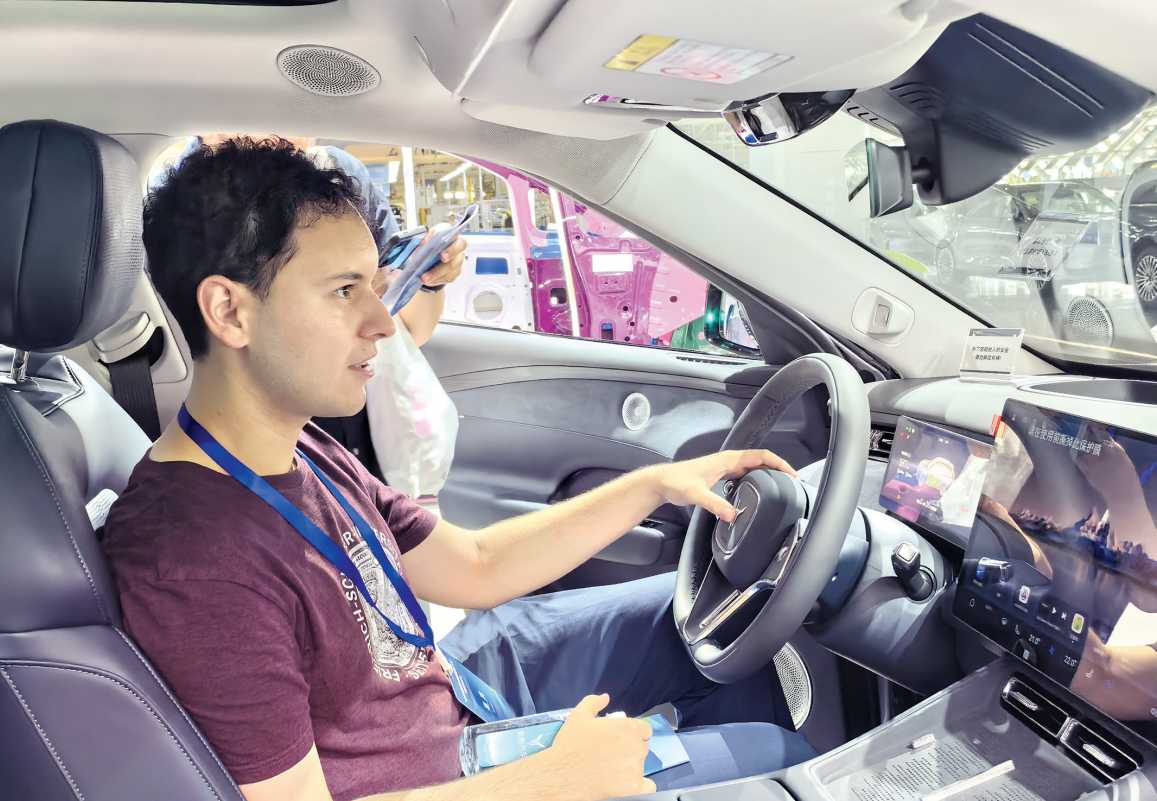
外籍代表在汉体验“通往未来的方式”
Chang Jiang Ri Bao· 2025-09-18 00:24
Group 1 - The international seminar on "New Quality Productive Forces in the Modernization Process" is scheduled for September 19 in Beijing, with representatives visiting regions like Hubei and Shandong from September 16 to 18 to observe local advancements in new quality productive forces [2] - Representatives visited the Wuhan Economic Development Zone, including the National Intelligent Connected Vehicle (Wuhan) Testing Demonstration Zone and Lantu Automotive Technology Co., Ltd., to understand the achievements in intelligent connected vehicles and automotive manufacturing [1] - The experience of test-riding autonomous vehicles generated excitement among foreign representatives, highlighting China's leadership in future transportation technologies [1] Group 2 - At Lantu Automotive's intelligent factory, foreign representatives learned about the research and manufacturing processes of electric vehicles and green technology innovations [1] - The representatives expressed a strong interest in electric vehicles as a modern innovation to address environmental and climate challenges, emphasizing the need for international cooperation in this field [1] - The event is supported by various Chinese governmental and research institutions, indicating a collaborative effort to promote technological advancements and international partnerships [2]
云南锗业:公司子公司的化合物半导体产品为砷化镓晶片、磷化铟晶片
Zheng Quan Ri Bao Zhi Sheng· 2025-09-17 12:09
Core Viewpoint - Yunnan Zheye's subsidiary produces compound semiconductor products, specifically Gallium Arsenide (GaAs) chips and Indium Phosphide (InP) chips, which are essential for various high-tech applications [1] Group 1: Product Applications - Indium Phosphide chips are primarily used in the production of lasers and detector chips within optical modules, with downstream applications in 5G communication, data centers, and wearable devices [1] - Gallium Arsenide chips are utilized in radio frequency devices, lasers, sensors, and high-brightness light-emitting diode (HBLED) products, with downstream applications in smartphones, computers, communication base stations, autonomous driving, next-generation displays (MiniLED, MicroLED), industrial lasers, and facial recognition [1]

自动驾驶卡车公司 Bot Auto 完成其首次无人化枢纽间验证运输
雷峰网· 2025-09-17 09:14
Core Viewpoint - Bot Auto, founded by former TuSimple CEO Hou Xiaodi, aims to revolutionize the autonomous driving industry by achieving fully unmanned operations in freight transport, positioning itself as the "OpenAI of the autonomous driving sector" [9][10]. Company Overview - Bot Auto was established in 2023 and is headquartered in Houston, Texas, focusing on developing and operating Level 4 autonomous trucks under the "Transport as a Service" (TaaS) model [3]. - In October 2024, Bot Auto secured $20 million in Pre-A funding led by Linear Capital and M31 Capital [3]. Milestone Achievements - On September 17, 2025, Bot Auto successfully completed its first unmanned hub-to-hub verification transport in Houston, demonstrating the capability of its trucks to operate without human intervention in real traffic conditions [2][5]. - The verification transport was a significant step towards achieving full unmanned operations, with the goal of maintaining lower operational costs than human drivers [5]. Technology and Operations - Bot Auto's autonomous trucks are equipped with 15 cameras, 8 LiDARs, and 3 millimeter-wave radars, providing superior perception capabilities that exceed human drivers [5]. - The system's "thinking core" is based on advanced algorithms that enable it to understand the environment, perform target detection, path planning, and vehicle control [6]. - The company emphasizes the importance of a comprehensive system that can perceive, understand, and react to its surroundings without human backup, which is crucial for achieving full autonomy [5][6]. Future Plans - Bot Auto plans to continue its verification program, including its first unmanned commercial freight transport between Houston and San Antonio [11]. - Hou Xiaodi expresses a commitment to ensuring the safety and reliability of autonomous driving technology, focusing on the long-term goal of reaching the pinnacle of the industry [11].

千里科技涨2.07%,成交额3.92亿元,主力资金净流入1331.42万元
Xin Lang Cai Jing· 2025-09-17 05:30
Company Overview - Qianli Technology Co., Ltd. is located in Beibei District, Chongqing, established on December 1, 1997, and listed on November 25, 2010. The company primarily engages in the research, production, and sales (including exports) of passenger vehicles (including new energy vehicles), motorcycles, engines, and general gasoline engines, as well as financial investments. The revenue composition is 98.14% from manufacturing, 0.99% from real estate, and 0.87% from other sources [1]. Stock Performance - On September 17, Qianli Technology's stock rose by 2.07%, reaching a price of 11.82 yuan per share, with a trading volume of 392 million yuan and a turnover rate of 0.75%. The total market capitalization is 53.439 billion yuan [1]. - Year-to-date, the stock price has increased by 54.51%, with a 5-day increase of 5.72%, a 20-day increase of 5.16%, and a 60-day increase of 32.36% [1]. Financial Performance - For the first half of 2025, Qianli Technology achieved an operating income of 4.184 billion yuan, representing a year-on-year growth of 40.04%. The net profit attributable to shareholders was 31.1708 million yuan, up by 19.00% year-on-year [2]. Shareholder Information - As of June 30, 2025, the number of shareholders is 58,400, a decrease of 12.63% from the previous period. The average number of circulating shares per person is 77,377, an increase of 14.46% [2]. - The company has cumulatively distributed 1.406 billion yuan in dividends since its A-share listing, with no dividends distributed in the past three years [3]. Institutional Holdings - As of June 30, 2025, Hong Kong Central Clearing Limited is the sixth-largest circulating shareholder, holding 47.6895 million shares, a decrease of 10.628 million shares compared to the previous period [3].

小县城孕育国际产业 浙江德清力推地理信息产业“造峰”
Zheng Quan Shi Bao· 2025-09-16 18:12
Core Viewpoint - Deqing has rapidly developed its geographic information (Geo-Information) industry, becoming a global hub with significant achievements in smart transportation and geographic data applications, supported by a robust industrial ecosystem and government initiatives [1][2][3]. Group 1: Industry Development - Deqing's Geo-Information industry has grown from scratch in just over a decade, establishing a complete industrial chain that includes data acquisition, processing, application, and services [3]. - The region has become a national leader in Geo-Information, hosting over 430 companies and achieving industry revenue exceeding 30 billion yuan [1][2]. - Deqing has been recognized as a national pilot area for vehicle networking and a county-level innovation development zone for artificial intelligence [2]. Group 2: Strategic Initiatives - The local government has initiated a three-year action plan to enhance the Geo-Information industry, aiming to attract 100 landmark projects and cultivate 100 scale enterprises by 2026, with a target industry scale of over 60 billion yuan [7][8]. - A 5 billion yuan industry fund has been established to support the integration of social capital into local enterprises [8]. Group 3: Key Players and Innovations - Companies like KuanDeng Technology are pivotal in the Geo-Information sector, focusing on high-precision map data production and processing, and have relocated their headquarters to Deqing to enhance collaboration with key clients [5]. - YunChuang ZhiXing has launched a large-scale autonomous sanitation vehicle project in Deqing, operating over 31 vehicles and covering 240,000 kilometers, showcasing the practical application of Geo-Information technology [6]. Group 4: Future Outlook - Deqing aims to strengthen its industrial ecosystem by fostering leading enterprises and enhancing collaboration among various sectors, transitioning from mere scale aggregation to value aggregation [8]. - The region's unique advantages include hosting the first UN-affiliated organization in China and high-level research platforms, which contribute to its competitive edge in the Geo-Information industry [3].
万马科技:公司产品不涉及无人驾驶飞行器通信设备但可应用于低空经济领域
Sou Hu Cai Jing· 2025-09-16 07:47
Core Viewpoint - Wanma Technology (300698) is focused on providing network connectivity and data closed-loop solutions for the smart industry, including smart vehicles, but does not currently offer products directly applicable to unmanned aerial vehicles [1] Group 1: Company Products and Services - The company is committed to offering cloud solutions/services necessary for autonomous driving research and development to manufacturers [1] - Current products do not include communication devices or software specifically for unmanned aerial vehicles [1] - The company's capabilities in 5G high-quality connectivity solutions, eSIM, and edge computing can be applied to the low-altitude economy sector [1]