金融科技

Search documents
601519,重组再起波澜!
Zheng Quan Shi Bao Wang· 2025-11-12 00:28
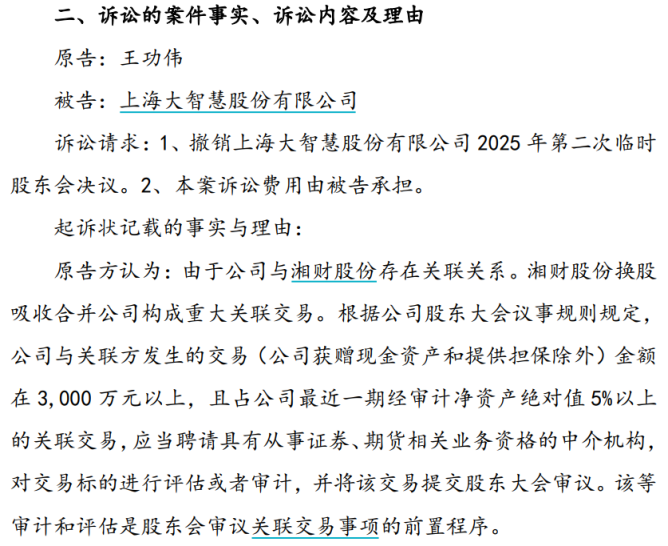
Core Viewpoint - The ongoing merger between Dazhihui (601519) and Xiangcai Co. (600095) faces legal challenges as a shareholder has filed a lawsuit to annul a recent shareholder meeting resolution related to the merger [1][3][15] Group 1: Legal Proceedings - A shareholder, Wang Gongwei, has filed a lawsuit against Dazhihui, claiming that the merger with Xiangcai Co. constitutes a significant related party transaction that requires compliance with specific auditing and evaluation procedures [3][5] - Dazhihui asserts that it has followed all necessary procedures for the merger and will actively respond to the lawsuit, although the case does not currently involve specific financial amounts [5][6] Group 2: Historical Context - The merger discussions between Dazhihui and Xiangcai Co. have been ongoing for ten years, with a previous attempt in 2015 to acquire Xiangcai Securities for 8.5 billion yuan that was halted due to regulatory investigations [6][7] - Xiangcai Co. became Dazhihui's second-largest shareholder in 2020 after Xiangcai Securities went public through a reverse merger [7] Group 3: Financial Performance - Dazhihui's revenue has declined from 819 million yuan in 2021 to 771 million yuan in 2024, with a net loss of 201 million yuan in 2024 [7] - Xiangcai Co. has also faced financial difficulties, with total revenue dropping from 4.571 billion yuan in 2021 to 2.192 billion yuan in 2024, and a net profit of just over 100 million yuan in 2024 [7] Group 4: Merger Details - The merger plan involves Xiangcai Co. issuing A-shares to acquire all Dazhihui shares, with a total fundraising target of up to 8 billion yuan to support various financial technology projects and improve liquidity [13][14] - The merger aims to enhance synergies between the two companies, particularly in internationalizing their securities business [13]


新华财经早报:11月12日
Xin Hua Cai Jing· 2025-11-12 00:20
Financial Technology and Manufacturing - The People's Bank of China plans to develop a financial technology development plan for the "14th Five-Year Plan" period, focusing on the integration of finance and digital technology, and promoting the application of AI models in finance [1] - The Ministry of Industry and Information Technology announced a notification to accelerate the construction of high-level manufacturing pilot platforms, aiming to establish a modern pilot platform system by 2027, covering six key areas and 37 industry directions [1] REITs and Investment - The National Development and Reform Commission has recommended 105 REITs projects to the China Securities Regulatory Commission, with 83 projects already issued, expected to drive new project investments exceeding 1 trillion yuan [1] Trade and Economic Relations - The Ministry of Commerce emphasized the importance of stabilizing the global semiconductor supply chain and urged Germany to encourage the Netherlands to correct its actions regarding semiconductor exports [1] - China's foreign trade in regions like the Yangtze River Delta and the Guangdong-Hong Kong-Macau Greater Bay Area showed a strong resilience, with a 6% year-on-year increase in imports and exports in the first ten months [1] Corporate Developments - Midea Group announced a mid-term dividend of 5 yuan per 10 shares, with the record date set for November 17, 2025 [5] - Haike Sina signed a strategic cooperation agreement with Kunlun New Materials for raw material supply [5] - Zhongyou Engineering won a joint bid for a project in Kazakhstan worth approximately 3 billion yuan [5] Market Performance - The Shanghai Composite Index closed at 4002.76, down 0.39%, while the Shenzhen Component Index fell by 1.03% to 13289.01 [4] - The Hang Seng Index increased by 0.18% to 26696.41, indicating mixed performance across different markets [4]

专访品牌南非姆普法内:非洲首届G20峰会为中资提供历史性机遇
2 1 Shi Ji Jing Ji Bao Dao· 2025-11-11 23:37
Core Insights - South Africa is signaling new cooperation opportunities to global investors, particularly from China, in the context of global green transition and supply chain restructuring [1][2] - The South African Investment Conference held in Beijing emphasized the potential for collaboration in renewable energy, fintech, and agri-tech, highlighting the urgency for early participation [1][5] Renewable Energy - South Africa is actively promoting investments in renewable energy, including hydrogen, solar, and wind energy projects, creating ample opportunities for external investors [4][5] - The urgency for investment in renewable energy is underscored, with the potential for significant mutual benefits for both South Africa and China [5] Financial Services - The financial services sector in South Africa is mature and well-developed, presenting new growth opportunities, particularly in fintech [5] - South Africa encourages Chinese enterprises to engage in digital banking, payments, credit, and blockchain collaborations [5] Agriculture - Agriculture remains a crucial economic pillar for South Africa, with increasing opportunities for investment and collaboration in agri-tech [5] - The opening of the Chinese market has facilitated the entry of more South African products, enhancing bilateral agricultural cooperation [5] Key Mineral Resources - South Africa possesses abundant "critical minerals" essential for battery and renewable energy industries, ranking fifth globally in mining GDP contribution [2][8] - The country produces nearly 60% of the world's platinum group metals, providing a significant resource base for potential investors [2] Strategic Positioning - South Africa serves as a strategic gateway for Chinese investors looking to enter the African market, leveraging its industrialization and financial infrastructure [2][7] - The upcoming G20 summit in South Africa is expected to enhance the country's role in attracting high-quality investments and promoting sustainable development [2][6] Youth and Talent - South Africa has a relatively young population, which is adaptable to new technologies, providing a dynamic labor force for future industries [9] - The country’s industrial base and financial services support innovation, creating a conducive environment for technology-driven investments [9]
105018美元!比特币昨夜突破关键点位,有人狂欢,有人沉默
Sou Hu Cai Jing· 2025-11-11 18:45
Core Insights - Bitcoin has surged to $105,000, but market sentiment is divided, with significant sell orders at this level causing volatility [1] - The price has fluctuated between $100,000 and $113,000 over the past month, even dipping below $99,000, marking a five-month low [1] Institutional Dynamics - The core conflict driving price volatility is the battle between institutions and long-term holders, with MicroStrategy increasing its Bitcoin holdings to 7390 coins at an average price of $103,500, totaling 576,000 coins valued at $59.2 billion [3] - Institutions like Metaplanet and Mubadala are accumulating Bitcoin, contributing to a trend of "institutional hoarding" [3] - The U.S. Bitcoin Strategic Reserve Act has incorporated 198,000 confiscated Bitcoins into national reserves, freezing 6% of the circulating supply [3] - Long-term holders have also been active, with 405,000 previously dormant Bitcoins moved to exchanges in the past month, indicating profit-taking by large holders during price spikes [3] Market Influences - Bitcoin's price movements are closely tied to global financial market dynamics, with geopolitical tensions in the Middle East amplifying market volatility [5] - The Federal Reserve's monetary policy continues to influence capital flows, with a weakening dollar during rate cuts driving some funds towards Bitcoin as a "digital gold" [5] - Traditional financial markets are also competing for capital, impacting Bitcoin's price stability [6] Technological Developments - Bitcoin's value is supported not only by its financial attributes but also by technological advancements, such as a 140% increase in Lightning Network nodes to 18,000 and over 1 million payment channels, with total locked funds reaching $420 million [8] - These upgrades facilitate small payments, exemplified by support from convenience stores in Tokyo [8] - However, competition is intensifying, with Ethereum struggling to maintain the $3,000 mark and new projects like HYPE and RTX emerging [8] Market Sentiment and Historical Trends - The Bitcoin market is characterized by extreme volatility, with a historic sell-off in October resulting in a $1.2 billion market cap evaporation, breaking a seven-year trend of October gains [8] - Despite this, November has historically been a "lucky month" for Bitcoin, with an average increase of over 19% in the past decade [8] - Technical indicators reveal retail investor anxiety, with potential support levels identified at $94,200 following a drop below the 200-day moving average [10] - The contrasting perspectives on Bitcoin's future—ranging from a vision of digital civilization to concerns of a bubble—highlight the ongoing uncertainty in the market [10]

再添新势力!上海信托出资成立外滩金科,瞄准AI赛道
Bei Jing Shang Bao· 2025-11-11 13:29
Core Insights - The establishment of Shanghai Bund Jinke Economic Development Co., Ltd. (referred to as "Bund Jinke") on November 10, 2023, marks a new player in the financial technology sector with a registered capital of 50 million RMB [1][3] - Bund Jinke is jointly owned by Shanghai Huangpu Science and Technology Innovation Group Co., Ltd. and Shanghai International Trust Co., Ltd. Its business scope includes services related to entrepreneurship, technology mediation, artificial intelligence, and intellectual property [1][3] Company Overview - Shanghai International Trust, founded in 1981, is one of the earliest trust companies in China with a registered capital of 5 billion RMB, focusing on asset management and wealth management for high-net-worth clients [3] - The company has a total scale of nearly 40 billion RMB in science and technology equity investments, including significant investments in major Shanghai municipal science and technology funds [3] Strategic Intent - The establishment of Bund Jinke aligns with Shanghai's initiative to enhance its global financial technology center and create a financial technology industry integration demonstration area in Huangpu District [3][4] - The move is seen as a strategic investment to capture opportunities in the financial technology sector, leveraging policy benefits from local government initiatives [4] Business Model and Synergy - Bund Jinke's focus on artificial intelligence and data platforms complements Shanghai International Trust's core business of wealth management and cross-border finance, facilitating a "technology + finance" ecosystem [4][5] - The subsidiary's specialized operations in AI technology are expected to enhance the parent company's capabilities in family trusts and cross-border asset securitization [4][5] Challenges and Considerations - Direct involvement in AI by trust companies faces challenges such as strict regulatory compliance, data security management, and high costs associated with technology development [5] - The establishment of Bund Jinke is anticipated to strengthen Shanghai International Trust's brand influence in the financial technology sector in the short term, while exploring innovative financial models in the long term [5]

45万亿建行新曲线:绿色、普惠、科技三轮驱动
市值风云· 2025-11-11 10:15
Core Viewpoint - The article emphasizes that China Construction Bank (CCB) is focusing on high-quality development amidst a challenging industry environment, characterized by pressure on interest margins and a shift towards value-driven growth in the banking sector [3][17]. Financial Performance - For the first three quarters of 2025, CCB reported operating income of 573.7 billion yuan, a year-on-year increase of 0.82%, and net profit attributable to shareholders of 257.4 billion yuan, up 0.62% year-on-year [4][6]. - In Q3 2025, CCB achieved a net profit of 95.3 billion yuan, reflecting a significant year-on-year growth of 4.19%, indicating a positive trend in profitability [5][6]. Revenue Structure - Non-interest income reached 146.1 billion yuan, growing by 13.95% year-on-year, becoming a key driver of revenue growth [6]. - The net interest margin for the first three quarters was 1.36%, a decrease of 4 basis points from the previous half-year, primarily due to declining asset yields [6]. Asset Quality and Capital Strength - As of September 30, 2025, CCB's total assets amounted to 45.37 trillion yuan, an increase of 11.83% from the end of the previous year, with total loans and advances reaching 27.68 trillion yuan, up 7.1% [7][10]. - The non-performing loan (NPL) ratio stood at 1.32%, a slight decrease of 2 basis points, indicating stable asset quality [8][10]. - CCB's capital adequacy ratios remain strong, with a core Tier 1 capital ratio of 14.36% and a total capital ratio of 19.24%, positioning the bank favorably within the industry [10][18]. Strategic Initiatives - CCB is actively pursuing digital transformation and strategic breakthroughs in areas such as green finance and inclusive finance, with green loan balances increasing by 18.38% year-to-date [12][13]. - The bank has also made significant strides in supporting small and micro enterprises, with loans in this segment exceeding 3.8 trillion yuan [13][18]. Future Outlook - CCB plans to continue enhancing its "retail + inclusive + green" collaborative development strategy, leveraging digital transformation to optimize its asset-liability structure and improve risk pricing capabilities [19].

央行Q3货政报告:未来金融总量增速有所下降是自然的,研究制定“十五五”时期金融科技发展规划
Sou Hu Cai Jing· 2025-11-11 09:42
Core Viewpoint - The People's Bank of China (PBOC) emphasizes the natural decline in financial growth rates as the economy transitions from high-speed growth to high-quality development, aiming to create a suitable monetary and financial environment for sustainable economic growth [1][9][12]. Monetary Policy - The PBOC plans to implement a moderately loose monetary policy, maintaining ample liquidity and ensuring that the growth of social financing and money supply aligns with economic growth and price level expectations [1][4][13]. - The report highlights the importance of using various monetary policy tools to support the real economy and optimize the allocation of financial resources [10][11]. Financial Market Development - The PBOC aims to enhance the bond market, particularly the "technology board," to support private technology enterprises and improve the legal framework for bond issuance [3]. - There is a focus on developing a multi-tiered bond market and promoting the internationalization of the Renminbi, enhancing its use in cross-border trade and investment [3][4]. Financial Technology and Innovation - The PBOC plans to formulate a financial technology development plan for the 14th Five-Year Plan period, promoting the application of artificial intelligence in finance and improving credit data governance [2]. - The report emphasizes the need for continuous innovation in financial tools to maintain market stability and support economic development [8]. Risk Management and Stability - The PBOC is committed to strengthening the macro-prudential management system and enhancing the monitoring and assessment of systemic financial risks [8]. - The report outlines measures to ensure the stability of the financial market and prevent systemic financial risks, including the establishment of a comprehensive risk management framework [8][12]. Economic Performance - The report indicates that China's GDP grew by 5.2% year-on-year in the first three quarters, reflecting resilience and vitality in the economy [9][11]. - The PBOC's policies have contributed to a stable financing environment, with social financing and broad money supply (M2) growing by 8.7% and 8.4% year-on-year, respectively [11].
参股设立科技公司!这家信托公司回应
Zheng Quan Shi Bao Wang· 2025-11-11 09:38
Core Insights - Shanghai Trust has established a new technology company, Shanghai Bund Jinke Economic Development Co., Ltd., with a registered capital of 50 million yuan, in collaboration with Shanghai Huangpu Science and Technology Innovation Group [1][2] - The new company focuses on technology promotion and application services, including entrepreneurial space services, technology intermediary services, and artificial intelligence platforms [1] - This initiative aligns with Shanghai's strategy to enhance its global financial technology center and create a financial technology industry integration demonstration area [1] Company Overview - Shanghai Trust, founded in 1981, is one of the earliest trust companies in China, with a registered capital of 5 billion yuan [2] - In 2023, Shanghai Trust has participated in the establishment of several investment funds and companies, including Shanghai Xinhui Chuang No. 1 Private Investment Fund and Shanghai Guozhi Technology Co., Ltd., with varying ownership stakes [2] - The company has increased its investment in emerging technology industries, focusing on high-end manufacturing, technological innovation, new energy, biomedicine, and digital economy sectors [2] Investment Strategy - Shanghai Trust's total scale of equity investment in technology innovation is nearly 40 billion yuan, with its subsidiary, Xinxin Asset Management Co., Ltd., managing specialized equity investment funds [2] - The company aims to dynamically adjust its investment structure and optimize the scale and duration of its equity investments to seize opportunities across various sectors [2] - By leveraging its trust business experience and resources, Shanghai Trust seeks to enhance investment decision-making and achieve long-term stable returns [2]
央行:稳妥有序推进金融领域人工智能大模型应用 深化征信数据治理与产品创新
Zheng Quan Shi Bao Wang· 2025-11-11 09:23
Core Viewpoint - The People's Bank of China emphasizes the integration of finance and digital technology, highlighting the vast development potential in this area and outlining plans for advancing financial technology during the 14th Five-Year Plan period [1] Group 1: Financial Technology Development - The People's Bank of China will leverage the dual drivers of "digital technology + data elements" to deepen structural reforms in financial supply [1] - A financial technology development plan for the 14th Five-Year Plan period will be researched and formulated [1] - The application of artificial intelligence large models in the financial sector will be advanced in a prudent and orderly manner [1] Group 2: Data Governance and Innovation - There will be a focus on enhancing credit data governance and product innovation [1] - Efforts will be made to improve the financial service system for new industrialization [1] - The evaluation of financial service quality and efficiency will be strengthened [1] Group 3: Economic Support - These initiatives aim to provide solid support for building a strong financial nation and achieving high-quality economic development [1]
金融科技概念股走低,相关ETF跌约2%
Sou Hu Cai Jing· 2025-11-11 06:18
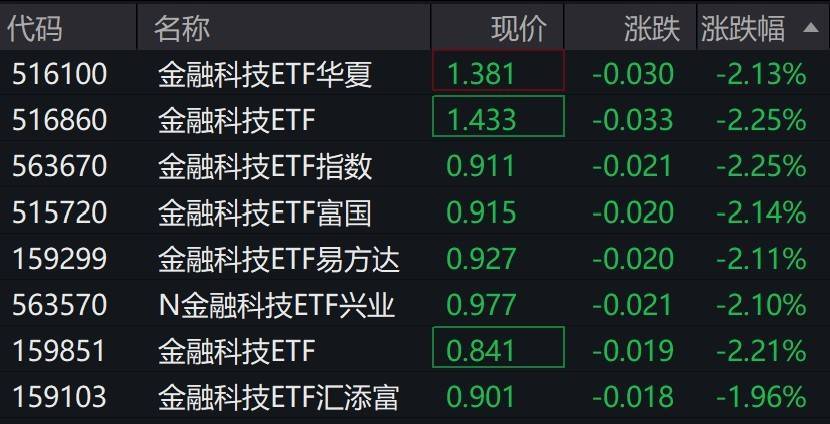
Group 1 - Financial technology stocks have declined, with notable drops including a more than 6% decrease in Zhihui and over 3% in Dazhihui, while Tonghuashun, Hengsheng Electronics, and Runhe Software fell by more than 2% [1] - Financial technology-related ETFs have also experienced a decline of approximately 2% [1] Group 2 - Specific financial technology ETFs reported the following price changes: - Huaxia Financial Technology ETF at 1.381, down 0.030 (-2.13%) - Financial Technology ETF at 1.433, down 0.033 (-2.25%) - Financial Technology ETF Index at 0.911, down 0.021 (-2.25%) - Other ETFs also showed similar declines [2] - Institutions have indicated that with policy support, the macro environment is improving, and ongoing capital market reforms are enhancing the fundamentals of the financial industry, which is expected to lead to gradual revenue growth for financial IT companies [2] - The recent acceleration of "revolutionary" stablecoins and the anticipated release of significant financial policies are expected to create investment opportunities in the financial IT sector [2]