充足准备金制度

Search documents
深夜!减肥药巨头大涨!
Sou Hu Cai Jing· 2026-02-09 15:27
Group 1 - Novo Nordisk's stock rose over 6% and Eli Lilly's stock increased nearly 4% due to a lawsuit against Hims & Hers for infringing on the patent of semaglutide [3][4] - Hims & Hers' stock plummeted over 26% after the announcement of the lawsuit, which claimed that their competing product could pose potential dangers to consumers [3][4] - The FDA has indicated it will restrict the use of GLP-1 active ingredients in unapproved compounded drugs, which has been widely sold as alternatives to original drugs [3][4] Group 2 - Analyst Soren Lontoft Hansen from Sydbank noted that the rise in Novo Nordisk's stock reflects investor optimism regarding the FDA's crackdown on the compounded pharmaceutical industry [4] - The FDA's actions are seen as a direct challenge not only to Hims & Hers' compounded oral medication but also to the entire GLP-1 drug sector, benefiting both Novo Nordisk and Eli Lilly [4] - Since peaking in June 2024, Novo Nordisk's market value has evaporated by nearly two-thirds, with a cumulative decline of almost 50% over the past year [4]
美财长贝森特表态沃什任内美联储不会迅速缩表 或需一年敲定调整方案 国库券持仓占比未来五到七年将从不足5%升至55%
Sou Hu Cai Jing· 2026-02-09 10:30
Core Viewpoint - The U.S. Treasury Secretary, Becerra, stated that even with the nomination of Kevin Warsh as the Federal Reserve Chair, there will not be a rapid reduction in the Fed's balance sheet, indicating a potential year-long deliberation on adjustments [1]. Group 1: Federal Reserve's Balance Sheet Management - Becerra emphasized that the decision on how to adjust the balance sheet will be made independently by the Federal Reserve, suggesting that if they adopt a "sufficient reserves" policy, immediate action is unlikely [1]. - The Federal Reserve restarted its balance sheet expansion in December by purchasing short-term Treasury securities to manage market liquidity and maintain control over interest rate targets [1]. - Goldman Sachs noted that the market may misinterpret Warsh's actual stance, as the Fed under his leadership is expected to retain options for rate cuts and quantitative easing without significantly reducing the balance sheet [1]. Group 2: Proposed Changes to Federal Reserve-Treasury Relationship - Warsh has long advocated for a new version of the 1951 Federal Reserve-Treasury Agreement to redefine the relationship between the two institutions, which could clarify the Fed's balance sheet size in relation to Treasury issuance plans [2]. - If significant changes to the Fed's asset portfolio occur, it could lead to volatility in the $30 trillion U.S. Treasury market and raise concerns about the Fed's independence [2]. - Market expectations suggest that if the agreement is implemented, the Fed's holdings may shift from long-term securities to short-term Treasury bills, with predictions indicating that the Fed could become a significant buyer of Treasury bills over the next five to seven years, increasing its holdings from less than 5% to 55% [2].
事关美联储“缩表”!美国财长,紧急发声
证券时报· 2026-02-09 09:57
Core Viewpoint - The article discusses concerns regarding the Federal Reserve's potential balance sheet reduction, emphasizing that Treasury Secretary Becerra does not expect rapid action under the leadership of Fed Chair nominee Kevin Walsh [1][3]. Group 1: Federal Reserve's Balance Sheet Management - Becerra stated that the Federal Reserve may take up to a year to decide on its balance sheet adjustments, indicating a cautious approach [3]. - The Fed restarted its balance sheet expansion in December, initiating a short-term Treasury purchase program to manage market liquidity [3]. - Analysts express concerns that significant adjustments to the Fed's current $6 trillion securities portfolio could increase market volatility and raise deeper worries about the Fed's independence [1][8]. Group 2: Walsh's Proposed Reforms - Walsh's proposal to establish a new version of the 1951 Fed-Treasury agreement aims to redefine the relationship between the two institutions, potentially impacting the $30 trillion U.S. Treasury market [8]. - If the reform is merely administrative, its short-term impact on the Treasury market may be limited; however, substantial changes could lead to increased market fluctuations [8]. - Analysts suggest that Becerra and Walsh share a critical stance on prolonged quantitative easing, which they believe undermines the market's ability to signal important financial information [8]. Group 3: Market Expectations and Predictions - There is a general expectation that a more substantial agreement may involve a significant shift in the Fed's asset holdings, moving from medium- and long-term securities to Treasury bills with maturities of 12 months or less [9]. - Deutsche Bank strategists predict that under Walsh's leadership, the Fed could become an active buyer of Treasury bills, with their share in the Fed's portfolio potentially rising from less than 5% to 55% over the next five to seven years [9].

美联储,突发!美国财长,紧急发声!
券商中国· 2026-02-09 09:05
Core Viewpoint - The article discusses U.S. Treasury Secretary Becerra's comments on the Federal Reserve's potential actions regarding its balance sheet, emphasizing that under the leadership of Kevin Walsh, the Fed is unlikely to quickly reduce its balance sheet [1][2]. Group 1: Federal Reserve's Balance Sheet Management - Becerra believes the Fed may take up to a year to decide on its balance sheet adjustments, indicating a cautious approach [2]. - The Fed restarted its balance sheet expansion in December, initiating a short-term Treasury purchase program to manage market liquidity [2]. - Analysts express concerns that Walsh's hawkish stance may halt the Fed's rate-cutting path, although Goldman Sachs suggests that the market may misinterpret Walsh's actual position [3][4]. Group 2: Proposed Reforms and Market Impact - Walsh's proposal to establish a new version of the 1951 Federal Reserve-Treasury agreement aims to redefine the relationship between the two institutions, potentially impacting the $30 trillion U.S. Treasury market [6]. - If the reform is merely administrative, the short-term impact on the Treasury market may be limited; however, significant adjustments to the Fed's $6 trillion securities portfolio could increase market volatility and raise concerns about the Fed's independence [6]. - There is speculation that the Fed under Walsh may shift its asset holdings from medium- and long-term securities to Treasury bills, with predictions that T-bills could rise from under 5% to 55% of the Fed's portfolio over the next five to seven years [7].
贝森特:美联储料不会迅速缩表
财联社· 2026-02-09 05:35
Core Viewpoint - Concerns surrounding the nomination of Kevin Walsh as the next Federal Reserve Chairman focus on potential liquidity tightening and the independence of the Fed, despite Treasury Secretary Basent's efforts to alleviate market fears [1][2]. Group 1: Federal Reserve's Policy and Actions - The Federal Reserve may take up to a year to make decisions regarding its balance sheet under Walsh's leadership, with an emphasis on independent decision-making [2]. - The Fed's balance sheet peaked at $9 trillion during the global financial crisis and COVID-19 pandemic, and is projected to reduce to $6.6 trillion by the end of 2025 [2]. - The Fed restarted balance sheet expansion in December, initiating a short-term Treasury bond purchase program to manage market liquidity [3]. Group 2: Kevin Walsh's Stance and Market Reactions - Walsh, who served as a Fed governor from 2006 to 2011, advocates for a significant reduction in the Fed's bond holdings, which he believes distorts financial conditions [4]. - Analysts express concerns that Walsh's hawkish past may halt the Fed's path toward rate cuts, although Goldman Sachs suggests that the market may misinterpret Walsh's actual stance, indicating that rate cuts and quantitative easing remain possible [5]. - President Trump has made it clear that he expects Walsh to lower interest rates, stating that any nominee expressing a desire to raise rates would not be considered [5][6].
2026年2月债券投资策略展望:经济非典型修复下的配置行情
Shenwan Hongyuan Securities· 2026-02-04 12:07
Group 1 - The current macroeconomic environment features a coexistence of strong expectations and weak realities, with market implied economic growth expectations potentially exceeding those of the past three years, while actual economic performance remains weak [3] - The recent configuration trend in the bond market shows that 10-year bonds are outperforming 30-year bonds, government bonds are better than policy bank bonds, and credit bonds are preferred over interest rate bonds [3] - In February, the overall environment is favorable for the bond market due to a policy and economic data vacuum, seasonal production slowdown, and strong initial configuration forces, although the weak asset status of bonds has not fundamentally reversed [3] Group 2 - The analysis of the bond market from Q4 2025 to the present indicates that the bond market experienced a range-bound fluctuation, with yields initially rising and then falling due to central bank bond purchases and fundamental downward pressure [36] - In January 2026, the bond market saw a recovery from pessimistic expectations, driven by configuration activities that led to a decline in bond yields, despite a generally bearish outlook [36] - The central bank's liquidity provision in January was ample, aiming to support economic activity and align with government bond issuance, although the pricing of funds remained restrained due to various influencing factors [41][45]

资产负债表规模究竟应该多大 美联储直面“三难困境”
Sou Hu Cai Jing· 2026-01-16 08:23
Core Insights - The Federal Reserve faces a dilemma regarding the optimal size of its balance sheet after halting the reduction of its $6.5 trillion asset portfolio, needing to balance between a smaller size, lower interest rate volatility, and limited market intervention [1][2] Group 1: Balance Sheet Management - Researchers highlight a "trilemma" where the Fed can only achieve two of the three goals simultaneously, due to the financial sector's demand for reserves and the frequency of liquidity supply and demand shocks [1] - The Fed's balance sheet peaked at $8.9 trillion in June 2022, up from $800 billion two decades ago, driven by large-scale asset purchase programs in response to the 2008 financial crisis and the COVID-19 pandemic [1] - The Fed's Vice Chair Michelle Bowman advocates for a balance sheet as small as possible, indicating internal disagreements on how low reserves can be reduced while restoring the balance sheet to pre-crisis levels [1] Group 2: Liquidity and Market Impact - In December 2025, the Fed plans to initiate a Reserve Management Purchase program to maintain adequate reserve levels amid year-end pressures and high money market rates [2] - The trilemma emphasizes the Fed's need to decide how much liquidity changes will be absorbed through its balance sheet size, frequent market interventions, or allowed to cause interest rate volatility [2] - A large balance sheet enhances the Fed's structural influence in financial markets, creating a safe and liquid asset buffer that can prevent short-term interest rate fluctuations without frequent interventions [2]
失控预警!美联储重启QE是鲍威尔给继任者留下的“烂摊子”?
Jin Shi Shu Ju· 2025-12-19 08:33
Group 1 - The Federal Reserve has returned to a quantitative easing (QE) approach, with a recent decision to purchase approximately $40 billion in short-term Treasury bills and potentially similar amounts monthly until at least April [1][2] - The Fed's interest rate cuts, totaling 1.75 percentage points since September 2024, are part of a broader strategy to manage its balance sheet and respond to liquidity needs in the banking sector [1][3] - The new "ample reserves regime" has complex implications, as high reserve balances can paradoxically hinder banks from lending to the public and affect Treasury trading [2][3] Group 2 - Concerns have arisen regarding the Fed's control over its balance sheet, as the current system allows banks to dictate the demand for reserves, potentially leading to instability in the overnight lending market [3][4] - The Fed's recent actions, framed as technical adjustments, indicate a shift back to QE despite claims of maintaining an anti-inflation stance, suggesting a need for a higher balance sheet relative to the economy [3][4] - Kevin Warsh, a candidate for the Fed chair position, is seen as eager to abandon the current ample reserves system, indicating potential for significant reform in the future [4]
美联储本周或宣布450亿购债计划?资产负债表走向仍有变数!
Jin Shi Shu Ju· 2025-12-09 08:47
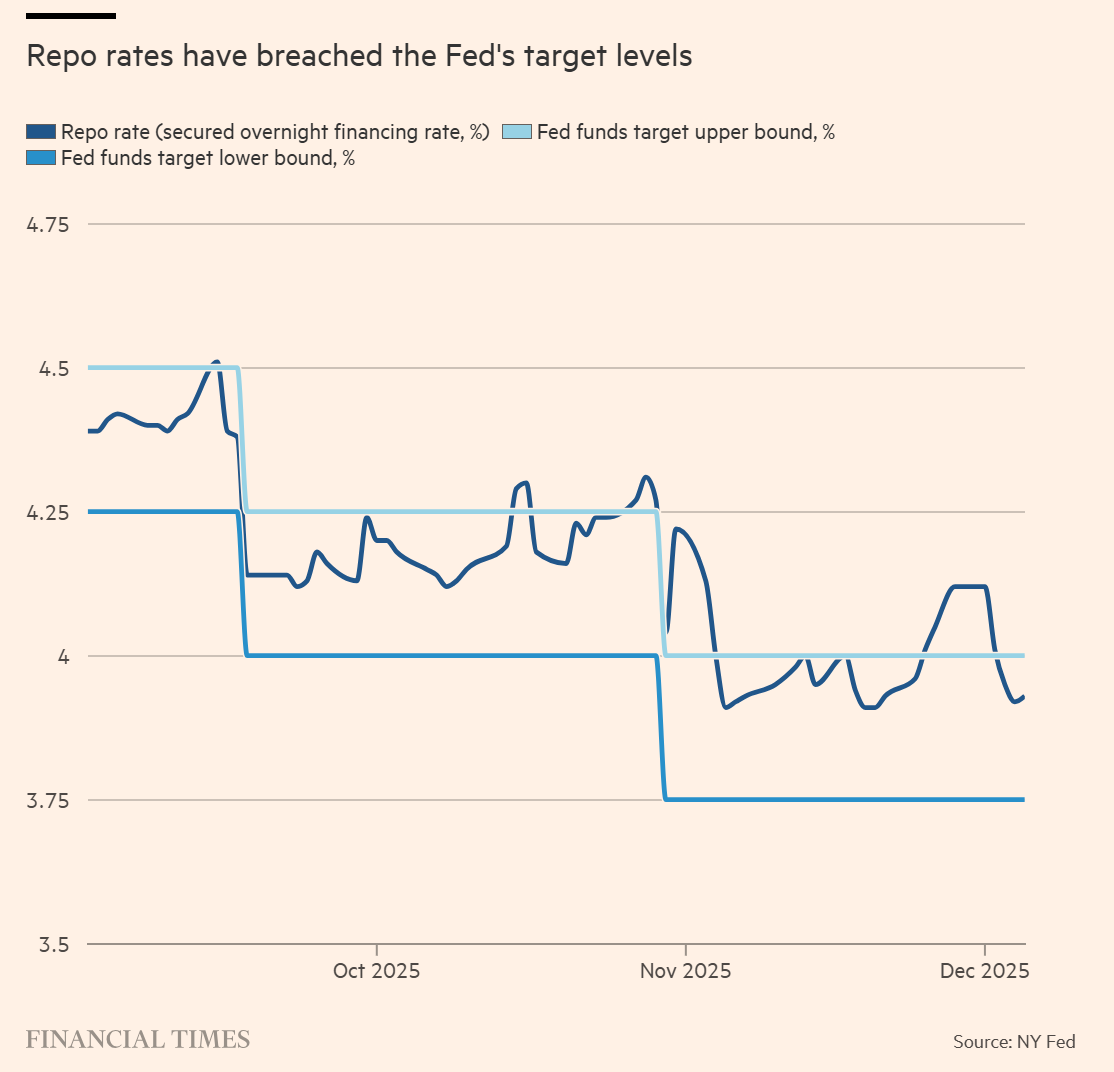
Core Viewpoint - The Federal Reserve's upcoming meeting is expected to focus on interest rate trends and the state of the U.S. economy, with a high probability of a third rate cut this year. Additionally, updates regarding the Fed's asset portfolio may be announced following the conclusion of the balance sheet reduction process on December 1 [1]. Group 1: Federal Reserve Actions - In October, the Federal Reserve announced plans to reinvest the principal of maturing Treasury and mortgage-backed securities into short-term Treasury bills to address pressures in the repo market, although this measure has not fully resolved the issues [1]. - Overnight rates have frequently exceeded the Fed's target range, indicating that banks continue to rely on the central bank's liquidity support tools, such as the standing repo facility [2][1]. - The Fed is expected to announce a "reserve management purchase" plan of approximately $45 billion per month to maintain order in the repo market and ensure smooth transmission of monetary policy [1]. Group 2: Balance Sheet Expansion Debate - The future trajectory of the Fed's balance sheet is viewed as increasingly uncertain, despite expectations of expansion due to pressures in the repo market [3]. - There are significant disagreements within the Fed regarding how to implement the ample reserves policy, raising doubts about the inevitability of balance sheet expansion [4]. - Dallas Fed President Logan has expressed support for a more flexible approach to balance sheet expansion, suggesting that the scale and timing of reserve management purchases should not be mechanical [4]. Group 3: Regulatory Considerations - The argument for reducing the Fed's influence on the economy through a smaller balance sheet is gaining traction, particularly from figures like Stephen Miran, who advocate for regulatory reforms to alleviate pressures in the repo market [5][6]. - Miran has criticized the "regulatory dominance" that leads to banks holding excessive reserves, suggesting that relaxing capital rules for Treasury securities could reduce the required reserve levels [5]. - Current regulatory adjustments under Fed Governor Bowman aim to allow banks to hold more Treasuries without additional capital requirements, potentially increasing capacity by approximately $2.1 trillion [6]. Group 4: Future Implications - The anticipated changes in regulatory frameworks and the potential for a new Fed chair next year could further alleviate pressures in the repo market and allow for lower reserve levels [7]. - These adjustments align with the previous administration's goal of increasing private sector involvement, although they carry risks of increasing bank size and leverage [7].