全球央行去美元化

Search documents
黄金收复5000美元大关,未来金价是涨是跌?给你明确答案
Sou Hu Cai Jing· 2026-02-04 08:30
Core Viewpoint - Gold prices have recently surged past the $5,000 mark and are approaching the $5,100 level, indicating a volatile market with potential for further fluctuations in the short term [2] Short-term Outlook - Gold prices are expected to continue experiencing volatility, with resistance anticipated between $5,100 and $5,300, while strong support is seen in the $4,800 to $4,900 range [2] - The market is influenced by high-leverage fund adjustments, uncertainty regarding the timing of U.S. interest rate cuts, and fluctuating geopolitical risks, making sustained price increases challenging [2] Medium to Long-term Outlook - The long-term outlook for gold remains positive due to ongoing central bank purchases, a trend towards de-dollarization, and persistent inflationary pressures in the U.S. [2] - Major financial institutions like JPMorgan and UBS project that gold prices could exceed $6,000 by the end of 2026 [2] Investment Strategy - Investors are advised to consider gradual accumulation of gold positions during price dips rather than engaging in chasing price increases [2]

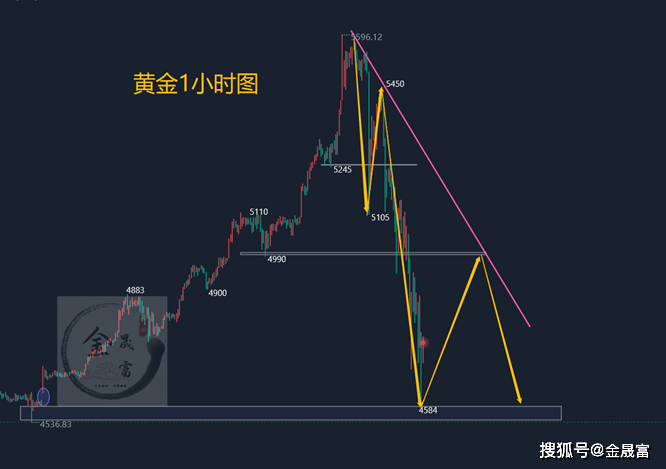
金晟富:2.2黄金疯狂下跌关注缺口回补!日内黄金分析参考
Sou Hu Cai Jing· 2026-02-02 04:24
Core Insights - The gold market in 2025 has experienced both digital growth and a deeper understanding of the importance of recognizing opportunities and maintaining composure amidst volatility [1] - Recent fluctuations in gold and oil prices are influenced by various news events, with gold prices currently around $4,700 per ounce, reflecting a decline of approximately 3% in a single day [1][2] - The easing of political uncertainty in the U.S. has led to a significant correction in gold prices, which had previously reached historical highs [2] Market Analysis - The decline in gold prices is attributed to reduced concerns over the independence of the Federal Reserve, which has triggered profit-taking among bullish investors [2] - Market sentiment is shifting, indicating a temporary retreat of risk premiums, as the stability of the dollar and U.S. Treasury yields diminishes gold's appeal relative to other assets [2] - Upcoming U.S. ISM manufacturing PMI data is expected to influence market perceptions of economic fundamentals and monetary policy, potentially impacting short-term gold price direction [2] Technical Analysis - Current technical indicators suggest that gold is in a weak state, with resistance levels around $4,950 and support levels near $4,535 [3][5] - The market is experiencing a bearish trend, with short-term strategies recommending selling on rebounds near $4,950 and buying on dips around $4,580 [6] - The overall market sentiment indicates that gold may continue to face downward pressure in the short term, with a focus on maintaining proper risk management and position sizing [5][6]
泽连斯基作出重大妥协!美国宣布:解除制裁!美联储巨变酝酿中?
Sou Hu Cai Jing· 2025-12-17 03:24
Group 1: Ukraine Situation - Ukraine's President Zelensky has softened his stance on NATO membership, now accepting bilateral security guarantees from the West due to lack of support from the US and some European countries [1] - A meeting between US and Ukrainian officials in Berlin resulted in significant progress on peace plans and economic issues, focusing on territorial disputes and security concerns [1] - The shift in Ukraine's position reflects a pragmatic approach amid prolonged conflict and diminishing aid, influenced by changing US policies under a potential Trump administration [1] Group 2: Belarus Sanctions - The US announced the lifting of sanctions on Belarusian potash fertilizer, a key economic sector for Belarus, following negotiations between US envoy John Cole and President Lukashenko [3] - The sanctions were initially imposed in 2021 due to election manipulation, severely impacting Belarus's economy, which has since adapted by shifting export markets [3] - The agreement includes the release of 123 political prisoners, indicating economic pressures on Belarus and a potential shift in US-Belarus relations away from Russia [3] Group 3: Federal Reserve Actions - The Federal Reserve lowered the benchmark interest rate by 25 basis points to a range of 3.5%-3.75%, marking the third rate cut of the year [5] - The Fed's decision reflects internal divisions and a need to balance employment and inflation targets, with a plan to purchase $40 billion in short-term Treasury securities to maintain liquidity [5] - Future rate cuts are anticipated, but market expectations may differ, indicating a complex economic landscape [5] Group 4: Gold Market Dynamics - Gold prices have shown strong performance, with significant inflows into physical gold ETFs, reaching $5.2 billion in November [7] - The recent Fed rate cut has reduced the opportunity cost of holding gold, supporting its price amid fluctuating market conditions [7] - Long-term prospects for gold remain positive due to geopolitical tensions and central bank policies favoring gold accumulation [8]
美联储巨变酝酿中?美国非农就业数据公布在即,黄金价格将维持强势?
Zheng Quan Shi Bao Wang· 2025-12-15 00:44
Group 1: Belarus Potash Sanctions - The U.S. announced the lifting of sanctions on Belarusian potash fertilizers, marking a significant shift in diplomatic relations [1][3] - The sanctions were initially imposed in August 2021 by the Biden administration due to alleged election manipulation, severely impacting Belarus's economy and foreign exchange sources [1] - The decision to lift the sanctions was made after a productive two-day meeting between U.S. officials and Belarusian President Lukashenko [2][3] Group 2: U.S. Federal Reserve Changes - A major transformation is anticipated within the Federal Reserve, as the boundaries between the U.S. Treasury and the Fed become increasingly blurred, with the Treasury Secretary playing a crucial role [4] - The Fed is reportedly restarting asset purchases to provide financing support for U.S. Treasury expenditures, which may stabilize market fluctuations [4] - This new structure suggests tighter policy coordination and could lead to a significant shift in the relationship between fiscal and monetary policy, with inflation becoming a dominant narrative in the next two years [4] Group 3: Gold Market Trends - Gold prices have shown strong upward momentum, with a notable increase in global physical gold ETF inflows reaching $5.2 billion in November, marking six consecutive months of inflows [5] - The recent interest rate cut by the Federal Reserve has reduced the opportunity cost of holding gold, further supporting its price [5] - Long-term factors driving gold prices include central bank de-dollarization and ongoing geopolitical conflicts, with expectations of a weaker U.S. dollar [7]
美国非农就业数据公布在即 黄金价格将维持强势?
Sou Hu Cai Jing· 2025-12-15 00:07
Core Viewpoint - Gold prices have shown a strong upward trend, reaching historical highs in September and October, followed by a brief correction but maintaining an upward trajectory thereafter [1] Group 1: Market Dynamics - In November, global physical gold ETF inflows reached $5.2 billion, marking six consecutive months of inflows [1] - The Federal Reserve's decision to lower interest rates to a range of 3.50% to 3.75% has reduced the opportunity cost of holding gold, supporting its price [1] - Increased demand for safe-haven assets and ongoing central bank purchases of gold are reinforcing a high volatility and upward price trend in the gold market [1] Group 2: Employment Data Impact - The U.S. Labor Department is set to release November non-farm payroll data, which was delayed due to a government shutdown [1] - Previous employment data indicated a deterioration in the labor market, but initial unemployment claims suggest a stable hiring environment [2] - The upcoming non-farm payroll data is expected to have a limited impact on gold prices, as the market has already priced in the recent interest rate cut [1][2] Group 3: Long-term Outlook - Long-term factors driving gold prices include global central bank de-dollarization and ongoing geopolitical conflicts [2] - The market anticipates a further weakening of the U.S. dollar index, which could support gold prices [2] - Despite gold prices hovering around $4,000 per ounce, there is no significant panic selling, indicating low bearish sentiment [2] - The current market trend favors buying on dips, with expectations of continued central bank gold purchases and a favorable long-term outlook for gold prices [3]
突变!泽连斯基作出重大妥协!美国宣布:解除制裁!美联储巨变酝酿中?
Sou Hu Cai Jing· 2025-12-14 23:37
Group 1 - Ukrainian President Zelensky has made a significant compromise by accepting a bilateral security guarantee instead of direct NATO membership, which is a core demand of Ukraine but lacks support from the US and some European countries [2] - The ongoing discussions between the US and Ukraine have shown "significant progress," focusing on the "peace plan," economic agenda, territorial issues, and frozen Russian central bank assets [2] Group 2 - The US has announced the lifting of sanctions on Belarusian potash fertilizer, which had been imposed in response to alleged election manipulation, significantly impacting Belarus's economy [4] - The discussions between US officials and Belarusian President Lukashenko have been described as productive, marking an important milestone in US-Belarus relations [6] Group 3 - A major shift is anticipated in the Federal Reserve's operations, with indications that the Fed may restart asset purchases to support US Treasury spending and stabilize market fluctuations [8] - The evolving relationship between the US Treasury and the Federal Reserve suggests a merging of their balance sheets, with the Treasury Secretary playing a crucial role in this new structure [8] Group 4 - Gold prices have shown strong performance, with a significant inflow of $5.2 billion into global physical gold ETFs in November, marking six consecutive months of inflows [10] - The recent interest rate cut by the Federal Reserve has reduced the opportunity cost of holding gold, contributing to its price support [11] - Long-term factors driving gold prices include central bank de-dollarization and ongoing geopolitical conflicts, with expectations of continued interest in gold from global investors [12]
香港第一金PPLI:黄金暴拉破3700创历史新高!美联储决议前夕的多头狂欢与操作全攻略
Sou Hu Cai Jing· 2025-09-17 04:10
Core Insights - Gold prices are currently fluctuating near historical highs, with a recent peak of $3703 per ounce, driven primarily by market expectations regarding Federal Reserve policy [1][2]. Group 1: Market Drivers - The surge in gold prices is attributed to multiple factors, including a weakening US dollar and declining US Treasury yields, which enhance gold's appeal as a non-yielding asset [2]. - Market expectations for a Federal Reserve interest rate cut have reached a peak, with an 88% probability of a 25 basis point cut and a 12% chance of a 50 basis point cut, contributing to the rise in gold prices [2]. - Ongoing geopolitical risks, particularly the escalation of conflict in the Middle East, have increased demand for gold as a safe-haven asset [2]. Group 2: Trading Recommendations - In the current high volatility environment, caution is advised. Key resistance levels are identified at $3702-$3705, with potential further gains if these levels are breached [3]. - Suggested trading strategy includes buying on dips, particularly in the $3680-$3690 range, with a stop-loss set below $3670 and a target of $3700-$3710 [3]. - For aggressive traders, a short position may be considered if gold rebounds to the $3705-$3715 range and shows signs of resistance, with a stop-loss above $3720 [3]. Group 3: Future Outlook - The future trajectory of gold prices is heavily dependent on the outcome of the Federal Reserve's interest rate decision. A 25 basis point cut could push prices above $3725, while a surprise 50 basis point cut may lead to a rapid increase towards the $3750-$3800 range [4]. - There is a risk of profit-taking if the Fed's guidance does not meet market expectations, potentially leading to a pullback to the $3650-$3620 support area [4]. - Long-term bullish sentiment remains intact due to strong global central bank demand for gold and favorable technical indicators [4].
伊以冲突再升级,撩拨大宗商品琴弦
和讯· 2025-06-18 10:23
Core Viewpoint - The article discusses the impact of escalating geopolitical tensions in the Middle East, particularly the Israel-Iran conflict, on international oil and gold prices, highlighting the potential for price fluctuations due to supply concerns and market sentiment [1][2]. Oil Market Analysis - Since the onset of the Israel-Iran conflict on June 13, international oil prices have risen, with Brent crude oil prices increasing by over 9% [2]. - Concerns regarding oil supply stem from Iran's current production of approximately 3.4 million barrels per day and an export volume of about 1.5 million barrels per day, predominantly to China [2]. - The potential for conflict escalation raises fears of Iran blocking the Strait of Hormuz, through which approximately 20 million barrels of oil are transported daily, accounting for 75% of oil transport in the region [2]. - Despite these concerns, the global oil supply situation remains manageable, with OPEC in a production increase cycle and an estimated 4-5 million barrels per day of idle capacity available [2][3]. - Long-term projections suggest that international oil prices may stabilize around $65 per barrel, influenced by inflationary pressures in the U.S. and geopolitical dynamics [3][4]. Gold Market Analysis - International gold prices have surged due to the heightened tensions in the Middle East, currently hovering around $3,400 per ounce [5]. - Over the past month, gold prices have rebounded from below $3,200 per ounce, with a potential challenge to the previous high of $3,500 per ounce [5]. - The increase in gold prices is attributed to rising risk aversion amid geopolitical instability and a declining U.S. dollar index, which enhances the valuation of dollar-denominated gold [5]. - Long-term trends indicate that gold prices are influenced by the global monetary system, central bank policies, and inflation expectations, with potential for prices to reach $3,700-$3,800 per ounce if they surpass the $3,500 mark [6].

ETO Markets市场洞察:黄金多头惨遭“空袭”,CPI数据或成“救命稻草”?
Sou Hu Cai Jing· 2025-05-13 10:21
Core Viewpoint - The international gold price has shown resilience and rebounded after significant fluctuations, reflecting a complex interplay of geopolitical and macroeconomic factors [1][3] Group 1: Market Dynamics - Gold prices stabilized after hitting a low of $3207.73 per ounce, reaching a peak of $3260.47 per ounce during the day, with a daily increase of 0.8% [1] - The recent volatility in gold prices was primarily triggered by a breakthrough in US-China trade relations, where both parties agreed to significantly reduce tariffs [3] - The agreement entails the US reducing tariffs on Chinese goods from 145% to 30%, while China will lower tariffs on US goods from 125% to 10%, boosting global risk appetite and leading to a sell-off in gold [3] Group 2: Analyst Insights - ETO Markets' chief strategist noted that the tariff reduction marks a "fragile easing period" in global trade, suggesting that while short-term risk sentiment may suppress gold prices, there remains potential demand for gold as a safe-haven asset due to execution details of trade agreements and geopolitical tensions [4] - The rebound in gold prices is supported by three main factors: adjustments in economic growth expectations, a technical correction in the dollar, and fluctuations in inflation data [4] Group 3: Federal Reserve Signals - Recent comments from Federal Reserve Governor Kugler indicated that easing trade tensions may reduce the risk of an economic "hard landing," thereby diminishing the immediate necessity for interest rate cuts [5] - This statement led to a significant drop in the probability of a rate cut in July from 65% to 42%, and the expected annual rate cut was reduced from 55 basis points to 35 basis points, impacting the cost of holding gold [5] Group 4: Upcoming Economic Indicators - The focus is on the upcoming US May CPI data, which could determine the direction of gold prices; a core CPI increase above 0.3% may strengthen inflation concerns and challenge the dollar index, while lower-than-expected data could reignite rate cut expectations, potentially pushing gold prices towards $3300 [6] Group 5: Trading Strategies - Short-term traders are advised to monitor the $3200-$3280 range for potential breakouts, with a recommendation to consider light short positions if gold falls below $3200 post-CPI data [7] - Long-term investors are encouraged to maintain gold's strategic position in their portfolios, as ongoing geopolitical conflicts, central bank gold purchases, and expectations of declining real interest rates continue to provide long-term support [7] Group 6: Diverging Institutional Views - There is a notable divergence in market views on gold's future; Citibank has lowered its three-month target price for gold to $3150, citing delayed Fed policy shifts, while Goldman Sachs maintains that $3300 is not a ceiling, emphasizing ongoing de-dollarization trends and demand from emerging markets [9] Group 7: Market Transition - The gold market is transitioning from being driven by geopolitical risks to being influenced by macroeconomic data, with the recent easing of US-China trade tensions reducing the risk premium on gold, yet persistent global economic recovery imbalances and central bank policy uncertainties continue to support gold prices [10]