商业用房去库存

Search documents
最低降至30%!河北下调公寓、商铺等商业用房首付款比例
Xin Lang Cai Jing· 2026-02-05 06:58
Core Viewpoint - The minimum down payment ratio for commercial properties in Hebei Province has been reduced to 30%, effective from February 4, 2026, as part of a broader effort to stimulate the commercial real estate market and support economic development [1][3]. Summary by Category Policy Changes - The People's Bank of China, Hebei Branch, announced a new policy that lowers the minimum down payment for commercial property loans from 50% to 30% for various types of commercial real estate, including shops, apartments, office buildings, and hotels [2][4]. - The adjustment is part of a strategy to implement city-specific measures based on local government requirements and aims to facilitate the reduction of inventory in the commercial real estate market [2][4]. Market Impact - The reduction in the down payment requirement is expected to lower the barriers for purchasing commercial properties, thereby attracting more potential investors to the commercial real estate sector [2][4]. - This policy change is seen as a specific measure to promote economic growth by directing resources towards more efficient sectors and projects [2][4].
降首付新政推动商办市场去库存
Bei Jing Shang Bao· 2026-01-18 15:11
Core Viewpoint - The People's Bank of China and the National Financial Regulatory Administration have announced a reduction in the minimum down payment ratio for commercial property loans to 30%, down from the previous 50% or higher, aiming to stimulate demand in the commercial real estate market [1][3]. Group 1: Policy Impact - The adjustment to a 30% down payment significantly lowers the initial financial burden on buyers, particularly benefiting small and medium-sized businesses and startups [3][4]. - The new policy is expected to enhance transaction activity and accelerate the inventory reduction of commercial properties, which have been facing liquidity challenges [4][5]. - The policy aligns with other recent measures, such as personal tax refunds and housing quality improvements, signaling a sustained effort to stabilize the real estate market and mitigate structural risks [4][5]. Group 2: Market Conditions - Commercial properties account for approximately 20%-30% of real estate inventory, and their slow turnover has been a bottleneck for companies' cash flow [4]. - As of November 2025, the total unsold area of commercial properties is 750 million square meters, with office space accounting for 52.34 million square meters, indicating a pressing need for inventory reduction [3][4]. - The demand for commercial space is expected to rise as the consumer economy recovers and the service sector continues to rebound, making the timing of the policy particularly relevant [5]. Group 3: Regional Variations - The implementation of the 30% minimum down payment may vary by region, with local governments having the discretion to set lower limits based on specific market conditions [6][7]. - Some cities have already introduced various supportive measures to promote inventory reduction in the commercial market, including subsidies for purchasing commercial properties [6][7]. - Analysts suggest that cities with high inventory and slow turnover should adhere to the 30% minimum, while core areas in first-tier cities may maintain a higher threshold of 40%-50% to balance inventory reduction and risk management [7].


利好落地!降首付新政推动商办市场去库存,各地执行有差异
Bei Jing Shang Bao· 2026-01-18 08:59
Core Viewpoint - The People's Bank of China and the National Financial Regulatory Administration have announced a reduction in the minimum down payment ratio for commercial property loans to 30%, aimed at stimulating demand in the commercial real estate market [1][3]. Group 1: Policy Impact - The adjustment of the down payment ratio from over 50% to 30% significantly lowers the initial financial burden on buyers, particularly benefiting small and medium-sized enterprises and startups [3][4]. - This policy is expected to enhance transaction activity and accelerate the inventory reduction of commercial properties, which have been lagging behind the residential market [3][4]. - The new policy aligns with other recent measures, such as personal tax refunds and housing quality improvements, signaling a continued effort to stabilize the real estate market and prevent structural risks [4][5]. Group 2: Market Dynamics - Commercial properties account for approximately 20%-30% of real estate inventory, and their slow turnover has been a bottleneck for companies' cash flow [4]. - The reduction in down payment requirements is anticipated to stimulate demand in active commercial markets, particularly in first- and second-tier cities, thereby speeding up inventory clearance [5]. - The fundamental recovery of the commercial property market will depend on sustained growth in consumption and the service sector, as well as stability in the employment market and corporate expansion willingness [5][6]. Group 3: Regional Implementation - The 30% down payment is a minimum requirement, with regional variations possible based on local government policies, allowing for tailored approaches to inventory management and risk prevention [5][6]. - In cities with high inventory and slow turnover, the minimum down payment may be strictly enforced at 30%, while core areas in first-tier cities may maintain higher ratios of 40%-50% to balance inventory reduction and risk management [5][6].
首付比例大降至最低30%,商业用房去库存新政落地
Di Yi Cai Jing Zi Xun· 2026-01-17 12:33
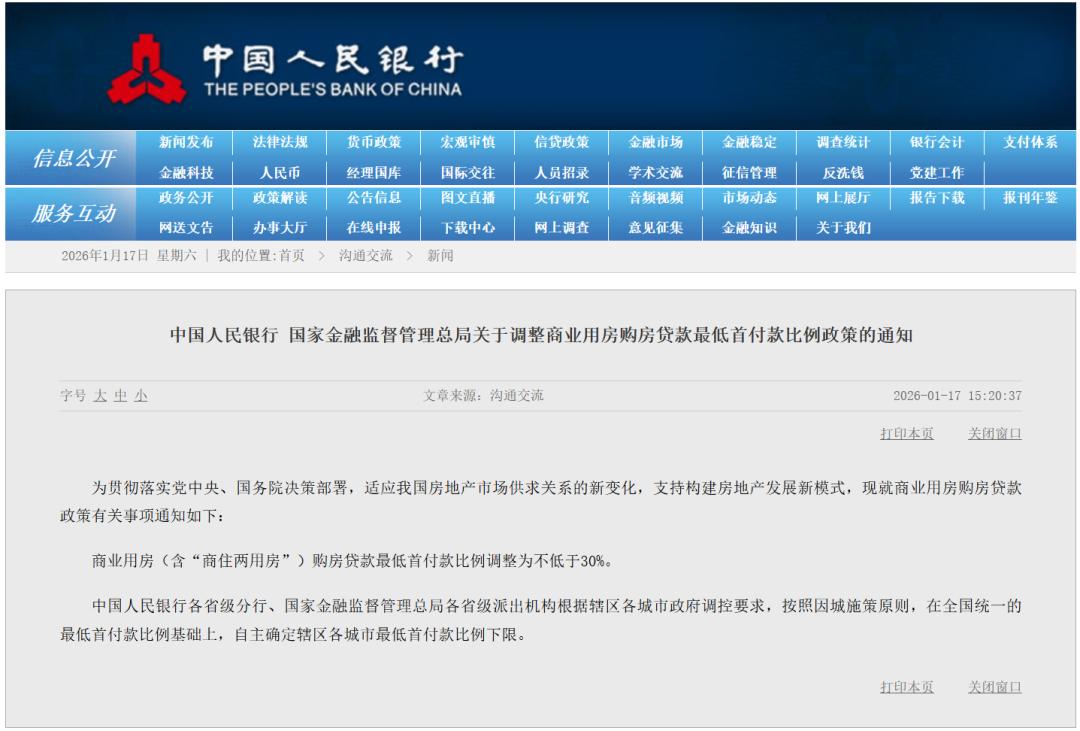
Core Viewpoint - The People's Bank of China and the National Financial Regulatory Administration have announced a nationwide adjustment to the minimum down payment ratio for commercial property loans, lowering it to no less than 30% to support a new model of real estate development and promote the destocking of commercial real estate [1][3]. Group 1: Policy Changes - The minimum down payment ratio for commercial property loans has been adjusted to 30%, significantly lowering the barrier for purchasing commercial properties [3][5]. - Prior to this adjustment, most cities had a minimum down payment requirement of 50%, with some banks setting it as high as 60% or more [3]. - The adjustment is seen as a direct response to the high inventory levels in the commercial real estate market, with a focus on enhancing market activity [3][4]. Group 2: Market Conditions - As of November 2025, there is an estimated 141 million square meters of commercial real estate available for sale nationwide, with 52 million square meters of office space included in this figure, indicating a significant oversupply [2]. - The average time for inventory turnover is reported to be around 30 months, with some areas experiencing turnover periods of 50 to 70 months, highlighting the urgency of destocking [4]. Group 3: Industry Expectations - There is a consensus in the industry regarding the need for further policy relaxation to address the high inventory levels and the challenges in selling existing commercial properties [4][6]. - Various cities are implementing supportive policies, such as allowing the conversion of existing commercial properties into rental housing and other uses, to stimulate market activity [4]. - The demand for loans related to long-term rental apartments and other commercial property investments is expected to increase as a result of the lowered down payment requirement [5].
周末楼市重磅,商业用房首付比例下调至30%
2 1 Shi Ji Jing Ji Bao Dao· 2026-01-17 08:41
Core Viewpoint - The People's Bank of China and the National Financial Regulatory Administration have announced a significant policy change, lowering the minimum down payment ratio for commercial property loans to no less than 30%, which is a substantial decrease from the previous 50% requirement, aimed at stimulating the commercial real estate market and reducing inventory levels [1][4]. Group 1: Policy Changes - The minimum down payment ratio for commercial property loans has been adjusted from 50% to 30% [1][4]. - Some banks previously set the down payment ratio even higher, at 60% or more, indicating a significant reduction in transaction barriers for commercial properties [4]. Group 2: Market Impact - This policy is expected to positively impact the inventory reduction of commercial properties, which include office buildings and retail spaces, as the lower down payment will facilitate more transactions [4]. - As of November 2025, there is a substantial inventory of commercial properties, with 52.34 million square meters of office space and 14 million square meters of commercial space available for sale, totaling nearly 200 million square meters [5]. Group 3: Expert Insights - Experts suggest that the policy addresses the high inventory levels and prolonged sales cycles faced by commercial properties, which have led to declining prices and negatively impacted property values and corporate cash flows [5]. - The reduction in the down payment requirement is seen as a means to revitalize existing commercial properties and promote the development of affordable rental housing or long-term rental apartments, potentially benefiting the growth of Real Estate Investment Trusts (REITs) [5].
周末楼市重磅,商业用房首付比例下调至30%
21世纪经济报道· 2026-01-17 08:30
Core Viewpoint - The People's Bank of China and the National Financial Regulatory Administration have announced a significant policy change, lowering the minimum down payment ratio for commercial property loans to no less than 30%, which is expected to facilitate the transaction of commercial properties and address the high inventory levels in the market [1][4]. Group 1: Policy Changes - The minimum down payment ratio for commercial property loans has been adjusted from 50% to 30%, with some banks previously setting it as high as 60% [4]. - This policy aims to adapt to the new changes in the supply-demand relationship of the real estate market and support the development of a new model for real estate [1][4]. Group 2: Market Impact - The reduction in the down payment requirement is anticipated to significantly lower the transaction barriers for commercial properties, which include office buildings and shops, thereby promoting inventory reduction [4]. - As of November 2025, there is a substantial inventory of commercial properties, with 52.34 million square meters of office space and 140 million square meters of commercial space available for sale, totaling nearly 200 million square meters [4]. Group 3: Expert Insights - Experts suggest that the policy will help activate existing commercial properties and may also support the development of affordable rental housing or long-term rental apartments [5]. - The cautious evaluation practices of banks mean that a 30% down payment is still considered significant, and there is potential for further reductions in the future [5].
降低购房门槛 激活商业用房需求
Zheng Quan Ri Bao· 2026-01-16 16:26
Core Viewpoint - The People's Bank of China announced a reduction in the minimum down payment ratio for commercial property loans to 30%, aimed at stimulating demand and improving cash flow for real estate companies [1][2]. Group 1: Policy Changes - The minimum down payment for commercial property loans will be unified to 30%, down from previous requirements that were often as high as 50% or even 60% in some cases [2]. - This policy is expected to lower the entry barrier for purchasing commercial properties, thereby activating demand and promoting transaction activity [1][2]. Group 2: Market Impact - The reduction in down payment will significantly alleviate the initial financial burden on buyers, particularly benefiting small and medium-sized enterprises and startups [2][3]. - Commercial properties account for approximately 20% to 30% of real estate companies' inventory, and the slow turnover has been a bottleneck for cash flow [3]. - The policy is expected to stimulate transaction activity, accelerate the de-stocking of commercial properties, and improve the cash flow situation for real estate companies [3]. Group 3: Economic Context - The demand for commercial properties is closely linked to the activity levels in sectors such as retail and services, with the current recovery in consumer markets and service industries expected to increase demand for commercial spaces [3]. - The policy aligns with other recent measures, such as individual tax refunds and housing quality improvements, signaling a sustained effort to stabilize the real estate market and manage structural risks [3].
首付比例下调至30%,商业用房拉开去库存大幕
21世纪经济报道· 2026-01-15 14:36
Core Viewpoint - The People's Bank of China has announced a significant policy change by lowering the minimum down payment ratio for commercial property loans to 30%, aimed at stimulating the commercial real estate market and reducing inventory levels [1]. Group 1: Policy Impact - The previous minimum down payment for commercial property loans was 50%, with some banks setting it as high as 60%, making this reduction a substantial easing of transaction barriers [1]. - The policy is expected to positively impact the inventory reduction of commercial properties, which include office buildings and retail spaces, as the current inventory is notably high [1]. Group 2: Market Conditions - As of November 2025, there is a total of approximately 200 million square meters of unsold commercial properties in China, comprising 52.34 million square meters of office space and 14 million square meters of commercial space [1]. - The high inventory levels are attributed to various factors, including prolonged sales cycles and declining property prices, which negatively affect overall property values and corporate cash flows [1]. Group 3: Future Expectations - The reduction in the down payment ratio is anticipated to invigorate the existing commercial property market and promote the development of affordable rental housing and long-term rental apartments [2]. - Financially, this move may also support the growth of Real Estate Investment Trusts (REITs) [2]. - More cities are expected to implement policies aimed at reducing commercial property inventory, with a focus on optimizing purchase restrictions to enhance transaction activity [3].

商业用房首付比例降至30% 专家:未来还有可能再次降低
Zheng Quan Shi Bao Wang· 2026-01-15 13:35
Core Viewpoint - The People's Bank of China (PBOC) has announced a reduction in the minimum down payment ratio for commercial property loans to 30%, aiming to enhance liquidity and stimulate the commercial real estate market [1] Group 1: Policy Changes - The minimum down payment ratio for commercial property loans has been reduced from 50% to 30%, indicating a significant decrease in the financial barrier for buyers [1] - The PBOC plans to increase liquidity through various market operations to maintain ample liquidity and guide overnight interest rates near policy levels [1] Group 2: Market Dynamics - There is a high inventory of commercial properties and challenges in depleting this inventory, leading to significant price declines in second-hand commercial properties [2] - The rise of the rental market has encouraged investors to shift towards long-term rental products, such as serviced apartments, indicating a change in investment strategies [2] - The reduction in the down payment ratio is seen as a reasonable response to structural loan demand amidst a decline in residents' willingness to leverage for home purchases [2] Group 3: Future Outlook - The adjustment in down payment requirements is expected to optimize the allocation of commercial real estate resources, potentially attracting new investors to poorly performing properties for redevelopment [2] - Various cities are implementing policies to promote the de-inventory of commercial properties, including converting existing commercial projects into rental housing and providing subsidies for buyers [3] - Despite the policy changes, high transaction costs and other loan restrictions still deter many potential buyers from investing in second-hand business apartments [3]
首付比例下调至30% 商业用房去库存大幕拉开
2 1 Shi Ji Jing Ji Bao Dao· 2026-01-15 12:21
Core Viewpoint - The People's Bank of China has announced a significant policy change by lowering the minimum down payment ratio for commercial property loans from 50% to 30%, aimed at reducing the inventory of commercial real estate, which currently stands at nearly 200 million square meters [1][2]. Group 1: Current Market Conditions - As of November 2025, the inventory of unsold office buildings is 52.34 million square meters, while the inventory of commercial properties is 140 million square meters, totaling close to 200 million square meters [2]. - The high inventory levels and prolonged sales cycles have led to declining prices in commercial properties, negatively impacting overall property values and the financial health of businesses [2]. Group 2: Policy Implications - The reduction in the minimum down payment is expected to lower the transaction threshold for commercial properties, thereby facilitating the de-inventory process [1]. - This policy is seen as a crucial step in revitalizing existing commercial properties and promoting the development of affordable rental housing and long-term rental apartments [2]. Group 3: Regional Policy Initiatives - Various cities are implementing supportive policies to address the high inventory in the commercial property market, such as allowing mixed-use functions for business buildings in Shanghai and reforming industrial land policies in Hangzhou [3]. - Financial incentives are also being introduced, such as tax rebates in Wuhan and purchase subsidies in Nanning for commercial property buyers [3].