
大宗商品轮动

Search documents
地缘冲突持续升级,大宗轮动的风吹到了农业ETF?
市值风云· 2026-03-16 10:12
Core Viewpoint - In the current environment, investors need to distinguish between different agricultural investments, specifically "pigs," "grains," or "fertilizers" [4][18]. Group 1: Agricultural Sector Dynamics - The agricultural sector has recently gained attention from public and institutional funds due to ongoing geopolitical conflicts, making it a high-interest area for investment [4]. - Since March 2026, the issuance of agricultural-related ETFs has accelerated, with seven companies filing for agricultural index products in just one week [5]. - As of March 2026, there are 16 listed ETFs tracking the agricultural sector, covering various sub-sectors such as planting, breeding, feed, seed, and agricultural machinery [8]. Group 2: Fund Flows and Performance - Several agricultural ETFs have seen significant net inflows since March, with the Agricultural ETF (159825.SZ) and Grain ETF (159698.SZ) recording net subscriptions of 1.1 billion and 720 million respectively [8]. - The agricultural sector has shown a positive trend, with many products achieving around 4% returns in March and several exceeding 10% returns year-to-date [10]. - The Grain Index has emerged as a strong performer, with its corresponding ETFs returning over 15% year-to-date [29][30]. Group 3: Geopolitical Influences - The escalation of geopolitical risks, particularly the instability in the Middle East since February 2026, has disrupted global commodity markets, impacting agricultural costs and prices [13][14]. - Rising prices of natural gas and crude oil, essential for agricultural fertilizers, are expected to increase agricultural production costs [13]. Group 4: Investment Strategies - Investors are advised to carefully select agricultural ETFs based on their underlying assets, as there are significant differences in the investment logic of these funds [18]. - The largest ETF tracking the Livestock Index (159865.SZ) focuses on the "pig cycle," while comprehensive agricultural ETFs like the Agricultural ETF (159825.SZ) provide broader exposure across various agricultural sectors [20][24]. - Commodity-linked ETFs, such as the Soybean Meal ETF (159985.SZ), are highly correlated with international commodity prices and can respond quickly to supply shocks, but they are also more volatile [33].

美伊局势对后续大宗商品走势影响几何?
An Liang Qi Huo· 2026-03-16 09:40
Report Industry Investment Rating - Not provided in the content Core Viewpoints - The recent geopolitical conflict between the US and Iran has led to significant fluctuations in oil prices and affected the performance of various commodity sectors. The subsequent market trend depends on the evolution of the US - Iran conflict. The conflict has also increased the market's attention to agricultural products, and this conflict may be a catalyst for the reversal of agricultural product price expectations [2][16] - The price changes of commodities in a war state follow a clear transmission path of geopolitics, industry chain, and psychological expectations. The transmission logic of commodities is that precious metals start first, copper confirms, oil detonates, and agriculture ends [4][6] Summary by Directory 1. Recent US - Iran Geopolitical Conflict Timeline - The US - Israel military action against Iran has led to shipping risks in the Strait of Hormuz, causing violent fluctuations in oil prices. The US government has made intensive policy statements to suppress the rapid rise of oil prices. Currently, oil prices have regained their upward momentum, driving the energy - chemical sector to strengthen significantly. However, the uncertainty of the geopolitical conflict remains high [2] - From February 28 to March 12, different stages of the conflict have had different impacts on the commodity market. For example, on February 28, oil and gold prices jumped; from March 1 - 2, energy - chemical products soared; from March 3 - 8, oil prices hit new records; on March 9, oil prices had a "roller - coaster" market; from March 10 - 11, oil prices fell, and gold prices fluctuated; on March 12, oil prices returned above $100 [3] - As of March 13, 2026, in the domestic commodity market, the bullish atmosphere has converged, but the crude - oil related products have continued to rise. The chemical sector has shown a differentiated trend, and the shipping index has fallen. The precious metals and non - ferrous sectors are weak, while the oilseeds and grains have risen [4] 2. Commodity Rotation: Will Agricultural Products Be the Next Relay? (1) Commodity Transmission Logic - In the past thirty years, the rotation law of commodities has been that precious metals start first, copper confirms, oil detonates, and agriculture ends. This price - increase order follows a chain from "expectation" to "reality", reflecting the macro - narrative transformation of the global economy from "risk aversion" to "recovery trading" and then to "inflation reality" [4] - Since January this year, commodities have shown a structural market with strong energy, high - level precious metals, rising agricultural products, and weak black - series products. The price changes of commodities in a war state follow a clear transmission path. Oil is highly sensitive to supply interruptions, and the rise in oil prices will drive up the prices of coal and natural gas, and then affect the prices of downstream chemical products. Urea is the key node for the transmission of commodity price increases to agricultural products [6] (2) Impact Path of Agricultural Products - The impact of the US - Iran conflict on agricultural products is mainly through fertilizers. Iran is the second - largest urea exporter. The conflict may lead to a reduction in fertilizer production and export, causing a global fertilizer price increase, which will directly raise the cost of grain planting. In addition, the rise in shipping costs, the increase in bio - diesel demand, and the increase in fertilizer prices will also push up the price of agricultural products [7][8] - From February 27 to March 13, both domestic and foreign agricultural products have shown different degrees of price increases, with palm oil, rapeseed oil, and other varieties having relatively large increases [9] - The price trend of agricultural products is more likely to follow the fluctuations of oil prices, and the macro - level impact is greater than the low - dimensional supply - demand fundamentals [11] (3) Key Focus on Oilseeds and Grains and Corn - The core transmission logic of agricultural product price increases is closely related to oil prices. One is cost transmission, and the other is alternative demand. The correlation between oil and agricultural products is different, and the impact on agricultural products with high import dependence is the greatest [13][15] - The order of capital attack is "oilseeds first, then corn, and staple grains last" [16] 3. Outlook Analysis of the Impact of the US - Iran War on Commodity Sectors (1) Energy Products - Crude oil: The conflict has led to damage to refineries in the Middle East and production cuts in oil - producing countries, reversing the expectation of global oil supply surplus. The bottom of oil prices has risen to $70 per barrel. In the benchmark scenario, the Brent crude oil central price in each quarter of this year is expected to be $75, $80, $75, and $72.5 per barrel; in the risk scenario, the oil price central price may soar above $120 per barrel [17] - Natural gas: The attack on Qatar's energy facilities has led to the suspension of production, pushing up European natural gas prices and putting cost pressure on European chemical production [17] (2) Non - ferrous Metals - Aluminum: The Middle East accounts for 9% of the global electrolytic aluminum production capacity, but the alumina supporting facilities are seriously insufficient. The blockade of the strait will lead to the interruption of alumina supply, forcing aluminum plants to cut production. If the blockade continues, the global electrolytic aluminum shortage will push up the aluminum price to challenge and stabilize above 25,000 yuan per ton [19] (3) Chemical Products - Energy - chemical products: The soaring oil price directly raises the cost of basic raw materials such as naphtha. The supply interruption of methanol and other products from Iran will strongly support their prices [20] - Coal - chemical industry: In the context of high oil prices, the oil - coal price difference widens, and the coal - chemical route is more economical, and its energy security status may be re - evaluated at the national strategic level [20] - Fine chemicals: The soaring European natural gas price has put cost pressure on European chemical products. Some small - variety additives have begun to increase prices [20] (4) Agricultural Products - In the short term, the impact of the geopolitical conflict on most agricultural product varieties is gradually decreasing, and the market may tend to be stable. In the long term, this conflict may be a catalyst for the reversal of agricultural product price expectations [21][22]
市场已经提前炒农产品了?
雪球· 2026-03-15 03:16
Core Viewpoint - The article discusses the rising oil prices due to geopolitical conflicts and its impact on agricultural and energy chemical sectors, suggesting that the market is beginning to anticipate a rise in agricultural product prices [3][4]. Group 1: Commodity Rotation Cycle - A widely circulated commodity rotation cycle indicates that agricultural products typically rise last, following increases in precious metals, non-ferrous metals, and crude oil [4]. - The current market environment, characterized by significant uncertainty and oil price volatility, justifies early speculation on agricultural products [4]. Group 2: Price Transmission Mechanism - Rising oil prices directly boost the agricultural chemical sector, increasing costs for agricultural machinery and supplies, which in turn raises expectations for agricultural product prices [4]. - The transmission chain is clear: higher oil prices lead to stronger demand for pesticides and fertilizers, subsequently pushing up grain prices, which then affects oilseeds and livestock prices [4]. Group 3: Market Sentiment and Investment Strategy - The market is beginning to trade on expectations of rising prices and increased demand, favoring agricultural products due to their lower valuations and potential for significant price movement [4][5]. - Current low pig prices and strong expectations for capacity reduction in the pig cycle are attracting market attention, with a belief that future prices will improve [5]. - The agricultural sector's performance may not match that of gold or chemicals in the short term, but its low position and potential for long-term narratives make it an attractive investment [5].

未知机构:为何此刻推荐农业地缘因素推动化肥供应紧张叠加供给收缩这里的黎明静悄悄-20260306
未知机构· 2026-03-06 02:35
Summary of Key Points from the Conference Call Industry Overview - The focus is on the agricultural sector, particularly the dynamics affecting fertilizer supply and agricultural product prices due to geopolitical factors and supply constraints [1][2]. Core Insights and Arguments - Geopolitical factors are driving fertilizer supply tightness, leading to increased agricultural product costs, with corn futures showing a significant upward trend [1][2]. - In Brazil's Mato Grosso state, corn production is expected to decline by over 8%, and national corn forecasts have been lowered by 1 million tons [1][2]. - In South Korea, rising rice prices have prompted the government to release 150,000 tons of reserve rice to alleviate supply pressures and stabilize prices [1]. - Domestic corn spot prices are experiencing widespread increases, with prices in regions like North China and Huanghuai rising over 1.2 yuan per jin, indicating a "one-sided" upward trend [2]. - A critical window for commodity rotation is identified, following a historical pattern where commodities move in a sequence: gold and silver lead, followed by copper, oil, and finally agricultural products [2]. - Current geopolitical tensions, particularly the conflict in Iran, could lead to significant fertilizer supply disruptions, as Iran accounts for 10% of global fertilizer supply, and the Strait of Hormuz is crucial for transporting 25%-35% of ammonia and urea trade [2]. - The agricultural sector is transitioning from a phase of waiting for transmission to one driven by cost pressures and risk-averse positioning [2]. - The domestic agricultural sector has faced a three-year downturn, but signs of a potential reversal are emerging, as indicated by the forecasts from companies like Denghai Seeds [2].
大宗商品“轮动”序幕拉开?黄金之后 原油面临一场大考
Sou Hu Cai Jing· 2026-02-27 10:29
Core Viewpoint - The international oil prices are currently strong due to geopolitical tensions, particularly the U.S.-Iran conflict, but there is a prevailing bearish sentiment regarding oil prices in the medium term as global supply is expected to exceed demand by 3.05 million barrels per day in 2026 [1][5]. Geopolitical Tensions - The Middle East situation remains tense, with the U.S. deploying military assets in the region, including F-22 fighter jets and the USS Ford aircraft carrier [2]. - Upcoming negotiations between the U.S. and Iran may lead to various military action scenarios, including limited strikes aimed at deterring Iran's military capabilities [3]. Oil Price Volatility - Short-term oil price movements are heavily influenced by geopolitical factors, with potential conflicts threatening oil transportation through the Strait of Hormuz, which could lead to significant price increases [4]. - Analysts suggest that if military actions escalate, oil prices could spike, but if tensions ease, prices may stabilize or decline [4]. Medium-Term Supply Outlook - Despite current price support from geopolitical factors, many institutions predict a return to a bearish trend for oil prices due to an oversupply situation expected in 2026 [5]. - The U.S. Energy Information Administration (EIA) and the International Energy Agency (IEA) both forecast significant oversupply, with estimates of 3.05 million barrels per day and 3.73 million barrels per day, respectively [5]. Historical Context and Future Trends - Historical trends indicate that oil prices are influenced by multiple factors beyond supply and demand, with expectations for commodity prices to strengthen in a specific order leading up to 2026 [6]. - The oil market may experience upward price elasticity due to geopolitical events, despite a generally oversupplied market [6][7]. Strategic Supply Considerations - The decline in global oil exploration investment over the past decade may constrain long-term supply capabilities, potentially leading to price increases if geopolitical tensions ease and strategic stockpiling occurs [7].
大宗商品轮动序幕?黄金之后 原油面临一场大考
Xin Hua Cai Jing· 2026-02-26 09:23
Group 1 - The core viewpoint of the articles indicates that international oil prices are currently strong due to geopolitical tensions, particularly the U.S.-Iran conflict, but there is a prevailing bearish sentiment regarding oil prices in the medium term as global supply is expected to exceed demand [2][6][7] - The market anticipates that if geopolitical disturbances subside, oil prices are likely to decline due to supply pressures, despite current optimism for commodity performance in 2026 [2][6] - Analysts suggest that the potential for military conflict in the Middle East could significantly impact oil supply, with estimates of potential production losses ranging from 500,000 to 1.5 million barrels per day, and a worst-case scenario of 14 million barrels per day if the Strait of Hormuz is blocked [5][6][8] Group 2 - The U.S. military's increased presence in the Middle East, including the deployment of aircraft and naval vessels, indicates a heightened risk of conflict, which could further influence oil prices [3][4] - Various analysts propose different military strategies that the U.S. might employ against Iran, with potential implications for regional stability and global oil markets [4][5] - Historical trends suggest that oil prices are influenced by multiple factors beyond supply and demand, and the current geopolitical climate may lead to increased volatility in oil prices [7][8]
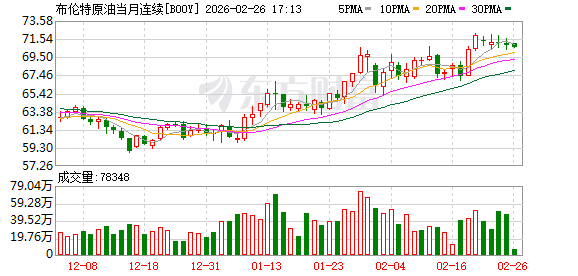
【财经分析】大宗商品“轮动”序幕拉开?黄金之后 原油面临一场大考
Xin Hua Cai Jing· 2026-02-26 07:55
Group 1: Oil Price Trends - The international oil price has shown strong performance during the Spring Festival holiday due to the US-Iran conflict, but there is a prevailing bearish sentiment that oil prices may decline once geopolitical tensions ease [1][6] - Experts predict that if conflict erupts, oil prices could surge due to potential disruptions in oil transportation through the Strait of Hormuz, with possible impacts ranging from 500,000 to 14 million barrels per day depending on the situation [4][6] - Historical trends indicate that oil prices are influenced by multiple factors beyond supply and demand, with expectations for commodity prices to strengthen in a specific order, starting with gold and moving through industrial metals to oil and agricultural products [7][8] Group 2: Geopolitical Factors - The ongoing tensions in the Middle East, including the deployment of US military assets, are critical to the current oil market dynamics, with potential military actions by the US against Iran being a significant concern [2][3] - Analysts suggest that the US may escalate military actions against Iran, which could lead to severe repercussions, including personnel casualties and disruptions in global energy markets [3][4] - The potential for Iran to retaliate by closing the Strait of Hormuz could lead to panic-driven increases in global oil prices, further complicating the supply chain and inflationary pressures [3][4] Group 3: Supply and Demand Outlook - The US Energy Information Administration (EIA) and the International Energy Agency (IEA) project a global oil supply surplus of 3.05 million barrels per day and 3.73 million barrels per day for 2026, respectively, indicating a long-term bearish outlook for oil prices [6] - Despite the current geopolitical support for oil prices, the overall supply-demand balance suggests that prices may face downward pressure in the medium term as global demand for traditional energy sources declines [6][8] - The historical decline in capital investment in oil exploration over the past decade may constrain long-term global oil supply capabilities, potentially leading to price increases if geopolitical tensions ease and strategic stockpiling resumes [8]
【财经分析】大宗商品“轮动”序幕拉开?黄金之后,原油面临一场大考
Zhong Guo Jin Rong Xin Xi Wang· 2026-02-26 07:52
Core Viewpoint - The article discusses the strong performance of international oil prices during the Spring Festival holiday due to the US-Iran conflict, while also highlighting the prevailing bearish sentiment towards oil prices once geopolitical tensions subside, despite a generally optimistic outlook for commodities in 2026 [2] Geopolitical Tensions - The Middle East situation remains tense, with reports of US military deployments, including F-22 fighter jets and the USS Ford aircraft carrier, indicating a potential escalation in military presence in the region [3][4] Military Action Analysis - Analysts from the Atlantic Council outline three potential US military strategies against Iran: limited strikes targeting military and security forces, long-term weakening of Iran's military capabilities, and regime change through direct attacks on leadership [5][6][7] Market Reactions and Predictions - Short-term oil price movements are heavily influenced by geopolitical factors, with potential supply disruptions from conflict in the Strait of Hormuz being a significant concern. Analysts suggest that if conflict escalates, oil prices could surge, while a de-escalation could lead to a rapid decline in prices [8][9] Supply and Demand Outlook - Despite short-term support for oil prices from geopolitical tensions, many institutions predict a medium-term oversupply in the global oil market, with the US Energy Information Administration (EIA) and International Energy Agency (IEA) forecasting oversupply of 3.05 million barrels per day and 3.73 million barrels per day for 2026, respectively [9][10] Historical Context and Future Trends - Historical trends indicate that oil prices are influenced by multiple factors beyond supply and demand. Analysts expect a rotation in commodity strength leading up to 2026, with oil prices potentially impacting various sectors, including energy and agriculture [10][11] Current Market Conditions - Current market conditions show low US oil inventories and high refinery utilization rates, which provide some support for oil prices despite a generally oversupplied market. Analysts warn that geopolitical events could amplify upward price movements [11]

机构研究周报:节后成长或更具弹性,大宗商品轮动机会显现
Wind万得· 2026-02-15 23:27
Core Viewpoint - The article discusses the resilience of growth sectors post-holiday and highlights emerging opportunities in commodity rotation [2] Group 1: Growth Sector Resilience - Growth sectors are expected to show greater resilience after the holiday period, indicating potential for investment [2] - The analysis suggests that certain industries may outperform due to favorable economic conditions and consumer demand [2] Group 2: Commodity Rotation Opportunities - There are indications of rotation opportunities within the commodity market, driven by changing supply and demand dynamics [2] - The article emphasizes the importance of monitoring commodity price movements as they may present strategic investment opportunities [2]

关键词 先后有别
Qi Huo Ri Bao Wang· 2026-02-11 01:36
Core Insights - The article discusses the cyclical nature of commodity price movements in relation to the global macroeconomic cycle, highlighting the distinct phases of "recovery, prosperity, stagflation, and recession" and their corresponding impacts on different commodity sectors [1] Group 1: Economic Phases and Commodity Performance - During the recovery phase, black and non-ferrous metals typically lead price increases driven by improved demand, while agricultural products like grains remain stable [1] - In the prosperity phase, energy and industrial metals lead the price surge, with agricultural products rising due to inflation transmission and increased planting costs [1] - The stagflation phase sees a divergence in commodity performance, with inflation-resistant assets like gold and oil outperforming, while industrial demand weakens [1] - In the recession phase, overall commodity prices decline, with industrial products falling the most, while safe-haven assets like gold and essential agricultural products experience smaller declines [1] Group 2: Sensitivity to Economic Signals - Commodities sensitive to interest rates, such as precious metals and industrial metals like copper, face increased holding costs during rising interest rates, leading to quicker adjustments [2] - Agricultural products and energy, with more rigid demand, are less affected by short-term interest rate fluctuations compared to supply and demand fundamentals [2] Group 3: Internal Mechanisms of Industrial Products - The price dynamics of black metals like steel and coal are closely tied to infrastructure investment and real estate cycles, with a clear transmission path from policy stimulus to steel demand and coal prices [2] - Non-ferrous metals like copper and aluminum are driven by global manufacturing PMI and renewable energy demand, with price movements linked to economic recovery expectations and inventory depletion [2] - Chemical products are strongly correlated with oil prices, with price transmission influenced by oil costs and adjustments in production rates [2] Group 4: Global Supply Chain and Commodity Rotation - The global division of labor has significantly reshaped the paths of commodity rotation, with China as a key demand driver for industrial products, influencing the rotation of black metals and certain chemicals [4] - The development of the renewable energy sector has altered the demand structure for non-ferrous metals like lithium and copper [4] - Supply constraints from resource-producing countries directly impact commodity prices, with geopolitical risks and trade policies exacerbating regional supply-demand mismatches [4]