流动性挤兑

Search documents
多资产周报:黄金价格深度回调-20260325
Guoxin Securities· 2026-03-25 07:12
证券研究报告 | 2026年03月22日 2026年03月25日 多资产周报 黄金价格深度回调 黄金价格深度回调。2026 年 3 月以来,国际黄金价格迎来深度调整。(1) 地缘政治引美元走强,成为压制金价的核心推手。3 月美伊冲突在核心 产油区爆发并持续升级,油价大幅暴涨,市场对美元需求激增,美元指 数突破 100 大关成为最强避险资产,直接对以美元计价的黄金形成价格 压制。与此同时,油价大涨加剧全球通胀担忧,美联储 3 月议息会议释 放鹰派信号,不仅暂停降息,还上调通胀预期,市场对降息的预判大幅 下修,无息资产黄金的持有机会成本激增,进一步削弱其投资吸引力。 (2)流动性挤兑与黄金的风险资产化特征,放大了价格下跌幅度。美 伊冲突引发全球权益市场震荡,韩国股市等触发熔断,高杠杆投资者为 回补股市保证金,被迫平仓流动性较好且有浮盈的黄金头寸,形成短期 抛压。而黄金在前期大涨中积累了大量投机资金,定价权阶段性从央行 转向投机资本,使其短期内与美股呈现强正相关的风险资产特征,最终 引发多头踩踏式平仓。此外,全球央行购金势头在 2026 年初有所放缓, 波兰、俄罗斯等央行甚至出现售金行为,也在一定程度上弱化了黄金的 ...
金价狂泻不止,风险资产全线失守
第一财经· 2026-03-23 08:28
2026.03. 23 本文字数:1730,阅读时长大约4分钟 作者 | 第一财 经 齐琦 全球金融市场经历"黑色星期一"。 3月23日国际金价继续跳水,继上周重挫超10%后,伦敦现货黄金盘中失守4100美元/盎司大关,最低 触及每盎司4098美元,日内跌超8.7%。国内金价跟随下挫,截至收盘报940元/克,跌超8%。 同时,现货白银同步崩溃,向下跌至60美元/盎司,盘中跌幅超10%,沪银期货收盘跌超11%。有色 金属板块全线承压,铜、铝、锌、锡联手大跌;此外,加密货币市场全线大跌,比特币大跌超3%, 美股三大指数期货、欧洲主要指数期货亦集体走低。 "传统意义上的'避险'与'风险'资产在本轮波动中出现界限模糊的特征。"一位交易人士对第一财经记 者称,美国总统特朗普的最新表态加剧了市场对局势升级的担忧情绪。 这场波及全球的抛售潮背后,市场究竟在交易怎样的逻辑? 大有期货贵金属研究员段恩典分析称,当美联储释放鹰派信号时,名义利率维持高位甚至上行,将推 高实际利率,直接增加黄金这一零息资产的持有机会成本。更重要的是"预期差"的极端放大,市场此 前已充分定价2026年多次降息,而点阵图显示全年仅降息一次,这种远超预期 ...

格林大华期货早盘提示-20260317
Ge Lin Qi Huo· 2026-03-16 23:30
早盘提示 Morning session notice 更多精彩内容请关注格林大华期货官方微信 格林大华期货研究院 证监许可【2011】1288 号 2026 年 3 月 17 日 星期二 | 板块 | 品种 | 多(空) | | | --- | --- | --- | --- | | | | | 【重要资讯】 | | | | | 1、瑞银警告,若霍尔木兹海峡封锁持续至 4 月底,全球日供应缺口将达 1000 万桶, | | | | | 推升油价突破 150 美元,并使美国通胀逼近 5%。此类供给冲击将导致全球股市普遍 | | | | | 下挫,消费、金融板块首当其冲。 | | | | | 2、美股机构出现十年规模最大的单周抛售。高盛数据显示,标普 500 期货遭净卖 | | | | 出 | 362 亿美元,创逾十年纪录;同时,ETF 空头敞口飙升至三年来高点。市场处于 | | | | | 危险临界点:若两周内地缘局势未见转机,股市将面临崩盘式下挫。 | | | | | 3、《华尔街日报》报道,美国政府打算近日宣布组建所谓霍尔木兹海峡"护航联 | | | | | 盟",一些国家同意为通行这一国际石油海运关键航 ...


深夜惊魂!金价银价突然大跳水,有人一夜亏惨
Sou Hu Cai Jing· 2026-02-14 04:33
Core Viewpoint - The significant drop in gold and silver prices was triggered by strong U.S. employment data, leading to a sharp decline in market expectations for interest rate cuts by the Federal Reserve [3][4]. Group 1: Market Reaction - Gold prices fell nearly $200 within 30 minutes, dropping from above $5000 to below $4900, marking a single-day decline of over 4%, the largest since 2026 [2][3]. - Silver prices plummeted over 10%, falling below $75, with a minimum price of $74.98, indicating extreme market conditions [3][6]. - The Shanghai Gold Exchange saw gold T D contracts drop by 2.49% to 1096.99 CNY/kg, while silver T D contracts fell by 8.62% to 18201 CNY/kg, with some contracts nearing the limit down [3][6]. Group 2: Economic Indicators - The U.S. non-farm payroll report for January showed an addition of 130,000 jobs, significantly exceeding the expected 70,000, with the unemployment rate decreasing from 4.4% to 4.3% and hourly wages increasing by 0.4% [3][4]. - These strong employment figures led to a sharp decrease in the probability of a Fed rate cut in March, dropping from 20% to 8%, with the first expected cut now pushed to July [3][4]. Group 3: Market Dynamics - The market experienced a "liquidity squeeze" as investors sold off gold and silver to cover losses from the stock market, which saw significant declines in major indices like the Nasdaq and S&P 500 [6]. - Technical factors exacerbated the price drop, as gold had previously risen 28% in January, leading to a chain reaction of stop-loss orders being triggered when prices fell below key psychological levels [6]. - Silver's decline was more severe due to its dual role as both a precious and industrial metal, with concerns over industrial demand following a drop in global manufacturing PMI [6]. Group 4: Broader Market Impact - Other precious and industrial metals also saw declines, with platinum down 3.2% to $1895/oz and palladium down 2.8% to $2150/oz [7]. - The broader commodity market faced selling pressure, with copper and aluminum prices also falling [7]. Group 5: Asset Reallocation - There was a noticeable shift in investor behavior, with U.S. Treasury bonds gaining favor as gold and silver prices fell, leading to a drop in 10-year and 2-year Treasury yields [9]. - The dollar index rose by 0.6% to 104.8, indicating a reallocation of assets from precious metals to traditional safe havens like U.S. debt [9]. Group 6: ETF Movements - Significant outflows were observed in gold and silver ETFs, with SPDR Gold Shares experiencing an outflow of $870 million and a reduction in holdings by 14.3 tons [9]. - iShares Silver Trust saw outflows of $320 million, with holdings decreasing by 285 tons, marking the largest single-day outflow for precious metal ETFs in 2026 [9]. Group 7: Institutional Insights - Citibank reported that global gold allocation as a percentage of GDP reached 0.7%, the highest in 55 years, suggesting potential future adjustments if this ratio returns to historical norms [10].
帮主快评:黄金白银一天跌没一周涨幅,避险资产为何不避险?
Sou Hu Cai Jing· 2026-02-13 00:37
Core Viewpoint - The global market experienced a peculiar "indiscriminate sell-off," with significant declines in various asset classes, including gold and silver, despite the absence of clear negative catalysts [1][4]. Group 1: Market Dynamics - The sell-off was characterized by algorithmic trading, where CTA strategy models triggered stop-loss orders, leading to a rapid sell-off without consideration for fundamental factors [3]. - The phenomenon is described as a liquidity squeeze, where even traditionally safe-haven assets like gold were sold off to raise cash and cover losses elsewhere [4]. Group 2: Investment Outlook - The short-term view suggests that the decline is driven by emotional panic, while the long-term fundamentals supporting gold prices remain intact, including ongoing central bank purchases and low real interest rates [4]. - Three operational guidelines are proposed: avoid catching falling knives, distinguish between trading and long-term positioning, and monitor specific signals indicating a return to safe-haven characteristics for gold and silver [5].

史诗级暴跌!逃出“火场”,是否后怕?切勿成为股市的“猎物”
券商中国· 2026-02-07 23:29
Core Viewpoint - The article discusses the volatility in the financial markets, particularly focusing on the recent drastic fluctuations in silver prices and their impact on the stock market, emphasizing the importance of managing risk and liquidity during such events [1][2]. Group 1: Market Volatility - On January 30, silver prices experienced a significant drop of over 30%, marking the largest single-day decline since 1980, which also affected the stock market, leading to a more than 12% drop in the non-ferrous metal index within three trading days [1]. - The article highlights the potential risks for investors using leverage, noting that a 1x leveraged investor could face a nearly 60% loss if they bought at the peak, with the possibility of forced liquidation if prices continued to fall [1]. - The article reflects on past market events, such as the liquidity crisis in 2015 and 2016, where leveraged investors faced severe consequences, emphasizing the need for caution in volatile markets [1][3]. Group 2: Managing Risk - The article stresses the importance of maintaining sufficient cash reserves and avoiding excessive debt to withstand market fluctuations, advocating for a conservative investment strategy [4][5]. - It draws a comparison between investing and farming, suggesting that investors should adopt a long-term perspective and be prepared for occasional market downturns, rather than engaging in high-risk speculative trading [5]. - The article cites Warren Buffett's investment philosophy, which includes maintaining cash reserves, avoiding leverage, and steering clear of high-risk stocks, reinforcing the idea that successful investors view themselves as farmers rather than hunters [5][6]. Group 3: Lessons from History - Historical events, such as the 9/11 attacks and the 2008 financial crisis, are referenced to illustrate the potential for sudden market declines and the importance of being prepared for such scenarios [3][4]. - The article emphasizes that while some investors may become wealthy through leverage, it can also lead to significant losses, highlighting the addictive nature of leverage and the risks associated with it [4][5]. - It concludes with a reminder that avoiding catastrophic mistakes is paramount for investors, advising against high-priced investments, risky companies, and excessive leverage [6].
黄金白银深夜大跳水背后,特朗普不打了?第一批受害者已出现
Sou Hu Cai Jing· 2026-02-03 03:11
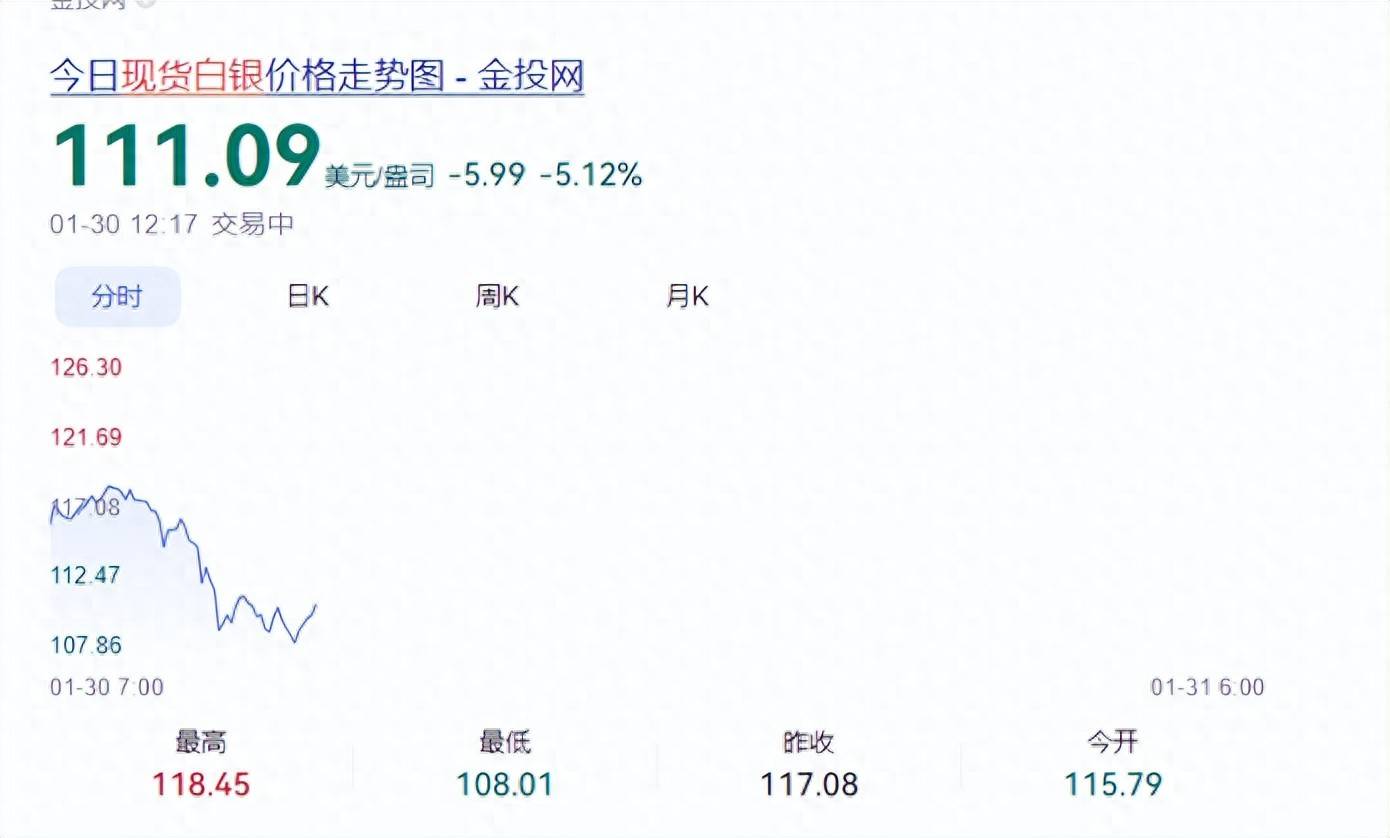
Core Viewpoint - The sudden crash in gold and silver prices on January 29 and 30 was driven by a combination of retail investor behavior, liquidity issues, and geopolitical tensions, leading to significant market volatility and panic selling [1][3][4]. Group 1: Market Reactions - On January 29, gold prices plummeted from a high of 5600 to 5200, while silver dropped from 121 to 106 [1]. - The morning of January 30 saw a broader market decline, with the A-share Shanghai Composite Index falling by 40 points, gold dropping to 5152.94 USD/oz (a 4% decline), and silver falling by 5.12% to 111.09 USD/oz [1][3]. Group 2: Causes of Price Decline - The surge in gold prices was primarily driven by retail investors, whose enthusiasm often leads to volatile market conditions. When retail interest peaks, it signals an impending correction [4]. - A wave of selling began as some investors opted to secure profits at high prices, triggering automated stop-loss orders and leading to a panic sell-off [6]. - The overall decline in asset prices, including stocks and cryptocurrencies, indicates a liquidity crisis, exacerbated by the Federal Reserve's decision to maintain interest rates and rising long-term bond yields [6]. Group 3: Geopolitical Factors - The current international environment suggests that gold prices are influenced more by "deterrent demand" rather than traditional "safe-haven demand," as countries react to perceived instability in U.S. policies under the Trump administration [8][10]. - Countries like Poland and Germany are increasing their gold reserves, indicating a shift away from reliance on the U.S. dollar and a collective effort to counteract U.S. monetary dominance [10][12]. Group 4: Central Bank Actions - Global central banks have significantly increased their gold reserves, with a tenfold increase over the past two years, reflecting a strategic move to counter the weakening of the dollar's dominance [12]. - Central banks are actively purchasing gold as a defensive measure against the potential collapse of the dollar's hegemony, with gold now comprising 28.9% of official reserves [12][14]. Group 5: Investor Sentiment - Many retail investors have expressed frustration and losses due to the sudden price drop, highlighting the risks associated with speculative trading in precious metals [18][20][22]. - Industry experts warn that this decline is not merely a minor correction, and investors holding long positions should implement strict risk management strategies to mitigate further losses [22].