
滞涨风险

Search documents
公募基金指数跟踪周报(2026.03.16-2026.03.20):震荡盘整,防御优先-20260323
HWABAO SECURITIES· 2026-03-23 13:20
Report Industry Investment Rating No relevant information provided. Core Viewpoints of the Report - The core variable in the current market lies in the Middle East. Until the geopolitical uncertainty decreases or the commodity price volatility declines, the market will continue to be affected by event narratives and liquidity, and may even fall into a game of long - term expectations. A - shares will maintain a volatile market, with more structural opportunities than overall opportunities [3][13]. - In the equity market, it is recommended to focus on energy sectors related to the Middle East situation, "three - low" sectors with low valuation, low volatility, and low consensus, and sectors that can maintain high - growth independently regardless of geopolitics and oil prices [3][13]. - In the bond market, short - term yields are down while long - term yields are up, and the yield curve is moving towards a bearish steepening. In the short term, it is recommended to maintain a neutral or slightly lower duration, and credit bonds may offer better value [4][14]. Summary by Directory 1. Weekly Market Observation 1.1 Equity Market Review and Observation - Last week, the A - share market showed a volatile downward trend, with significant fluctuations in market sentiment. The average daily trading volume of the entire A - share market was 2209.1 billion yuan, a decrease compared to the previous week [12]. - Due to the ongoing blockage of shipping in the Strait of Hormuz and the unresolved Middle East situation, global risk assets accelerated their decline. Funds shifted from cyclical sectors sensitive to macro - fluctuations to technology and manufacturing sectors with independent industrial logic and long - term growth potential [12]. - AI hardware industry chains such as memory chips, CPO, PCB, and computing power leasing attracted market attention, driven by multiple industry benefits. In contrast, resource - related cyclical sectors such as non - ferrous metals and chemicals faced pressure and declined [12]. 1.2 Pan - Fixed - Income Market Review and Observation - Last week, the bond market showed a significant differentiation between short - and long - term yields. The 1 - year Treasury yield decreased by 2.00BP to 1.26%, the 10 - year Treasury yield increased by 1.56BP to 1.83%, and the 30 - year Treasury yield increased by 2.16BP to 2.39% [4][14]. - The bond market is currently in a volatile pattern. Short - term yields have been declining due to extreme risk - aversion, while long - term yields are rising due to concerns about intensifying geopolitical conflicts and increased imported inflation expectations. The yield curve is moving towards a bearish steepening [4][14]. - The US Treasury yields increased across the board last week. The 1 - year US Treasury yield increased by 14BP to 3.80%, the 2 - year US Treasury yield increased by 15BP to 3.88%, and the 10 - year US Treasury yield increased by 11BP to 4.39% [15]. - The performance of REITs was differentiated. The CSI REITs Total Return Index fell 0.13% to 1021.78 points. Affordable housing and expressways had the highest gains, while warehousing and logistics, environmental protection, etc. had the highest losses [15]. 2. Fund Index Performance Tracking 2.1 Equity Strategy Theme - Based Index - **Active Equity Fund Selection**: The index selects 15 funds each period, with equal - weight allocation. The core positions select active equity funds based on performance competitiveness and style stability, and balance the style distribution according to the CSI Equity - Oriented Fund Index [19]. 2.2 Investment Style - Based Index - **Value Equity Fund Selection**: The index selects 10 funds with deep - value, quality - value, and balanced - value styles, with the CSI 800 Value Index as the benchmark [19]. - **Balanced Equity Fund Selection**: The index selects 10 relatively balanced and value - growth style funds, with the CSI 800 as the benchmark [22]. - **Growth Equity Fund Selection**: The index selects 10 funds with active - growth, quality - growth, and balanced - growth styles, with the 800 Growth Index as the benchmark [26]. 2.3 Industry Theme - Based Index - **Pharmaceutical Equity Fund Selection**: The index selects 15 funds based on the intersection market value ratio of fund equity holdings and the representative index, with the CSI All - Index Pharmaceutical and Healthcare Index as the benchmark [28]. - **Consumer Equity Fund Selection**: The index selects 10 funds based on the intersection market value ratio of fund equity holdings and the representative index, with the consumer - theme fund index as the benchmark [32]. - **Technology Equity Fund Selection**: The index selects 10 funds based on the intersection market value ratio of fund equity holdings and the representative index, with the technology - theme fund index as the benchmark [35]. - **High - End Manufacturing Equity Fund Selection**: The index selects 10 funds based on the intersection market value ratio of fund equity holdings and the representative index, with the high - end manufacturing - theme fund index as the benchmark [38]. - **Cyclical Equity Fund Selection**: The index selects 5 funds based on the intersection market value ratio of fund equity holdings and the representative index, with the CS Cyclical Index as the benchmark [40]. 2.4 Money - Market Enhancement Index - **Money - Market Enhancement Strategy**: The index aims for liquidity management, targeting a curve that outperforms money - market funds. It mainly invests in money - market funds and inter - bank certificate of deposit index funds, with the CSI Money - Market Fund Index as the benchmark [45]. 2.5 Pure - Bond Index - **Short - Term Bond Fund Selection**: The index aims for liquidity management, selecting 5 funds with stable long - term returns, strict drawdown control, and significant absolute - return capabilities, with a benchmark of 50% Short - Term Pure - Bond Fund Index + 50% Ordinary Money - Market Fund Index [47]. - **Medium - and Long - Term Bond Fund Selection**: The index invests in medium - and long - term pure - bond funds, aiming for stable returns while controlling drawdowns. It selects 5 funds, balancing coupon strategies and band - trading operations, and adjusting the ratio of credit - bond funds and interest - rate - bond funds according to market conditions [50]. 2.6 Fixed - Income Plus Index - **Low - Volatility Fixed - Income Plus Selection**: The index has an equity central position of 10%, selects 10 funds with an equity central position within 15% in the past three years and recently, with a benchmark of 10% CSI 800 Index + 90% ChinaBond New Composite Full - Price Index [53]. - **Medium - Volatility Fixed - Income Plus Selection**: The index has an equity central position of 20%, selects 5 funds with an equity central position between 15% - 25% in the past three years and recently, with a benchmark of 20% CSI 800 Index + 80% ChinaBond New Composite Full - Price Index [55]. - **High - Volatility Fixed - Income Plus Selection**: The index has an equity central position of 30%, selects 5 funds with an equity central position between 25% - 35% in the past three years and recently, with a benchmark of 30% CSI 800 Index + 70% ChinaBond New Composite Full - Price Index [56]. 2.7 Other Pan - Fixed - Income Index - **Convertible Bond Fund Selection**: The index selects 5 funds from a sample space of bond - type funds with a convertible - bond investment ratio meeting certain criteria, based on multiple evaluation indicators [60]. - **QDII Bond Fund Selection**: The index selects 6 funds with stable returns and good risk control based on credit and duration conditions, with underlying assets being overseas bonds [64]. - **REITs Fund Selection**: The index selects 10 funds with stable operations, reasonable valuations, and certain elasticity based on the underlying asset types of REITs [65].
【公募基金】震荡盘整,防御优先——公募基金指数跟踪周报(2026.03.16-2026.03.20)
华宝财富魔方· 2026-03-23 09:20
Equity Market Review and Outlook - The core variable affecting the market remains the Middle East, with both short-term trading logic and long-term "stagflation risk" expectations dependent on whether the geopolitical conflict can be resolved quickly [1][5] - Until uncertainties in the geopolitical situation decrease or commodity price volatility declines, the market will continue to be impacted by event narratives and liquidity shocks, leading to a focus on long-term expectations [5][6] - A-shares are expected to maintain a volatile trend, with structural opportunities being more prominent than overall opportunities; recommended sectors include energy-related stocks (oil, green energy, coal, coal chemical), low valuation and low volatility stocks (state-owned banks, utilities), and sectors that can maintain high prosperity independent of geopolitical and oil price influences (energy storage, domestic AIDC) [1][5][6] Fixed Income Market Review and Outlook - The bond market showed significant differentiation between short and long ends, with the 1-year government bond yield decreasing by 2.00 basis points to 1.26%, while the 10-year and 30-year yields increased by 1.56 basis points to 1.83% and 2.16 basis points to 2.39%, respectively [2][7] - The current bond market is in a volatile state, with extreme risk aversion driving down short-end yields, while long-end yields are rising due to escalating geopolitical conflicts and heightened inflation expectations [7][8] - The market sentiment is cautious, with a focus on short-end credit products showing strong allocation value; however, long-end yields have limited downward momentum, and liquidity may face certain shocks as the quarter-end approaches [2][7] Market Performance - The A-share market experienced a volatile decline, with average daily trading volume at 22,091 billion, a decrease from the previous week; the ongoing disruption in the Strait of Hormuz has led to a significant drop in global risk assets [4][5] - Funds are shifting from macro-sensitive cyclical sectors to technology manufacturing sectors with independent growth logic, driven by multiple industry benefits such as the overseas GTC conference and price increases in cloud computing and storage products [4][5] - Resource cyclical sectors like non-ferrous metals and chemicals are under pressure, primarily due to external macroeconomic impacts, including rising oil prices and concerns over the Federal Reserve's hawkish stance [4][5]


广发期货日评-20260320
Guang Fa Qi Huo· 2026-03-20 06:08
Report Summary 1. Report Industry Investment Ratings - Not provided in the given content. 2. Core Views - The overall market is affected by geopolitical conflicts, especially in the Middle East, leading to increased energy costs and inflationary pressures. Global central banks' monetary policies are difficult to loosen, and there is a risk of stagflation in overseas markets, which suppresses market sentiment. However, the domestic A - share market shows relative resilience and is likely to experience a differentiated market as the performance period approaches [3]. - The performance of different varieties varies. Some are affected by supply - demand relationships, cost factors, and geopolitical situations, showing trends such as weak or strong fluctuations, and investors need to adjust their strategies according to different situations [3]. 3. Summary by Categories Financial - **Stock Index**: The energy sector is rising against the trend, but overseas stagflation risks suppress market sentiment. The domestic A - share market is relatively resilient and is expected to show a differentiated market. The view is neutral with weak fluctuations, and it is recommended to stay on the sidelines [3]. - **Precious Metals**: Geopolitical conflicts increase inflationary pressures, and global central banks turn hawkish. Precious metals will generally remain in a weak - fluctuating state, seeking to build a bottom at the low level in early February. Gold put option buyers can continue to hold, and it is recommended to short - sell silver lightly above $75 - 80. Platinum follows gold and silver in a weak - fluctuating state, with resistance between $2000 - 2050, and palladium fluctuates weakly in the range of $1450 - 1500 [3]. Ferrous Metals - **Steel**: The steel price center moves up, and attention should be paid to the previous high pressure. For rebar and hot - rolled coils, pay attention to the pressure at 3150 yuan/ton and 3300 yuan/ton respectively [3]. - **Iron Ore**: Macroeconomic disturbances intensify, and the resumption of iron - making production accelerates. It fluctuates widely, with a reference range of 780 - 840 [3]. - **Coking Coal**: Some coal varieties are rising, and overseas energy commodities are surging. Affected by geopolitical risks, it is recommended to go long on coking coal 2605 on dips, with a reference range of 1100 - 1300 [3]. - **Coke**: Coke spot prices are temporarily stable, and cost increases raise the expectation of price hikes. The futures price fluctuates with coking coal. It is recommended to go long on coke 2605 on dips, with a reference range of 1650 - 1850 [3]. - **Silicon Iron**: Geopolitical conflicts continue, and both supply and demand of silicon iron increase. It fluctuates widely, with a reference range of 5700 - 6200 [3]. - **Manganese Silicon**: Market sentiment is changeable, and the cost of manganese silicon rises. It fluctuates widely, with a reference range of 5800 - 6400 [3]. Non - Ferrous Metals - **Copper**: The conflict between the US and Iran escalates, and copper prices are under pressure to decline. It is recommended to stay on the sidelines, and pay attention to the pressure at 97000 - 98000 for the main contract [3]. - **Aluminum Products**: Speculative demand increases, and spot prices continue to rise. For the main contract, refer to the range of 2800 - 3100, and continue to hold short positions [3]. - **Aluminum**: There are both recession expectations and supply crises, and the differentiation between domestic and overseas aluminum markets intensifies. For the main contract, refer to the range of 23000 - 25000, and try to go long with a light position [3]. - **Aluminum Alloy**: The price of primary aluminum fluctuates and falls, and the alloy price is adjusted downward accordingly. The main contract is expected to run in the range of 22000 - 24000, and try to go long with a light position [3]. - **Zinc**: The path of interest rate cuts is not clear, and zinc prices are under pressure to decline. Stop - profit on short positions, and pay attention to the support at 22800 - 23000 for the main contract [3]. - **Tin**: The Middle - East situation remains stalemate, market risk sentiment decreases, and supply - side recovery leads to a continued decline in tin prices. It is in a short - term weak - fluctuating state, and the medium - to - long - term strategy is to go long on dips [3]. - **Nickel**: Macroeconomic sentiment is significantly adjusted, and the futures price weakens rapidly. Operate in the range of 130000 - 140000 for the main contract [3]. - **Stainless Steel**: Macroeconomic sentiment suppresses the futures price, and supply and demand are gradually recovering. It is in a weak - fluctuating adjustment state, and the main contract is expected to be in the range of 13800 - 14500 [3]. New Energy - **Industrial Silicon**: The spot price stabilizes, but the futures price drops significantly due to market sentiment. It is advisable to hold the previously sold options cautiously [3]. - **Polysilicon**: The spot price stabilizes, and the futures price drops significantly due to market sentiment. It fluctuates in the range of 40000 - 45000 [3]. - **Lithium Carbonate**: Macroeconomic factors dominate market sentiment, and the decline in the futures price widens. For the main contract, refer to the range of 146,000 - 158,000, and conduct short - term range operations [3]. Energy and Chemicals - **Crude Oil**: Iran launches a large - scale counter - attack in response to the attack on its oil and gas fields, and the US and Israeli presidents announce a suspension of attacks on Iranian energy facilities. Oil prices fluctuate widely. Hold long positions cautiously or stay on the sidelines [3]. - **PX**: The cost - side support is strong, but the downstream negative feedback drags down the trend. Long positions can be protected with put options, and pay attention to oil price trends [3]. - **PTA**: Similar to PX, the cost - side support is strong, but the downstream negative feedback drags down the trend. The single - side strategy is the same as that of PX [3]. - **Short - Fiber**: It has limited self - driving force and follows the raw material price fluctuations. The single - side strategy is the same as that of PX, and the processing fee on the PF futures fluctuates between 800 - 1100 [3]. - **Bottle Chips**: Due to the expected shortage of raw material supply, the supply - demand situation of bottle chips is expected to be tight. The single - side strategy is the same as that of PTA, and the processing fee on the PR main - contract futures runs strongly [3]. - **Ethanol**: Affected by the Middle - East conflict, the de - stocking amplitude of MEG in the near - term is expected to increase. Before the resumption of oil transportation in the Middle - East, EG still has the momentum to rise, but the market fluctuates greatly. Pay attention to the risk of a pull - back after the rise. Long positions can be protected with put options; temporarily observe the spread between EB04 and BZ04, and pay attention to opportunities to narrow the spread [3]. - **Pure Benzene**: The cost - side support is strong, but the high - level fluctuations increase. Temporarily observe and pay attention to opportunities to narrow the spread [3]. - **Styrene**: The price of raw material ethylene has increased significantly, and the profit of styrene is significantly compressed. The strategy is the same as that of pure benzene [3]. - **LLDPE**: It maintains a risk - free basis, and trading is light. Stay on the sidelines [3]. - **PP**: More upstream plants stop production or reduce production, and the futures price is strong. Take profit on the 5 - 9 positive spread [3]. - **Methanol**: Affected by the geopolitical situation, methanol is strong. Continue to hold the bottom - position long positions [3]. - **Caustic Soda**: The Middle - East situation escalates, and the caustic - soda price remains firm. Stay on the sidelines mainly, and be vigilant against a significant decline in the futures price if the Middle - East situation eases [3]. - **PVC**: Geopolitical disturbances bring export expectations, and the emotional fluctuations of PVC are magnified. Stay on the sidelines [3]. - **Urea**: With the release of commercial reserves and the measures to ensure supply and stabilize prices, urea may fluctuate and decline. Pay attention to the situation among the US, Israel, and Iran, and take profit on the previous long positions [3]. - **Soda Ash**: Supply reaches a new high and continues to increase, downstream demand is average, and multiple production lines are planned for maintenance. Stay on the sidelines [3]. - **Glass**: Downstream demand recovers slowly, and glass enterprises mainly digest inventory. Pay attention to changes in production lines and demand [3]. - **Natural Rubber**: The Middle - East situation remains stalemate, and rubber prices are weak. Stay on the sidelines mainly [3]. - **Synthetic Rubber**: Under the tense Middle - East situation, the fundamentals generally support the strength of BR. In the short term, it is recommended to go long on the spread between RU2605 and BR2605 on dips with a light position [3]. - **Container Shipping on the European Route**: Shipowners raise the fuel surcharge, and the offline price weakens. The futures price fluctuates widely. Hold the 6 - 10 positive spread [3]. Agricultural Products - **Meal**: US soybeans stop falling and rebound, and the tight spot supply - demand situation supports the domestic meal futures. It fluctuates in a range [3]. - **Pigs**: The pressure of pig slaughter is large, and attention should be paid to the intensity of supply reduction. It fluctuates weakly [3]. - **Corn**: The spot price is stable, and corn fluctuates [3]. - **Vegetable Oils**: Affected by repeated geopolitical disturbances, vegetable oils follow the rise of crude oil. It fluctuates and consolidates [3]. - **Sugar**: The raw - sugar price rises again, and the Zhengzhou sugar futures remain strong. Pay attention to the pressure around 5450 - 5500 [3]. - **Cotton**: Commodity prices weaken, and cotton prices continue to adjust. Reduce long positions [3]. - **Eggs**: The market supply is stable, and the sales speed is average. It fluctuates at a low level [3]. - **Apples**: The inventory reduction is smooth, and the futures price rises significantly. It fluctuates strongly [3]. - **Jujubes**: Consumption is hard to improve, and the futures price fluctuates weakly. Pay attention to the support around 8600 - 8700 [3].
一文梳理 | 中东战火如何改变农产品逻辑
对冲研投· 2026-03-13 12:04
Core Viewpoint - The article emphasizes that inflation expectations serve as a "macro engine" for commodity markets, with recent geopolitical tensions in the Middle East significantly influencing commodity trends, particularly leading to a surge in oil prices and a renewed focus on inflation trades, which may also heighten the risk of stagflation [2]. Group 1: Commodity Trends - Since January, commodities have shown overall strength with a structural market characterized by significant increases in energy prices, high levels in precious metals, a rebound in agricultural products, and weaker performance in the black commodities sector, reflecting rising supply chain risks and intensified policy negotiations [2]. - The recent geopolitical conflicts have notably increased market attention on agricultural products, leading to heightened speculative activity and a significant rise in implied volatility, with agricultural prices increasingly following oil price movements, indicating that macro-level influences outweigh basic supply-demand fundamentals [2]. Group 2: Correlation Between Oil and Agricultural Products - Historical data shows varying correlations between oil and agricultural products, with imported agricultural products being most affected. From 2016 to present, the correlation between Brent crude oil and agricultural prices, such as U.S. soybean oil, cotton, and corn, has been notably strong, often exceeding 0.67 [3]. Group 3: Oil Market Dynamics - In early March, the oil market experienced a rapid upward pulse due to U.S.-Iran tensions, although prices have since retreated, establishing a higher price baseline. The oilseed market has strengthened due to both commodity market sentiment and the supportive fundamentals of biodiesel, making oilseeds a preferred choice among agricultural products [6]. - The current oil market dynamics differ from the 2022 Russia-Ukraine conflict, as the oil market is now influenced by ongoing geopolitical tensions, with no clear signals for a ceasefire, leading to a gradual increase in oil price baselines [9]. Group 4: Agricultural Costs and Production - The conflict has raised fertilizer and chemical costs significantly, with the USDA estimating a 92% increase in fertilizer costs and a 54% increase in chemical costs for soybean planting in 2022. This cost increase is expected to persist into 2025 and 2026, leading to an overall rise in planting costs by approximately 9% [11]. - The soybean market is currently under pressure due to several years of high production, resulting in relatively low prices. However, the market sentiment is shifting, with the potential for upward price movement due to geopolitical events and changes in trade policies [12]. Group 5: Cotton Market Outlook - The ongoing U.S.-Iran conflict is expected to impact the cotton industry through increased costs across the supply chain, including planting, processing, and transportation. The ICAC predicts a 4% decline in global cotton production, which, combined with geopolitical uncertainties, may lead to increased price volatility [19]. - Short-term cotton prices are expected to remain strong, with potential for further increases if the conflict continues, as rising energy costs and declining production expectations converge [20]. Group 6: Sugar Market Dynamics - The global sugar market is currently in a production increase cycle, but prices are under pressure due to high industrial inventories. However, the market is showing signs of cost support, and geopolitical tensions may indirectly influence sugar prices through the ethanol market [27]. - The conflict has created disruptions in sugar supply chains, particularly affecting refined sugar exports, which may lead to tighter supply and upward price pressure in the sugar market [27]. Group 7: Corn Market Insights - The geopolitical tensions have led to significant uncertainty in logistics and production in the Middle East, driving up oil prices and subsequently impacting grain markets. Despite a generally loose supply-demand balance for corn and wheat, macroeconomic factors are currently dominating market dynamics [34]. - Domestic corn prices have strengthened due to market speculation and concerns over supply gaps, with expectations of continued price increases in the short term [34]. Group 8: Egg and Pork Markets - The fluctuations in oil prices are impacting the egg market primarily through cost channels, as rising feed prices due to increased demand for biofuels are expected to elevate production costs for eggs [42]. - The pork market is experiencing indirect effects from rising feed costs, which could lead to increased production costs and potential supply pressures in the near term [49].

招银国际每日投资策略-20260313
Zhao Yin Guo Ji· 2026-03-13 02:39
Industry Insights - The U.S. software and IT services sector is focusing on client value creation, with leading companies emphasizing their competitive advantages in enterprise data, product deployment, and workflow governance [5] - There is a notable shift towards hybrid pricing models in application software, driven by the need to demonstrate value based on results [5] - Network security and infrastructure software are facing lower concerns regarding AI replacement, making them areas of focus for investment [5] Company Insights - Li Auto (LI US/2015 HK) reported a slight increase in gross margin to 17.8% for Q4 2025, exceeding expectations due to supplier rebates and strong performance from the i6 model [6] - The upcoming L9 model is critical for Li Auto's strategy, as its success may influence the positioning of future models like the L8 and L7 in a competitive SUV market [6] - Li Auto has revised its 2026 sales target down to approximately 490,000 units, reflecting challenges in inventory clearance and subsidy impacts, with expectations of a gross margin drop to around 5% in Q1 2025 [7][8]
通胀即将反弹
Zhao Yin Guo Ji· 2026-03-12 11:29
Inflation Trends - The U.S. CPI and core CPI year-on-year growth rates remain stable at 2.4%, the lowest in nearly two years[2] - March CPI is expected to rise significantly to 3.1% due to a projected 17% increase in gasoline prices, contributing approximately 0.5 percentage points to the CPI growth[6] - Core CPI year-on-year growth is at a near five-year low of 2.5%, with core services growth slowing to 2.9%[6] Economic Risks - Rising oil prices are a major variable for future inflation, with a 10% increase in crude oil prices estimated to raise inflation by 0.3-0.4 percentage points[6] - The market's expectation for interest rate cuts has decreased from 60 basis points to 29 basis points, with the first anticipated cut pushed from June to September[6] - The ongoing Middle East conflict may prolong inflationary pressures, increasing the risk of stagflation in the U.S.[6] Core Components - Rent inflation continues to slow, currently at 0.2% month-on-month, with an annualized growth rate of 2.5%, below the pre-pandemic average of 3.3%[6] - Core goods inflation has slightly rebounded, with furniture, clothing, and leisure goods showing increases of 0.2%, 1.3%, and 0.4% respectively[6] - Core services, excluding rent, have a month-on-month growth rate of 0.35%, still reflecting high wage growth trends[6]
2026年2月27日申万期货品种策略日报-黄金白银-20260227
Shen Yin Wan Guo Qi Huo· 2026-02-27 02:11
1. Report Industry Investment Rating No information provided. 2. Core View of the Report - Precious metals continue to fluctuate. The overall performance of precious metals has been relatively strong recently, driven by three core logics: the change in US tariff policy impacts the US dollar's credit, the tense situation in Iran boosts the safe - haven demand for gold, and the stagflation risk strengthens the anti - inflation property of gold. In the short term, tariff rulings and geopolitical conflicts have a resonance effect on precious metals. In the medium to long term, factors such as de - dollarization and geopolitical risks will support gold to return to an upward channel. Due to the resonance of industrial and financial attributes, silver is expected to continue its volatile and relatively strong trend in the short term [3]. 3. Summaries According to Relevant Catalogs 3.1 Futures Market - **Gold Futures**: For Shanghai Gold 2606, the previous day's closing price was 1154.34, yesterday's closing price was 1150.10, with a decline of 4.24 and a decline rate of - 0.37%. The trading volume was 37536, and the open interest was 103854. For Shanghai Gold 2604, the previous day's closing price was 1151.060, yesterday's closing price was 1146.480, with a decline of 4.580 and a decline rate of - 0.40%. The trading volume was 169407, and the open interest was 151642 [2]. - **Silver Futures**: For Shanghai Silver 2606, the previous day's closing price was 22786, yesterday's closing price was 22286, with a decline of 500 and a decline rate of - 2.19%. The trading volume was 276956, and the open interest was 153835. For Shanghai Silver 2604, the previous day's closing price was 23029, yesterday's closing price was 22572, with a decline of 457 and a decline rate of - 1.98%. The trading volume was 357610, and the open interest was 173529 [2]. 3.2 Spot Market - **Gold Spot**: The previous day's closing price of Shanghai Gold T + D was 1145.07, yesterday's closing price was 1143.00, with a decline of 2.07 and a decline rate of - 0.18%. The price of London gold was 5181.10, with an increase of 16.79 and an increase rate of 0.33% [2]. - **Silver Spot**: The previous day's closing price of Shanghai Silver T + D was 22131, yesterday's closing price was 21600, with a decline of 531 and a decline rate of - 2.40%. The price of London silver was 88.18, with a decline of 1.04 and a decline rate of - 1.16% [2]. 3.3 Inventory - **Gold Inventory**: The current inventory of Shanghai Futures Exchange gold is 105,072 kg, unchanged from the previous value. The current inventory of COMEX gold is 33,487,689 troy ounces, a decrease of 139850 troy ounces from the previous value [2]. - **Silver Inventory**: The current inventory of Shanghai Futures Exchange silver is 346,369 kg, a decrease of 9461 kg from the previous value. The current inventory of COMEX silver is 360,638,935 troy ounces, a decrease of 1205466 troy ounces from the previous value [2]. 3.4 Related Derivatives - **ETF Holdings**: The current holding of SPDR Gold ETF is 1,098 tons, an increase of 0.28 tons from the previous value. The current holding of SLV Silver ETF is 16,080 tons, a decrease of 28 tons from the previous value [2]. - **CFTC Speculators' Net Positions**: The current net position of CFTC speculators in gold is 159,915, a decrease of 97 from the previous value. The current net position of CFTC speculators in silver is 24,003, an increase of 1048 from the previous value [2]. 3.5 Macro News - Iran's Foreign Minister Araqchi said that the negotiations with the US have made good progress [3]. - Six US aerial refueling tankers are flying to Israel's Ben - Gurion Airport to join the expanding US military deployment in the region [3]. - The US - Ukraine Geneva talks ended on the 26th, and no specific results have been announced [3]. - After Trump's tariff lawsuit lost in the Supreme Court, government officials are formulating legal strategies to retain billions of dollars in tariffs ruled illegal by the Supreme Court [3]. - Fed's Goolsbee said that interest rates can be cut, but he doesn't want to cut them significantly before inflation eases [3]. - Fed Governor Milan believes that interest rates need to be cut by about 1 percentage point this year, in four 25 - basis - point cuts and as early as possible [3]. - The increase in the number of Americans applying for unemployment benefits last week was lower than expected, indicating that lay - offs remain at a low level. The number of initial jobless claims in the week ending February 21 increased by 4000 to 212,000, with a median forecast of 215,000. The number of continuing claims dropped to 1.83 million [3].
2026年2月26日申万期货品种策略日报-黄金白银-20260226
Shen Yin Wan Guo Qi Huo· 2026-02-26 01:47
1. Report Industry Investment Rating - No relevant information provided 2. Core Viewpoints - The precious metals market showed a strong performance recently, with silver leading the gains. The core drivers are three - fold: the change in US tariff policy impacts the US dollar's credit; the tense situation in Iran boosts the safe - haven demand for gold; and the stagflation risk strengthens the anti - inflation property of gold. Short - term tariff rulings and geopolitical conflicts drive the precious metals market, and in the medium - to - long - term, factors like de - dollarization and geopolitical risks will support gold's upward trend. Silver is expected to continue its volatile and strong trend in the short term due to the resonance of its industrial and financial attributes [5] 3. Summary by Directory 3.1 Futures Market - **Prices**: The closing prices of Shanghai Gold 2606 and 2604 were 1154.34 and 1151.06 respectively, with increases of 0.52 and 0.56, and increases of 0.05%. The closing prices of Shanghai Silver 2606 and 2604 were 22786 and 23029 respectively, with increases of 756 and 702, and increases of 3.43% and 3.14% [2] - **Positions and Volumes**: The positions of Shanghai Gold 2606 and 2604 were 100812 and 155075 respectively, and the trading volumes were 51239 and 198537 respectively. The positions of Shanghai Silver 2606 and 2604 were 149845 and 182667 respectively, and the trading volumes were 272487 and 413159 respectively [2] - **Spot Premium**: The spot premiums of Shanghai Gold 2606 and 2604 were - 9.27 and - 5.99 respectively. The spot premiums of Shanghai Silver 2606 and 2604 were - 655 and - 898 respectively [2] 3.2 Spot Market - **Prices**: The closing price of Shanghai Gold T + D was 1145.07, with a decrease of 1.81 and a decrease of 0.16%. The closing price of London Gold was 5164.31, with an increase of 32.30 and an increase of 0.63%. The closing price of Shanghai Silver T + D was 22131, with an increase of 645 and an increase of 3.00%. The closing price of London Silver was 89.22, with an increase of 2.13 and an increase of 2.45% [2] - **Price Differences**: The difference between Shanghai Gold 2606 and 2604 was 3.28, and the difference between Shanghai Silver 2606 and 2604 was - 243.00. The gold - to - silver ratio (spot) was 51.74. The ratio of Shanghai Gold to London Gold was 1.00, and the ratio of Shanghai Silver to London Silver was 1.12 [2] 3.3 Inventory - **Domestic**: The inventory of Shanghai Futures Exchange gold was 105,072 kg (no change), and the inventory of Shanghai Futures Exchange silver was 355,830 kg, an increase of 5951 kg [2] - **Overseas**: The inventory of COMEX gold was 33,627,539 troy ounces, a decrease of 73624 troy ounces. The inventory of COMEX silver was 361,844,401 troy ounces, a decrease of 2155763 troy ounces [2] 3.4 Related Derivatives - **ETF Holdings**: The position of SPDR Gold ETF was 1,098 tons, an increase of 3 tons. The position of SLV Silver ETF was 16,080 tons, a decrease of 28 tons [2] - **CFTC Net Positions**: The net position of CFTC speculators in gold was 159,915, a decrease of 97. The net position of CFTC speculators in silver was 24,003, an increase of 1048 [2] 3.5 Macro News - **US - Iran Relations**: US Secretary of State Rubio said that Iran has long posed a serious threat to the US, and Iran is trying to reach a state where it can conduct uranium enrichment. On February 25, the US Treasury's Office of Foreign Assets Control (OFAC) imposed sanctions on multiple individuals, entities, and vessels related to Iran [3][4] - **Venezuela**: The Central Bank of Venezuela sold nearly 6 tons of gold in the second half of last year due to a severe shortage of US dollars caused by US restrictions on its oil exports. After the US Special Forces arrested Venezuelan President Maduro in January, the US allowed some of Venezuela's oil sales revenue to flow back to the country, which revitalized the official foreign exchange market [4] - **US Tariff Policy**: US Trade Representative Greer said that the tariffs of some countries will be raised to 15% [4]
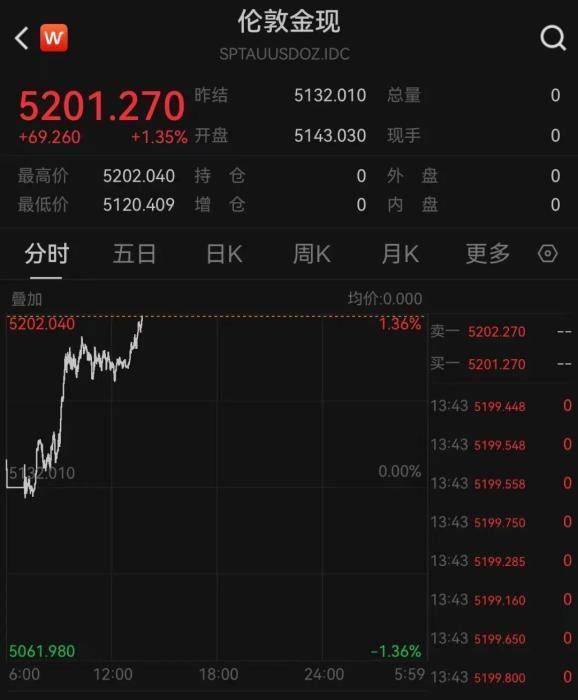
现货黄金刚刚涨破5200美元关口
Sou Hu Cai Jing· 2026-02-25 06:26
Core Viewpoint - UBS analysts indicate that despite a relatively mild response of gold prices to recent geopolitical tensions, there is still potential for further increases, predicting prices to rise to $6200 per ounce in the coming months due to strong underlying drivers [1]. Group 1: Market Drivers - The recent performance of precious metals is primarily driven by three key factors: 1. Changes in U.S. tariff policies impacting dollar credibility, with the Supreme Court ruling against large-scale tariffs imposed by the Trump administration, leading to increased tariffs on imported goods [1]. 2. Ongoing tensions in Iran during the holiday period significantly boosting gold's safe-haven demand [1]. 3. Rising stagnation risks enhancing gold's anti-inflation properties, as recent U.S. data shows inflation exceeding expectations alongside slowing economic growth [1]. Group 2: Short-term and Long-term Outlook - In the short term, the combination of tariff rulings and geopolitical conflicts is expected to drive precious metals, while in the long term, factors such as de-dollarization and geopolitical risks will support gold's upward trajectory [1]. - Silver is anticipated to maintain a strong oscillating trend in the short term due to its industrial and financial attributes resonating together [1]. Group 3: Recent Market Activity - On the 25th, spot gold prices continued to rise, breaking the $5200 mark with an increase of over 1.3% during the trading session [2].
2026年2月25日申万期货品种策略日报-黄金白银-20260225
Shen Yin Wan Guo Qi Huo· 2026-02-25 01:54
Report Industry Investment Rating - Not provided in the content Core Viewpoints - The recent performance of precious metals has been strong, driven by three main factors: the change in US tariff policy impacting the US dollar's credit, the tense situation in Iran during the holiday boosting the safe - haven demand for gold, and the enhanced anti - inflation property of gold due to stagflation risks. In the short term, the tariff ruling and geopolitical conflicts have a resonance effect on precious metals, and in the long - term, factors like de - dollarization and geopolitical risks will support gold to return to an upward channel. Silver is expected to maintain a volatile and slightly strong trend in the short term due to the resonance of its industrial and financial attributes [6] Summary by Relevant Catalogues Futures Market - **Prices and Changes**: The closing prices of Shanghai Gold 2606 and 2604 increased by 40.36 and 40.40 respectively, with a growth rate of 3.62% and 3.64%. The closing prices of Shanghai Silver 2606 and 2604 increased by 2460 and 2545 respectively, with a growth rate of 12.57% and 12.87% [2] - **Positions and Volumes**: The positions of Shanghai Gold 2606 and 2604 are 93903 and 157411 respectively, and the trading volumes are 34008 and 126903 respectively. The positions of Shanghai Silver 2606 and 2604 are 136869 and 175097 respectively, and the trading volumes are 129011 and 210732 respectively [2] - **Spot Premiums or Discounts**: The spot premiums or discounts of Shanghai Gold 2606 and 2604 are - 6.94 and - 3.62 respectively, and those of Shanghai Silver 2606 and 2604 are - 544 and - 841 respectively [2] Spot Market - **Prices and Changes**: The closing price of Shanghai Gold T + D increased by 38.38, with a growth rate of 3.46%. The closing price of London Gold decreased by 95.42, with a decline rate of 1.83%. The closing price of Shanghai Silver T + D increased by 2216, with a growth rate of 11.50%. The closing price of London Silver decreased by 1.10, with a decline rate of 1.25% [2] - **Price Ratios**: The current value of the spread between Shanghai Gold 2606 and 2604 is 3.32, and the spread between Shanghai Silver 2606 and 2604 is - 297.00. The gold - to - silver ratio in the spot market is 53.38. The ratio of Shanghai Gold to London Gold is 1.01, and the ratio of Shanghai Silver to London Silver is 1.11 [2] Inventory - **Changes**: The inventory of Shanghai Futures Exchange gold is 105,072 kg, and the inventory of Shanghai Futures Exchange silver decreased by 3680 kg to 349,879 kg. The COMEX gold inventory decreased by 73343 ounces to 33,701,164 ounces, and the COMEX silver inventory decreased by 2969 ounces to 364,000,164 ounces [2] Related Derivatives - **Positions and Changes**: The position of SPDR Gold ETF increased by 8 tons to 1,094 tons, and the position of SLV Silver ETF increased by 313 tons to 15,830 tons. The net position of CFTC speculators in gold decreased by 97 to 159,915, and the net position in silver increased by 1048 to 24,003 [2] Macro News - **Military Deployment**: The US deployed 12 F - 22 fighter jets to Israel, and the F - 22s landed at an Israeli air base on Tuesday evening [3] - **Sanctions and Agreements**: The President of the European Commission is confident in passing the 20th round of sanctions against Russia. Iran's Deputy Foreign Minister said that Tehran is ready to reach an agreement with the US as soon as possible [3] - **Tariff Policy**: The Trump administration is working to raise the temporary global tariff rate from 10% to 15%. The US may simplify the wide - ranging tariffs on steel and aluminum products, and the scope of the 50% tariff on so - called steel and aluminum "derivative products" may be narrowed in a few weeks [3][5] - **Iran Situation**: US Secretary of State Rubio will brief major lawmakers on the situation in Iran. The US government is weighing possible strikes against Iran. A resolution requiring Trump to obtain congressional authorization before using force against Iran may be voted on next week or later, and its passage in the House of Representatives seems unlikely [4]