潮玩经济

Search documents
泡泡玛特再涨近5% 月内累升逾20% 2025年集团全IP全品类产品全球销售超4亿只
Xin Lang Cai Jing· 2026-02-10 03:19
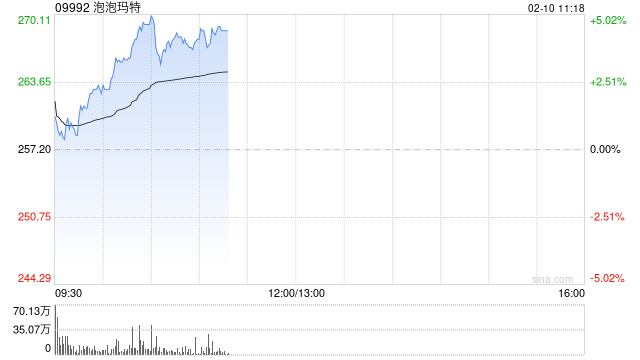
Core Viewpoint - Pop Mart's stock price has increased nearly 5%, reaching 270 HKD, with a monthly gain of over 20% [1][5]. Group 1: Stock Performance - As of February 10, Pop Mart's stock is priced at 268.6 HKD, with a trading volume exceeding 3.2 billion HKD [1][5]. - The stock opened at 263.4 HKD and has a highest price of 270.0 HKD and a lowest price of 257.2 HKD during the trading session [2][6]. - The average price during the session is 264.595 HKD, with a trading volume of 12.29 million shares [2][6]. Group 2: Financial Metrics - The company's total market capitalization is 360.34 billion HKD, with a price-to-earnings (P/E) ratio of 48.47 [2][6]. - The stock has a price-to-book (P/B) ratio of 23.167 and a dividend yield of 0.330% [2][6]. - The stock has experienced a 52-week high of 339.8 HKD and a low of 100.712 HKD [2][6]. Group 3: Sales Data - On February 9, 2025, Pop Mart announced that its total global sales of all IP and product categories exceeded 400 million units, with sales of THE MONSTERS category surpassing 100 million units [2][6].


泡泡玛特涨6%,LABUBU全年销量超1亿只
Ge Long Hui· 2026-02-09 06:21
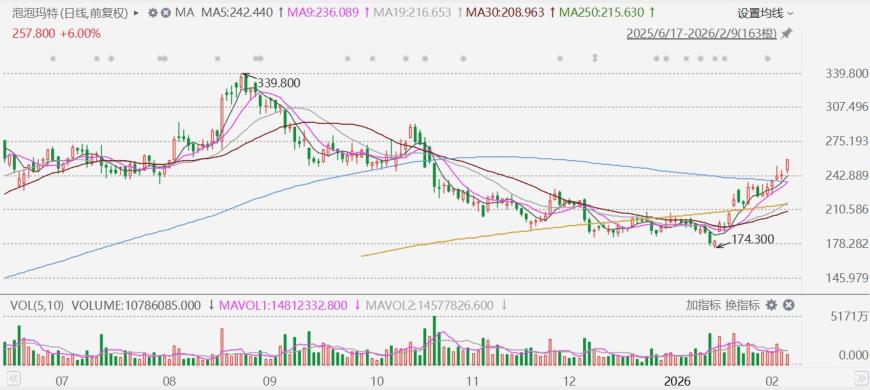
Group 1 - The core viewpoint of the article highlights that Pop Mart (9992.HK) experienced a significant stock price increase of 6%, reaching a new high of 258 HKD since October 2025 [1] - In the recent annual meeting, Pop Mart announced key annual data, indicating that in 2025, the company had over 10,000 global employee partners and more than 100 million registered members worldwide [1] - Pop Mart reported that LABUBU's annual sales exceeded 100 million units, with total sales across all product categories and IPs surpassing 400 million units [1] Group 2 - The company's business has expanded to over 100 countries and regions, with more than 700 global stores and six major supply chain bases [1] - Pop Mart has created over 200,000 employment opportunities through its operations [1]
泡泡玛特20260129
2026-01-30 03:11
Summary of the Conference Call for Pop Mart Company Overview - **Company**: Pop Mart - **Industry**: Toy and Entertainment Key Points and Arguments Competitive Advantages - Pop Mart has established a unique dynamic barrier through aesthetic culture and top-tier artist resources, which are difficult to replicate [2][3] - The founder's aesthetic vision and deep connections with top artists are crucial to the company's success [2] - The company has successfully extended its reach into various top-tier circles across industries, occupying a significant position in the minds of key consumers, creating a competitive edge that is hard for other brands to match [2] Operational Mechanisms - Pop Mart has institutionalized its operational mechanisms across various aspects, including IP and brand management, product and content development, marketing and operations, store and amusement park management, and new product launches, forming deep operational barriers [2][3] Market Demand and Trends - Demand for trendy toys is driven by demographic changes, shifts in mass media, and consumer psychological needs, with the Kidult subculture becoming particularly prominent during economic downturns [2][6] - Current global systemic anxiety has extended the demand stickiness and lifecycle of trendy toys [2][6] Growth Strategy - The company plans to expand its retail footprint with approximately 600 new stores domestically and over 400 internationally, supported by IP licensing and cross-industry collaborations [2][10] - Product diversification and premiumization strategies are in place to increase average transaction value, with some products priced close to 20,000 RMB [2][13] Future Revenue Projections - For 2026, Pop Mart expects to achieve revenues between 37.5 billion to 68 billion RMB, with adjusted net profits projected between 12.3 billion to 22.6 billion RMB [7][8] Investment Value - The current stock price is considered to have a high safety margin compared to international giants, with a PE ratio significantly above 10, indicating attractive investment potential [5][8] International Market Development - As of mid-2025, overseas revenue was approximately 5.593 billion RMB, with an estimated overseas membership of about 44 million [12] - The company aims to replicate its domestic success in international markets, leveraging its established operational strategies [12] Product Innovation and Customer Engagement - Pop Mart is innovating through diverse product offerings, including figures, plush toys, and movable dolls, enhancing customer engagement and brand loyalty [13][19] - The company has seen significant growth in its membership base, with over 59 million members in mainland China by mid-2025 [11] Expansion into New Business Areas - The company is diversifying into amusement parks, gaming, and film, with notable collaborations such as the development of a movie with Sony Pictures [2][15][16] Artist Collaboration and Marketing - Pop Mart leverages collaborations with renowned artists and brands to enhance its market presence and consumer recognition [17][20] - The company has established a strong operational mechanism that allows for timely market responses and efficient product launches [19] Valuation Assessment - Based on historical valuation metrics of similar companies, Pop Mart is projected to achieve a market valuation of approximately 500 billion HKD by 2026, maintaining a buy rating [22]
爆火!这款挂件盲盒登上热搜,网友:挺懂年轻人的
Bei Jing Ri Bao Ke Hu Duan· 2026-01-25 04:01
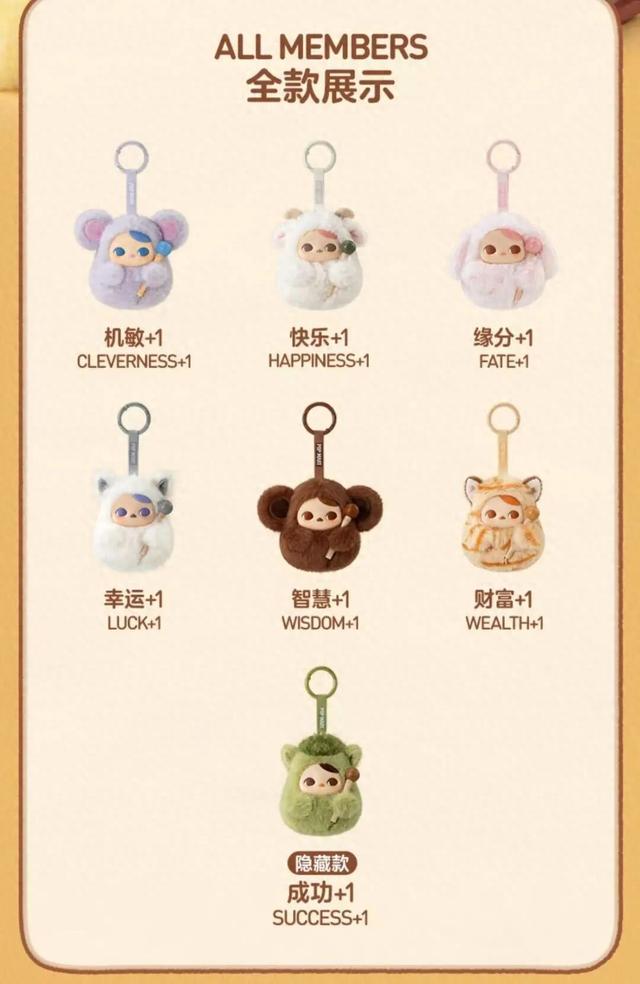
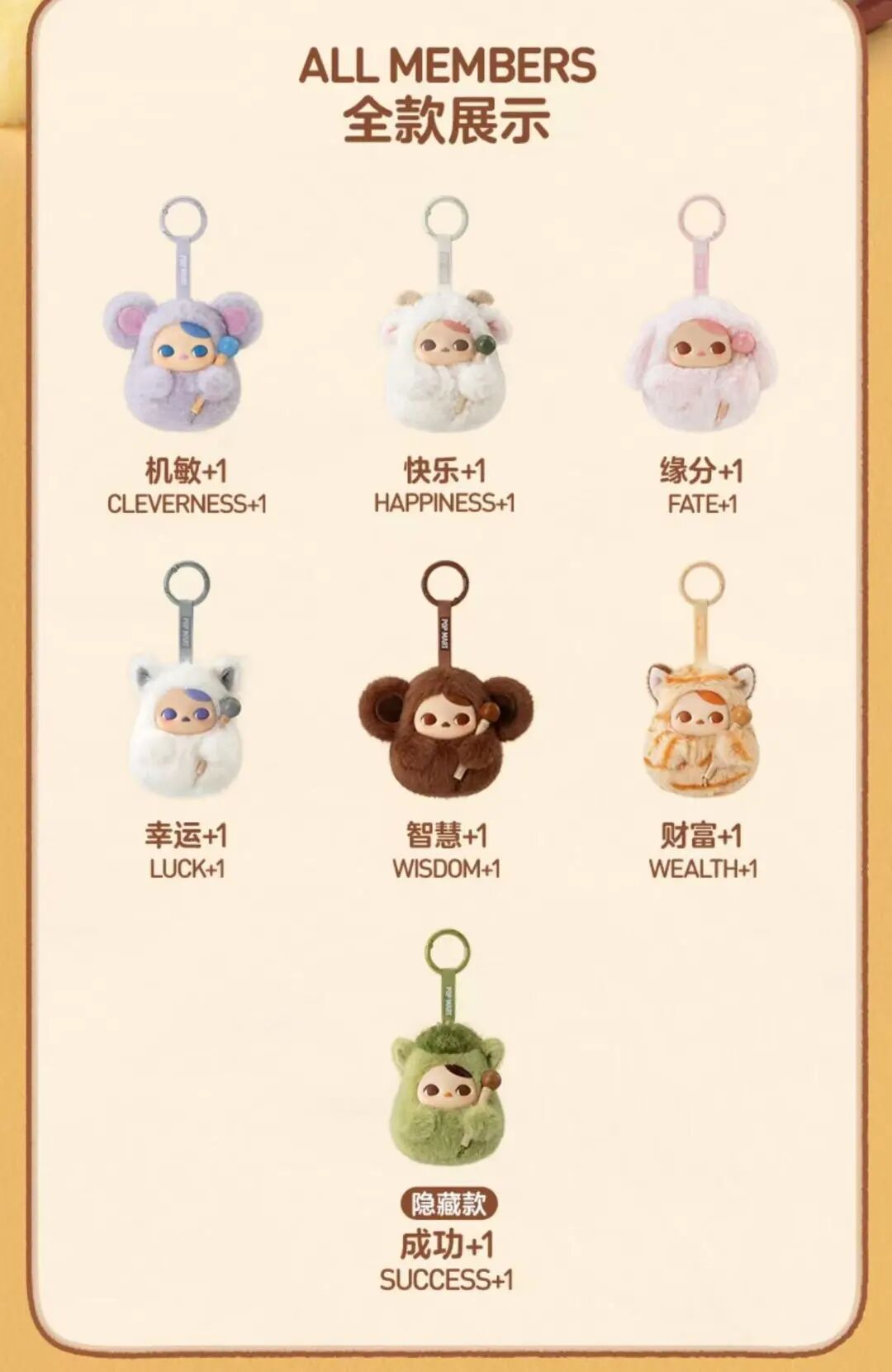
Core Insights - The recent launch of the "PUCKY Knock Knock Series" plush blind box by Pop Mart has gained significant popularity, featuring an electronic sound device that triggers sound effects when tapped, aimed at emotional relief [1][2] - The initial market response has seen the hidden variant "Success" increase in price from 99 yuan to 396 yuan, a 300% premium, while the most popular regular variant "Wisdom" rose from 99 yuan to 209 yuan, a 100% premium [2] Group 1 - The "PUCKY Knock Knock Series" consists of 6 regular characters and 1 hidden character, priced at 99 yuan per box and 594 yuan for a full set [1] - The series has sold out on Pop Mart's official mini-program, indicating strong demand [2] - Social media reactions highlight that Pop Mart understands the preferences of young consumers [4] Group 2 - As of January 23, Pop Mart's stock price increased by 6.6%, closing at 219.600 HKD per share, with a market capitalization of 294.6 billion HKD [5] - The company has repurchased 500,000 shares for a total of 96.49 million HKD, marking its second buyback within the week, with a cumulative buyback amount nearing 350 million HKD [7] - For the third quarter of 2025, Pop Mart reported a 245% year-on-year increase in overall revenue, with the Chinese market growing by 185% to 190% and online channels seeing a remarkable growth of 300% to 305% [7][8] Group 3 - International investment bank Morgan Stanley projects Pop Mart's net profit to reach 12.6 billion RMB in 2025, with the company holding 20 billion RMB in net cash at the end of the previous year [12]
泡泡玛特新品爆火,刚上架就秒空!99元涨到396元
Shen Zhen Shang Bao· 2026-01-24 15:31
Group 1 - The core product launched by Pop Mart in January is the "PUCKY Knock Knock Series" plush blind box, which features an electronic sound device that triggers sound effects when the head is tapped, aimed at emotional stress relief [6] - The blind box includes 6 regular characters and 1 hidden character, priced at 99 yuan per box and 594 yuan for a full set of 6. The product quickly sold out on the official website, with resale prices skyrocketing [6] - The hidden character "Success" saw its market price rise from 99 yuan to 396 yuan, a 300% increase, while the most popular regular character "Wisdom" increased from 99 yuan to 209 yuan, a 100% increase [6] Group 2 - Following the product's success, Pop Mart's stock price surged over 6% on January 22, closing at 206 HKD per share, with a market capitalization of 276.4 billion HKD [9] - On January 21, Pop Mart announced a share buyback of 500,000 shares for a total of 96.49 million HKD, marking the second buyback within the week, with a cumulative buyback amount nearing 350 million HKD [9] - Morgan Stanley projects that Pop Mart's net profit will reach 12.6 billion RMB by 2025, supported by a net cash flow of 20 billion RMB at the end of last year, indicating strong performance potential for 2025 and Q1 2026 [9]
泡泡玛特电子木鱼爆火,隐藏款被炒到超300元
2 1 Shi Ji Jing Ji Bao Dao· 2026-01-23 06:31
Core Viewpoint - The recent popularity of Pop Mart's "PUCKY Knock Knock Series" has significantly impacted both consumer interest and the company's stock performance, highlighting the potential for collectible toys in the market [1][5][9]. Group 1: Product Details - The "PUCKY Knock Knock Series" features plush keychains that produce a sound when lightly tapped, earning the nickname "electronic wooden fish" among consumers [1]. - The series includes 6 regular characters and 1 hidden character, with a single box priced at 99 yuan and a full set (6 pieces) priced at 594 yuan. The product is currently sold out on the official website [1]. Group 2: Market Performance - On January 23, Pop Mart's stock (09992.HK) surged over 7%, reaching 222.2 HKD per share, with a market capitalization of 298.1 billion HKD [9]. - The company announced a share buyback of 500,000 shares for a total of 96.49 million HKD, with prices ranging from 191.1 HKD to 194.9 HKD per share. This marks the second buyback within the week, totaling nearly 350 million HKD [9]. Group 3: Pricing and Resale Market - On an e-commerce platform, the hidden version of the "PUCKY Knock Knock" plush keychain is being sold for approximately 327 yuan, reflecting a premium of 230% [5]. - On second-hand trading platforms, the price for this item starts at 245 yuan and above, indicating strong demand in the resale market [5].
一边万人大厂停工,一边出口订单暴增:“潮玩之都”东莞,深陷冰火两重天
首席商业评论· 2026-01-11 04:57
Core Viewpoint - The article discusses the decline of the Dongguan toy industry, exemplified by the closure of the Changrong Dongguan Toy Factory, and highlights the need for transformation from a reliance on OEM (Original Equipment Manufacturer) to developing proprietary brands and IP (Intellectual Property) in response to changing market demands [4][7]. Group 1: Industry Overview - Dongguan, known as the "Toy Capital of China," hosts over 4,000 toy manufacturers and nearly 1,500 supporting enterprises, forming a robust industrial cluster [6]. - The city has historically thrived on low labor and land costs, alongside an outward-oriented economic strategy, making it a leader in toy manufacturing [6][11]. - The industry has faced significant challenges, including a heavy reliance on OEM models, lack of product innovation, and increasing operational costs, leading to many factories closing down [6][7]. Group 2: Market Dynamics - Despite the decline of some manufacturers, the overall toy export market remains strong, with China's toy exports reaching $60.04 billion in the first 11 months of 2025, a year-on-year increase of 18% [7]. - Some companies, like "Pinku," have successfully transitioned from OEM to developing their own brands, achieving a 50% year-on-year growth in overseas e-commerce revenue in 2024 [7][19]. Group 3: Transformation and Future Outlook - The closure of Changrong Toy Factory symbolizes a broader shift in the traditional manufacturing sector, moving towards a future characterized by stronger and more innovative companies [7]. - Dongguan's toy industry is evolving from a focus on OEM to prioritizing original IP products, with local government support for innovation and market expansion [21][27]. - The "潮玩" (trendy toys) sector has seen significant growth, with exports increasing by 78% year-on-year, indicating a shift in consumer preferences and market opportunities [21][23].

2025年十四大事件
Xin Lang Cai Jing· 2025-12-31 16:02
Core Insights - The year 2025 marks a significant "paradigm shift" in the global business landscape, transitioning from visions of AI, consumption, and geopolitics into practical industrial applications [1][40]. Group 1: AI and Technology Developments - DeepSeek's emergence and Manus's $1 billion sale to Meta signify a pivotal moment in China's AI technology sector, reducing reliance on foreign models and initiating a trend towards open-source large models [2][41]. - The rapid competition in the AI field has led to numerous emerging competitors for DeepSeek, including Doubao, Qianwen, Lingguang, and Antifufu, alongside established players like Baidu and Kimi [4][43]. - AI models have evolved from mere chat tools to autonomous decision-making agents, with companies shifting from "buying models" to "nurturing agents" for task execution [6][45]. Group 2: Economic and Market Trends - The low-altitude economy in China is projected to exceed 1.5 trillion yuan, with cities like Shenzhen and Guangzhou pioneering eVTOL urban routes and drone deliveries becoming standard for logistics giants [8][46]. - The year 2025 is recognized as the year of humanoid robots entering factories, with significant orders surpassing 10,000 units, indicating a shift from experimental technology to industrial-grade products [10][49]. - Global trade dynamics are shifting, with the normalization of tariff battles between the US and Europe against Chinese electric vehicles and solar industries, prompting a "global localization" strategy among Chinese firms [12][51]. - The introduction of solid-state batteries in China, including the first national standards, addresses electric vehicle charging anxieties and strengthens China's position in the global renewable energy value chain [13][52]. Group 3: Consumer Behavior and Cultural Shifts - The establishment of the Hainan Free Trade Port marks a critical step in China's institutional openness, attracting global capital and talent [15][54]. - The rise of the "silver economy" in response to China's aging population is expected to create a trillion-yuan market for elder care products and services [28][67]. - The backlash against high-priced pre-made dishes, highlighted by public figures like Luo Yonghao, reflects a growing consumer demand for transparency and value, signaling the end of the "arrogant brand era" [24][63]. - The decline of the Labubu toy series from a speculative investment to a more accessible product illustrates a shift in consumer sentiment towards value-driven purchases [29][72]. Group 4: Capital and Investment Trends - The focus of global capital is shifting from generic large models to investments in "sovereign AI" infrastructure, with data centers becoming strategic national assets [16][57]. - Starbucks' decision to sell part of its Chinese operations to local investors signifies the end of the era where foreign brands dominated the market solely through globalization [34][73].

每一朵繁花都曾奋力开放
Sou Hu Cai Jing· 2025-12-29 23:20
Core Insights - The article reflects on the economic developments in Henan province, highlighting the stories of individuals and businesses that contribute to the region's economic narrative in 2025 [28][29]. - It emphasizes the importance of personal experiences and sentiments over macroeconomic data, focusing on how people perceive their industries and livelihoods [29][30]. Group 1: Economic Developments - The "New Henan Business" is noted for its exploration in commerce, showcasing resilience in foreign trade and the rise of local supermarkets [28]. - The popularity of "micro-dramas" is discussed, indicating a shift in consumer behavior and emotional spending among the youth [28]. - The "performing arts economy" is highlighted as a catalyst for urban vitality, suggesting a growing intersection between culture and commerce [28]. Group 2: Personal Experiences - The article seeks to capture the real-life experiences of individuals in various industries, asking them about their feelings regarding the economic climate [29]. - Responses reveal a mix of confusion and determination, showcasing the diverse challenges and opportunities faced by different sectors [29]. - The narrative aims to humanize economic data by focusing on the daily lives and aspirations of people in Henan [29][30].
2025年21世纪新消费大会优秀案例发布
2 1 Shi Ji Jing Ji Bao Dao· 2025-12-19 23:12
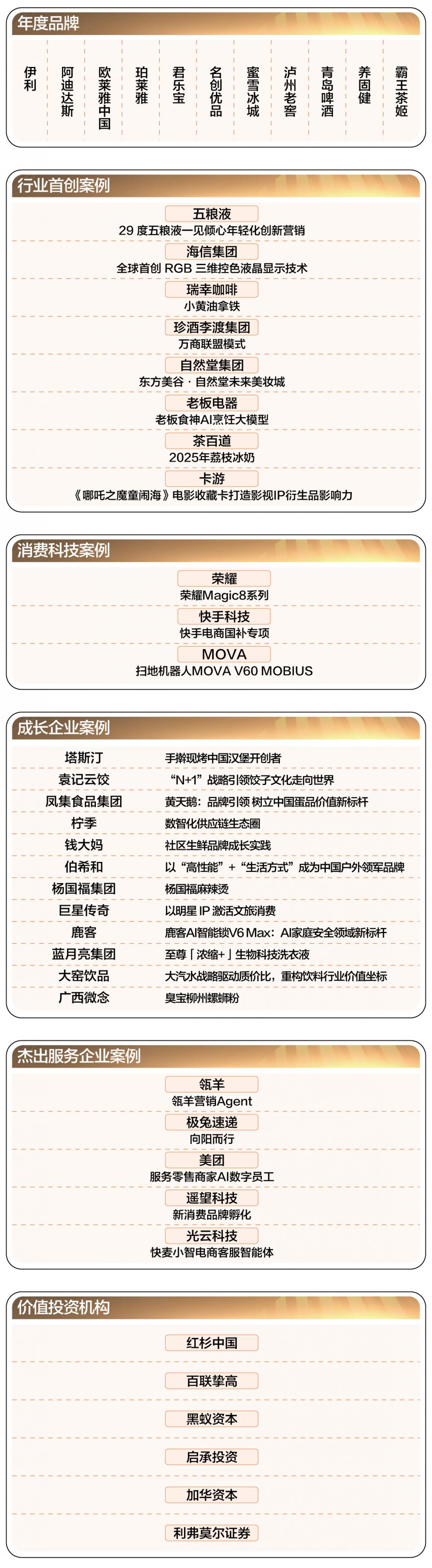
Core Insights - The "2025 New Consumption Conference" held on December 17, organized by 21st Century Business Herald, gathered over a hundred guests from various sectors including consumer brands, investment institutions, and brokers to discuss rapid growth, innovation, and strategies in the consumer industry [1] Group 1: Industry Trends - The conference theme was "Cross-Border Growth and Integrated Innovation," focusing on industry trends, business models, products and services, and growth logic [1] - The consumer industry is undergoing profound changes, with new forces emerging for growth, driven by factors such as the IP economy and the rise of the Z generation's purchasing power [1] - AI is beginning to permeate the fabric of consumption and e-commerce, indicating a technological shift in the industry [1] - The competition among major platforms in the takeaway market is creating a resonance between online and offline channels [1] - Chinese consumer brands are increasingly entering global markets, while niche sectors like pet and technology consumption are experiencing robust growth [1] Group 2: Awarded Excellent Cases - Categories for awarded excellent cases include Annual Brand Case, Industry Innovation Case, Growth Enterprise Case, Consumption Technology Case, Value Investment Institution Case, and Outstanding Service Enterprise Case [1] - Notable awarded companies in the Consumption Technology category include Honor with its Magic8 series, Kuaishou Technology with its e-commerce initiatives, and MOVA with its V60 MOBIUS robot vacuum [4] - Growth Enterprise cases feature companies like Tasting, Yuanji Yunjiao, and Fengji Food Group, showcasing innovative strategies and market leadership [5] - Outstanding Service Enterprise cases include companies like Lingzhu and Jitu Express, highlighting advancements in service delivery [6] - Value Investment Institutions recognized include Sequoia China, Bailian Zhigao, and others, reflecting strong investment interest in the consumer sector [8]