
电气化转型

Search documents
【微特稿】电车业务大收缩 斯泰兰蒂斯集团报巨额亏损
Xin Hua She· 2026-02-26 14:49
Core Insights - Stellantis Group is projected to incur a net loss of €22.3 billion (approximately $26.3 billion) in 2025, primarily due to significant cutbacks in its electric vehicle (EV) business and the associated costs of reverting to traditional fuel vehicles [1] - The company anticipates a revenue of €153.5 billion in 2025, reflecting only a 2% decline, with vehicle sales expected to increase by approximately 70,000 units to 5.48 million compared to 2024 [1] - The CEO, Antonio Filosa, indicated that the 2025 performance highlights the costs of overestimating the speed of energy transition, emphasizing the need to reset the business model to offer a full range of vehicle options [1] Financial Impact - Stellantis Group's financial burden is exacerbated by U.S. tariff policies, estimating a cost of €1.2 billion in tariffs for 2025, which is expected to rise to €1.6 billion in 2026 [2] - The company has confirmed its retreat from the EV sector by selling its 49% stake in the Canadian battery joint venture NextStar Energy and plans to exit the joint venture with Samsung for a U.S. battery factory [2] Market Strategy - Stellantis is set to reintroduce fuel models, including diesel vehicles, in the European and American markets as part of its strategy to adapt to current market conditions [2] - The company is banking on new model launches, particularly in the U.S. market with fuel pickup trucks, to drive profitability growth [1]
铜价短期内不太可能跟随金价上涨
Wen Hua Cai Jing· 2026-02-24 02:01
Group 1 - Copper prices surged to over $13,000 per ton last month but have since retreated to around $12,700 due to a combination of strong long-term demand expectations and significant inventory accumulation in major exchanges [2] - Despite the long-term outlook for copper demand remaining strong due to electrification and increased electricity consumption, the short-term outlook is less stable compared to rising gold prices [2] - Analysts from Goldman Sachs expect a divergence in returns across the commodity sector, with short-term oversupply in the copper market suppressing price increases [2][6] Group 2 - Ole Hansen from Saxo Bank noted that rising visible inventories and weakened demand in China ahead of the Lunar New Year indicate ample short-term supply, which diminishes copper's appeal as a long-term investment [3] - The Chinese market, being closed for over a week due to the Lunar New Year, typically sees weakened demand, affecting global metal prices [3] - Deutsche Bank highlighted that factors such as supply disruptions and potential tariffs on refined copper in the U.S. have contributed to recent price increases, but high copper prices are currently dampening domestic demand in China [5] Group 3 - Goldman Sachs indicated that copper prices are expected to decline later this year following the clarification of U.S. tariffs on refined copper, with a potential 15% tariff announcement in mid-2026 [6] - The uncertainty surrounding tariffs could lead investors to refocus on the significant oversupply in the global copper market, putting further pressure on prices [6] - The copper industry in China faces three main challenges: increasing reliance on foreign resources, overcapacity in the midstream processing sector, and suppressed downstream demand due to high copper prices [7]



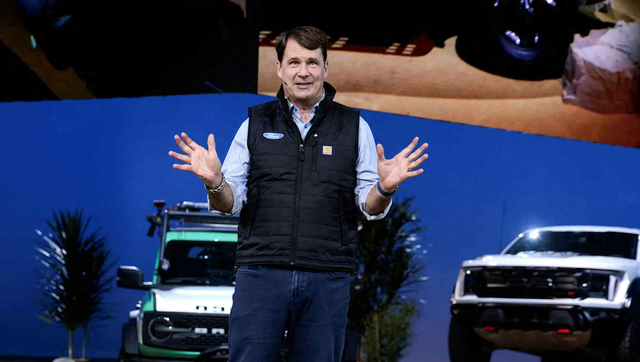
福特CEO:中国汽车改变全球“游戏规则”
Xin Lang Cai Jing· 2026-02-11 08:24
Core Viewpoint - Ford's CEO Jim Farley stated that Chinese automakers are changing the global "game rules" and pose a threat to traditional car manufacturers, emphasizing that the real issue for Ford is the dominance of Chinese companies in the electrification transition and the shift in pricing power [1][3]. Group 1: Financial Performance - Ford reported a net loss of $8.18 billion (approximately 56.54 billion RMB) for 2025, following a $15.9 billion (approximately 110 billion RMB) impairment related to the cancellation of electric vehicle projects, contrasting with a profit of $5.87 billion (approximately 40.57 billion RMB) in the previous year [3]. Group 2: Competitive Landscape - General Motors' CEO Mary Barra acknowledged fierce competition from Chinese automakers and expressed confidence in GM's business in China after significant restructuring and a shift towards electrification, although she admitted it would be challenging to restore GM's operations in China to their previous state [3]. - Farley indicated that Ford plans to "play smart" in China by leveraging its joint venture factories for low-cost production and as an export base [3]. Group 3: Strategic Focus - Despite canceling most electric vehicle projects, Ford continues to collaborate with CATL at its Michigan plant to provide affordable electric vehicle models for the local market [3]. - The company is focusing on "correct capital allocation" and "meaningful partnerships," aiming for efficient investments in electrification to penetrate less competitive markets [3].

沃尔沃2025年利润125亿瑞典克朗,Q4同比跌超50%
Ju Chao Zi Xun· 2026-02-09 12:56
Core Viewpoint - Volvo Cars reported a challenging fourth quarter for 2025, with significant declines in revenue and profit, but managed to maintain positive cash flow through cost-cutting measures and strategic actions [2][3]. Financial Performance - In Q4 2025, Volvo Cars' revenue was 94.4 billion SEK, down from 112.1 billion SEK in Q4 2024; operating profit was 1.9 billion SEK, compared to 3.9 billion SEK in the previous year [2]. - The EBIT margin for Q4 2025 was 2%, down from 3.4% in Q4 2024; basic earnings per share were 0.43 SEK, compared to 0.84 SEK in the same quarter last year [2]. - For the full year 2025, adjusted operating profit was 12.5 billion SEK, with an adjusted EBIT margin of 3.5%; free cash flow reached 2.4 billion SEK [3]. Sales and Market Trends - In Q4 2025, pure electric vehicle sales accounted for 24% of total sales, up from 21% in Q4 2024; electrified vehicle sales reached 49%, compared to 47% in the previous year [2]. - The company experienced a three-month consecutive growth in pure electric vehicle sales and an increase in retail orders by the end of December 2025 [3]. Strategic Initiatives - Volvo Cars aims to achieve an EBIT margin exceeding 8% and strong positive cash flow through electrification and strategic execution, as outlined in their strategic update from November [3]. - The launch of the new pure electric EX60 SUV received positive initial customer feedback, with significant order numbers expected to boost deliveries in the second half of 2026 [3]. Industry Challenges - The automotive industry is expected to face ongoing challenges in 2026, including pricing pressure from market competition, tariff impacts, regulatory uncertainties, and weak consumer sentiment [4]. - In the first half of 2026, cash flow may be negatively impacted due to increased inventory for popular models to meet annual demand and to compensate for initial production gaps of the EX60 [4].
铜铝锌镍锡铅集体狂飙 “金属风暴”席卷全球商品市场
Di Yi Cai Jing· 2026-01-07 14:04
Group 1: Market Overview - The global metal futures market experienced a strong start in 2026, with significant price increases across major metals including copper, aluminum, zinc, nickel, tin, and lead on January 6 [1] - LME copper futures reached a new high, while LME nickel futures saw intraday gains exceeding 10%, hitting $18,800 per ton [1] - Domestic markets also saw a surge in investment in non-ferrous metals, with notable price increases in nickel, tin, and aluminum [1] Group 2: Supply Concerns - The surge in nickel prices is primarily driven by supply concerns, particularly due to Indonesia's plan to cut its nickel production target from 379 million tons to 250 million tons, a reduction of 34% [2] - The International Nickel Study Group (INSG) projects a global nickel demand of 3.82 million tons and a production of 4.09 million tons in 2026, indicating potential oversupply despite Indonesia's production cuts [3] - High inventory levels, with LME nickel stocks at 254,000 tons and domestic stocks in China significantly above the five-year average, are exerting long-term pressure on prices [3] Group 3: Copper Price Dynamics - LME copper prices rose by 1.9% to $13,238 per ton, with a peak of $13,387.5, marking a cumulative increase of over 5% since the beginning of 2026 [4] - The price increase is attributed to structural supply shortages and accelerating demand driven by investments in electrification and data centers [4] - Recent disruptions, such as strikes at Capstone Copper's Mantoverde mine and delays in Ecuador's copper projects, have heightened supply concerns [5] Group 4: Investment Trends - Significant capital inflow into the non-ferrous metals sector has been observed, with various ETFs seeing substantial net inflows, particularly in the first two trading days of 2026 [6] - The non-ferrous metals sector was a standout performer in 2025, with a 94.73% increase in the A-share market and many stocks doubling in value [7] - Analysts suggest that macroeconomic factors, including lower-than-expected U.S. inflation data and geopolitical uncertainties, are driving investment demand in the sector [7]

美国彻底失势!中国冲向电气化文明,人类未来格局已定
Sou Hu Cai Jing· 2026-01-07 06:15
Core Insights - The core competitive advantage of the future world lies in China's electrification transformation, which is already underway and is reshaping the global landscape [1][3] - China is positioned to lead the fourth energy revolution, unlike the West, which is still debating the transition [3][5] Electrification Transformation - China's electrification is not a localized pilot but a comprehensive national economic shift towards a fully electrified society, unmatched globally [5] - China accounts for 60% of global renewable energy equipment production, with 80% of solar components manufactured domestically [5] Global Energy Landscape - Electrification will not only change the energy sector but also fundamentally reshape global power dynamics, allowing for localized energy production and reduced costs [7] - China's energy security has shifted from vulnerability to a position of external supply capability, altering the global energy competition [7] AI and Industrial Integration - China holds 70% of global AI patents and half of the AI talent, enhancing its electrification efforts [8] - The integration of electrification and AI creates a unique, self-sufficient industrial ecosystem in China, covering all aspects from mining to AI management [8] Manufacturing and Capital Flow - China has evolved from a traditional manufacturing hub to a core center for green technology and energy equipment manufacturing [10] - Global capital is increasingly flowing towards Asia, particularly China, as Western countries struggle with high energy costs and manufacturing challenges [10] Future Competitiveness - The mastery of the energy revolution will define national competitiveness for the next fifty years, with China effectively completing this logic chain while the West remains mired in basic debates [12] - China's unique national and industrial capabilities, including a vast market and robust supply chains, provide a competitive edge that is difficult for other nations to replicate [12][14] Infrastructure and Execution - China's ability to execute large-scale infrastructure projects, such as high-speed rail and charging networks, demonstrates its strong execution efficiency [14] - The comprehensive industrial system in China, from basic components to advanced technologies, supports its electrification goals [14][16] Investment Opportunities - The next decade (2026-2036) presents significant investment opportunities in three key areas: renewable energy supply chains, electric vehicle industries, and AI industrial chains [17] - Entrepreneurs should focus on energy and smart technology services, which are experiencing rapid market growth [19] Employment and Asset Allocation - Job seekers should consider emerging industries related to electrification, automation, and AI, as these fields will see sustained demand over the next decade [19] - Asset allocation strategies should shift focus from traditional major cities to regions like Harbin, Changchun, and Chengdu, which are key areas for electrification industry clusters [21]

史上销量最好?!这家“佛系”的豪华品牌,也要卷起来了?
电动车公社· 2026-01-06 16:39
Core Viewpoint - The article discusses the unique positioning and potential of the Volvo XC70, highlighting its unexpected success in the luxury plug-in hybrid (PHEV) market, particularly in China, where it has achieved significant monthly sales figures [1][4]. Group 1: Market Positioning and Sales - The XC70 has managed to break into the top 5 in its segment, a feat previously unachieved by any luxury brand's PHEV in China, with monthly sales surpassing 5000 units [1][4]. - Traditional luxury brands have struggled with pricing strategies for PHEVs, often relying on policy advantages in major cities to maintain sales, which has become less effective as regulations change [13][15]. - The XC70's sales success is attributed to its innovative SMA hybrid architecture, which allows for a more competitive pricing strategy compared to traditional PHEVs [15][18]. Group 2: Technological Innovations - The XC70 utilizes a new SMA architecture that supports various configurations, including a large 39.6 kWh battery, enabling a pure electric range of 212 km [18][21]. - This architecture allows for a more efficient design, reducing costs and improving performance, including the use of a 1.5T engine instead of a 2.0T engine, which lowers the overall vehicle cost [21][24]. - The XC70 features advanced technology such as a centralized electronic architecture and improved user interface, enhancing the overall driving experience and usability [33][39]. Group 3: Design and User Experience - The XC70 is described as a "Nordic-inspired Chinese car," designed to meet the specific needs of Chinese consumers while maintaining Volvo's Scandinavian design ethos [30][31]. - The vehicle's interior and exterior design emphasize simplicity and functionality, aligning with the Scandinavian principle of human-centered design [54][59]. - The XC70 incorporates advanced safety features and materials that prioritize user comfort and environmental considerations, such as low-VOC materials and recyclable components [51][52]. Group 4: Future Outlook - Volvo's commitment to electrification is evident in its investment of over €2 billion and the development of the SMA architecture, indicating a strong future direction for the brand [75][76]. - The XC70 represents a significant step in Volvo's electrification strategy, with the potential to maintain a competitive edge in the evolving automotive market [77][78].

供应扰动加剧,铜价延续上行
Tong Guan Jin Yuan Qi Huo· 2026-01-06 12:21
1. Report Industry Investment Rating - Not provided in the content 2. Core Views of the Report - Although the expected interest rate cut in the first quarter of 2026 has slightly declined, the Fed remains in an easing cycle. Trump's upcoming nomination of a new chairman has raised market concerns about the decline in the Fed's independence. Amidst the global electrification transformation and AI - driven industrial revolution, copper is crucial for data centers, electric vehicles, and power grid infrastructure. Domestically, the central bank will flexibly use reserve - requirement ratio and interest rate cuts, implement an expansionary fiscal policy to boost domestic demand, and promote high - quality development through innovation and industrial upgrading. [3][83] - The sudden strike at mines in northern Chile has intensified disturbances in concentrate supply. Global refined copper production capacity may enter a contraction phase, and domestic imports have decreased month - on - month. At the consumption end, traditional industries face weak demand at the end of the year, while emerging industries offer significant growth potential. Non - US inventories overseas are declining, and US copper inventories are rising, accounting for over 50%. [3][83] - In the third quarter, both the Chinese and US economies showed strong resilience. The global AI - driven industrial revolution has created vast demand prospects for metals. The Fed's interest rate cut has increased market risk appetite. It is expected that copper prices will continue to rise strongly in January, and attention should be paid to the internal linkages among gold, silver, and copper. [3][83] 3. Summary According to the Table of Contents 3.1 2025 December Copper Market Review - In December 2025, copper prices accelerated upward. LME copper rose from a low of around $11,120 to $12,960, and SHFE copper soared from 87,500 to around 102,500. By December 31, LME copper closed at $10,901.5/ton with a monthly increase of 5.8%, and SHFE copper closed at 87,010 yuan/ton with a monthly increase of 4.7%. The weak US dollar and tight fundamentals supported the price increase. [8] - Domestic refined copper terminal consumption faced downward pressure in December. Traditional industries had low - growth consumption, while emerging industries showed good demand. Social inventories rebounded slightly to around 200,000 tons at the end of December, and the spot premium shifted to a deep discount. It is predicted that traditional industries will remain seasonally sluggish in January 2026, while emerging industries will have certain resilience. [10][11] 3.2 Macroeconomic Analysis 3.2.1 Fed's New Chairman Nomination and US Third - Quarter Economic Growth - After the Fed cut interest rates in December as expected, the federal funds rate is now in the 3.5% - 3.75% range. The new dot - plot shows one rate cut in 2026 and 2027 respectively. Trump will announce a new Fed chairman in early January, and the most likely candidate, Kevin Hassett, may support rate cuts. [13][14] - In November, the US CPI was +2.7% year - on - year, and the core CPI was +2.6% year - on - year. The US GDP in the third quarter grew 4.3% year - on - year after inflation adjustment. However, the government shutdown may affect the fourth - quarter economy. It is expected that the Fed may pause rate cuts in the first quarter of 2026. [15] 3.2.2 Lack of Recovery in US Manufacturing and Continued Contraction in Eurozone Manufacturing - The US ISM manufacturing PMI in November shrank to 48.2, below the boom - bust line of 50 for the ninth consecutive month, indicating weak market demand. [16] - The eurozone's manufacturing PMI in December was 49.2, lower than expected. Germany's manufacturing output contraction was a major drag, and although France's manufacturing PMI rebounded, its service PMI declined. The ECB maintained key interest rates in December, and the eurozone economy is in a weak recovery. [16][17] 3.2.3 Flexible Use of Reserve - Requirement Ratio and Interest Rate Cuts and Expansion of "National Subsidies" in 2026 - The central bank will continue to implement a moderately loose monetary policy, strengthen the coordination between monetary and fiscal policies, and support key areas such as domestic demand expansion, innovation, and small and medium - sized enterprises. [18] - In 2026, "national subsidies" will cover four categories: car scrapping, car replacement, home appliances and digital products, and smart products. The scope and subsidy intensity have changed compared to 2025. It is expected that the policy will shift from pure commodity subsidies to a dual - drive model including service consumption. [19] 3.3 Fundamental Analysis 3.3.1 Slow Resumption of Overseas Interrupted Mines and Further Decline in 2026 Long - Term TC Benchmark Price - The 2026 copper concentrate long - term TC/RC benchmark price was set at $0/dry ton and $0/lb, hitting a new low. The global copper concentrate supply growth in 2026 is expected to be less than 1.5% due to slow resumption of interrupted mines and postponed new mine projects. [22] - A strike at Capstone Copper's Mantoverde mine in Chile may cause losses of up to $160 million. Some mines such as Oyu Tolgoi, QB, and KFM have production increases or expansion plans. [23][24] 3.3.2 Flat Domestic Refined Copper Production in November and Hurdles in Overseas Refined Copper Capacity Release - In November, China's electrolytic copper production was 1.1034 million tons, a year - on - year increase of 9.8%. The stable production was due to high profits from by - products and sufficient copper concentrate imports. The 125,000 - ton cathode copper refining project of Sichuan Liangshan Copper will start production in March 2026. [32] - Overseas, some smelters have been shut down or reduced production due to low processing fees. For example, Glencore's PASAR and Altonorte smelters have stopped production. Some projects' production increases are postponed, and overall, overseas refined copper capacity release will slow down. [33] 3.3.3 Widening Year - on - Year Decline in Refined Copper Imports and Month - on - Month Rebound in Scrap Copper Imports - From January to November, China's imports of unwrought copper and copper products decreased by 19% year - on - year, and refined copper imports decreased by 8.3% year - on - year. In November, imports dropped significantly due to high US copper tariffs and port congestion. [53] - From January to November, scrap copper imports increased by 3.63% year - on - year. China will expand scrap copper imports from Southeast Asia and strengthen the recycling and utilization of scrap copper. However, policies have increased the tax burden on scrap copper rod enterprises, leading to supply tightening. [55] 3.3.4 Rising COMEX Inventories and Rebound of Domestic Social Inventories from Low Levels - Since December, domestic inventories have rebounded from low levels, and global visible inventories have continued to rise. COMEX copper inventories have exceeded 50% of the global total. The increase in domestic inventories is due to high copper prices suppressing consumption and reduced overseas supply. It is expected that global visible inventories will remain high and volatile in January 2026. [59][60][61] 3.3.5 Weak Demand in Traditional Industries and Large Growth Potential in Emerging Industries - In the power grid, investment growth has slowed, and the demand for copper in January 2026 may be restricted. [64][67] - In the photovoltaic and wind power sectors, the photovoltaic industry is in a critical stage of anti - involution, and wind power growth has marginally rebounded. However, the copper consumption in the wind and solar industries may decline by about 10% this year. [68][70] - The real estate market is still at the bottom, with investment, construction, and sales data showing a downward trend. The demand for copper is expected to remain low in January 2026. [71][72] - The air - conditioning industry is in adjustment. Domestic sales are under pressure in the short term, but the "trade - in" policy in 2026 will promote the industry's upgrade. [73][74] - The new - energy vehicle industry has maintained high - speed growth. Although the subsidy policy will change in 2026, the market demand space is still large, and sales are expected to maintain a high - speed growth in January 2026. [75][76][77] - The data center industry is accelerating due to AI computing power demand. It is expected that the copper consumption in data centers will increase by about 1.05 million tons in 2026. [78][79] 3.4 Market Outlook - Macroeconomically, the Fed is in an easing cycle, and China will implement expansionary policies. Fundamentally, supply disturbances intensify, and consumption shows a differentiation between traditional and emerging industries. It is predicted that copper prices will continue to rise strongly in January 2026, and attention should be paid to the internal linkages among gold, silver, and copper. [83]
沃尔沃汽车12月销量达16,063辆,全新XC70蝉联品牌销冠
Cai Jing Wang· 2026-01-05 11:57
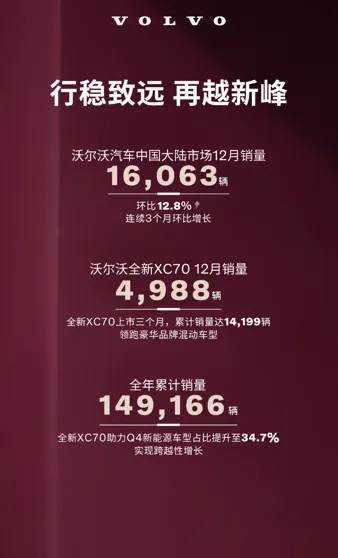
Group 1 - Volvo Cars reported a total sales of 16,063 units in the Chinese mainland market for December 2025, representing a month-on-month increase of 12.8%, with a total annual sales of 149,166 units, indicating a robust market performance [1] - The all-new XC70 has been a significant contributor to Volvo's sales growth, achieving a December sales figure of 4,988 units and a cumulative sales of 14,199 units within three months of its launch, leading the luxury hybrid vehicle segment [3] - The XC60, a classic model for Volvo, sold 4,683 units in December, and together with the XC70, the duo achieved a combined sales of 9,671 units, marking a new high and maintaining a leading position in the luxury mid-size to large SUV segment for three consecutive months [4] Group 2 - The launch of the all-new XC70 has significantly boosted the sales of Volvo's new energy vehicles, with fourth-quarter sales reaching 15,328 units, accounting for 34.7% of total sales, indicating a substantial growth in this segment [5] - Looking ahead, Volvo Cars aims to deepen its presence in the Chinese luxury automotive market, leveraging its strong brand heritage and exceptional product capabilities to enhance the quality of travel experiences for users [5]
世界能源行业就业矛盾凸显
Zhong Guo Hua Gong Bao· 2025-12-12 04:05
Group 1 - The global energy sector is creating jobs at an unprecedented rate, with employment expected to exceed 76 million by 2024, reflecting a growth rate of 2.2%, nearly double the overall economic growth rate [1] - The electricity sector is the largest employer in the energy industry, contributing nearly three-quarters of new jobs, driven primarily by the solar photovoltaic industry, along with nuclear power, grid construction, and energy storage [1] - The traditional energy sector shows resilience, with coal industry employment in countries like India, China, and Indonesia recovering to 8% above 2019 levels, while the oil and gas sector has largely regained jobs lost during the pandemic [1] Group 2 - Employment growth in the energy sector is projected to slow to 1.3% by 2025, reflecting ongoing labor market tensions and increased geopolitical and trade uncertainties [2] - There is a significant shortage of skilled labor in the energy sector, with over half of the 700 surveyed energy-related organizations reporting recruitment bottlenecks for key positions, particularly technical roles [2] - To address the skills gap, the global energy sector needs to increase the number of qualified new entrants by 40% by 2030, requiring an estimated annual investment of $2.6 billion, which represents only 0.1% of global education spending [2] Group 3 - Solutions to the skills shortage require collaboration across multiple sectors, with barriers to energy training including cost, income loss, and limited awareness of training programs [3] - Recommendations include targeted learning incentives, expanded apprenticeship programs, and continuous investment in training facilities, along with internal reskilling within the energy sector [3] - China's talent cultivation model, which integrates government guidance, enterprise leadership, and institutional participation, serves as a significant reference for global energy talent development [3]