
稳投资促消费

Search documents
(全国两会)2025年中国国务院各部门采纳代表委员意见建议4900余条
Xin Lang Cai Jing· 2026-02-27 12:13
Group 1 - In 2025, the State Council of China adopted over 4,900 suggestions from representatives and implemented 2,200 related policy measures [1] - The State Council handled 8,754 suggestions from the National People's Congress and 4,868 proposals from the Chinese People's Political Consultative Conference, achieving a completion rate of 95.6% and 97.3% respectively [1] - The policies introduced aimed at optimizing national development strategies, supporting the construction of a modern industrial system, and addressing key issues in people's livelihoods [1] Group 2 - The Ministry of Science and Technology reported that by the end of 2025, loans to technology-based small and medium-sized enterprises reached 3.63 trillion RMB, reflecting a year-on-year growth of 19.8% [1] - The Ministry of Commerce announced initiatives to boost consumption, with consumption contributing 52% to economic growth, an increase of 5 percentage points from the previous year [1] - The Ministry of Agriculture and Rural Affairs aims for the agricultural technology progress contribution rate to exceed 64% by 2025, focusing on organized research and application of significant technological achievements [2] Group 3 - The State Administration for Market Regulation is working on revising the Anti-Unfair Competition Law and has released several regulatory documents to guide platform enterprises in compliant operations [2]
多项财税金融支持稳投资促消费政策发布 以更大力度激发民间投资、促进居民消费
Sou Hu Cai Jing· 2026-01-20 22:50
Core Viewpoint - The Chinese government is implementing a more proactive fiscal policy in 2025 to support economic growth and enhance social welfare, with significant measures including the issuance of long-term special bonds and increased government debt to stimulate consumption and investment [1][2][3]. Fiscal Policy Measures - In 2025, the issuance of long-term special bonds will amount to 1.3 trillion yuan, aimed at supporting "two new" and "two heavy" initiatives [1]. - The fiscal deficit rate is set at around 4%, with new government debt totaling 11.86 trillion yuan, significantly higher than previous years [1]. - A special bond issuance of 500 billion yuan will be allocated to replenish the core tier one capital of major state-owned commercial banks [1]. Consumer Support Initiatives - The government plans to enhance consumer spending by allocating 300 billion yuan for a trade-in program for consumer goods, expected to drive sales exceeding 2.6 trillion yuan [1]. - Policies such as personal consumption loans and service industry loans will be implemented to encourage and expand consumption [1]. Social Welfare Enhancements - Employment support funds of 66.74 billion yuan will be allocated, alongside increased subsidies for social insurance and unemployment insurance [1]. - Additional funding of 100 billion yuan will be provided for childcare subsidies for children under three years old, enhancing social welfare and consumer capacity [1]. Debt Management and Investment Support - A total of 20 trillion yuan will be arranged for the replacement of existing hidden debt, with 800 billion yuan in new special bonds to support local government financial capacity [2]. - The average interest cost of local government debt has decreased by over 2.5 percentage points, reducing the financial burden on local governments [2]. Support for Private Investment - New policies include interest subsidies for loans to small and micro enterprises in key industries, with a maximum loan amount of 50 million yuan and a subsidy rate of 1.5% [4]. - A special guarantee plan for private enterprises will provide loan guarantees up to 20 million yuan for eligible small and micro enterprises [4]. Optimization of Consumption Policies - The consumer service loan subsidy has been enhanced, with the maximum subsidy amount increased from 500 yuan to 3,000 yuan per transaction [7]. - The loan limit for service industry enterprises has been raised from 1 million yuan to 10 million yuan, expanding the scope of eligible consumption areas [7][8]. Long-term Fiscal Strategy - The fiscal strategy for 2026 will focus on increasing total spending while ensuring that key areas receive stronger support, with an emphasis on boosting consumption and social welfare [3]. - The government aims to deepen fiscal and tax reforms to stimulate economic vitality and adapt to new economic models [9]. Overall Economic Impact - The coordinated fiscal and monetary policies are expected to effectively address bottlenecks in production, circulation, and consumption, enhancing the internal economic cycle [10][11]. - The proactive measures are designed to instill confidence in the market, encouraging both enterprise investment and consumer spending, thereby strengthening the resilience of the economy [11].
多项财税金融支持稳投资促消费政策发布
Sou Hu Cai Jing· 2026-01-20 22:50
Core Viewpoint - The Chinese government is implementing a more proactive fiscal policy in 2025 and 2026 to support economic growth, enhance consumer spending, and improve social welfare, with significant financial allocations and new policies aimed at stimulating both investment and consumption [2][4][10]. Fiscal Policy Measures - In 2025, the government plans to issue 1.3 trillion yuan in ultra-long-term special bonds to support key areas, including consumption and infrastructure, with a focus on boosting consumer spending through various financial incentives [2][4]. - The fiscal deficit rate is set at around 4%, with new government debt expected to reach 11.86 trillion yuan, significantly higher than previous years [2][3]. Consumer Spending Initiatives - The government aims to enhance consumer spending by allocating 300 billion yuan for a trade-in program for consumer goods, projected to generate sales exceeding 2.6 trillion yuan [2]. - New policies include interest subsidies for personal consumption loans and service industry loans, encouraging consumer spending across various sectors [5][6]. Support for Employment and Social Welfare - A total of 667.4 billion yuan is allocated for employment support, alongside increased funding for social insurance and healthcare services, aimed at improving residents' disposable income and consumption willingness [2][4]. - Additional measures include childcare subsidies for families with children under three years old, further enhancing social welfare [2]. Investment in Private Sector - New policies to support private investment include interest subsidies for loans to small and micro enterprises in key industries, with a focus on technology and innovation [5][6]. - A risk-sharing mechanism for private enterprise bonds is introduced to lower financing barriers for businesses, promoting investment in growth sectors [5][7]. Structural Reforms and Market Optimization - The government plans to deepen fiscal and tax reforms to create a more balanced and efficient financial relationship between central and local governments, ensuring a conducive environment for new industries and business models [7][8]. - Efforts to optimize government procurement processes are underway, aiming to create a fair and competitive market environment for all businesses [8]. Overall Economic Strategy - The overarching strategy emphasizes expanding domestic demand as a key task for economic recovery, with coordinated efforts from various government departments to stimulate both investment and consumption [4][10]. - The proactive fiscal measures are expected to enhance the resilience and internal dynamics of the economy, laying a solid foundation for sustainable growth in the coming years [3][10].
滨州今年将发放消费券2000万元以上,坚定不移稳投资 促消费
Qi Lu Wan Bao· 2026-01-20 09:00
Group 1 - The core focus of the government report is on expanding domestic demand, stabilizing investment, and promoting consumption in Binzhou by 2026 [1] - The strategy includes attracting significant investment by introducing 20 new projects from the Fortune 500 and over 60 projects with investments exceeding 1 billion yuan, aiming for over 70 billion yuan in new investment [1] - The report emphasizes the importance of a service mechanism that ensures resources follow the projects, guaranteeing land, water, and energy for key projects [1] Group 2 - The government plans to implement 10 digital infrastructure projects and has surpassed 10,000 public charging stations for new energy vehicles [2] - Construction is accelerating on 87 water projects, including the Runyang Reservoir, and 120 community water supply facility upgrades [2] - Key transportation projects include the comprehensive upgrade of the Ta'er River Port area, the construction of the Qingzhang Expressway, and the expansion of the Changshen Expressway, with the Jibin High-speed Railway expected to be operational within the year [2]
新年更大力度稳投资促消费,央地政策密集落地
Di Yi Cai Jing· 2026-01-04 13:15
Economic Initiatives - Various regions are intensifying efforts to boost the economy, with Shanghai and Hubei holding conferences to optimize the business environment and promote technological innovation [1] - The National Development and Reform Commission (NDRC) emphasizes the need for timely policy implementation to stimulate consumption, investment, and green development [1] Consumer Spending Promotion - The "Buy in China" initiative and Spring Festival consumption season have been launched, focusing on product and service consumption [2] - The first batch of 625 billion yuan in national subsidies has been allocated to support consumer demand during the New Year and Spring Festival [3] Investment Expansion - Major projects are being initiated across various regions, with Shanghai's Yangpu District launching 50 key industrial projects with a total investment exceeding 20 billion yuan [4] - The NDRC has organized the early release of approximately 295 billion yuan for "two new" construction projects to accelerate funding and investment [4] Infrastructure Development - The NDRC has approved multiple significant infrastructure projects, including transportation and water resource projects, with total investments exceeding 400 billion yuan [5] - A more proactive fiscal policy is expected to accelerate infrastructure investment growth to around 5.0% in 2026, significantly higher than in 2025 [5]
“反内卷”下出现新信号 政策加力稳投资促消费
Jing Ji Guan Cha Wang· 2025-12-20 01:18
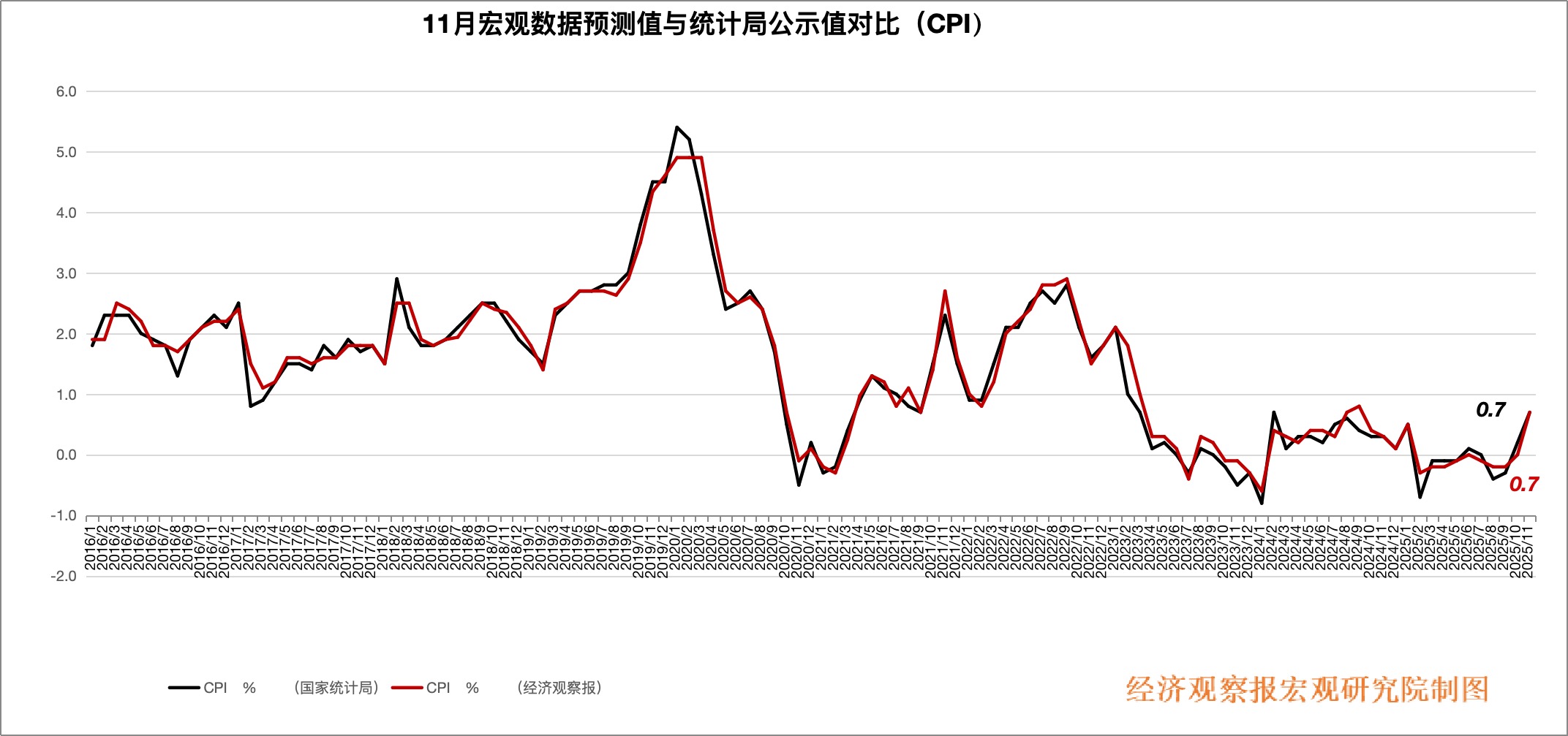
Core Viewpoint - The "anti-involution" policy is significantly impacting economic operations, with November 2025 economic data showing fluctuations that reflect adjustments in industry pricing and profit structures, as well as uneven recovery in domestic demand, indicating a need for policy support to stabilize growth [1] CPI - November CPI year-on-year growth increased to 0.7%, up from 0.2% in October, marking the highest level since March 2024 [4] - Food prices rose by 0.2% year-on-year, while non-food prices increased by 0.8%, with core CPI remaining stable at 1.2% [4] PPI - November PPI year-on-year decline expanded to -2.2%, primarily due to a high base from the previous year [7] - The "anti-involution" policy is showing effects, with price declines in certain industries narrowing [7] PMI - November manufacturing PMI recorded at 49.2%, indicating a slight improvement from the previous month, driven by increases in production and new orders [10] - External demand has improved, potentially linked to positive outcomes from recent trade discussions [10] Fixed Asset Investment - Fixed asset investment decreased by 2.6% year-on-year, the lowest level since June 2020, prompting calls for increased central budget investment and optimization of project management [14] - The real estate sector continues to face challenges, with measures aimed at stabilizing the market [14] Credit - New loans in November totaled 390 billion yuan, a decrease from 220 billion yuan in October, reflecting weak consumer confidence and employment expectations [18] - Short-term loans decreased significantly, indicating a cautious approach among consumers regarding borrowing [18] M2 - M2 growth rate fell to 8.0%, down from 8.2%, while M1 growth rate decreased to 4.9% [22] - The widening gap between M1 and M2 suggests a shift in deposit behavior, with more funds moving to fixed deposits [22]

稳投资促消费、破除“内卷式”竞争……国家发改委召开会议
Di Yi Cai Jing· 2025-07-31 11:40
Group 1 - The meeting emphasized the need for the development reform system to fully implement the decisions and deployments of the Central Committee and the State Council, focusing on stabilizing employment, enterprises, markets, and expectations, while strengthening domestic circulation and optimizing external circulation to achieve annual targets and tasks of the 14th Five-Year Plan [2][3] - Key areas of focus include conducting analysis and research on major changes, important indicators, and significant issues, with an emphasis on stabilizing employment and expanding domestic demand [2] - The meeting highlighted the importance of promoting investment and consumption, enhancing government project management, and stimulating private investment to boost market vitality and consumption [2][4] Group 2 - The meeting called for the cultivation and strengthening of new productive forces tailored to local conditions, promoting the "Artificial Intelligence +" initiative, and advancing the high-quality development of the low-altitude economy to stimulate innovation in the digital economy [2][4] - It was noted that there is a need to deepen the construction of a unified national market, eliminate "involution" competition, and promote the smooth flow of factors to support the healthy and high-quality development of the private economy [2][3] - The meeting also stressed the importance of expanding high-level opening up, balancing "bringing in" and "going out," and collaboratively building the Belt and Road Initiative with high quality [3]
国家发改委:加大力度稳投资促消费,拓展投资增量
Hua Er Jie Jian Wen· 2025-07-31 11:13
Group 1 - The core message emphasizes the need to increase efforts in stabilizing investment and promoting consumption, while expanding investment increments [1] - The government aims to strengthen the full-cycle management of government investment projects to enhance efficiency [1] - There is a focus on stimulating private investment vitality and promoting high-quality construction through the "two heavy" initiatives [1] Group 2 - The implementation of "two new" policies is aimed at improving quality and efficiency in the investment landscape [1] - The meeting highlights the importance of invigorating market vitality to boost consumption [1]