
负担能力危机

Search documents
美国大行亮眼财报背后:消费者储蓄投资双增长,低收入群体逾期率攀升现隐忧
Zhi Tong Cai Jing· 2026-01-15 00:44
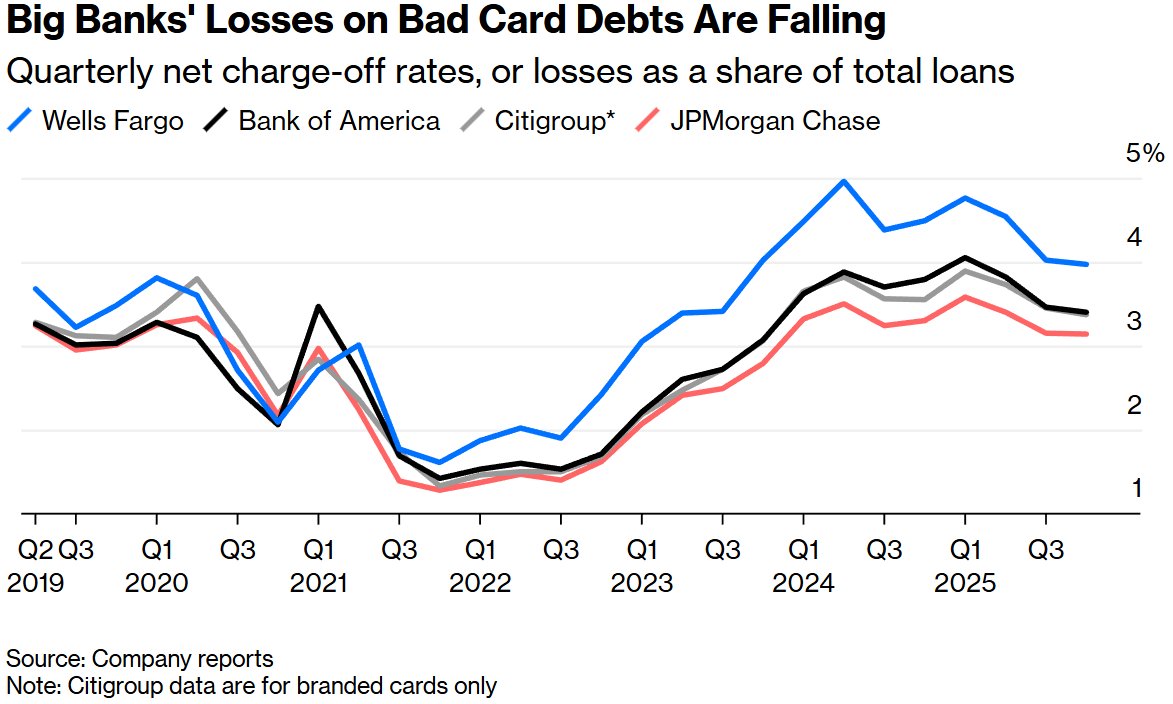
Core Viewpoint - Despite the affordability crisis faced by many Americans, large banks in the U.S. are not experiencing significant pressure, with consumer spending increasing and credit card delinquency rates declining [1][5]. Group 1: Economic Outlook - Major banks, including Bank of America, Citigroup, JPMorgan Chase, and Wells Fargo, reported strong economic outlooks for at least 2026, indicating resilience among households and small businesses [1]. - JPMorgan's CEO Jamie Dimon noted a positive outlook for the next 6 to 12 months, highlighting that consumers have money and job availability remains despite a slightly weak job market [1]. - Bank of America's CFO Alastair Borthwick stated that consumers are in an "excellent state," with no signs of increased borrowing or reduced savings to maintain living standards [1]. Group 2: Consumer Spending and Retail Sales - Consumer spending continues to rise, aligning with economic growth, supported by strong retail sales data for November, which showed the most robust growth since July due to a rebound in auto purchases and holiday shopping [2]. - Wells Fargo's CEO Charlie Scharf mentioned that alternative early indicators, such as unemployment benefits and direct deposit amounts, do not show significant trend changes, indicating stability [2]. Group 3: Credit Card Performance - Large banks are experiencing a decline in credit card bad debt losses, with delinquency rates not worsening and actual bad debt losses expected to decrease by 2025 [5]. - Despite rising delinquency rates among lower-income borrowers, major banks are not feeling the impact significantly, and smaller banks may reveal more consumer pressure in upcoming reports [5][6]. Group 4: Policy Implications - Proposed policies targeting high credit card interest rates and rental properties by President Trump are opposed by major banks, as they could harm profitability and restrict credit access for high-risk borrowers [5]. - JPMorgan has expressed a strong stance against such potential policies, indicating readiness to take legal action if necessary [5].


入局容易抽身难!特朗普或加剧美国“负担能力危机”
Jin Shi Shu Ju· 2026-01-05 06:19
Group 1 - The U.S. military intervention in Venezuela aims to assert influence in the region, with President Trump indicating intentions to "take over" Venezuela [1] - If the U.S. government follows through on controlling Venezuela, it must prepare for potential impacts on consumer purchasing power and inflation risks for businesses and investors [2] - The diesel market is particularly vulnerable, as Venezuela and Colombia are key suppliers of heavy crude oil, which is essential for diesel production [2][3] Group 2 - Disruptions in Venezuelan oil production and exports could lead to significant increases in diesel prices, impacting energy and food prices in the U.S., especially in rural areas [3] - The Gulf Coast refineries in the U.S. are configured to process Venezuelan crude, with approximately 4% of their raw material inputs coming from Venezuela and Colombia [3] - A military intervention could lead to a scenario where international crude oil prices rise by $5 to $8 per barrel, with diesel retail prices potentially increasing to $4.15 to $4.50 per gallon, a rise of 15% to 25% from previous levels [6] Group 3 - The potential for a swift military resolution is low, as Maduro's regime remains resilient, and external factors may hinder a quick turnaround in oil production [5] - The diesel market is already under pressure due to low inventories and structural supply shortages, which could exacerbate price increases [7] - The trucking industry, heavily reliant on diesel, is particularly at risk, with significant operational costs tied to fuel prices, impacting profitability [8] Group 4 - The U.S. government is advised against large-scale military intervention in Venezuela, as it may worsen financial pressures on American consumers and increase costs in diesel-dependent states [9] - Alternative non-military strategies are suggested to weaken Maduro's regime and alleviate immigration pressures in the Americas [9]
油价暴跌却没人夸?奥巴马前智囊“心疼”特朗普:这届消费者太难带
Jin Shi Shu Ju· 2025-12-25 03:03
Group 1 - The article discusses the challenges faced by President Trump in addressing American consumers' concerns about affordability, despite low gasoline prices [1][2] - According to AAA, the average price of unleaded gasoline in December reached its lowest level of the year at $2.85 per gallon, which is $0.18 cheaper than last year [1] - Consumer confidence has dropped to its lowest level since April, indicating increasing discontent with Trump's economic management [1] Group 2 - Jason Furman highlights that consumers are primarily focused on rising grocery prices, which have increased nearly 30% over the past five years, complicating the economic outlook [2] - The U.S. economy grew at its strongest pace in two years, with a GDP growth of 4.3%, surpassing analysts' expectations, while the unemployment rate rose to 4.6% in November, up from 4.2% a year ago [2] - Furman expresses uncertainty about the "K-shaped economy," noting that while low prices persist, wage growth remains strong, although the lowest income quartile has seen a decline in wage growth from 7.5% to about 3.5% [2][3] Group 3 - Diane Swonk, chief economist at KPMG, connects economic growth and rising unemployment to the "K-shaped economy," suggesting that companies are achieving growth without hiring, which may be exacerbated by AI replacing jobs [3] - The current productivity gains are largely attributed to companies being hesitant to hire and trying to operate more efficiently [3]
美国第三季度GDP料保持强劲,但经济学家称“难以持续”
Xin Lang Cai Jing· 2025-12-23 07:31
Economic Growth - The US economy is expected to grow at a fast pace in the third quarter, driven by robust consumer spending and business investment, although the momentum appears to be weakening due to rising living costs and a recent government shutdown [1][7] - The US Department of Commerce is set to release the preliminary GDP data for the third quarter, with an estimated annualized growth rate of 3.3%, down from 3.8% in the second quarter [2][8] - Consumer spending, which accounts for over two-thirds of US economic activity, is projected to accelerate from a growth rate of 2.5% in the second quarter, largely due to preemptive purchases of electric vehicles before a tax credit expiration [2][8] Consumer Behavior - Low-income households are experiencing financial strain, allocating more of their budgets to groceries and reducing spending on dining out, clothing, travel, and hotels, reflecting limited capacity for alternative consumption in a high-inflation environment [3][8] - In contrast, high-income households are increasing their spending on dining, travel, entertainment, and hotel accommodations [4][9] Inflation and Costs - The Personal Consumption Expenditures (PCE) price index is expected to grow at a rate of 2.8% in the last quarter, up from 2.1% in the previous quarter, indicating an acceleration in inflation [5][9] - The Federal Reserve has lowered the benchmark overnight interest rate by 25 basis points to a range of 3.50%-3.75%, signaling that borrowing costs are unlikely to decrease further in the short term as policymakers await clearer labor market and inflation trends [5][9] Business Investment - Business investment is contributing to GDP growth, particularly in artificial intelligence-related intellectual property and equipment spending, although construction spending, including factories, may have contracted for the seventh consecutive quarter [5][10] - The recent government shutdown is expected to negatively impact fourth-quarter GDP by 1.0 to 2.0 percentage points, with an estimated irrecoverable loss of $7 billion to $14 billion [2][8] Trade and Supply Chain - The narrowing trade deficit may also support economic growth, with tariffs causing significant fluctuations in imports, leading to rare levels of impact on GDP [6][10] - Economic experts express differing views on the impact of inventory and government spending on GDP, with some anticipating a slight contribution while others expect neutral effects [10]
“负担能力危机”!消费者信心创疫情以来“次低”,美国零售惨淡
Hua Er Jie Jian Wen· 2025-11-26 00:15
Economic Health Concerns - A series of weak economic data is raising concerns about the health of the U.S. economy, with retail sales growth significantly slowing and consumer confidence dropping to a five-year low [1][3] - September retail sales increased by only 0.2%, falling short of Wall Street expectations and ending a previous acceleration trend [1][2] - The consumer confidence index from the Conference Board fell from 95.5 to 88.7 in November, marking the second-lowest reading in five years [1][3] Consumer Spending and Inflation - Rising prices for housing, groceries, and healthcare are putting pressure on low-income groups, while wealth disparity is increasing as the affluent benefit from a booming stock market [1][4] - Inflation data shows wholesale prices rose by 2.7% over the past year, higher than expected, indicating that tariffs may be affecting consumer prices [2] Labor Market Weakness - The unemployment rate rose to 4.4%, the highest in four years, with wage growth for low-income workers slowing down [1][5] - The labor market's deterioration is contributing to a decline in consumer confidence, with economists warning that this could lead to a self-fulfilling prophecy of reduced economic growth [3][5] Federal Reserve's Dilemma - The Federal Reserve is considering whether to implement its third interest rate cut of the year at the December meeting, complicated by the recent government shutdown that delayed key economic reports [1][5] - The combination of a weakening labor market and rising living costs is testing the Fed's ability to balance economic growth support with inflation control [5]
美国六周政府停摆终结 银价上涨仍占主力
Jin Tou Wang· 2025-11-17 00:58
Group 1 - The silver market experienced a bullish trend, with a significant breakout above the key retracement area of $50.02-$51.07, reinforcing the upward momentum [1] - On Thursday, silver was trading above the key moving average MA60 and the Vegas channel, although the relative strength index showed negative signals [1] - Market sentiment remained generally bullish on Friday, indicating continued interest in silver [1] Group 2 - The recent six-week U.S. government shutdown officially ended, but its impact on the already challenged U.S. economy will persist, with full effects expected to take months to materialize [2] - The Congressional Budget Office (CBO) estimates that the shutdown will reduce economic growth by approximately 1.5 percentage points in Q4, effectively halving the growth rate [2] - Despite a potential rebound of 2.2 percentage points in Q1 2024, there will be a permanent loss of about $11 billion in economic activity due to the shutdown [2] - Trade agreements have been signed with several Latin American countries to reduce tariffs on certain imports, such as coffee and fruits, reflecting the current economic environment [2] Group 3 - On Thursday, silver prices tested previous highs around $54.5 but experienced a significant drop to around $52 before rebounding, closing near $53 [3] - On Friday, silver prices surged in the last trading session, approaching the key resistance level of $54.40, with a dominant bullish trend [3] - Positive overlapping signals appeared on the relative strength index, indicating a potential bullish divergence after reaching oversold levels, further strengthening the bullish momentum [3]
金十整理——特朗普阴影笼罩下 加拿大选举结果即将出炉
news flash· 2025-04-28 15:01
Group 1 - The core viewpoint of the article revolves around the upcoming Canadian federal election, highlighting the competition between Liberal Party leader Carney and Conservative Party leader Poilievre, with Carney currently leading in polls [2] - The affordability crisis is a major concern for voters, with rising housing prices and rents. Both candidates propose building more housing to lower prices, with Poilievre focusing on easing regulations for new building permits and Carney discussing financing for new projects [3] - The influence of former President Trump is significant, as he has reshaped global trade and imposed tariffs on key Canadian exports. Carney uses Trump's threat as a central theme in his campaign, while Poilievre is less direct in his challenges to Trump, which is seen as a potential weakness [4] Group 2 - Social issues are also prominent in the election discourse, including crime reduction, immigration policy tightening, and addressing urban addiction and mental health crises. Poilievre advocates for government intervention in addiction treatment, while Carney acknowledges the need for a tougher stance but does not support more severe government measures [5]