
贸易紧张局势缓和

Search documents
12月29日上期所沪银期货仓单较上一日减少22692千克
Jin Tou Wang· 2025-12-29 08:48
Group 1 - The total silver futures in Shanghai Futures Exchange is 796,739 kilograms, with a decrease of 22,692 kilograms compared to the previous day [1] - The main silver futures maintained a fluctuating pattern, opening at 18,210 yuan per kilogram, reaching a high of 19,998 yuan per kilogram, and a low of 17,500 yuan per kilogram, closing at 18,205 yuan per kilogram, an increase of 0.51% [1] Group 2 - In Shanghai, the total warehouse inventory decreased by 16,063 kilograms, with specific reductions from 中工美供应链 (13,216 kilograms) and 中储吴淞 (2,847 kilograms) [2] - In Guangdong, the Shenzhen 威豹 warehouse saw a decrease of 6,629 kilograms, contributing to the overall decline in silver futures inventory [2]

摩根士丹利策略师:韩元最糟糕时期可能已经过去
Sou Hu Cai Jing· 2025-12-01 13:48
Core Viewpoint - Morgan Stanley strategist James Lord indicates that the South Korean won may stabilize and potentially reverse some recent declines as the U.S. approaches interest rate cuts and South Korea's monetary easing cycle comes to an end [1] Group 1: Currency Trends - The won has experienced its most severe sell-off since the 2008 financial crisis, but Lord expects it to remain volatile [1] - The depreciation of the won is partly due to a surge in domestic funds investing overseas, bringing the exchange rate close to its lowest level since 2009 [1] - In the second half of this year, the won has been the worst-performing currency in Asia, depreciating over 8% against the U.S. dollar [1] Group 2: Economic Predictions - Lord believes that the shift in monetary policy and easing trade tensions are driving a risk-return profile that favors a recovery of the won [1] - Morgan Stanley forecasts that the U.S. will cut interest rates three times by 2026, while the South Korean central bank's easing cycle is "basically over" [1] - As U.S. economic data weakens, it is expected that the dollar will weaken, providing an opportunity for the won to recover by 2026 [1]
澳大利亚黄金股指数大跌 北方之星等股价下挫11月3日跌1.3%,今年迄今涨87.8%
Sou Hu Cai Jing· 2025-11-03 07:33
Core Points - The Australian gold stock index (AXGD) fell by 1.3% to 15,816 points on November 3, marking the largest single-day decline since October 28 [1] - The drop in gold and silver prices is attributed to a stronger US dollar and reduced expectations for further interest rate cuts by the Federal Reserve [1] - Easing trade tensions have also put pressure on gold prices [1] - Major industry players Northern Star Resources (NST.AX) and Evolution Mining saw their stock prices decline by 1.5% and 2.3%, respectively [1] - Year-to-date, the index has increased by 87.8% [1]
澳股异动丨黄金股下跌 因金价疲软
Sou Hu Cai Jing· 2025-11-03 04:11
Group 1 - The Australian gold stock index (AXGD) fell by 1.3% to 15,816 points, marking the largest single-day decline since October 28 [1] - The decline in gold and silver prices is attributed to a stronger US dollar and reduced expectations for further interest rate cuts by the Federal Reserve [1] - Major companies in the industry, Northern Star Resources (NST.AX) and Evolution Mining, saw their stock prices drop by 1.5% and 2.3% respectively [1] Group 2 - Despite the recent decline, the AXGD index has increased by 87.8% year-to-date [1]
中国经济_贸易紧张局势缓和后政策重心转向国内-China Economics_ Shifting Focus To Domestic Policies After Trade De-escalation
2025-11-03 02:36
Summary of Conference Call Notes Industry Overview - The conference call discusses the economic relationship between the United States and China, particularly in the context of trade tensions and tariffs [1][2][3]. Key Points and Arguments 1. **Trade Tensions De-escalation**: The summit between US President Trump and China President Xi has led to a de-escalation of trade tensions, with initial agreements including a reduction of fentanyl tariffs from 20% to 10% [2][3]. 2. **Effective Tariff Rate**: The effective tariff rate on China is now approximately 31%, with additional tariffs set at 20% for 2025, aligning with ASEAN and other economies [2][7]. 3. **Suspension of Export Controls**: China will suspend its extraterritorial export control on rare earth materials and magnets for one year, with potential for extension [2][3]. 4. **Soybean Purchases**: China is set to resume purchasing US soybeans, with reports indicating that this has already begun [2][12]. 5. **Future Diplomatic Engagements**: President Trump is scheduled to visit China in April 2026, followed by President Xi's visit to the US [2][3]. Economic Implications 1. **Sentiment Relief vs. Growth Boost**: The summit is viewed as providing sentiment relief rather than a significant boost to economic growth. The immediate economic benefits for China's exports and growth are expected to be limited [3][5]. 2. **Export Growth Deceleration**: Despite a slump in exports to the US, China's exports to the rest of the world have compensated for this decline. However, headline export growth is anticipated to decelerate in Q4 2025 due to a higher base effect [3][9]. 3. **Tech Self-Reliance**: China's commitment to tech self-sufficiency remains strong, as reiterated in the 15th Five-Year Plan, despite the positive developments regarding chips [3][5]. Future Considerations 1. **Monitoring Implementation**: The details and implementation of the agreements made during the summit will be crucial to watch moving forward [5]. 2. **Domestic Economic Focus**: With the risks of escalation and decoupling better contained, China's focus is expected to shift towards domestic economic policies and growth targets, maintaining a GDP target of "around 5%" for 2026 [5][3]. 3. **Upcoming Political Events**: The year-end Politburo meeting and the Central Economic Work Conference scheduled for December 11-12, 2024, are significant events to monitor for future policy directions [5]. Additional Insights - The conference highlights the importance of bilateral relations and the potential for future diplomatic engagements to further stabilize economic interactions between the US and China [1][3].
分析师:铜价在飙升至纪录高位之后涨势可能降温
Wen Hua Cai Jing· 2025-10-31 02:04
Group 1 - Copper prices surpassed historical highs this week, driven by concerns over mine supply and trade developments, but analysts are skeptical about the sustainability of this price surge due to lack of demand recovery [1] - Year-to-date, copper prices have increased by over 27%, aided by a weaker dollar and declining interest rates, making metal prices more affordable for holders of other currencies [1] - ING analysts expect tighter copper market balance by 2026, predicting a shortage, similar to many banks and brokers [1] Group 2 - Glencore reported a decline in copper production for the first nine months of 2025 and lowered its annual production guidance, following competitor Anglo American [1] - The International Copper Study Group (ICSG) forecasts a refined copper market shortage of 150,000 tons next year, with total consumption at 28.7 million tons [1] - Panmure Liberum analysts believe that the main drivers behind recent copper price increases—easing trade tensions and Federal Reserve rate cut expectations—will soon be fully priced in [1][2] Group 3 - Panmure Liberum anticipates a slight surplus of 80,000 tons in the copper market next year, suggesting a potential exit of some investors due to lack of price-driving factors [2] - WisdomTree commodity strategist noted that speculative bets on commodities often cool off after becoming overly heated, as seen in the precious metals market [2] - Goldman Sachs projected that due to market oversupply, copper prices are expected to remain in the range of $10,000 to $11,000 per ton in 2026/2027, although the long-term outlook remains optimistic [2]
Commodity wrap: gold, crude tumble on easing trade tensions; copper near record highs
Invezz· 2025-10-28 13:20
Group 1 - Gold prices continued to decline as easing trade tensions increased investor risk appetite, negatively impacting the demand for gold [1] - Oil prices fell by over 1%, marking a third consecutive day of decline, indicating a potential shift in market dynamics [1]

金银暴跌!盘中分别创十二年来和四年多来最大跌幅,“所有目光聚焦沪金开盘”
Sou Hu Cai Jing· 2025-10-22 01:09
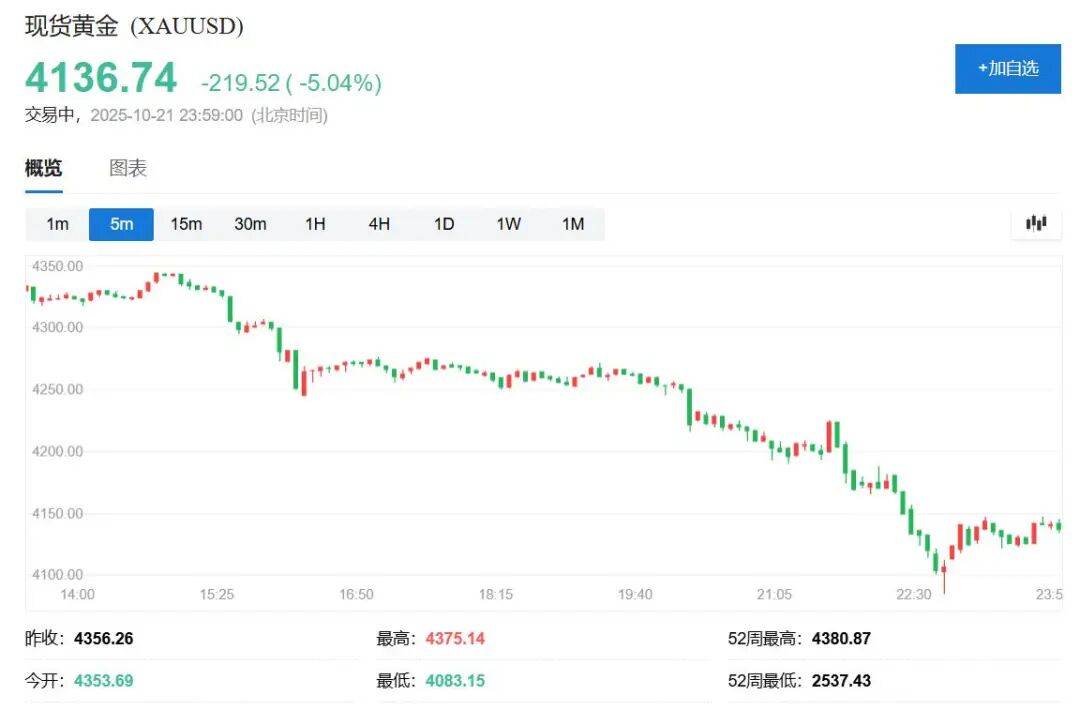
Core Viewpoint - The precious metals market experienced a significant downturn after a period of record highs, with gold and silver prices plummeting to their largest daily declines in years, raising concerns among investors about future price movements [1][4][7]. Price Movements - Gold reached a historical intraday high before falling approximately 6.3% to around $4,082, marking its largest daily drop since April 2013, with a closing price of $4,130.41 per ounce [1]. - Silver also saw a dramatic decline, dropping nearly 8.7% to below $47.90, the largest intraday drop since February 2021, with a closing price of $48.7050 per ounce [4]. Market Influences - Multiple factors contributed to the pressure on precious metal prices, including expectations of easing trade tensions, a strengthening dollar, and overbought technical indicators, which diminished the safe-haven demand for these metals [7][10]. - The ongoing U.S. government shutdown has led to a lack of critical positioning data, increasing uncertainty in the market and potentially allowing speculative long positions to accumulate excessively [10][12]. Technical Analysis - The relative strength index for gold indicated that prices had entered an overbought territory, prompting concerns about potential corrections and profit-taking among traders [8][11]. - Analysts noted that the absence of significant media catalysts on the day of the price drop suggested that the market was due for a correction due to extreme overbought conditions [11][12]. Investor Sentiment - Despite the sharp declines, some analysts believe that the fundamental factors supporting precious metals have not changed, and potential buying interest may limit the extent of any corrections [7][13]. - The recent lack of significant physical demand from India and the absence of key buyers in the Shanghai Gold Exchange were highlighted as notable factors contributing to the market's weakness [12][16]. Future Outlook - Analysts from various firms expressed differing views on the future of gold and silver prices, with some maintaining a bullish outlook while acknowledging the potential for a consolidation phase [10][13]. - The global largest gold ETF, GLD, saw unprecedented trading volumes, indicating heightened interest and activity in the market despite the recent downturn [14].
特朗普最新签署 征收25%的新关税!区域银行“爆雷”恐慌退潮 美股收涨 黄金跳水 加密货币超24万人爆仓
Mei Ri Jing Ji Xin Wen· 2025-10-18 01:27
Market Performance - On October 17, US stock indices collectively rose, with the Dow Jones up 0.52%, accumulating a weekly increase of 1.56% [1] - The Nasdaq also increased by 0.52%, with a weekly gain of 2.14% [1] - The S&P 500 index rose by 0.53%, totaling a weekly increase of 1.7% [1] Technology Sector - Popular tech stocks showed mixed performance, with Tesla rising by 2.46%, adding $35.1 billion (approximately 250.2 billion RMB) to its market value [2] - Apple increased by nearly 2%, while Oracle fell over 6% and AMD and ARM dropped more than 3% [2] - The automotive and consumer electronics sectors saw significant gains, with Stellantis rising over 3% and several major automotive companies increasing by over 1% [2] Banking Sector - The recent turmoil in US regional banks has eased market panic, with analysts suggesting that the issues are more related to market sentiment and liquidity rather than a systemic credit collapse [2] - The crisis was triggered by Zions Bancorporation's disclosure of a $60 million provision for two loans and a $50 million write-off, which represents 5% of its expected earnings for 2025 [2] - Goldman Sachs anticipates that NDFI loan exposure will be a focal point in upcoming earnings calls, highlighting the differences in underwriting standards among banks [3] Commodity Markets - Gold prices experienced volatility, reaching a historical high of $4,380.79 per ounce before dropping to $4,251.45, closing down 1.73% [5] - WTI crude oil futures rose by 0.14% to $57.54 per barrel, while Brent crude increased by 0.38% to $61.29 per barrel [6] Cryptocurrency Market - Bitcoin briefly fell below $107,000, trading at $107,034 as of October 18, with a total liquidation amount of $913 million (approximately 6.51 billion RMB) across the crypto market [6][7] Geopolitical Factors - Easing trade tensions have positively influenced market sentiment, with reports indicating a constructive dialogue between US President Trump and Russian President Putin [9] - President Trump signed an executive order imposing new tariffs on imports of medium and heavy trucks and parts, effective November 1 [9]

新动态 大提振!昨夜 A50猛拉!
Zheng Quan Shi Bao· 2025-10-18 01:23
Market Performance - The U.S. stock market rebounded, benefiting from strong tech stocks, rising expectations for interest rate cuts in October, and easing risk sentiment in bank stocks [1][6] - On October 17, all three major U.S. indices closed higher: the Dow Jones Industrial Average rose 0.52% to 46,190.61 points, the S&P 500 increased by 0.53% to 6,664.01 points, and the Nasdaq Composite gained 0.52% to 22,679.97 points [1][2] - For the week, the Dow Jones rose 1.56%, the S&P 500 increased by 1.7%, and the Nasdaq gained 2.14% [1] European Market Performance - European stock indices closed lower, with Germany's DAX down over 1.5%, France's CAC40 down 0.18%, and the UK's FTSE 100 down 0.86% [2] Chinese Market Performance - The Nasdaq China Golden Dragon Index initially fell over 1.3% but later rebounded, closing down 0.14% [2] - The FTSE China A50 Index futures saw a significant intraday rise, with a maximum increase of over 1% [4] Commodity Market - International gold prices fell over 3% during the trading session, with spot gold dropping to below $4,200 per ounce [7][8] - As of the close, spot gold was down 1.73% at $4,251.448 per ounce, while COMEX gold fell 0.85% to $4,267.9 per ounce [8][9] - The decline in gold prices led to significant drops in gold stocks, with Kinross Gold down over 9% and Barrick Gold down over 6% [9] Economic Sentiment - Analysts noted that easing trade tensions boosted market sentiment, with confidence expressed regarding potential negotiations between President Trump and Treasury Secretary Mnuchin [6][11] - The recent issues with regional banks were viewed as isolated incidents rather than indicative of a systemic crisis, which helped alleviate panic in the market [12] Federal Reserve Outlook - White House economic advisor Kevin Hassett indicated that the anticipated three interest rate cuts are just the beginning, with the Fed expected to lower rates further if economic conditions warrant [13] - The market widely expects the Fed to cut the federal funds rate target range by 25 basis points to 4%-4.25% at the upcoming FOMC meeting [13][14]
