
适度宽松

Search documents
21社论丨为稳增长创造良好的货币金融环境
21世纪经济报道· 2026-03-24 00:08
Group 1 - The central viewpoint is that the People's Bank of China (PBOC) is committed to supporting economic growth through a supportive monetary policy stance, aiming for stable growth and high-quality development amidst complex external conditions and domestic demand-supply imbalances [1] - The monetary policy will focus on "moderate easing" as the main trend, with a comprehensive use of various policy tools to ensure liquidity is abundant, especially in light of structural challenges such as insufficient demand and low price levels [1][2] - The average reserve requirement ratio for financial institutions is approximately 6.3%, with an expected room for a reduction of about 50 basis points to release long-term funds and lower bank funding costs [2] Group 2 - Financial support for consumption sectors will be enhanced through targeted structural tools, directing financial resources towards areas like culture, tourism, dining, and elderly care to stimulate consumption potential [3] - The PBOC's re-lending for technological innovation aims to provide funds at preferential rates to financial institutions, encouraging increased credit support for technology-driven enterprises [3] - A scientific risk assessment mechanism is needed to guide financial institutions in avoiding excessive financing to industries engaged in "involution" competition, which undermines resource allocation efficiency and industry upgrades [4]


央行开展1万亿买断式逆回购操作,流动性投放量为三个月内最高
Sou Hu Cai Jing· 2026-02-13 03:07
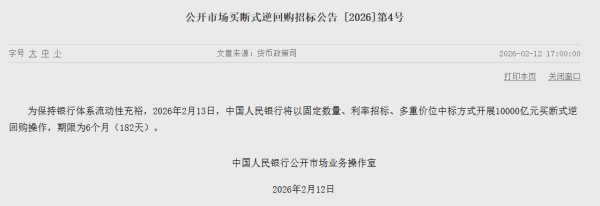
Group 1 - The People's Bank of China (PBOC) announced a 1 trillion yuan reverse repo operation to maintain ample liquidity in the banking system, with a fixed quantity and multi-price bidding method, set for February 13, 2026, with a term of 6 months [1] - The PBOC will achieve a net liquidity injection of 500 billion yuan due to the maturity of a 6-month reverse repo in February, alongside an additional 800 billion yuan 3-month reverse repo operation conducted on February 4, leading to a total net liquidity injection of 600 billion yuan for the month [1] - This marks the ninth consecutive month that the PBOC has injected medium-term liquidity into the market through reverse repos, reflecting a continuation of the "moderately accommodative" monetary policy stance [1] Group 2 - Analysts suggest that the PBOC's actions through reverse repos and Medium-term Lending Facility (MLF) operations have effectively maintained market liquidity and improved the maturity structure of liquidity, ensuring stability in the financial market at the year's end [2] - It is anticipated that the PBOC will conduct an MLF operation around February 25, likely maintaining or slightly increasing the amount injected [2]
央行释放新信号!本月第二次大手笔操作→
Xin Lang Cai Jing· 2026-01-15 03:58
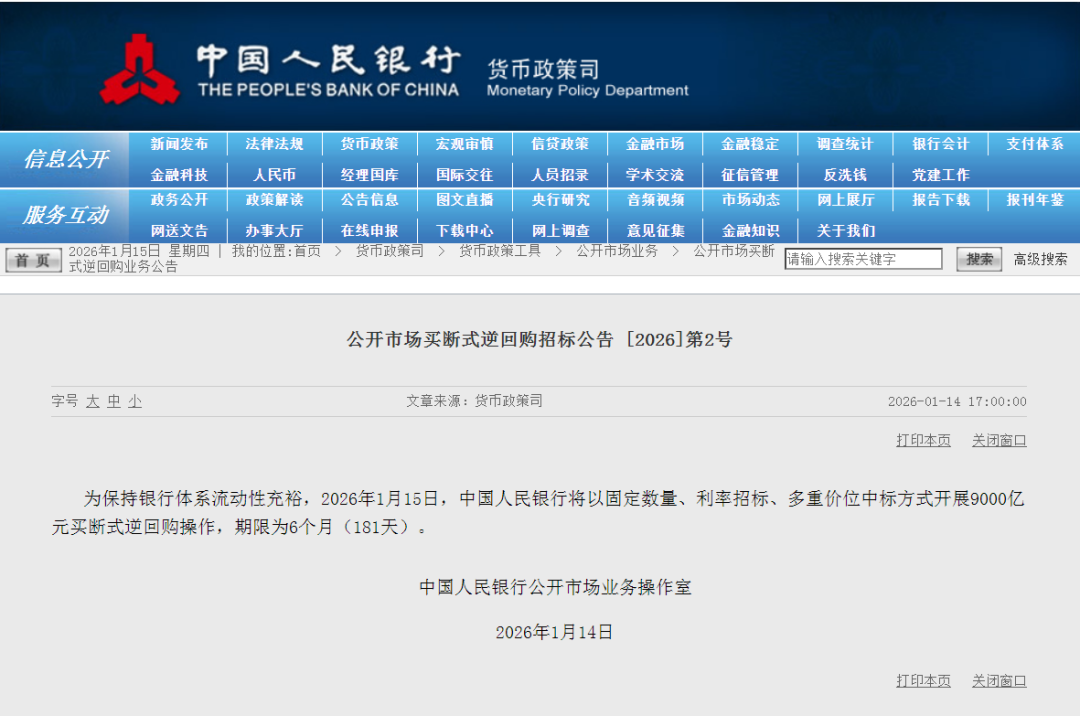
Core Viewpoint - The People's Bank of China (PBOC) is continuing its policy of maintaining ample liquidity in the banking system through a series of reverse repo operations, with a significant operation of 900 billion yuan scheduled for January 15, 2026 [1][4]. Group 1: Reverse Repo Operations - On January 14, 2026, the PBOC announced a 900 billion yuan reverse repo operation with a term of 6 months, utilizing a fixed quantity, interest rate bidding, and multiple price levels [1]. - This operation marks the second reverse repo conducted by the PBOC in January, following an earlier operation of 1.1 trillion yuan for a 3-month term on January 8, 2026 [4]. - The PBOC has been increasing the amount of 6-month reverse repos for five consecutive months, indicating a sustained effort to inject medium-term liquidity into the market [4]. Group 2: Market Liquidity and Economic Context - The overall liquidity in January has remained stable, although there was a slight tightening mid-month due to the maturity of 6-month reverse repos and government bond issuance pressures [4]. - Analysts suggest that the PBOC's actions are aimed at ensuring liquidity around the reserve requirement payment date of January 15, which is a critical time for banks [4]. - The PBOC's operations are seen as a reflection of its commitment to a moderately accommodative monetary policy for 2026, supporting government bond issuance and encouraging financial institutions to increase credit supply [4][5]. Group 3: Future Monetary Policy Outlook - The PBOC is expected to continue using various monetary policy tools, including reverse repos and Medium-term Lending Facility (MLF), to maintain liquidity and support economic growth [5]. - The central bank's recent work meeting emphasized the need for flexible and efficient use of monetary policy tools to ensure liquidity remains ample and financing conditions are relatively loose [5][6]. - The monetary policy in 2026 aims to balance multiple objectives, including promoting economic growth and risk prevention, while supporting stability in employment, businesses, markets, and expectations [6].
等量续作,央行明日开展3个月期11000亿元买断式逆回购操作|快讯
Sou Hu Cai Jing· 2026-01-07 15:45
Core Viewpoint - The People's Bank of China (PBOC) is set to conduct a 1.1 trillion yuan reverse repo operation on January 8, 2026, to maintain ample liquidity in the banking system, marking the third consecutive month of equal-scale operations [1] Group 1: Reverse Repo Operations - On January 8, 2026, the PBOC will conduct a fixed-quantity, interest-rate tender, multi-price reverse repo operation amounting to 1.1 trillion yuan with a term of 3 months (90 days) [1] - The operation on January 8 will match the 1.1 trillion yuan of 3-month reverse repos maturing on the same day, indicating a continuation of the same scale of operations [1] - In January, an additional 600 billion yuan of 6-month reverse repos is set to mature, with expectations for another 6-month operation, likely with an increased amount [1] Group 2: Monetary Policy Outlook - Analysts anticipate that the PBOC will also consider the 200 billion yuan of Medium-term Lending Facility (MLF) maturing in January, potentially leading to an increased operation [1] - Overall, the PBOC is expected to utilize both reverse repos and MLF tools to inject medium-term liquidity into the market, reflecting a continuation of a moderately accommodative monetary policy stance in 2026 [1]
二〇二五年中国经济关键词
Xin Lang Cai Jing· 2025-12-29 22:22
Group 1: New Quality Productive Forces - In 2025, China focuses on technological innovation and industrial upgrading to cultivate new quality productive forces, enhancing the foundation for high-quality development [2] - Traditional industries are crucial for accelerating the development of new quality productive forces, with the Ministry of Industry and Information Technology releasing action plans for ten key industries [2] - Strategic emerging industries and future industries are the main battlegrounds for cultivating new quality productive forces, with significant growth in sectors like new energy vehicles, photovoltaics, and quantum technology [2][3] Group 2: Expanding Domestic Demand - Expanding domestic demand is a strategic choice for China to respond to economic changes and promote high-quality development, with policies implemented to stimulate consumption and investment [4] - Consumer markets are recovering, with significant growth in retail sales of home appliances and communication equipment, with year-on-year increases of 14.8%, 18.2%, and 20.9% respectively [6] - Investment in emerging sectors is also strong, with notable increases in manufacturing and renewable energy investments, such as a 15.3% growth in automotive manufacturing [6] Group 3: High-Level Opening Up - Expanding high-level opening up is essential for China's high-quality development, providing stability to the uncertain global economy [7] - China's foreign trade resilience is improving, with policies promoting service exports and green trade, reflecting a commitment to innovative leadership [7][8] - Trade with major partners like ASEAN has seen growth, with a year-on-year increase of 8.5% in trade volume [8] Group 4: Risk Mitigation - In 2025, China continues to address key risk areas to ensure high-quality development, with measures in place to manage local government debt and mitigate financial risks [9] - The real estate sector has seen successful completion of housing delivery tasks, with policies aimed at stabilizing the market and supporting housing supply [9] Group 5: Appropriate Monetary Easing - Since 2025, a moderately loose monetary policy has been in effect, with social financing scale increasing significantly, reaching 33.39 trillion yuan in the first eleven months [10] - The structure of credit has improved, supporting key sectors and strategic economic transformations, with notable growth in technology and green loans [11] Group 6: Green Transition - China has introduced numerous policies for green low-carbon transition and ecological civilization construction, achieving significant progress in various fields [14] - The energy structure is shifting towards non-fossil sources, with ambitious targets for renewable energy installations [14][15] - The green economy is thriving, with over 218.7 million existing green economy-related enterprises, indicating sustained vitality in the sector [14]
国债ETF(511010)近20日资金净流入超3亿元,"适度宽松"为债券市场提供重要支撑
Sou Hu Cai Jing· 2025-12-19 02:04
Group 1 - The central economic work conference's "moderate easing" stance provides significant support for the bond market in the medium to long term, with liquidity conditions remaining ample [1] - The National Bond ETF (511010) tracks the 5-year government bond index (000140), which reflects the overall performance of fixed-rate government bonds with a remaining maturity of approximately 5 years, composed of short- to medium-term bonds issued by the Chinese government [1]
货币政策取向会改变吗?
2025-12-08 00:41
Summary of Key Points from the Conference Call Industry or Company Involved - The discussion primarily revolves around the monetary policy of the central bank and its implications for the financial market, particularly focusing on interest rates and liquidity management. Core Points and Arguments 1. The central bank's "short-term collection and long-term release" operation aims to adjust liquidity based on different term structures, rather than a comprehensive tightening of liquidity or raising funding costs, to smooth key term interest rate fluctuations around the policy rate [1][4][6] 2. Recent movements in the 30-year treasury futures and rising interest rates have led to speculation about potential changes in monetary policy, but these movements are attributed more to market dynamics rather than significant policy shifts [3][15] 3. The current monetary policy remains supportive and stable, with expectations that the central political bureau meeting at the end of 2025 will continue the 2024 stance, indicating a high probability of interest rate cuts in the first quarter of 2026 [4][16] 4. The central bank's liquidity management framework includes various tools for different time horizons, with a focus on meeting the demand for funds across short, medium, and long-term periods [5][12] 5. The widening spread between 30-year and 10-year interest rates, which has reached 41 basis points, suggests potential trading opportunities, particularly in the 10-year segment, while the 30-year segment may present more of a rebound opportunity rather than a bottom-fishing opportunity [14][16] Other Important but Possibly Overlooked Content 1. The central bank's communication emphasizes the need for agility and robustness in monetary policy, but this has been a consistent theme and does not indicate imminent major changes [7][8] 2. The current market behavior regarding the independent rise of long-term rates is seen as a result of institutional trading strategies rather than a reflection of significant changes in policy or market conditions [4][15] 3. The concept of "appropriate loosening" is defined as maintaining ample liquidity supply, with social financing and broad money supply growth rates above 6-7%, and involves dynamic adjustments based on economic conditions [11][12] 4. The central bank's operations are designed to balance supply and demand across different maturities, and any future adjustments will depend on market conditions, particularly if short-term rates show abnormal increases [6][10]
深度专题|2026年:财政货币政策展望
赵伟宏观探索· 2025-12-02 16:03
Group 1: Policy Review for 2025 - Fiscal policy shows increased strength, with a historical high financing scale of 14.36 trillion yuan, accounting for 10.2% of GDP [1][8] - General fiscal expenditure grew by 7.9% year-on-year in the first three quarters of 2025, indicating a high level of spending [11][12] - Monetary policy returned to a "moderately loose" tone, with a focus on guiding expectations and improving transmission efficiency [1][23] Group 2: Fiscal Policy Outlook for 2026 - Fiscal policy is expected to become more proactive in supporting economic growth and structural transformation, with a deficit rate maintained around 4% [2][61] - Special bonds and new special debt scales are anticipated to expand slightly compared to 2025, aiming to keep fiscal expenditure growth in line with or above nominal GDP growth [2][63] - The focus will be on investing in social welfare and new infrastructure, particularly in areas like elderly care and child welfare [2][61] Group 3: Tax and Fiscal System Reform - Fiscal reforms will address structural contradictions, focusing on macro tax burden, central-local relations, and social security systems [3][61] - The aim is to maintain a reasonable macro tax burden and regulate tax incentives to curb excessive competition among local governments [3][61] Group 4: Monetary Policy Outlook for 2026 - Monetary policy is likely to maintain a "moderately loose" stance, with an emphasis on liquidity support and precise policy implementation [4][6] - The social financing scale is expected to increase, with M1 growth slightly rebounding due to fiscal input [4][6] - The central bank may implement a rate cut of about 10 basis points to maintain liquidity [4][6] Group 5: Policy Coordination and Macro Governance - The central bank's operations in government bond trading reflect a flexible response to market changes, enhancing policy effectiveness [1][42] - Fiscal injections into commercial banks are aimed at stabilizing their capital adequacy ratios and facilitating monetary policy transmission [49][51] - The collaboration between fiscal and monetary policies is evolving, with a focus on improving the overall governance system [1][42]

【笔记20250627— 70%认为十年国债利率年内创新低】
债券笔记· 2025-06-29 05:14
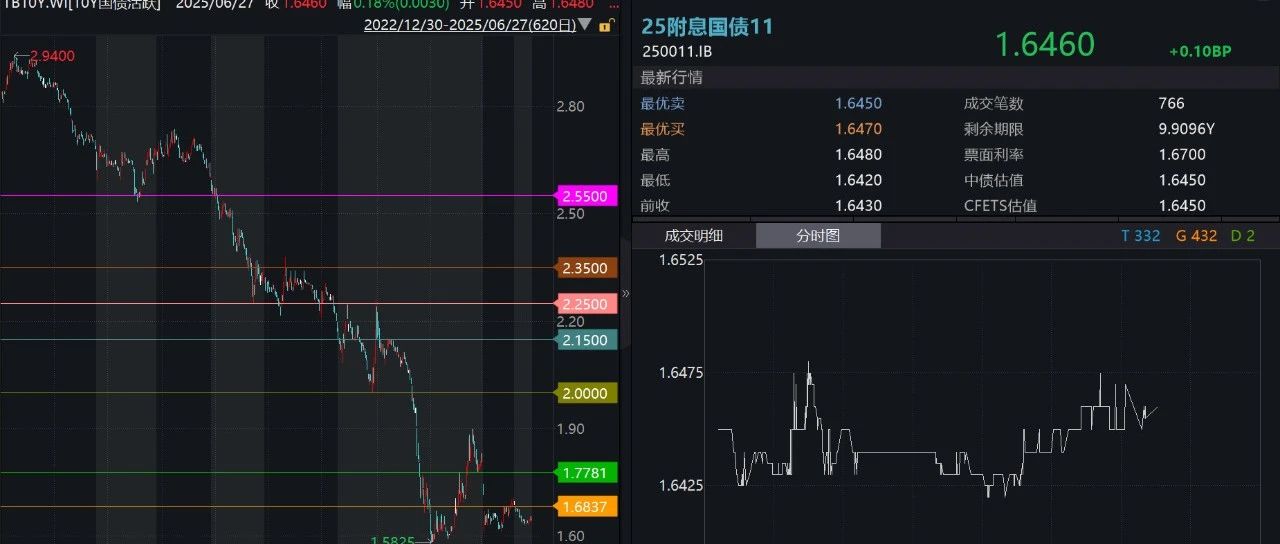
Core Viewpoint - The article discusses the diminishing returns of news and rumors in the market, emphasizing that the impact of the same news decreases significantly after the first and second announcements, leading to a near-zero or even negative effect on the third and subsequent announcements [1]. Group 1: Market Conditions - The central bank conducted a net injection of 364.7 billion yuan through a 7-day reverse repurchase operation, with 161.2 billion yuan maturing today, indicating a balanced and slightly loose funding environment [2]. - The interbank funding rates remained stable, with DR001 around 1.37% and DR007 around 1.70% [2]. - The 10-year government bond yield fluctuated around 1.65%, with a monthly range of less than 5 basis points, reflecting a stable market sentiment [5]. Group 2: Economic Indicators - Industrial enterprise profit data for January to May showed a significant decline, with profit growth dropping to -9.1%, indicating worsening profit margins and collection periods [5]. - The article highlights the need for structural reforms to boost consumer confidence rather than merely preparing for potential external troubles, as suggested by a Cornell University professor [5]. Group 3: Investor Sentiment - A survey indicated that 70% of investors expect the 10-year government bond yield to reach a new low within the year, driven by the established tone of "moderate easing" [5]. - The market sentiment was influenced by the weak industrial profit data and a declining stock market, leading to fluctuations in bond market rates [4][5].
业内人士称货币政策在“适度宽松”的方向上还有发力空间
news flash· 2025-06-03 23:58
Core Viewpoint - Industry experts believe that there is still room for monetary policy to exert "moderate easing" considering both internal and external factors [1] Summary by Relevant Categories - **Monetary Policy Direction** - The People's Bank of China will flexibly adjust the intensity and pace of policy implementation based on domestic and international economic and financial conditions, as well as the operation of financial markets [1] - **Liquidity Management** - The central bank aims to maintain reasonable and ample liquidity in the market [1]