
农产品贸易

Search documents
养殖产业链日报:近月宽松明显-20260319
Guan Tong Qi Huo· 2026-03-19 11:26
Report Industry Investment Rating There is no information about the report industry investment rating in the provided content. Core Viewpoints - The soybean auction restart can increase market supply, but the volume is limited, and the market procurement is rational. The soybean price has fallen from the high level, and the decline space is relatively limited. Attention should be paid to the arrival of imported soybeans and the release of reserved imported beans [1]. - The driving force of corn price weakens after continuous rise, and there may be a certain price adjustment in the short - term, but the adjustment range is relatively limited. In the future, it is still possible to consider actively replenishing stocks or buying on dips [2]. - The high egg inventory restricts the rapid rise of egg prices. However, the number of newly - laid hens will decrease significantly in March - April 2026, and the egg inventory will decline in April - May. Although the short - term supply and demand are still loose, there is an obvious decline expectation in March. It is recommended to adopt a low - buying strategy [2]. - The pig market is likely to repeatedly bottom out in the first half of the year. The short - term supply pressure is difficult to reduce, and the pig price may continue to bottom out at 10.0 - 11.0 yuan/kg. The continuous loss will promote the breeding end to gradually accelerate the production reduction. The far - month contract may have some support, but the supply - demand pattern will not change until the official data is significantly adjusted [3][4]. Summary by Related Content Soybean - Since March, the auctions of other market entities have restarted, but the trading volume is limited. The 41% protein price of 5037 yuan/ton is basically the same as the market price, indicating rational market procurement [1]. - Due to the resumption of Brazilian soybean shipments and the delay of Trump's visit to China, the soybean price has fallen from the high level, and the decline space is relatively limited. Attention should be paid to the arrival of imported soybeans and the release of reserved imported beans, which may put pressure on the price [1]. Corn - The remaining grain in the northeast region is less than 30%. As the corn price rises to a high level, the willingness of growers to sell grain increases, and the market supply of grain has increased. Feed enterprises mainly make rigid replenishment, while deep - processing enterprises continue to purchase due to the recovery of the startup rate, and some enterprises have slightly adjusted the purchase price [1]. - There are rumors that the release of over - aged rice is about to be implemented, which may suppress the corn price [1]. - After continuous rise, the driving force of corn price weakens, and there may be a certain price adjustment in the short - term, but the adjustment range is relatively limited. In the future, it is still possible to consider actively replenishing stocks or buying on dips [2]. Egg - In late February 2026, the national laying hen inventory was 1.35 billion, a year - on - year increase of 3.4%, which restricts the rapid rise of egg prices [2]. - The number of newly - laid hens in March - April 2026 will decrease significantly, and the laying hen inventory will decline in April - May. Although the short - term supply and demand are still loose, there is an obvious decline expectation in March. It is recommended to adopt a low - buying strategy [2]. Pig - In the first half of the year, the pig market is likely to repeatedly bottom out along the path of "loss - capacity reduction - rebound - hoarding - price reduction - loss". The short - term supply pressure is difficult to reduce [3]. - In March, the pig price has fallen below 10.5 yuan/kg, and the losses of both breeding modes have exceeded 200 yuan/head. The supply in March - April may increase, and the pig price may continue to bottom out at 10.0 - 11.0 yuan/kg. The continuous loss will promote the breeding end to gradually accelerate the production reduction [3][4]. - Although a third - party institution predicts a slight reduction in the inventory of reproductive sows in February, the far - month contract may have some support, but the supply - demand pattern will not change until the official data is significantly adjusted [4].
【冠通期货研究报告】:油粕日报:震荡上涨-20260312
Guan Tong Qi Huo· 2026-03-12 09:46
Report Industry Investment Rating - Not provided Core Viewpoints - Brazil's soybean quarantine issue has triggered speculation on near - month arrivals, but institutions have not significantly reduced Brazil's export estimates, and the problem is expected to be resolved soon. Short - term strong export demand for US soybeans and near - month arrival speculation have strengthened soybean meal, which is expected to remain strong before the state reserves release [2]. - Market rumors about the US EPA's renewable fuel blending new regulations have attracted market attention. Indonesia is accelerating the road test of B50 biodiesel. However, due to the uncertainty of crude oil price increase, the expansion of biodiesel policies is still in the "possible" stage, and the Middle East situation and crude oil trend are the dominant factors for the rise and fall of the oil and fat sector [2]. Summary by Related Content Soybean Meal - ANEC estimates that Brazil's soybean exports in March 2026 will be 16.47 million tons, a 4.7% increase from 15.73 million tons in March 2025. From March 1st to 7th, the export volume was 3.71 million tons, and the estimated export volume from March 8th to 14th is 4.58 million tons, mostly concentrated in Santos Port, Paranagua Port, Bacarema Port, and São Luís do Itaqui Port. The estimated export volume from January to March may reach 26.25 - 29.19 million tons [1]. - Cargill has suspended soybean exports from Brazil to China due to Brazil's adjustment of inspection standards, which makes it difficult for traders to comply. The Brazilian Ministry of Agriculture has implemented stricter phytosanitary assessments at the request of the Chinese government [1]. Oils and Fats - There are market rumors that the US EPA is about to release new renewable fuel blending regulations, which may require large refineries to make up 70% of the biofuel blending exemption quota. If this happens, large refiners may sue [2]. - Indonesia's Energy Ministry is accelerating the road test of B50 biodiesel to cope with possible crude oil supply shortages. The test of 50% biodiesel blended fuel is expected to complete the passenger car test by the end of March, and the government is evaluating the conditions for mandatory implementation by the end of 2026 [2].
养殖产业链日报:近月宽松明显-20260311
Guan Tong Qi Huo· 2026-03-11 11:17
Report Industry Investment Rating No relevant information provided. Core Viewpoints - The domestic soybean market is expected to remain strong, and it is advisable to go long at low prices [1]. - Corn fundamentals are still strong, and it is recommended to replenish stocks or buy on dips [2]. - Egg prices are expected to be stable with a slight upward trend, and a low - long strategy is recommended [2]. - The pig market is in a key game period of short - term price pressure and long - term capacity clearance, and the near - term is expected to fluctuate at the bottom [4]. Summary by Related Catalogs Soybean - Northeast soybean prices have been rising since the listing. After the Chinese New Year, due to geopolitical conflicts, futures rally, and Cofco's increased purchase price, the price of the remaining soybeans has continued to rise. After a small amount of restocking, the overall market trading is still light [1]. Corn - In Northeast China, the remaining grain at the grass - roots level is less than 30%. As the temperature rises and the spot price increases, the remaining grain is gradually released. The post - holiday operating rate of processing enterprises has increased slightly, and the overall downstream demand is okay. The purchase price remains strong. On the 9th, all the grain sources put up by Sinograin were sold, with a large local premium [1]. Egg - As of the end of February 2026, the national laying hen inventory was 1.35 billion, a year - on - year increase of 3.4%. The number of newly - laid hens from March to April 2026 will decrease significantly. The laying hen inventory will enter a downward channel from April to May. The supply is expected to shrink, and the price is expected to be stable with a slight upward trend [2]. Pig - As of the end of December 2025, the national breeding sow inventory was 39.61 million, 101.6% of the normal level. In January 2026, it slightly decreased to 39.58 million, still above the regulatory red line. The first half of 2026 will face greater pressure on pig slaughter. The state has carried out pork purchases, and it is expected that subsequent purchases will continue. The industry is in a key game period, and the near - term is expected to fluctuate at the bottom [3][4].
加菜籽反倾销终审落地,对国内菜油价格影响中性偏空
Chang Jiang Qi Huo· 2026-03-06 11:34
Group 1: Report Industry Investment Rating - Not provided in the given content Group 2: Core Viewpoints - On February 28, 2026, China's Ministry of Commerce announced the final result of the anti - dumping investigation on Canadian rapeseed that started on September 9, 2024, imposing a 5.9% anti - dumping duty on Canadian rapeseed from March 1, 2026, for 5 years. After the result, the comprehensive tax rate dropped to 14.9%, reopening the trade channel between China and Canada [1][4]. - In the short term, the reduction in import tariffs on Canadian rapeseed did not exceed market expectations, and the decline in domestic rapeseed import profit limited new purchases. The short - term negative impact on the domestic rapeseed industry was relatively limited. Currently, the market focuses on the positive factors of rising crude oil and tight supply - demand of rapeseed products, and domestic rapeseed oil fluctuates strongly at a high level. However, after the tax reduction, rapeseed purchased in January - February can be processed, and the supply - demand of rapeseed products will loosen in March, suppressing the increase of rapeseed oil prices [2][12]. - In the medium - to - long term, from March to May is the peak period for imported rapeseed to arrive in China. The inventory of rapeseed and rapeseed oil has turned upward and will continue to increase. In the second quarter, the supply - demand of rapeseed oil will loosen significantly. With the record - high harvest of Brazilian soybeans and the increasing production season of Southeast Asian palm oil, the supply of oils at home and abroad will increase. The easing of the Middle East situation may weaken the driving force of international crude oil on oils. Domestic rapeseed oil faces the risk of high - level adjustment, but there is bottom support, and the overall trend is wide - range oscillation [2][12]. Group 3: Summary by Related Catalogs 1. Anti - Dumping Investigation Results - The investigation authority determined that Canadian rapeseed was dumped in China, harming the domestic rapeseed industry. A 5.9% anti - dumping duty was imposed from March 1, 2026, for 5 years. Companies that paid a 75.8% deposit from August 14 to December 31, 2025, will get the remaining deposit back after deducting the anti - dumping duty [4]. 2. Comparison of Tax Rates Before and After the Final Result - Before the final result, the comprehensive tax rate for importing Canadian rapeseed was 84.8% (9% tariff + 75.8% deposit), severely suppressing purchases. After the result, the comprehensive tax rate is 14.9% (9% tariff + 5.9% anti - dumping duty), which is within an acceptable range [1][6]. 3. Impact on Import Profit and Purchases - The market's early anticipation of improved China - Canada relations led to a sharp increase in ICE rapeseed futures prices and premiums from January to February, causing the domestic import profit of Canadian rapeseed to deteriorate rapidly. For example, the March - shipment rapeseed's disk profit on January 5 was 608 yuan/ton, but the May - shipment rapeseed's disk profit on March 5 dropped to - 141 yuan/ton. Currently, the loss in disk profit restrains short - term purchases [7]. 4. Changes in Rapeseed Supply and Demand - In the 2025/2026 season, the global rapeseed supply increased due to a bumper harvest, but demand was weak. The global rapeseed ending inventory and inventory - to - sales ratio increased year - on - year, with the inventory - to - sales ratio of 10.94% being the highest in the past five years. Canadian rapeseed's demand was suppressed due to export restrictions to China, and its inventory - to - sales ratio increased by 5.64% year - on - year to 17.65%, the second - highest in the past five years. After the tax reduction, the difference in rapeseed supply - demand between China and foreign countries will gradually narrow [9]. 5. Rapeseed Arrival Forecast - Chinese traders purchased about 650,000 tons of Canadian rapeseed in mid - January, which is expected to arrive in China from March to May. The estimated rapeseed arrivals from March to May are 195,000, 260,000, and 325,000 tons respectively, an increase compared to January - February. The inventory of rapeseed and rapeseed oil in China has started to increase, and the supply pressure will improve the current tight supply - demand situation [10]. 6. Potential Impact of Australian Rapeseed - There are market rumors that China is considering opening commercial purchases of Australian rapeseed. If implemented, the source of domestic rapeseed supply will be further expanded [11].
养殖产业链日报:近月宽松明显-20260302
Guan Tong Qi Huo· 2026-03-02 11:02
Report Industry Investment Rating No relevant content provided. Core Viewpoints - The low point of soybean prices has passed, and the subsequent trend will be an oscillating upward movement [1]. - Corn should be considered from a low - buying perspective, and if there is a pull - back adjustment, it is advisable to actively replenish stocks or buy [2]. - Eggs are expected to be stable with a slight upward trend later, and a low - buying approach is recommended [2]. - The contradiction of oversupply in the pig market may be alleviated, and the decline in pig prices is expected to slow down and reach the bottom. However, there is still significant pressure on pig slaughter in the first half of 2026 [3]. - The industry is in a critical game period between short - term price pressure and long - term capacity clearance. The near - term is expected to oscillate at the bottom [4]. Summary by Related Products Soybean - The domestic soybean spot market price shows a stable - to - strong trend. Northeast产区 traders' selling prices have increased after the Spring Festival, but new transactions are limited. Traders in Shandong, Jiangsu, Anhui, and Henan indicate slow local bean transactions, and prices are mostly stable. The selling price of Northeast beans in the sales area has increased following the production area, but the increase is smaller [1]. Corn - Northeast deep - processing enterprises have gradually resumed full - scale purchases. Driven by the futures market, the price of deep - processing acquisitions has risen significantly compared to before the Spring Festival. The fuel ethanol enterprise acquisition price has increased by 20 - 30 yuan/ton, and the dry - grain acquisition price in Songyuan is 2230 yuan/ton (+50 yuan). The port in Jinzhou is gradually resuming operations, and the shipping demand is still low, with full recovery expected after the Lantern Festival [1]. - The sharp rise in crude oil is beneficial to ethanol enterprises, indirectly driving up the price of corn. A low - buying strategy is recommended [2]. Eggs - Based on the previous chicken - chick sales volume, the supply of newly - laid hens from February to March may decrease, and the inventory of laying hens is expected to slightly decline from the high level. The supply pressure of eggs is expected to be alleviated to some extent. The average monthly inventory of laying hens from January to June 2026 is 1.134 billion, a year - on - year decrease of 0.02 billion (0.18%) compared to 2025, and an increase of 0.078 billion (7.39%) compared to the average of the previous six years [2]. Pigs - In early February, the domestic pig - to - grain ratio was below 5:1 for three consecutive weeks, meeting the conditions for frozen - meat purchase and storage. After the Spring Festival, the market demand is weak, and the supply is relatively normal, resulting in a situation of oversupply. With the implementation of the purchase - and - storage policy, the contradiction of oversupply may be alleviated. As of the end of December 2025, the national inventory of breeding sows was 39.61 million, 101.6% of the normal reserve. In January 2026, it slightly decreased to 39.58 million, still above the regulatory red line. There is still significant pressure on pig slaughter in the first half of 2026 [3].
亨泰发布中期业绩 股东应占亏损3344.3万港元 同比收窄12.54%
Zhi Tong Cai Jing· 2026-02-26 10:34
Core Viewpoint - The company reported a significant decline in revenue and a narrowed loss for the six months ending December 31, 2025, indicating challenges in its trading and operational segments [1] Financial Performance - Revenue for the period was approximately HKD 158 million, representing a year-on-year decrease of 33.57% [1] - The loss attributable to the company's owners was HKD 33.443 million, which is a 12.54% improvement compared to the previous year [1] - Basic loss per share was HKD 0.175 [1] Business Segments - The decline in revenue was primarily due to decreased income from the import goods trading business and upstream farming operations [1] - The termination of operations in the securities brokerage and margin financing business resulted in no related income [1] - This decline was partially offset by a slight increase in revenue from domestic agricultural product trading [1]
每日期货全景复盘2.26:船司挺价基本落空,集运欧线期价全线走弱
Xin Lang Cai Jing· 2026-02-26 10:23
Group 1 - The shipping European index has significantly declined, indicating a bearish sentiment in the market, with the main contract dropping by 5.19% to 1236 points [20][35] - The rebar steel inventory has increased to 8.006 million tons, with a week-on-week increase of 845,600 tons, while rebar production decreased by 52,800 tons, a decline of 3.10% [11][27] - Domestic soda ash manufacturers have reported a total inventory of 1.8944 million tons, an increase of 30,640 tons, representing a rise of 19.29% [11][28] Group 2 - The manganese silicon main contract has seen a notable increase, closing at 5,918 yuan per ton, with a rise of 2.85%, supported by strong cost support from factories [33][34] - The coking coal main contract has experienced a decline of 2.46%, closing at 1,090 yuan per ton, due to increased supply and pressure on demand from steel mills [21][36] - The palm oil prices have remained strong throughout January, indicating a potential short-term structural bottom despite facing challenges from the delayed implementation of Indonesia's B50 biodiesel mandate [11][28]


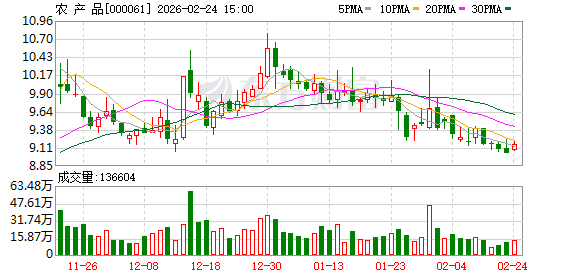
农产品:关于全资子公司果菜公司签订《收地补偿协议书》的进展公告
Zheng Quan Ri Bao· 2026-02-24 12:43
Core Viewpoint - The company has approved a land compensation agreement involving its wholly-owned subsidiary, indicating a strategic move in land management and urban development [2]. Group 1: Company Actions - The company's board approved the signing of a land compensation agreement with local government authorities [2]. - The agreement involves the return of land use rights for a specific plot (G14301-0001) to the Shenzhen Planning and Natural Resources Bureau [2]. - The agreement has been finalized and signed by all three parties involved [2]. Group 2: Implications - This action may reflect the company's strategy to optimize its land assets and align with urban development initiatives in Shenzhen [2]. - The involvement of multiple government agencies suggests a collaborative approach to urban planning and land use [2].

巴西2月前三周累计装出玉米134.82万吨
Xin Hua Cai Jing· 2026-02-24 01:57
Core Insights - Brazil's Secretary of Foreign Trade (Secex) reported that the cumulative corn exports for the first three weeks of February reached 1.3482 million tons, compared to a total of 1.4195 million tons for the entire month of February last year [1] - The average daily shipment volume was 103.7 thousand tons, which represents a 46.12% increase from 71 thousand tons in February of the previous year [1]
巴西2月前三周累计装出大豆408.47万吨
Xin Hua Cai Jing· 2026-02-24 01:55
Group 1 - Brazil's Secretary of Foreign Trade (Secex) reported that the cumulative soybean exports in the first three weeks of February reached 4.0847 million tons, a decrease from 6.4283 million tons in February of the previous year [1] - The average daily shipment volume for February was 314,200 tons, which represents a 2.24% decrease compared to the average of 321,400 tons in February of the previous year [1]