碳排放交易

Search documents
2026年4月碳排放月报:市场扩围,碳价持稳-20260330
Bao Cheng Qi Huo· 2026-03-30 11:43
1. Report Industry Investment Rating - No relevant information provided 2. Core Viewpoints - In March 2026, the National Carbon Emission Trading Market (CEA) operated stably and further expanded. After the Ministry of Ecology and Environment officially included the steel, cement, and aluminum smelting industries in the national carbon market in February, the market sentiment was generally optimistic this month. However, due to the end - of - quarter compliance expectations and the progress of data verification in new industries, the price showed a high - level volatile consolidation trend [3][39]. - The CEA quota price fluctuated between 80.00 yuan/ton and 83.20 yuan/ton this month, maintaining overall resilience. The market activity rebounded compared to February, with a significant proportion of bulk agreement transactions, indicating that institutional investors and newly included industry entities were adjusting their positions [4][39]. - The core focus this month was on the implementation of the quota allocation plan details for the three high - energy - consuming industries (steel, cement, and aluminum) and the start of data verification work, which provided strong support for the medium - and long - term carbon price. As April enters the traditional compliance peak period and the data verification results of the three industries become clearer, market enthusiasm may further increase, and the price is expected to strengthen [4][41]. 3. Summary by Directory 3.1 Industry News - The expansion of the carbon market started substantially. In February 2026, the Ministry of Ecology and Environment officially included the steel, cement, and aluminum smelting industries in the national carbon market. In March, local ecological environment departments and third - party verification agencies launched the verification of the 2025 carbon emission data of key enterprises in these three industries. The first batch of quota allocation plans for new industries is expected to be announced in early Q2, which has increased the attention of relevant industrial chain enterprises to carbon assets [9]. - In March, the trading volume and price of the national voluntary greenhouse gas emission reduction market (CCER) increased. On March 19, the average CCER transaction price was about 87.02 yuan/ton, slightly higher than the CEA price, showing a small inversion or parity, indicating the scarcity of high - quality emission reduction projects. Afforestation carbon sequestration and renewable energy grid - connected power generation projects were still the main trading items [10]. - Pilot markets in Hubei, Guangdong, etc. were also actively traded this month. In mid - March, the price of the Hubei carbon market (HBEA) maintained a reasonable price difference with the national carbon market, with limited inter - regional arbitrage space, and the market was maturing [11]. 3.2 National Carbon Market Carbon Emission Quotas (CEA) - As of February 27, 2026, the closing price of the national carbon market carbon emission quota (CEA) was 79.90 yuan/ton, the same as the previous month and down 7.23% year - on - year. In the past 30 trading days, the highest CEA price was 83.20 yuan/ton, the lowest was 74.00 yuan/ton, with a fluctuation range of about 9 yuan/ton. In terms of trading volume, the trading activity of national carbon emission quotas decreased in the past 30 trading days, with the average monthly trading volume decreasing by 759,000 tons [12]. 3.3 Carbon Price Influence Factor Analysis 3.3.1 Energy Price - There is a certain correlation between the carbon emission market and the energy market. When energy demand is strong and energy prices rise, the demand for carbon emission quotas is also relatively strong. The increase in carbon price increases the economic efficiency of corporate low - carbon emission reduction, which helps reduce corporate energy demand. Affected by external geopolitical conflicts, the prices of thermal coal and natural gas increased [14]. 3.3.2 Energy Consumption - From January to December 2025, the total apparent consumption of gasoline, coal, and diesel in China was 37,671.13 million tons, 628.74 million tons less than the previous year [22]. 3.3.3 Domestic Carbon Emission Structure - No specific analysis content provided, only relevant figures are mentioned [29] 3.3.4 Total Social Electricity Consumption - In 2025, the total social electricity consumption was 1,036.82 billion kWh, a year - on - year increase of 5.0%. The electricity consumption of the primary industry was 14.94 billion kWh, a year - on - year increase of 9.9%; the secondary industry was 663.66 billion kWh, a year - on - year increase of 3.7%; the tertiary industry was 199.42 billion kWh, a year - on - year increase of 8.2%; and the electricity consumption of urban and rural residents was 158.80 billion kWh, a year - on - year increase of 6.3%. The electricity consumption of the tertiary industry and urban and rural residents contributed 50% to the growth of electricity consumption. The growth rates of electricity consumption in the charging and battery - swapping service industry and the information transmission, software, and information technology service industry reached 48.8% and 17.0% respectively, which were important factors driving the growth of tertiary - industry electricity consumption. The slowdown in the growth rate of secondary - industry electricity consumption was in line with China's economic structural transformation [33]. 3.3.5 Power Generation Structure - From January to February 2026, the proportion of thermal power generation was 67.05%, slightly lower than the same period last year; the proportion of hydropower generation was 93%, slightly higher than the same period last year; and wind power generation was 194.64 billion kWh, also higher than last year [38]. 3.4 Conclusion - In March 2026, the National Carbon Emission Trading Market (CEA) operated stably and further expanded. The market sentiment was generally optimistic, but the price showed a high - level volatile consolidation trend. The CEA quota price fluctuated between 80.00 yuan/ton and 83.20 yuan/ton, maintaining overall resilience. The market activity rebounded compared to February, with a significant proportion of bulk agreement transactions. The implementation of the quota allocation plan details for the three high - energy - consuming industries and the start of data verification work provided strong support for the medium - and long - term carbon price. As April enters the traditional compliance peak period and the data verification results of the three industries become clearer, market enthusiasm may further increase, and the price is expected to strengthen [39][41].
银河期货每日早盘观察-20260324
Yin He Qi Huo· 2026-03-24 02:11
1. Report's Investment Rating for the Industry No investment rating for the industry is provided in the report. 2. Core Views of the Report - The overall market is significantly influenced by the geopolitical situation in the Middle East, especially the US - Iran conflict. Uncertainty in the negotiation between the US and Iran has led to large fluctuations in the prices of various commodities, including oil, precious metals, and industrial raw materials [22][69][118]. - Different sectors show different trends. For example, the financial derivatives market is expected to have technical rebounds in the stock index futures but with unclear directions due to the unstable Middle - East situation; the bond market is likely to be in a narrow - range fluctuation [22][25]. In the agricultural products market, factors such as supply, demand, and external market conditions lead to different price trends for each variety [28][29][34]. 3. Summary by Relevant Categories 3.1 Financial Derivatives Stock Index Futures - **Market Performance**: The stock index tumbled on Monday, with all major indices and futures contracts experiencing significant declines, and the trading volume and open interest increased. The main reason for the decline is the impact of the escalating Middle - East situation on market sentiment [21]. - **Investment Logic**: After continuous sharp drops, a technical rebound may occur, but the Middle - East situation remains unclear, and the risk preference is decreasing. The market direction after the shock is still uncertain [22]. - **Trading Strategy**: Adopt a grid operation in the shock consolidation; conduct the cash - and - carry arbitrage of IM\IC long 2609 + short ETF; and wait and see for options [23]. Bond Futures - **Market Performance**: Most bond futures closed down on Monday, with the yields of most active bonds in the inter - bank market rising, and the market capital tightened. The long - end spread narrowed slightly [24]. - **Investment Logic**: The bond market is short of substantial positive drivers for upward movement. However, factors such as the narrow - range fluctuation of capital prices, the general profit - making effect in the equity market, and relatively weak domestic demand support the bond market to some extent [25]. - **Trading Strategy**: Wait and see for single - side trading; consider lightly shorting the 30Y - 7Y term spread (TL - 3T) for arbitrage [26]. 3.2 Agricultural Products Protein Meal - **Market Performance**: The CBOT soybean index rose, while the CBOT soybean meal index fell. The domestic soybean crushing volume decreased slightly, and the soybean meal inventory increased [28][29]. - **Investment Logic**: Market disturbances have increased, and the market is in a wide - range shock. The fundamentals of US soybeans are under pressure, and rapeseed meal generally follows the trend of soybean meal [29]. - **Trading Strategy**: Wait and see for single - side trading, arbitrage, and options [29]. Sugar - **Market Performance**: The international sugar price declined slightly, and the domestic sugar price fluctuated. The number of sugar mills in Guangxi that have completed the crushing process has increased, and the spot price in the main production areas has remained stable [30][32][33]. - **Investment Logic**: Internationally, the expected increase in sugar production in India and Thailand may be lower than expected, which supports the international sugar price. Domestically, the supply pressure is relatively high, but considering the price difference between the domestic and international markets, the domestic sugar price is expected to follow the international trend slightly [34][35]. - **Trading Strategy**: For single - side trading, the international sugar price is expected to fluctuate slightly stronger, and Zhengzhou sugar is recommended to buy low and sell high; wait and see for arbitrage; sell put options [35]. Oilseeds and Oils - **Market Performance**: The overnight CBOT soybean oil price changed slightly, and the Malaysian market was closed for a holiday. The domestic palm oil inventory decreased, and the soybean arrival concern has alleviated [37]. - **Investment Logic**: Affected by the geopolitical conflict in the Middle East, the oil price dropped sharply and then rebounded, and the oil market followed the trend. The inventory of domestic oils is at a moderately high level [37]. - **Trading Strategy**: For single - side trading, the oil may fluctuate at a high level in the short term; consider the reverse arbitrage opportunity for p59; wait and see for options [38]. Corn and Corn Starch - **Market Performance**: The CBOT corn futures price declined. The domestic wheat price rose slightly, and the export of corn starch increased. The corn inventory in the northern ports increased [39][40][41]. - **Investment Logic**: The US corn price is expected to fluctuate strongly in the short term. The demand for deep - processing of corn has increased, and the port price is stable. The 05 corn contract is expected to fluctuate at a high level in the short term [40][41]. - **Trading Strategy**: For single - side trading, consider a long - position idea for the 05 corn contract on the callback; for the 05 corn - starch spread, consider narrowing the spread when it is high; wait and see for options [41]. Live Pigs - **Market Performance**: The live pig price has declined overall, and the prices of piglets and sows have also decreased [42]. - **Investment Logic**: The relatively strong feed price has affected the breeding profit, and there is still pressure on live pig sales due to the large inventory [42]. - **Trading Strategy**: Wait and see for single - side trading; wait and see for arbitrage; sell the wide - straddle strategy for options [43]. Peanuts - **Market Performance**: The average price of peanut kernels has decreased slightly, the price of peanut oil has been stable, and the price of peanut meal has been stable. The inventory of peanuts and peanut oil in sample enterprises has increased [45][46]. - **Investment Logic**: The peanut spot price is stable, and the 05 peanut contract is expected to fluctuate strongly. The current price is at a high level, and the market is in a state of contango [46]. - **Trading Strategy**: For single - side trading, consider short - term long positions when the 05 peanut contract is in a narrow - range shock; wait and see for arbitrage; sell the pk605 - P - 7700 option [47]. Eggs - **Market Performance**: The main egg price has remained stable, the inventory of laying hens has increased, and the sales volume of eggs has increased [48][49]. - **Investment Logic**: The previous good profit has reduced the enthusiasm for culling hens, and the future supply may be under pressure. Consider short - selling the June contract [50]. - **Trading Strategy**: For single - side trading, consider short - selling the June contract; wait and see for arbitrage and options [50]. Apples - **Market Performance**: The inventory of apples in cold storage has decreased rapidly, and the price in the origin has remained stable [51]. - **Investment Logic**: Although the fundamentals of apples are strong, the upward momentum of the May contract is limited. The market may focus on the production of new - season apples in the future, and there is a risk of frost damage [52]. - **Trading Strategy**: For single - side trading, exit and wait and see for the May contract; wait and see for arbitrage and options [53]. Cotton - Cotton Yarn - **Market Performance**: The outer - market cotton price has declined. The drought in the US cotton - producing areas is still at a relatively high level, and the price of Pakistani yarn has increased [54][55]. - **Investment Logic**: The increase in the import quota is expected to have a positive impact on the US cotton price and narrow the price difference between the domestic and international markets. The domestic cotton price is expected to follow the upward trend of the US cotton price, but the decline space is limited [56]. - **Trading Strategy**: For single - side trading, consider building long positions at low prices for Zhengzhou cotton; wait and see for arbitrage and options [56]. 3.3 Black Metals Steel Products - **Market Performance**: The downstream construction restart progress is slightly slower than last year, and the inventory of Shanghai construction steel is expected to start to decline in early April [58]. - **Investment Logic**: The black - metal sector declined at night due to the fall in the international oil price. The supply of steel products has increased, the demand has improved, but the overall inventory is still high. The steel price is expected to remain volatile in the short term [58]. - **Trading Strategy**: For single - side trading, the steel price is expected to remain volatile without a clear trend; for arbitrage, consider shorting the coil - coal ratio; wait and see for options [59]. Coking Coal and Coke - **Market Performance**: The imported Mongolian coking coal market is strong, and the first - round price increase of coke has started [60]. - **Investment Logic**: The coking coal price followed the oil price decline at night. The market is mainly driven by funds and emotions, and the fluctuation is large. It is recommended to wait and see [62]. - **Trading Strategy**: Wait and see for single - side trading, arbitrage, and options [62]. Iron Ore - **Market Performance**: The global iron - ore shipment volume has increased, and the port trading volume has increased [63]. - **Investment Logic**: The iron - ore price has risen to a high level, and the market game has intensified. Although the supply is still at a high level, there are multiple supply disturbances. It is recommended that spot enterprises hedge at high prices [63][64]. - **Trading Strategy**: For single - side trading, hedge at high prices for spot; for arbitrage, enter the reverse arbitrage for the 5/9 spread; wait and see for options [64]. Ferroalloys - **Market Performance**: The prices of ferrosilicon and ferromanganese have risen, and the supply and demand of steel products have improved [65][66]. - **Investment Logic**: Driven by energy costs, the prices of ferrosilicon and ferromanganese are expected to fluctuate strongly in the short term [65][66]. - **Trading Strategy**: For single - side trading, the price is expected to fluctuate strongly; wait and see for arbitrage; sell out - of - the - money put options [66]. 3.4 Non - ferrous Metals Gold and Silver - **Market Performance**: The gold and silver markets fluctuated widely, with gold prices falling and silver prices rising [68]. - **Investment Logic**: Affected by the Middle - East geopolitical situation and the Fed's attitude towards interest rates, the gold and silver prices are under pressure. In the short term, they are expected to face "headwinds" [69]. - **Trading Strategy**: For single - side trading, conservative investors should wait and see, while aggressive investors can consider short - term short - selling; wait and see for arbitrage and options [70][71]. Platinum and Palladium - **Market Performance**: The platinum and palladium markets fluctuated weakly and then rebounded [72]. - **Investment Logic**: The market is affected by the energy price, and the uncertainty is high. The platinum market is in a tight - balance state, and the palladium market is in a surplus state [72][73]. - **Trading Strategy**: Wait and see for single - side trading; wait for the opportunity to go long on the platinum - palladium spread at a low level; wait and see for options [73]. Copper - **Market Performance**: The copper futures price has risen, and the LME inventory has increased [75]. - **Investment Logic**: The US - Iran negotiation situation is uncertain. The copper supply is tight, and the copper price is expected to be affected by the negotiation situation [75]. - **Trading Strategy**: For single - side trading, the price is expected to fluctuate at a low level; wait and see for arbitrage and options [76]. Alumina - **Market Performance**: The alumina futures price has declined, and the spot price has risen slightly [77]. - **Investment Logic**: Guinea's bauxite export policy is uncertain. The new domestic alumina production capacity needs time to be released stably, and the alumina price is expected to fluctuate weakly [78]. - **Trading Strategy**: For single - side trading, the price is expected to fluctuate weakly; wait and see for arbitrage and options [79]. Electrolytic Aluminum - **Market Performance**: The electrolytic aluminum futures price has risen, and the spot price has declined [80]. - **Investment Logic**: The Middle - East situation is uncertain, and the aluminum price is expected to fluctuate. The local aluminum production capacity has reduced production preventively [82]. - **Trading Strategy**: No specific trading strategy is provided in the report. Cast Aluminum Alloy - **Market Performance**: No significant market performance information is provided in the report. - **Investment Logic**: The Middle - East situation is uncertain, and the financial attribute has a significant impact on the price. The supply and demand fundamentals are weak [84]. - **Trading Strategy**: For single - side trading, the price is expected to fluctuate with the aluminum price; wait and see for arbitrage and options [84]. Zinc - **Market Performance**: The zinc futures price has risen, and the spot price has been stable. The domestic inventory has decreased [87]. - **Investment Logic**: The zinc price is affected by macro and capital emotions. Although the domestic inventory is high, the consumption shows signs of recovery, and the overseas supply may be reduced [87]. - **Trading Strategy**: For single - side trading, the price is expected to fluctuate at a low level; wait and see for arbitrage and options [88]. Lead - **Market Performance**: The lead futures price has risen, and the spot price has been stable. The domestic inventory has decreased [89][90]. - **Investment Logic**: The lead price has been under pressure due to macro and fundamental factors, but there is support at the bottom due to the upcoming peak season [90]. - **Trading Strategy**: For single - side trading, the price is expected to fluctuate at a low level; wait and see for arbitrage and options [90]. Nickel - **Market Performance**: The nickel futures price has risen, and the LME inventory has decreased [91]. - **Investment Logic**: The nickel price is mainly affected by macro factors in the short term. The supply and demand in March have narrowed, and the inventory has decreased. It is necessary to wait for the trading logic to switch [91]. - **Trading Strategy**: Wait and see for single - side trading, arbitrage, and options [91]. Stainless Steel - **Market Performance**: No significant market performance information is provided in the report. - **Investment Logic**: The stainless - steel price is expected to follow the nickel price, and the short - term macro impact is large [93]. - **Trading Strategy**: Wait and see for single - side trading and arbitrage [93]. Industrial Silicon - **Market Performance**: The industrial silicon price is expected to fluctuate within a range [95]. - **Investment Logic**: The demand for industrial silicon from the silicone industry is expected to decrease, and the polysilicon production may increase in April. The short - term price is expected to fluctuate within a range [95]. - **Trading Strategy**: For single - side trading, consider buying at the lower end of the range; no specific strategy for arbitrage and options [97]. Polysilicon - **Market Performance**: The polysilicon price is expected to be weak in the short term [98]. - **Investment Logic**: The polysilicon production has increased in March, and the demand in April is expected to weaken. It is necessary to pay attention to policy guidance [98]. - **Trading Strategy**: For single - side trading, the price is expected to be weak; no specific strategy for arbitrage and options [99]. Lithium Carbonate - **Market Performance**: No significant market performance information is provided in the report. - **Investment Logic**: The domestic supply and demand in March have loosened, and the price is expected to remain volatile in the short term [101]. - **Trading Strategy**: No specific trading strategy is provided in the report. Tin - **Market Performance**: The tin futures price has risen, and the LME inventory has decreased [103]. - **Investment Logic**: The tin price is affected by the macro - sentiment and the supply and demand situation. It is necessary to pay attention to the negative impact of the helium blockade on tin consumption [105]. - **Trading Strategy**: For single - side trading, the price is expected to fluctuate widely; wait and see for arbitrage and options [105]. 3.5 Shipping and Carbon Emissions Container Shipping - **Market Performance**: The spot freight rate index has risen, and the market is affected by the US - Iran negotiation rumor [107]. - **Investment Logic**: The US - Iran negotiation rumor has disrupted the market expectation, and the oil price has fallen significantly. The shipping market is in the off - season, and it is necessary to pay attention to the negotiation situation and fuel cost changes [108][110]. - **Trading Strategy**: Wait and see for single - side trading and arbitrage [110]. Dry Bulk Freight - **Market Performance**: The spot freight rate index has shown different trends, with different ship - type sectors showing obvious differentiation [110]. - **Investment Logic**: The Middle - East situation has disrupted global shipments, and the high fuel price has put pressure on shipowners. Different ship - type markets are affected by different factors, and it is necessary to pay attention to the long - term impact of the conflict on the dry - bulk shipping chain [111][112]. - **Trading Strategy**: No specific trading strategy is provided in the report.
航运及碳排放日报-20260303
Yin He Qi Huo· 2026-03-03 07:50
Group 1: Investment Rating - There is no information about the industry investment rating in the report. Group 2: Core Views - The conflict in the Middle East has affected the passage of the Strait of Hormuz and the Red Sea. If the conflict persists, it may impact the supply - demand pattern of the Middle East and Europe - Mediterranean routes and drive up spot freight rates. In the container shipping market, short - term trading can adopt a long - on - dips strategy, and arbitrage should be on the sidelines [9][11][12]. - In the dry bulk shipping market, the small and medium - sized ship market is active, and the spot freight rate is expected to continue to rise. However, the upward movement of the Capesize ship type may be restricted. The geopolitical situation in the Middle East may disrupt regional trade and increase operating costs [23]. - In the carbon emission market, the domestic carbon market is dominated by sporadic large - scale transactions with limited activity. In the short term, carbon prices may be supported, but the increase may be limited. In the long term, the carbon price center in 2026 is expected to be higher than in 2025. The EU carbon market is in a structurally tight pattern, but the carbon price is in a low - level shock due to policy uncertainty [36][39]. Group 3: Summary by Directory Container Shipping - **Futures Market**: On March 2, 2026, the closing prices of EC2604, EC2605, EC2606, EC2608, EC2610, and EC2612 all rose significantly, with increases of 16.73%, 16.53%, 15.68%, 15.42%, 15.67%, and 15.33% respectively. The trading volume and open interest of each contract also increased [5]. - **Container Freight Rates**: SCFIS European line index was 1463.40, down 7.00% week - on - week and 7.43% year - on - year. SCFI comprehensive index was 1333.11, up 6.52% week - on - week and down 24.20% year - on - year. Different routes showed different trends [5]. - **Fuel Costs**: WTI crude oil near - month price was $67.06 per barrel, up 2.63% week - on - week and down 4.01% year - on - year. Brent crude oil near - month price was $73.21 per barrel, up 3.42% week - on - week and down 0.3% year - on - year [5]. - **Market Analysis and Strategy**: Affected by the Middle East conflict, some shipping companies have suspended bookings on Middle East routes and raised freight rates. The European line is in the traditional off - season from March to April, but if the conflict persists, it may drive up spot freight rates. The trading strategy is to go long on dips in the short term and wait and see for arbitrage [9][11][12]. Dry Bulk Shipping - **Dry Bulk Freight Index**: On February 27, 2026, BDI index was 2149 points, up 1.09% week - on - week; BCI index was 3056 points, up 0.16% week - on - week; BPI index was 1942 points, up 1.36% week - on - week; BSI index was 1338 points, up 3.0% week - on - week [22]. - **Dry Bulk Freight Rates**: On February 27, 2026, the BCI - C3 (Tubarao - Qingdao) route was quoted at $23.45 per ton; the BCI - C5 (West Australia - Qingdao) route was quoted at $10.239 per ton [22]. - **Market Analysis and Outlook**: The small and medium - sized ship market is active, and the spot freight rate is expected to continue to rise. The Capesize ship type may be restricted by inventory. The geopolitical situation in the Middle East may disrupt regional trade and increase operating costs [23]. - **Industry News**: The Islamic Revolutionary Guard Corps of Iran banned ships from passing through the Strait of Hormuz. The North Standard P&I Club issued a safety warning for the Porto Sudeste in Brazil. The throughput of Pilbara Ports in January reached a record high. CMB.TECH locked in multiple long - term charters. The US and Guinea reached a key minerals agreement [25][28][29]. Carbon Emission Market - **China Carbon Emission Market**: On March 2, 2026, the opening and closing prices of CEA were 80.5 yuan per ton, with no change from the previous day. There was no trading in the listing agreement, 200,000 tons were traded in the bulk agreement, and the turnover was 16.2 million yuan. CCER had no transactions [35]. - **EU Carbon Emission Market**: On February 27, 2026, the EUA auction price was 68.37 euros per ton, and the auction volume was 2.7125 million tons. In the futures market, the settlement price of the ICE continuous contract was 69.02 euros, down 0.98% from the previous trading day, and 711 lots were traded [35]. - **Market Analysis and Outlook**: The domestic carbon market has limited activity. In the short term, carbon prices may be supported, but the increase may be limited. In the long term, the carbon price center in 2026 is expected to be higher than in 2025. The EU carbon market is in a structurally tight pattern, but the carbon price is in a low - level shock due to policy uncertainty [36][39]. - **Industry News**: China's offshore oilfield achieved large - scale drone operations, saving costs and reducing carbon emissions. Shanghai launched a carbon trust. Qinghai issued a policy to promote the development of concentrated solar power. The price of European natural gas futures soared due to the Middle East conflict. The new construction projects of downstream construction enterprises decreased [39][40][44].
复旦碳价指数:2026年3月CEA与CCER价格指数走势分化
Cai Fu Zai Xian· 2026-02-28 03:31
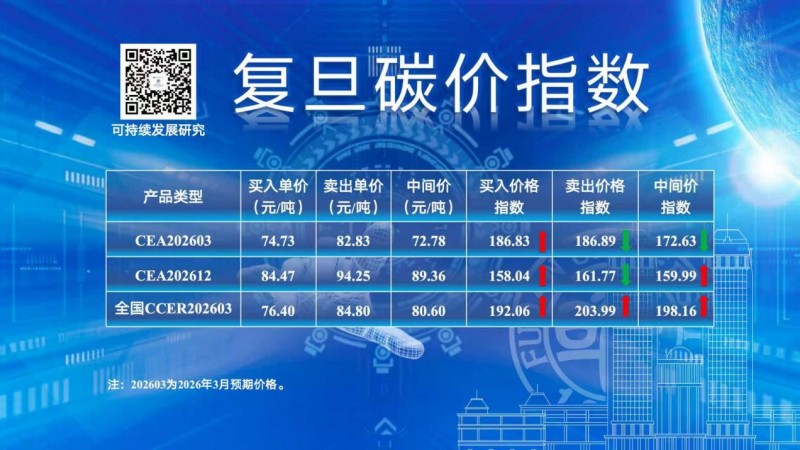
Core Insights - The Fudan University Sustainable Development Research Center released the carbon price indices for March 2026, including the national carbon emission allowance (CEA) price index, the national CCER price index, and the Chinese Green Electricity Certificate (GEC) price index [1] CEA and CCER Price Indices - The expected buy price for the national carbon emission allowance (CEA) in March 2026 is 74.73 CNY/ton, with a sell price of 82.83 CNY/ton, and a midpoint price of 72.78 CNY/ton. The buy price index increased by 3.12%, while the sell price index decreased by 1.03%, and the midpoint price index fell by 6.80% [2][3] - For December 2026, the expected buy price for CEA is 84.47 CNY/ton, with a sell price of 94.25 CNY/ton, and a midpoint price of 89.36 CNY/ton. The buy price index is 158.04, and the sell price index is 161.77, with a midpoint price index of 159.99 [2][3] - The expected buy price for the national certified voluntary emission reduction (CCER) in March 2026 is 76.40 CNY/ton, with a sell price of 84.80 CNY/ton, and a midpoint price of 80.60 CNY/ton. The buy price index rose by 6.41%, the sell price index increased by 1.19%, and the midpoint price index grew by 3.60% [2][3] GEC Price Indices - The expected prices for the three types of domestic green certificates (GEC) for 2025 production are as follows: centralized project price is 7.32 CNY/certificate (index 133.09), distributed project price is 7.15 CNY/certificate (index 145.07), and biomass power generation price is 6.85 CNY/certificate (index 132.75) [4][5] - The price trends for the three types of green certificates show divergence, with the distributed project certificates continuing to rise by 1.4%, while centralized and biomass project certificates experienced a decline [4] Carbon Market Overview - In February, the national carbon market exhibited a stable price with reduced trading volume. The average closing price for CEA was 79.57 CNY/ton, up approximately 2.33% from January's average of 77.76 CNY/ton. The market showed high-level fluctuations, with prices ranging between 76 and 81 CNY/ton [6] - The average daily trading volume for carbon allowances in February was 24.57 million tons, a significant decrease of about 55% compared to January's 54.68 million tons. Despite the overall reduction in trading volume, there were days with higher trading volumes, indicating ongoing adjustments by companies [6] Global Carbon Market Trends - The global carbon market in February showed a general decline in trading volumes, with the EU carbon market experiencing a 37.15% increase in daily trading volume, while the UK and Korea markets saw declines of 25.74% and 3.65%, respectively [7] - Price trends varied across carbon markets, with the EU market's price dropping from 96.66 USD/ton to 82.25 USD/ton (a cumulative decrease of 14.91%), while the Korean market saw an increase from 8.47 USD/ton to 8.89 USD/ton (a cumulative increase of 4.98%) [8]

碳配额价格同比降幅明显:碳排放月报-20260130
Bao Cheng Qi Huo· 2026-01-30 01:38
1. Report Industry Investment Rating - No information provided in the report. 2. Core Viewpoints of the Report - As of January 26, 2026, the closing price of the national carbon market's carbon emission allowances (CEA) was 81.79 yuan/ton, up 12.69% from the same period last month and down 12.46% from the same period last year. The average trading volume of national carbon emission allowances in the past 30 trading days was 145.2 million tons, a month-on-month decrease of 64.7 million tons, indicating a decline in the activity of the carbon emission spot market [1][55]. - As of January 27, 2026, the quotation of 5500K coal at Qinhuangdao Port was 686 yuan/ton, 10 yuan/ton higher than the end of last month and 77 yuan/ton lower than the end of 2024. During the peak winter period, the supply and demand of thermal coal are strong, but the market expects long - term looseness. Downstream users are still cautious in purchasing. It is expected that the thermal coal price will remain in a narrow range in February, and may weaken after the Spring Festival [1][55]. 3. Summary According to the Directory 3.1 Industry News - In 2025, the national carbon market operated smoothly and orderly, with steadily increasing market vitality. The carbon - reduction awareness of key emission units in the carbon emission trading market continued to strengthen, and the quota settlement completion rate remained at a high level. The support area of the voluntary greenhouse gas emission - reduction trading market was further expanded, and the market expanded rapidly. The total number of key emission units under quota management was 3378, including 2087 in the power generation industry, 232 in the steel industry, 962 in the cement industry, and 97 in the aluminum smelting industry. The market operated for 243 trading days. The cumulative trading volume of carbon emission allowances in 2025 was 235 million tons, a year - on - year increase of about 24%, and the trading volume was 14.63 billion yuan. The trading price remained in a reasonable range [7]. - In 2026, the National Development and Reform Commission will fully implement the dual control of carbon emission总量 and intensity. It will strengthen work measures in energy transformation, industrial upgrading, comprehensive conservation, and scientific assessment. It will develop non - fossil energy, build a new power system, promote industrial upgrading, implement a comprehensive conservation strategy, and establish a scientific assessment system [10][11][12]. - In 2025, the Ministry of Ecology and Environment carried out climate change response actions, promoted the coordinated progress of pollution reduction and carbon reduction, and accelerated the green and low - carbon transformation. In 2026, it will actively respond to climate change, strengthen ecological environment law enforcement supervision, and improve the adaptability to climate change [13][15][16]. 3.2 National Carbon Market Carbon Emission Allowances (CEA) - As of January 26, 2026, the closing price of CEA was 81.79 yuan/ton, up 12.69% from the same period last month and down 12.46% from the same period last year. In the past 30 trading days, the average trading volume was 141.3 million tons, a month - on - month decrease of 67.4 million tons, indicating a decline in market activity [17]. 3.3 Carbon Price Influence Factor Analysis 3.3.1 Energy Price - There is a certain correlation between the carbon emission market and the energy market. When energy demand is strong and energy prices rise, the demand for carbon emission allowances also increases, and a stronger carbon price promotes corporate low - carbon emission reduction. As of January 27, 2026, the port prices of thermal coal at different calorific values and the pit - mouth prices in some regions have changed compared to the end of last month and the end of 2024. The coke price has decreased, and the natural gas price has increased [20][21][22]. 3.3.2 Energy Consumption - From January to November 2025, the cumulative apparent consumption of natural gas nationwide was 388 billion cubic meters, 570 million cubic meters less than the same period last year; the cumulative apparent consumption of coke was 454.5211 million tons, 15.4757 million tons less than the same period last year; from January to December 2025, the total apparent consumption of gasoline, kerosene, and diesel was 376.7113 million tons, 6.2874 million tons less than the same period last year [2][32][56]. 3.3.3 Domestic Carbon Emission Structure - China's total carbon emissions exceed 10 billion tons, accounting for about one - third of global carbon emissions. In 2021, the largest carbon - emitting industry was the "production and supply of electricity, steam, and hot water" with 5.253 billion tons, accounting for 50.72%. By energy type, coal - related energy consumption was the main source of carbon emissions in 2021, accounting for 67.2% of the total [38][40][45]. 3.3.4 Total Social Electricity Consumption - In 2025, the total social electricity consumption was 10.3682 trillion kWh, a year - on - year increase of 5.0%. The electricity consumption of the third industry and urban and rural residents' living contributed 50% to the growth of electricity consumption. The slowdown in the electricity consumption growth rate of the secondary industry was in line with China's economic structural transformation [47]. 3.3.5 Power Generation Structure - In December 2025, the power generation of above - scale industrial enterprises was 858.6 billion kWh, a year - on - year increase of 0.1%. The proportion of clean energy power generation in December was 32.3%, 2.9 percentage points higher than the same period last year. In 2025, the thermal power generation of above - scale industrial enterprises had a year - on - year negative growth for the first time since 2014, indicating a turning point in the power industry's development model and accelerating the low - carbon transformation of the power system [52][53]. 3.4 Conclusion - The situation of the national carbon market CEA price and trading volume is the same as the core viewpoints. The energy price, energy consumption, and power - related data are also consistent with the previous analysis [55][56][57].
“十四五”期间,我国建成全球规模最大清洁电力供应体系
中国能源报· 2026-01-28 10:53
Core Viewpoint - During the "14th Five-Year Plan" period, China has established the world's largest clean electricity supply system and clean steel production system, along with the largest carbon emission trading market globally [1][3]. Group 1 - China has achieved a penetration rate of over 50% for new energy vehicles during the "14th Five-Year Plan" period [3]. - The clean transportation ratio in key regions and industries has reached 78% [3]. - By the end of 2025, the cumulative transaction volume of carbon emission quotas is expected to reach 865 million tons, with a transaction value of 57.663 billion yuan [3]. Group 2 - A national voluntary greenhouse gas emission reduction trading market has been initiated [3]. - The country is leading the establishment of a product carbon footprint management system [3]. - The implementation of the "National Climate Change Adaptation Strategy 2035" has been issued to continuously enhance climate resilience in key areas and sectors [3].
2025年全国碳市场累计成交额超570亿元
Ke Ji Ri Bao· 2026-01-14 00:30
Group 1 - The national carbon market in China has seen a cumulative trading volume of 865 million tons and a total transaction value of 57.663 billion yuan as of December 31, 2025 [1] - The number of key emission units included in the national carbon market is 3,378, with the power generation sector having the highest representation at 2,087 units [1] - The trading volume for 2025 is projected to reach 235 million tons, representing a year-on-year increase of approximately 24%, with a transaction value of 14.63 billion yuan [1] Group 2 - The development and release of methodologies for voluntary greenhouse gas reduction projects are accelerating, with 12 methodologies published, including oilfield gas recovery and salt marsh vegetation restoration [2] - As of December 31, 2025, there are 33 registered voluntary reduction projects with a total reduction volume of 17.7637 million tons [2] - The cumulative transaction volume of certified voluntary reduction amounts is 9.2194 million tons, with a transaction value of 650 million yuan [2]
德国碳排放交易收入创历史新高
Shang Wu Bu Wang Zhan· 2026-01-09 09:59
Core Insights - Germany's carbon trading revenue is expected to exceed €21.4 billion in 2025, marking a historical high [1] - All funds generated will be allocated to the Climate and Transformation Fund to support energy transition efforts [1] - Since the initiation of carbon trading in 2008, Germany's total revenue from this scheme has surpassed €100 billion [1] Emission Reduction Trends - The pace of greenhouse gas emissions reduction in Germany is slowing down [1] - In 2025, Germany's emissions are projected to be 640 million tons of CO2 equivalent, which represents a 49% decrease compared to 1990 levels [1] - However, the year-on-year reduction rate is only 1.5% [1]
生态环境部副部长李高:到2027年中国碳市场将基本覆盖工业领域主要排放行业
Xin Lang Cai Jing· 2025-12-15 03:08
Core Viewpoint - The Chinese carbon market is entering a new phase of rapid development, becoming a crucial mechanism for achieving carbon peak and carbon neutrality goals, with plans for comprehensive coverage of major industrial sectors by 2027 [1][6]. Group 1: Carbon Market Development - By 2027, the national carbon emission trading market is expected to cover major emission sectors, while the voluntary greenhouse gas reduction trading market aims for full coverage in key areas [1][5]. - The carbon market has been established as an important policy tool for addressing climate change and promoting a green transition in economic and social development [1][6]. - As of March this year, the carbon emission trading market has expanded to include four industries: power generation, steel, cement, and aluminum smelting, covering over 3,500 key emission units and managing more than 60% of national carbon emissions [2][6]. Group 2: Data Quality and Market Functionality - Data quality is emphasized as critical for the carbon market, with a long-term mechanism for data quality management established to enhance corporate carbon emission accounting capabilities [2][6]. - The carbon market is seen as injecting new momentum into the development of green and low-carbon industries, creating new market opportunities [2][6]. - There is a growing awareness in society regarding the costs of carbon emissions and the benefits of carbon reduction, highlighting the market's role in this shift [2][6]. Group 3: Future Plans and International Cooperation - During the 14th Five-Year Plan period, efforts will be made to accelerate the construction of the national carbon market and strengthen the connection with the dual control system for emissions [3][7]. - Plans include enriching the trading entities in the carbon market and enhancing market transaction supervision [3][7]. - The government aims to engage in international cooperation across multiple fields and channels to build a more effective and influential carbon market, contributing to global climate governance [3][7].
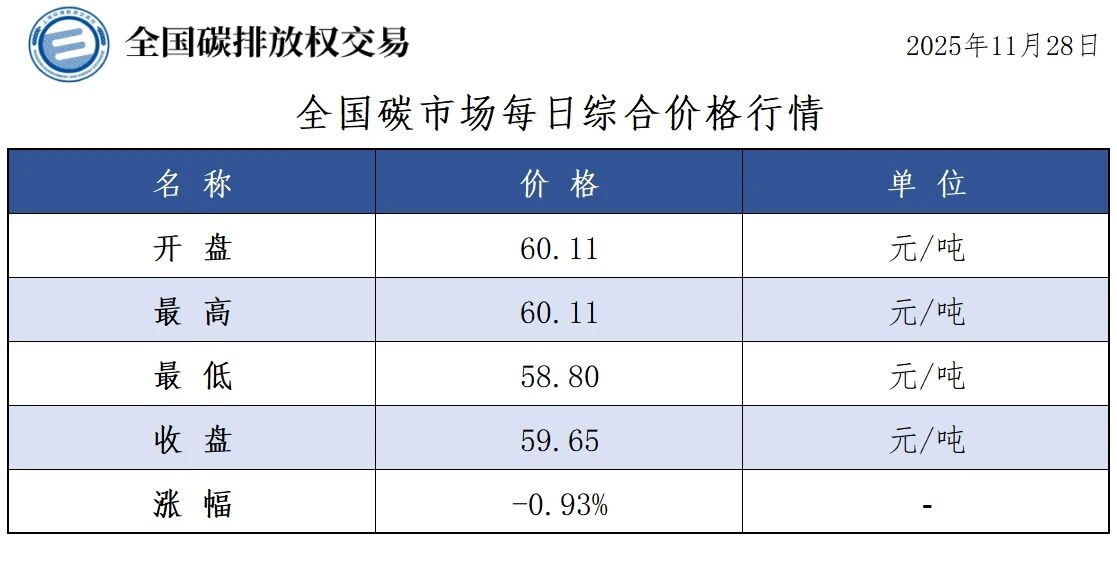
11月28日全国碳市场收盘价59.65元/吨 较前一日下跌0.93%
Xin Hua Cai Jing· 2025-11-28 08:49
Core Insights - The national carbon market's comprehensive price on November 28 was 59.65 yuan/ton, reflecting a decrease of 0.93% from the previous day [1][3] - The total transaction volume for carbon emission allowances today was 2,183,525 tons, with a total transaction value of approximately 131.1 million yuan [1][6] - Cumulative transaction volume from January 1 to November 28, 2025, reached 187,414,557 tons, with a total value of approximately 11.54 billion yuan [7][11] - As of November 28, 2025, the cumulative transaction volume in the national carbon market was 817,683,221 tons, with a total value of approximately 54.58 billion yuan [8][11] Daily Trading Summary - Today's opening price was 60.11 yuan/ton, with a highest price of 60.11 yuan/ton and a lowest price of 58.80 yuan/ton [1][3] - The trading volume for the day included 684,373 tons in the listed agreement trading and 1,499,152 tons in bulk agreement trading [1][5] - There were no single-direction auctions conducted today [1][5] Weekly Overview - The weekly comprehensive price range was between 65.42 yuan/ton (highest) and 58.80 yuan/ton (lowest), with a closing price drop of 8.61% compared to the previous Friday [4][10] - The total weekly transaction volume was 10,048,199 tons, with a total transaction value of approximately 585.29 million yuan [6][11] Monthly Performance - The monthly comprehensive price range recorded a highest price of 70.14 yuan/ton and a lowest price of 51.54 yuan/ton, with a closing price increase of 14.80% compared to the last trading day of the previous month [11][12] - The total monthly transaction volume was 47,753,225 tons, with a total transaction value of approximately 2.76 billion yuan [11][12]