
数码

Search documents
关于印发《内蒙古自治区家电以旧换新、数码和智能产品购新补贴实施细则》的通知
Xin Lang Cai Jing· 2026-01-29 12:12
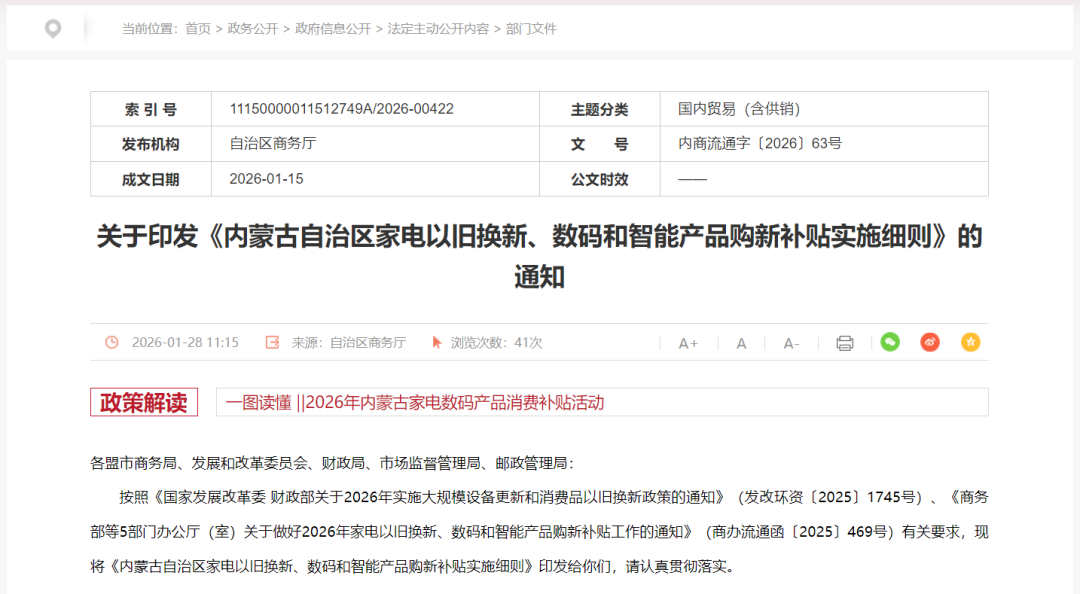
关于印发《内蒙古自治区家电以旧换新、数码和智能产品购新补贴实施细则》的通知 (来源:乌兰察布财政) | 索 | 11150000011512749A/2026-00422 | 主题分类 | 国内贸易(含供销) | | --- | --- | --- | --- | | 发布机构 | 自治区商务厅 | 文 号 | 内商流通字〔2026〕63号 | | 成文日期 | 2026-01-15 | 公文时效 | | 内商流通字〔2026〕63号 各盟市商务局、发展和改革委员会、财政局、市场监督管理局、邮政管理局: 按照《国家发展改革委 财政部关于2026年实施大规模设备更新和消费品以旧换新政策的通知》(发改环资〔2025〕1745号)、《商务部等5部门办公厅 (室)关于做好2026年家电以旧换新、数码和智能产品购新补贴工作的通知》(商办流通函〔2025〕469号)有关要求,现将《内蒙古自治区家电以旧换 新、数码和智能产品购新补贴实施细则》印发给你们,请认真贯彻落实。 内蒙古自治区商务厅 内蒙古自治区发展和改革委员会 内蒙古自治区财政厅 内蒙古自治区市场监督管理局 内蒙古自治区邮政管理局 2026年1月15日 内蒙古自治 ...

事关消费品以旧换新,扩大市场准入和开放领域……商务部最新发布
中汽协会数据· 2026-01-29 07:04
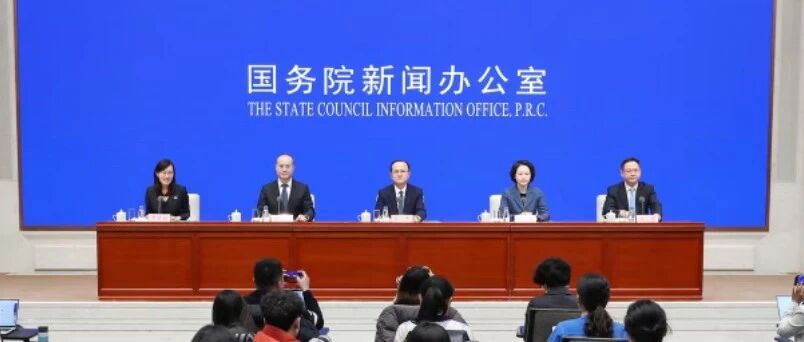
国务院新闻办公室于1月26日下午举行新闻发布会,商务部介绍2025年商务工作及运行情况,并答记者 问。一起关注—— 全年社会消费品零售总额首次突破50万亿元 全年社会消费品零售总额 首次突破50万亿元,达到50.1万亿元,增长3.7% ,消费对经济增长的贡献率 达到 52% ,提高了5个百分点。 优化实施消费品以旧换新,促进汽车、家电、数码和智能产品等大宗耐用商品消费。开展汽车流通消费 改革试点 ,进一步释放汽车消费潜力。开展好有奖发票试点工作。推动出台促进首发经济等一批务实 管用的政策举措。 加力培育服务消费新增长点 继续实施服务消费提质惠民行动,会同相关部门 推动提升文化娱乐、旅游休闲、餐饮住宿、体育赛 事、医疗健康等领域的供给水平 。 把握消费升级的趋势, 加力培育交通服务、家政服务、网络视听服务、旅居服务、汽车后市场服务、 入境消费等服务消费新的增长点 ,完善支持政策,推进先行先试,培育优质品牌,激发相关领域发展 活力,更好满足人民群众服务消费新需求。 以旧换新相关产品销售额2.61万亿元 扩围提质实施消费品以旧换新,汽车、家电、手机等相关产品销售额 2.61万亿元 ,惠及 3.66亿人次 。 限额以 ...
如何提高“以旧换新”受益人口覆盖率
李迅雷金融与投资· 2026-01-29 03:30
Core Viewpoint - The "old-for-new" policy for consumer goods, implemented from 2024 to 2025, is supported by a total of 450 billion yuan in long-term special government bond funds, with subsidies reaching over 480 million consumers. This policy is expected to drive sales exceeding 2.6 trillion yuan and contribute 0.6 percentage points to the growth of retail sales of consumer goods. However, the policy's multiplier effect appears to be less than expected, with a declining number of beneficiaries in the latter half of 2025 [1][2][29]. Group 1: Policy Implementation and Financial Support - The "old-for-new" policy has undergone a process of "introduction - strengthening - expansion," with the State Council allocating approximately 150 billion yuan in long-term special government bonds in July 2024 and 300 billion yuan in 2025 to support the initiative [2]. - The number of product categories eligible for subsidies increased from 8 to 12, including new subsidies for digital products like smartphones [2]. Group 2: Sales Impact and Trends - Retail sales growth for five major categories related to the "old-for-new" policy showed an initial acceleration followed by a decline, with significant growth in communication equipment and cultural office supplies, while home appliances and furniture saw negative monthly growth rates [4][14]. - The first full year after the policy's implementation saw a 10% increase in sales for related categories, significantly higher than the 3% growth in the year prior [8][11]. Group 3: Effectiveness and Challenges - The initial impact of the policy was strong, but the growth in retail sales is expected to weaken in the second year due to the nature of durable goods, where consumers may not replace items frequently [15]. - The expansion of eligible products is expected to support continued retail sales growth, particularly in categories like communication equipment and cultural office supplies [20]. Group 4: Automotive Sector Insights - The "old-for-new" subsidy for automobiles has had a limited effect on retail sales, as high vehicle prices and macroeconomic factors significantly influence consumer behavior [24]. - Despite a substantial number of vehicles benefiting from the subsidy, the overall impact on automotive retail sales remains modest compared to other categories [24]. Group 5: Environmental and Safety Benefits - The policy promotes green production and living practices, with significant energy savings and carbon emission reductions achieved through the promotion of low-carbon products and improved recycling systems [27]. - The initiative has also enhanced product safety, with a notable increase in the number of compliant electric bicycles being replaced [27]. Group 6: Future Considerations and Adjustments - The 2026 policy adjustments aim to increase the beneficiary population and improve subsidy effectiveness, including expanding the range of eligible products and standardizing subsidy amounts [28][29]. - There is a need to consider lowering the average price of subsidized products to enhance purchasing willingness among lower-income groups and to shift the focus of the policy towards job creation and income stability [30].
江苏优化实施消费品以旧换新,2026将是中国内需攻坚之年
Huan Qiu Wang· 2026-01-28 00:57
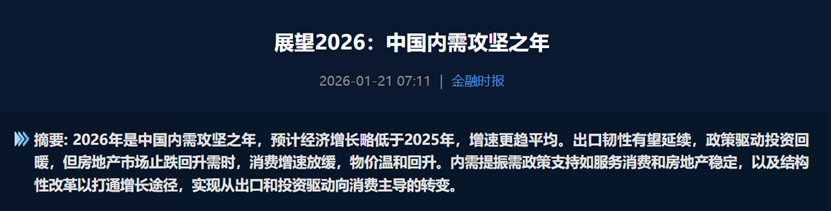
Group 1 - The core viewpoint of the articles highlights Jiangsu Province's initiative to promote large-scale equipment updates and optimize the implementation of the "old for new" consumption policy by 2026, including subsidies for various consumer goods [1][3] - The central economic work conference in December 2025 emphasized the importance of releasing potential and improving efficiency rather than increasing stimulus measures, indicating a cautious approach to economic growth in 2026 [1] - The retail sales of social consumer goods are projected to grow by 3% in 2026, lower than the 3.7% growth in 2025, due to high base effects, reduced subsidy scales, and pressures on income growth [3] Group 2 - The "old for new" policy is expected to significantly influence retail sales, with a doubling of subsidy scale compared to the previous year, although the actual impact may not meet expectations [3] - Service retail sales showed a positive trend with a year-on-year growth of 5.5%, indicating a recovery in this sector, while goods consumption faces challenges [3] - Recommendations include increasing counter-cyclical policies, particularly fiscal measures to support service consumption and stabilize the real estate market, aiming to shift the economic development model from export and investment-driven to consumption-led growth [3]
出政策办活动优场景,促消费今年继续加力
Ren Min Ri Bao· 2026-01-27 09:01
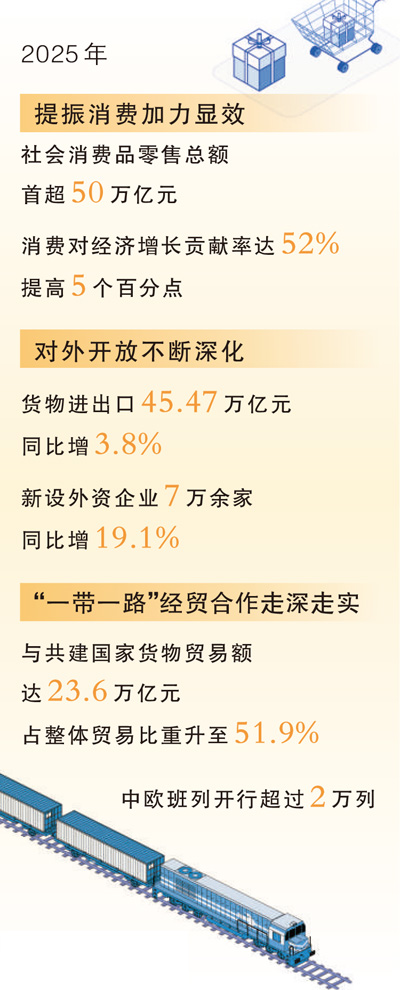
Core Insights - In 2025, China's total retail sales of consumer goods exceeded 50 trillion yuan for the first time, reaching 50.1 trillion yuan, with a year-on-year growth of 3.7% and a contribution rate to economic growth increasing by 5 percentage points to 52% [3][4] - The foreign trade maintained resilience, with total imports and exports reaching 45.47 trillion yuan, a year-on-year increase of 3.8%, and the number of newly established foreign-funded enterprises exceeding 70,000, up 19.1% [5][6] Economic Performance - The retail sales of consumer goods surpassed 50 trillion yuan, driven by policies and activities aimed at boosting consumption, with significant growth in both goods and service consumption [3][4] - The service retail sector saw a year-on-year growth of 5.5%, with specific services like cultural entertainment and tourism experiencing double-digit growth [3][4] Foreign Trade and Investment - The total value of goods traded with Belt and Road Initiative countries reached 23.6 trillion yuan, growing by 6.3%, which is 2.5 percentage points faster than overall trade growth [8] - The number of active trading entities exceeded 780,000, with private enterprises accounting for 57.3% of total foreign trade [5][6] Policy Initiatives - The Ministry of Commerce plans to enhance consumer support through policies, activities, and improved consumption environments, including trials for automobile circulation reforms and international consumption environment construction [4][5] - The government aims to attract foreign investment by optimizing support policies and ensuring equal participation of foreign enterprises in domestic consumption and procurement activities [6][7] International Cooperation - China signed 24 free trade agreements with 31 countries and regions, covering 45% of total goods trade, and actively participated in global trade discussions [8][10] - The "Belt and Road" initiative continues to deepen economic cooperation, with significant investments in infrastructure and trade facilitation projects [8][10]
出政策办活动优场景,促消费今年继续加力(权威发布)
Sou Hu Cai Jing· 2026-01-27 04:19
Group 1 - The core message of the news is the introduction of measures to boost consumption and expand two-way investment in 2026, following a stable performance in 2025, with a focus on enhancing the supply levels in various sectors such as culture, entertainment, tourism, and healthcare [4][5][6] - In 2025, the total retail sales of consumer goods reached 50.1 trillion yuan, marking a 3.7% year-on-year increase, with consumption contributing 52% to economic growth, an increase of 5 percentage points [4][5] - The service retail sector saw a year-on-year growth of 5.5%, with significant increases in cultural, recreational, and travel services, indicating a strong recovery in service consumption [5][6] Group 2 - The foreign trade sector demonstrated resilience, with total imports and exports reaching 45.47 trillion yuan, a 3.8% increase year-on-year, and the number of active trading entities exceeding 780,000 [6][7] - In 2025, over 70,000 new foreign-funded enterprises were established, with foreign investment amounting to 747.69 billion yuan, of which 32.3% was in high-tech industries [6][8] - The Belt and Road Initiative saw trade with partner countries reach 23.6 trillion yuan, a 6.3% increase, contributing to 51.9% of total trade, highlighting the expanding cooperation in various sectors [9][10]

今年如何进一步促消费?将围绕这3个方面开展→
Sou Hu Cai Jing· 2026-01-27 03:10
Core Viewpoint - The Chinese government aims to enhance consumer spending, targeting a 5 percentage point increase in the contribution of consumption to economic growth by 2025, with a retail sales target of 50.1 trillion yuan, reflecting a 3.7% year-on-year growth [7][8]. Group 1: Policy Initiatives - The Ministry of Commerce plans to implement a dual approach of "policy + activities" to stimulate consumption, focusing on enhancing supply in cultural, entertainment, tourism, and healthcare sectors [7][9]. - Specific policies include optimizing the "trade-in" program for consumer goods and promoting automotive consumption through pilot reforms [9][10]. Group 2: Consumption Activities - Over 20 "Buy in China" themed events will be organized, alongside city-specific activities to create a vibrant consumption atmosphere [9][10]. - The service sector is expected to see a 5.5% increase in retail sales, with significant growth in leisure, tourism, and transportation services [7][9]. Group 3: International Trade and Investment - In 2025, China's total goods import and export reached 45.47 trillion yuan, a 3.8% increase, with over 780,000 active trading entities [10][11]. - The government aims to attract foreign investment by expanding market access and supporting foreign enterprises in various economic activities [11][12]. Group 4: Global Economic Engagement - China has signed 24 free trade agreements with 31 countries, covering 45% of its total goods trade, and is actively participating in global economic cooperation initiatives [12][14]. - The "Belt and Road" initiative has led to a 6.3% increase in trade with partner countries, highlighting China's commitment to international collaboration [12][13].
商务部:进一步释放汽车消费潜力 推进有奖发票试点
Zhong Guo Jing Ying Bao· 2026-01-27 00:45
Core Viewpoint - In 2025, consumption continues to play a crucial role as the "main engine" of economic growth in China, with the total retail sales of consumer goods surpassing 50 trillion yuan for the first time, reaching 50.1 trillion yuan, and contributing 52% to GDP growth [1][2]. Group 1: Consumption Market Highlights - Durable goods consumption is experiencing rapid growth, driven by the old-for-new policy, with retail sales of household appliances, communication devices, and furniture increasing by 11%, 20.9%, and 14.6% respectively; passenger car retail volume rose by 3.8% [2]. - New types of consumption are thriving, with digital, green, and health consumption gaining momentum, and new business formats and models emerging; online retail sales of physical goods grew by 5.2%, and the market penetration rate of new energy passenger vehicles reached 53.9% [2]. - Rural consumption is becoming more active, with retail sales of consumer goods in rural areas reaching 6.8 trillion yuan, a year-on-year increase of 4.1%, outpacing urban growth by 0.5 percentage points [2]. - Inbound consumption is on the rise, with the expansion of visa-free countries and the optimization of tax refund policies; sales of tax refund goods nearly doubled, and the number of visa-free foreign visitors increased by nearly 30% within a year of implementing the 240-hour visa-free transit policy [2]. Group 2: Policy and Activity Initiatives - In 2026, there will be an emphasis on enhancing consumer welfare, optimizing the old-for-new policy for durable goods, and promoting automotive consumption through pilot reforms; a trial for prize invoices will be initiated, and practical policies to stimulate the economy will be introduced [3]. - The focus for 2026 will be on three themes: product consumption, service consumption, and consumption scenarios, with over 20 "Buy in China" themed activities planned, and support for local "station" activities to create a vibrant consumption atmosphere [3]. - Efforts will be made to improve the consumption environment, accelerate the cultivation of international consumption center cities, and promote pilot projects for new consumption formats and scenarios, aiming to create attractive new consumption experiences for both domestic and international consumers [3].
商务部:进一步释放汽车消费潜力,推进有奖发票试点
Zhong Guo Jing Ying Bao· 2026-01-27 00:16
Core Viewpoint - In 2025, consumption continues to solidify its role as the "main engine" of economic growth in China, with the total retail sales of consumer goods surpassing 50 trillion yuan for the first time, reaching 50.1 trillion yuan, and contributing 52% to GDP growth [2][3]. Group 1: Consumption Market Highlights - The retail sales of durable goods are experiencing rapid growth, driven by the old-for-new consumption policy, with retail sales of home appliances, communication equipment, and furniture increasing by 11%, 20.9%, and 14.6% respectively; passenger car retail volume increased by 3.8% [2]. - New types of consumption are thriving, with digital, green, and health consumption gaining momentum, and new business formats and models emerging; online retail sales of physical goods grew by 5.2%, and the market penetration rate of new energy passenger vehicles reached 53.9% [2]. - Rural consumption is showing active performance, with retail sales of consumer goods in rural areas reaching 6.8 trillion yuan, a year-on-year increase of 4.1%, outpacing urban growth by 0.5 percentage points [3]. - Inbound consumption is on the rise, with the expansion of visa-free countries and the optimization of tax refund policies for outbound tourists; sales of goods eligible for tax refunds nearly doubled, and the number of visa-free foreign visitors increased by nearly 30% within a year of implementing the 240-hour visa-free transit policy [3]. Group 2: Policy and Action Plans for 2026 - The government will enhance support for consumer welfare, optimizing the implementation of the old-for-new consumption policy to promote durable goods consumption, and will conduct pilot reforms in automotive circulation to further unleash automotive consumption potential [4]. - In 2026, over 20 "Buy in China" themed activities will be organized, focusing on product consumption, service consumption, and consumption scenarios, with 15 international consumption environment pilot cities hosting "city-specific" events [4]. - Efforts will be made to improve the consumption environment, accelerate the cultivation of international consumption center cities, and promote pilot projects for new consumption formats, models, and scenarios to create attractive new consumption experiences for domestic and international consumers [4].
今年将优化实施消费品以旧换新 全力稳住外贸基本盘
Xin Lang Cai Jing· 2026-01-26 22:42
Core Viewpoint - The Ministry of Commerce of China is committed to implementing the decisions of the Central Committee and the State Council, focusing on high-quality business development to contribute positively to the economic recovery by 2025 [1][5]. Group 1: Domestic Circulation and Consumption Promotion - The Ministry will enhance domestic circulation, facilitate both domestic and international circulation, and expand international circulation to promote high-quality business development [1][5]. - To boost consumption in 2026, the Ministry will focus on three areas: policy issuance, event organization, and scenario optimization [2][5]. - Specific policies will include promoting the replacement of old consumer goods, reforming automobile circulation, and implementing reward invoice trials to stimulate consumption [2][5]. Group 2: Consumption Environment and Activities - The Ministry plans to organize over 20 "Buy in China" themed events and support local activities to create a vibrant consumption atmosphere [2][6]. - Efforts will be made to improve the consumption environment by accelerating the development of international consumption center cities and creating new consumption scenarios [6]. Group 3: Foreign Trade and Investment - The Ministry acknowledges the complex external environment affecting foreign trade, emphasizing the resilience and potential of the Chinese economy [6][7]. - In 2026, the Ministry aims to stabilize foreign trade and promote service market openness, including improving the management of cross-border service trade [6][7]. - The Ministry will also enhance policies to attract foreign investment, ensuring equal support for foreign enterprises participating in various economic activities [7].