智能穿戴

Search documents
2025年北交所市场的机构调研热情迎来大提升 机器人、低空经济、6G等受关注
Zheng Quan Shi Bao Wang· 2025-12-09 23:36
人民财讯12月10日电,2025年,北交所市场的机构调研热情迎来大提升。截至目前,272家北交所公司 接受各类机构调研,覆盖比例超95%,一致魔芋以21次的高频调研成为"明星标的"。调研主体从基金、 券商,扩大到社保基金、知名私募、产业资本以及外资机构。从今年的调研标的来看,机器人、低空经 济、6G、量子科技、AI眼镜等"三新"公司成为机构调研的"香饽饽"。 ...

谷歌将于2026年推出首款AI眼镜,与Meta展开正面竞争
Huan Qiu Wang Zi Xun· 2025-12-09 03:55
Core Insights - Google plans to launch its first AI glasses in 2026, intensifying competition with Meta in the wearable AI device market [1][3] Group 1: Product Development - Google will release two types of AI glasses: an initial version focusing on audio interaction with its Gemini AI assistant, and a more advanced model featuring a display for navigation and real-time translation [3] - The AI glasses will be built on Google's Android XR operating system designed for head-mounted devices [3] Group 2: Strategic Partnerships - Google has partnered with Warby Parker to co-develop the first AI glasses, expected to be launched in 2026 [3] - Collaborations with Samsung for hardware design and a $150 million investment in fashion eyewear brand Gentle Monster further strengthen Google's position in the smart wearable ecosystem [3] Group 3: Market Context - This initiative is a direct response to Meta's rapid expansion in the AI glasses sector, which has seen success with its AI glasses developed in collaboration with Ray-Ban and EssilorLuxottica [3] - Meta's recent product release in September includes a new generation of AI glasses with display capabilities for message previews, photo viewing, and real-time subtitles [3] Group 4: Lessons Learned - Google co-founder Sergey Brin noted that the company has learned from past failures in smart glasses, emphasizing the importance of mature AI technology and efficient supply chain integration [4] - The new generation of AI glasses is expected to provide practical value without distracting users [4] Group 5: Software Updates - Google announced several software updates for the Galaxy XR head-mounted device, including features for connecting to Windows PCs and a "travel mode" for use in airplanes and cars [4]



DPVR大朋AI眼镜斩获金陀螺奖 国产芯片量产引领行业升级
Cai Fu Zai Xian· 2025-12-09 03:38
Core Insights - DPVR's "Dapeng AI Glasses" won the "Annual Excellent AI Shooting Glasses" award at the "2025 Future Business Ecosystem Link Conference and the 10th Golden Gourd Award" for its product strength of being "good-looking, comfortable to wear, and practical" [1] Group 1: Product Features - The Dapeng AI Glasses have achieved mass production based on the Unisoc domestic chip, marking them as one of the first AI glasses brands to complete the entire "R&D - mass production - delivery" closed-loop process [3] - The glasses emphasize lightweight design and imaging capabilities, with a significant increase in demand for "aesthetic and performance" products, as evidenced by a 25-fold year-on-year increase in sales during the 2025 Double 11 shopping festival [4] - The glasses feature a classic sunglasses design with lightweight materials for the frame, ensuring comfort for long-term wear, and achieving industry-leading lightweight standards [4] Group 2: Performance and Pricing - The Dapeng AI Glasses are equipped with a Sony IMX681 sensor, supporting 4K/1080P dual-mode first-person shooting, and include dual anti-shake technology to address image distortion and shaking issues [6] - An AI assistant named Sunny is built-in, allowing for voice control, scene capture, and image generation, which lowers the usage threshold [6] - The glasses are priced starting at 1189 yuan, breaking down the price barrier for high-end devices [6] Group 3: Industry Impact - The mass production of domestic chips by Unisoc represents a significant breakthrough, offering low power consumption and high stability, and DPVR is the first brand to launch products based on this chip [7] - This achievement validates the industry-level reliability of domestic AI chips and promotes the upgrade of the supply chain towards localization [7] - The award and mass production results signify that domestic AI lightweight wearables have entered a new stage of benchmark leadership and large-scale implementation [8] Group 4: Future Directions - DPVR will continue to deepen product iterations based on the core philosophy of "good-looking, comfortable to wear, and practical," leveraging its experience in VR and enterprise projects to accelerate collaborations in various sectors such as cultural tourism, retail, manufacturing, and security [10]

A股AI眼镜概念股集体走强,福蓉科技、齐心集团涨停
Ge Long Hui· 2025-12-09 02:50
Core Viewpoint - The A-share market saw a collective surge in AI glasses concept stocks, driven by the announcement of Google's collaboration with XREAL on the Project Aura smart glasses, set to launch in 2026 [1] Group 1: Market Performance - Stocks such as Furong Technology and Qixin Group hit the 10% daily limit up, while Star Technology rose over 7%, and Yintang Intelligent Control increased by over 6% [1] - Other notable performers included Ciweng Media, Pengding Holdings, which rose over 5%, and Pinming Technology, which increased by over 4% [1] - Haoyun Technology, Huilun Crystal, Sanan Optoelectronics, and Jucheng Co. all saw gains exceeding 3% [1] Group 2: Project Aura Details - Google and XREAL jointly launched the Project Aura smart glasses, utilizing the self-developed X1S chip by XREAL [1] - The hardware development and manufacturing of Project Aura are primarily reliant on a Chinese team, with the Prism™ optical system independently developed and mass-produced by this team [1] - The supply chain is rooted in the Yangtze River Delta, with Shanghai designated as XREAL's global R&D and future AI terminal innovation center [1]


Meta确认将部分投资“从元宇宙转向AI眼镜”
Sou Hu Cai Jing· 2025-12-06 14:28
Core Viewpoint - Meta has confirmed a shift in investment strategy, reallocating funds from its metaverse division, Reality Labs, to focus on AI glasses and wearable devices, amidst ongoing financial losses in the metaverse sector [1][3]. Group 1: Budget Adjustments - Meta's Reality Labs is facing a budget cut of up to 30%, primarily affecting VR and Horizon Worlds operations [3]. - The official statement from Meta indicates that the decision is driven by strong momentum in the AI glasses and wearable devices market, with no broader adjustment plans currently in place [3]. - The budget cuts are expected to impact funding for third-party studios developing content for Horizon Worlds, with potential layoffs as part of the adjustment [3]. Group 2: Financial Performance - Reality Labs has accumulated losses exceeding $60 billion since 2020, prompting the need for a strategic shift [3]. - Despite a record high quarterly revenue in Q4 2024 due to the launch of Quest 3S, sales of Quest devices saw a year-on-year decline in the first two quarters of 2025, with a temporary rebound attributed to retailers stocking up for the holiday season [4]. - Meta's investment in creator competitions for Horizon Worlds has not yielded significant results, as the platform struggles to compete with cross-platform giants like Roblox and Fortnite [4]. Group 3: Success in Smart Glasses - Sales of Meta's smart glasses have surged, with 2 million units sold as of February 2024, and a reported increase of over two times year-on-year by July 2025 [4][5]. - The company plans to increase annual production capacity for smart glasses to 10 million units by the end of 2026, with this target now expected to be met ahead of schedule due to strong sales contributions [5]. - The success in the smart glasses market, contrasted with stagnation in VR and metaverse platforms, is likely influencing Meta's decision to redirect funds to solidify its leadership position before competitors like Apple and Google enter the space [5].

李想承认错误,理想摸索新路
财富FORTUNE· 2025-12-06 13:04
Core Viewpoint - The article discusses the challenges faced by Li Auto in 2025, highlighting its transition from a profitable new energy vehicle company to a phase of declining sales and the introduction of new AI products as a potential growth avenue [2][5]. Financial Performance - Li Auto reported Q3 2025 revenue of 27.4 billion yuan, a year-on-year decrease of 36.2% [2] - Vehicle sales revenue was 25.9 billion yuan, down 37.4% year-on-year and 10.4% quarter-on-quarter [2] - The company incurred a net loss of 624.4 million yuan, contrasting with a net profit of 2.8 billion yuan in the same period last year [2] Market Dynamics - The demand for range-extended vehicles has declined, with their market share in the overall new energy vehicle wholesale structure dropping to 7.5% in October 2025 [3] - Increased competition in the range-extended vehicle segment is noted, with brands like XPeng and Buick launching their own models [3] Product Challenges - Li Auto's first pure electric model, the Li MEGA, faced a recall of 11,411 units due to a coolant defect, estimated to cost around 1.1 billion yuan [4] - The new electric SUVs, Li i8 and Li i6, have not stabilized in sales, with the i6 facing delivery delays due to sold-out production capacity for 2025 [4] Strategic Shift - CEO Li Xiang acknowledged the need to revert to a startup management model after three years of operating as a professional management organization [5] - The company aims to redefine itself as a "space robotics company" rather than just an automotive manufacturer, launching the AI smart glasses Livis as part of this vision [5] Future Outlook - The company anticipates that the true potential of AI glasses will emerge around 2027-2028, coinciding with advancements in autonomous driving technology [5] - The AI sector is still maturing, and the effectiveness of companies' strategies in this field remains to be validated over time [6]


李想造AI眼镜:未被暂停过的项目、从未公开的野心
2 1 Shi Ji Jing Ji Bao Dao· 2025-12-05 10:49
Core Viewpoint - Li Auto has officially launched its first AI eyewear product, Livis, priced at 1999 yuan, with a promotional price of 1699 yuan after subsidies. The company aims to target existing Li Auto users and tech enthusiasts, despite low initial sales expectations [1][2][9]. Product Launch and Features - Livis is claimed to be the lightest AI eyewear on the market, weighing only 36g, which is just 10g heavier than regular glasses [1]. - The product is a result of a strategic collaboration with Zeiss, focusing on integrating the AI assistant "Li Xiang" into users' daily lives through both a mobile app and the eyewear [3][12]. - The company has set a goal of acquiring at least 10,000 seed users for Livis, with a return rate lower than the industry average of 30-50% [8][9]. Market Context and Strategy - Li Auto has historically focused on refining a single vehicle model, but is now diversifying into AI eyewear amid declining sales, with monthly sales dropping from 50,000 to 30,000 units [2][10]. - The decision to enter the AI eyewear market comes after observing the success of Meta's Ray-Ban Meta glasses, indicating a strategic pivot to capitalize on emerging technology trends [3][6]. - Despite skepticism from investors and employees regarding the timing and focus of this new product, the company remains committed to its AI strategy, emphasizing user experience over immediate sales [5][10][12]. Development and Future Plans - The development of Livis has been a long-term project, with initial research dating back to 2020, and the first prototype completed in mid-2022 [14][15]. - Future iterations of the product are planned, including models with display capabilities, aiming to create a fully independent wearable device that does not require a smartphone [24][26]. - The company is focused on ensuring high-quality production standards, with plans for 100% inspection of each unit produced [24][27].
理想汽车发布AI眼镜Livis,可语音控车续航18.8小时
Zhong Guo Jing Ying Bao· 2025-12-05 04:47
Core Viewpoint - Li Auto has officially launched its first AI glasses, Livis, marking a significant expansion from the smart automotive sector into the smart wearable device market [1] Group 1: Product Features - Livis glasses weigh 36 grams and can operate continuously for 18.8 hours under typical usage scenarios [1] - The glasses are equipped with a 12-megapixel camera and features such as EIS electronic stabilization and automatic horizon correction [1] Group 2: Integration with Automotive Technology - Livis can execute voice commands through the "Li Xiang Classmate" system, allowing users to perform tasks like turning on the air conditioning and heating the steering wheel without needing to use their phones [1] Group 3: Strategic Vision - The Senior Vice President of Product at Li Auto, Fan Haoyu, stated that the company has been exploring smart device forms that can naturally and continuously accompany users, emphasizing that glasses are the most natural interaction entry point due to their long wear time [1]

A股AI眼镜概念股强势,可川科技涨停,博士眼镜涨超8%
Ge Long Hui· 2025-12-05 03:49
Core Viewpoint - The A-share market is witnessing strong performance in AI glasses concept stocks, driven by recent product launches and industry collaborations [1] Group 1: Market Performance - As of the half-day close, several AI glasses stocks have shown significant gains, with 可川科技 reaching the daily limit up, 中富通 increasing over 9%, 博士眼镜 up over 8%, 统联精密 up over 6%, 长盈精密 up over 5%, and both 联创电子 and 博杰股份 increasing over 4% [1] Group 2: Recent Developments - On December 3, 理想汽车 launched its first AI glasses, Livis, marking a significant entry into the market [1] - On November 27, 阿里巴巴's subsidiary launched the 夸克AI眼镜S1, further expanding the AI glasses product offerings [1] - 阿里巴巴 has formed the 夸克AI眼镜产业生态联盟 in collaboration with Qualcomm, 立讯精密, 博士眼镜, and 至格科技, indicating a strategic move to enhance the ecosystem around AI glasses [1]






赋能健康管理新范式,华为擎云入选新一代信息技术成果
Huan Qiu Wang Zi Xun· 2025-12-05 01:32
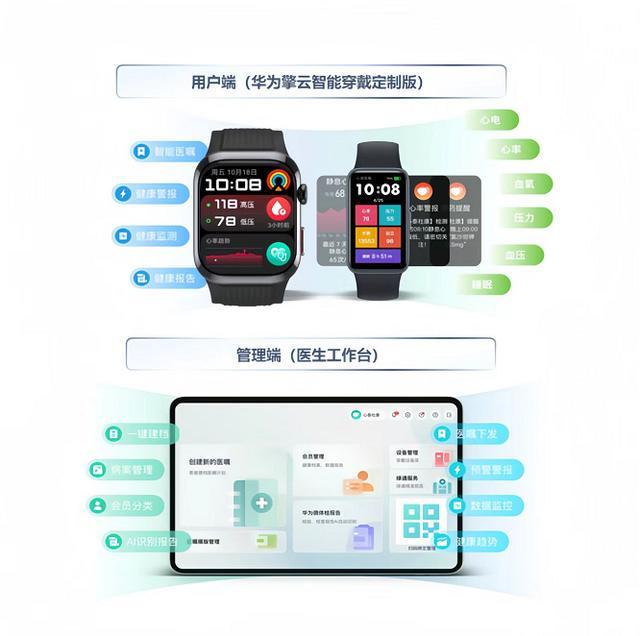
Core Viewpoint - The "China Search: Exploring the Future" forum aims to stimulate entrepreneurial innovation and promote the development of world-class enterprises, highlighting the importance of digital transformation in healthcare services to enhance public health levels [1]. Group 1: Digital Health Solutions - The Qingtian Smart Healthcare solution integrates AI algorithms, big data, and IoT technologies to create a comprehensive health management system covering prevention, monitoring, and intervention [1][3]. - The solution allows doctors to establish dynamic electronic health records and generate personalized health management plans based on real-time monitoring of vital signs such as heart rate and blood oxygen levels [3][4]. - The system includes a warning mechanism for abnormal indicators, enabling early detection and intervention through AI family doctor services [4]. Group 2: Implementation and Impact - The Qingtian Smart Healthcare solution has been implemented in over 100 public and private medical institutions across China, serving more than 20,000 users [4]. - The solution enhances the efficiency of grassroots medical services and patient compliance, alleviating the workload of primary care physicians while improving service quality and reputation [4]. - It establishes a three-tier health service system linking tertiary hospitals, communities, and families, making quality medical resources accessible to a broader population [4]. Group 3: Future Developments - Huawei Qingtian plans to deepen collaboration with partners in the healthcare sector, leveraging its innovative technology advantages to continuously improve AI algorithms and big data capabilities [5]. - The focus will be on standardizing and digitizing grassroots medical services, contributing to the creation of an interconnected intelligent health ecosystem [5].