石化

Search documents
荣盛石化:推进“三化”转型战略 回购与增持并举彰显发展信心
Zhong Zheng Wang· 2025-08-23 09:49
中证报中证网讯(王珞)8月22日晚间,国内石油化工民营龙头企业之一——荣盛石化(002493)发布 2025年半年度报告。报告期内,公司资产总额达3840.11亿元;实现营业总收入1486.29亿元,同比下降 7.83%;实现扣非净利润7.55亿元,同比增长12.28%。公司重点推进以国际化拓展、绿色化升级、数智 化赋能为核心的"三化"转型战略,在高质量发展的道路上迈出了坚实而有力的步伐。 战略转型持续推进 报告期内,荣盛石化一方面精耕细作,全力稳固现有核心产业的"基本盘",保障业绩稳健增长;另一方 面前瞻布局,积极开拓高端化工新材料等具有高附加值和发展潜力的"新赛道"。 国际合作方面,荣盛石化与全球能源巨头沙特阿美签署了具有战略意义的《谅解备忘录》及《合作框架 协议》,双方的战略合作逐步推进,为双方实现长期战略目标、提升全球竞争力奠定坚实基础。与此同 时,荣盛石化紧抓国内产业升级机遇,不断拓展业务领域,增强资源整合与市场影响力,为企业发展注 入新动力。 绿色升级方面,公司坚持创新驱动发展战略,在关键核心技术攻关上取得一系列突破性成果。例如,中 金石化自主研发的新型高性能歧化催化剂成功实现工业化应用,不仅大幅 ...

攻克“卡脖子”技术,我国规模最大石化产业基地新增项目建造完成
Sou Hu Cai Jing· 2025-08-23 09:33
Core Insights - The Daxie Petrochemical Refining and Chemical Integration Project in Ningbo has been fully completed, marking the addition of a new project to China's largest petrochemical industrial base, with total olefin production capacity exceeding 10 million tons [1] - The project involves 18 large-scale refining and chemical units, primarily producing high-end chemical products such as polypropylene, which are widely used in the new energy vehicle and electronics industries, with a total investment of 21 billion yuan [1] - The project has overcome several key technical challenges in the refining sector, establishing the largest heavy oil-to-olefins facility in the country, thus providing core technological support for the self-sufficiency of high-end chemical material supply chains in China [1][2] Investment and Production Capacity - The project is designed to process 12 million tons of crude oil annually, producing over 1 million tons of olefins and aromatics, utilizing domestically sourced medium and light crude oil supplemented by imported crude [1] - The core unit, a 3.2 million tons/year catalytic cracking facility, is the largest heavy oil-to-polymer-grade olefins equipment in the country, producing high-purity ethylene and propylene for various applications including mineral water bottles and high-end cables [2] - The olefin production capacity of Daxie Petrochemical is expected to reach 1.8 million tons per year, positioning it as the largest heavy oil-to-olefins base in China [2] Technological Advancements - The project employs innovative construction techniques that reduced the construction period by 90 days, setting a new record for the shortest installation time for large equipment in the country [1] - Daxie Petrochemical focuses on developing high-end strategic new materials, including recyclable cable materials and ultra-high molecular weight polyethylene, creating a complete innovation ecosystem from R&D to industrial application [2]
全面建成!关键工艺国产化率达100%
Sou Hu Cai Jing· 2025-08-23 05:39
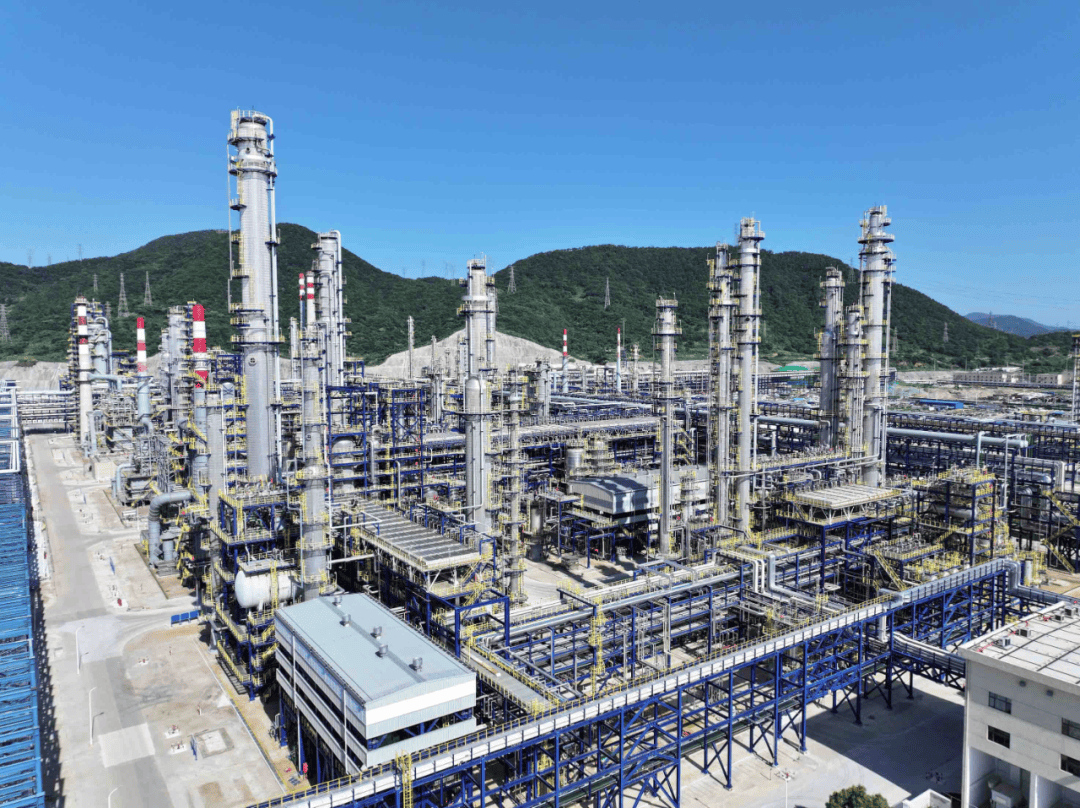
Group 1 - China National Offshore Oil Corporation (CNOOC) announced the completion of the Dasha Petrochemical Integration Project in Ningbo, Zhejiang, marking a significant addition to China's largest petrochemical industrial base [1][3] - The total investment for the project is 21 billion yuan, with the core production unit being a 3.2 million tons per year catalytic cracking unit, utilizing domestically developed technology for direct cracking of heavy oil [3] - The unit is capable of producing 1.2 million tons of polymer-grade ethylene and propylene annually, making it the largest single unit for direct conversion of heavy oil to polymer-grade olefins in the country [3] Group 2 - After the commissioning of the catalytic cracking unit, the Dasha Petrochemical's olefin production capacity will reach 1.8 million tons per year, establishing it as the largest production base for direct conversion of heavy oil to olefins in China [3]


中国海油大型炼化一体化项目建成
Ren Min Ri Bao· 2025-08-22 20:14
Core Insights - China National Offshore Oil Corporation (CNOOC) announced the completion of its integrated refining and petrochemical project in Ningbo, Zhejiang, which is significant for enhancing the efficient conversion of heavy oil and improving the self-sufficiency of high-end chemical materials [1] Investment and Economic Impact - The total investment for the project is 21 billion yuan, making it the largest newly constructed petrochemical industrial base in China [1] - The core facilities of the project can produce 1.2 million tons of ethylene and propylene annually, which are essential raw materials for everyday products such as mineral water bottles, food packaging bags, and synthetic clothing [1] Production Capacity and Environmental Benefits - After the project is operational, the annual production capacity of the Dasha Petrochemical will reach 1.8 million tons of olefins, establishing it as the largest heavy oil direct conversion to olefins production base in the country [1] - The new production process adopted by the core facilities can reduce energy consumption per unit product by over 30%, leading to a reduction of 200,000 tons of carbon dioxide emissions annually, significantly enhancing the efficiency of heavy oil resource utilization [1] Industry Advancement - The completion of the Dasha Petrochemical integrated refining and petrochemical project will further enhance China's capability in independently constructing core chemical processes and equipment, accelerating the petrochemical industry towards refinement and greening [1]
荣盛石化上半年营收1486亿 积极联合同行响应“反内卷”
Zheng Quan Shi Bao· 2025-08-22 18:54
Group 1 - The core viewpoint of the articles highlights the financial stability and growth strategies of Rongsheng Petrochemical, including significant share buybacks and shareholder confidence [1][2] - In the first half of 2025, the company reported total assets of 384 billion yuan, operating revenue of 148.63 billion yuan, and a net profit attributable to shareholders of 600 million yuan, indicating a steady operational status [1] - The company has implemented a total of 5.53 billion shares buyback plan, accounting for 5.46% of the total share capital, with a total expenditure of 6.99 billion yuan, ranking among the top in the A-share market [1] Group 2 - Rongsheng Petrochemical is a leading private enterprise in the domestic petrochemical industry, engaged in the research, production, and sales of various oil products, chemical products, and polyester products [2] - The company has established seven production bases in key economic circles and is a significant producer of polyester, new energy materials, engineering plastics, and high-value-added polyolefins [2] - The domestic petrochemical industry has faced challenges due to excessive capacity and changing demand, but recent government policies aim to stabilize growth and address low-price competition [2][3] Group 3 - In response to the "anti-involution" trend, the company is optimizing its investment structure and leveraging its integrated refining and chemical advantages to enhance efficiency and product differentiation [3] - Since July, the company has collaborated with other leading polyester bottle chip manufacturers to reduce production capacity, aiming to alleviate market inventory pressure and stabilize product prices [3]
恒力石化(600346.SH)发布上半年业绩,归母净利润30.5亿元,同比下降24.08%
智通财经网· 2025-08-22 11:38
智通财经APP讯,恒力石化(600346.SH)发布2025年半年度报告,报告期内,公司实现营业收入1038.87 亿元,同比下降7.69%。实现归属于上市公司股东的净利润30.5亿元,同比下降24.08%。实现归属于上 市公司股东的扣除非经常性损益的净利润22.96亿元,同比下降35.16%。基本每股收益0.43元。 ...

纯苯、苯乙烯日报:纯苯供需双增叠加油价反弹,苯乙烯弱势反弹待考-20250822
Tong Hui Qi Huo· 2025-08-22 07:57
Group 1: Report Industry Investment Rating - No relevant content provided Group 2: Core Views of the Report - The pure benzene market maintains a pattern of increasing supply and demand. The supply is driven by the stable operation of refineries and the recovery of hydrobenzene plants, while the demand shows a mixed performance. Overall, the short - term fundamentals have marginally improved, but the contradiction between high latent inventory and insufficient terminal demand remains [3]. - The styrene market rebounded with the cost in the short - term. However, the medium - term trend depends on the implementation of maintenance and the recovery of terminal demand. The supply is currently high, and the demand improvement is limited, but the situation may marginally ease in September [4]. Group 3: Summary of Each Section 1. Daily Market Summary (1) Fundamentals - **Price**: On August 21, the styrene main contract closed up 0.05% at 7289 yuan/ton with a basis of 26 (+36 yuan/ton), and the pure benzene main contract closed down 0.08% at 6200 yuan/ton [2]. - **Cost**: On August 21, Brent crude closed at 62.7 (+0.9 dollars/barrel), WTI at 66.8 (+1.1 dollars/barrel), and the spot price of East China pure benzene was 6110 yuan/ton (+5 yuan/ton) [2]. - **Inventory**: Styrene sample factory inventory was 20.3 tons (-0.3 tons, -1.1% MoM), Jiangsu port inventory was 16.2 tons (+1.3 tons, +8.5% MoM), and pure benzene port inventory was 14.4 tons (-0.2 tons, -1.1% MoM) [2]. - **Supply**: Styrene production may decrease in late August due to plant maintenance. Currently, the weekly output is 37.1 tons (+0.2 tons), and the plant capacity utilization rate is 78.5% (+0.3%) [2]. - **Demand**: The capacity utilization rates of downstream 3S vary. EPS is 61.0% (+2.9%), ABS is 71.1% (+0%), and PS is 57.5% (+1.1%), showing a continuous increase [2]. (2) Views - **Pure benzene**: The supply is relatively stable with some increase, and the demand shows a mixed trend. The cost is supported by the short - term oil price rebound, but the long - term oil price may face pressure. Overall, the short - term fundamentals improve, but problems remain [3]. - **Styrene**: It rebounded with the cost in the short - term. The supply is high, and the demand improvement is limited. In September, the supply may contract due to maintenance, and the demand may enter the peak season, which may ease the supply - demand contradiction [4]. 2. Industry Chain Data Monitoring - **Price**: The prices of styrene and pure benzene futures and spot, as well as related spreads, are presented, showing different trends of increase and decrease. For example, the styrene futures main contract increased by 0.05%, and the pure benzene futures main contract decreased by 0.08% [6]. - **Output and Inventory**: The output of styrene and pure benzene in China increased slightly, and the inventory situation varied. Styrene port inventory increased, while factory inventory and pure benzene port inventory decreased [7]. - **Capacity Utilization Rate**: The capacity utilization rates of styrene and its downstream products, as well as pure benzene downstream products, changed. Some increased, such as EPS and PS, while others decreased, such as aniline and caprolactam [8]. 3. Industry News - China's shale cracking raw material supply affects the cost of naphtha, and the import volume is expected to reach a record high in 2025 [9]. - The global diesel shortage supports refinery profits, having a structural impact on the crude oil and chemical chains [9]. - India plans to accelerate the expansion of petrochemical production to cope with China's leading position in the global petrochemical market [9]. 4. Industry Chain Data Charts - The report provides multiple charts showing the historical data of pure benzene and styrene prices, spreads, inventory, and capacity utilization rates, with data sources from iFinD and Steel Union data [14][21]
我国规模最大石化产业基地全面建成
Ke Ji Ri Bao· 2025-08-22 07:12
Core Viewpoint - China National Offshore Oil Corporation (CNOOC) announced the completion of the Dasha Petrochemical Integration Project in Ningbo, Zhejiang, marking it as the largest petrochemical industrial base in China, which is significant for enhancing the efficient conversion of heavy oil and improving the self-sufficiency of high-end chemical materials [1][4]. Investment and Project Details - The total investment for the Dasha Petrochemical Project is 21 billion yuan, with its core production facility utilizing domestically developed technology for the direct cracking of heavy oil into chemical products, achieving a 100% domestic production rate [4]. - The project focuses on enhancing resource utilization efficiency and the value of the industrial chain, transitioning from traditional fuel production to high-end chemical new materials [4]. Production Capacity and Environmental Impact - The core facility has a capacity of 3.2 million tons per year for catalytic cracking, producing 1.2 million tons of polymer-grade ethylene and propylene annually, making it the largest single unit for direct conversion of heavy oil to olefins in China [4][6]. - The project is expected to reduce carbon dioxide emissions by 200,000 tons annually and lower unit product energy consumption by over 30% compared to traditional methods, providing a new pathway for low-carbon transformation in refining enterprises [6]. Technological Innovations - The project team developed a unique "upside-down lining construction technology" to address challenges in the installation of the reactor and regenerator, which have the largest head diameter in the country [6]. - The innovative lining materials and segmented pouring process significantly reduced construction time by 90 days, setting a new benchmark for the shortest installation period for large petrochemical equipment in China [6].
丙烯日报:丙烯下游整体开工环比上升-20250822
Hua Tai Qi Huo· 2025-08-22 05:29
1. Report Industry Investment Rating - Unilateral: Neutral; supply-side device maintenance and restart changes frequently, combined with new device production capacity release, supply may still be relatively loose; downstream demand overall start-up recovery supports propylene prices in the short term [3] - Inter-period: None - Inter-variety: None 2. Core Viewpoints - South Korea's petrochemical industry's naphtha cracking has the expectation of capacity reduction, and the propylene futures price rebounds under the boost of macro sentiment. South Korea's propylene capacity accounts for 6% of the global total capacity, and from January to July this year, China imported 863,000 tons of propylene from South Korea, accounting for 67.6% of the total imports, and 73.7% in 2024. South Korea's petrochemical capacity reduction may support overseas propylene prices [2] - From the perspective of supply and demand fundamentals, the main PDH devices of Shandong Zhenhua and Jinneng are under maintenance, and the PDH devices of Tianhong and Xintai are restarted, and the PDH start-up rate decreases month-on-month; later, Wanhua Penglai PDH has the expectation of shutdown, and Jilin Petrochemical's new capacity is expected to be released, and the supply may still be relatively loose. Pay attention to the device maintenance situation after late August. The downstream start-up rate has rebounded overall except for acrylic acid. Among them, the start-up rate of octanol has rebounded significantly, the start-up rate of PP has increased slightly, and the start-up rate of acrylic acid has decreased significantly. Later, the PP device of Jingbo and the acrylic acid device of Hongxin have the expectation of recovery. The short-term demand is supported, but the sustainability is questionable. Pay attention to the downstream stocking demand as the peak season approaches [2] - On the cost side, the crude oil price rebounds and fluctuates. Pay attention to macro trends such as geopolitical situations and the implementation of South Korea's cracking device capacity reduction policy [2] 3. Summary by Related Catalogs 3.1 Propylene Basis Structure - Figures include propylene main contract closing price, propylene East China basis, propylene North China basis, propylene 01 - 05 contract, propylene market price in East China, and propylene market price in Shandong [6][9][11] 3.2 Propylene Production Profit and Start-up Rate - Figures include propylene China CFR - Japanese naphtha CFR, propylene capacity utilization rate, propylene PDH production gross profit, propylene PDH capacity utilization rate, propylene MTO production gross profit, methanol - to - olefins capacity utilization rate, propylene naphtha cracking production gross profit, and crude oil main refinery capacity utilization rate [15][23][25] 3.3 Propylene Import and Export Profit - Figures include South Korea FOB - China CFR, Japan CFR - China CFR, Southeast Asia CFR - China CFR, and propylene import profit [32][34] 3.4 Propylene Downstream Profit and Start-up Rate - Figures include PP powder production profit, PP powder start-up rate, propylene oxide production profit, propylene oxide start-up rate, n - butanol production profit, n - butanol capacity utilization rate, octanol production profit, octanol capacity utilization rate, acrylic acid production profit, acrylic acid capacity utilization rate, acrylonitrile production profit, acrylonitrile capacity utilization rate, phenol - acetone production profit, and phenol - acetone capacity utilization rate [40][42][45] 3.5 Propylene Inventory - Figures include propylene in - plant inventory and PP powder in - plant inventory [67]
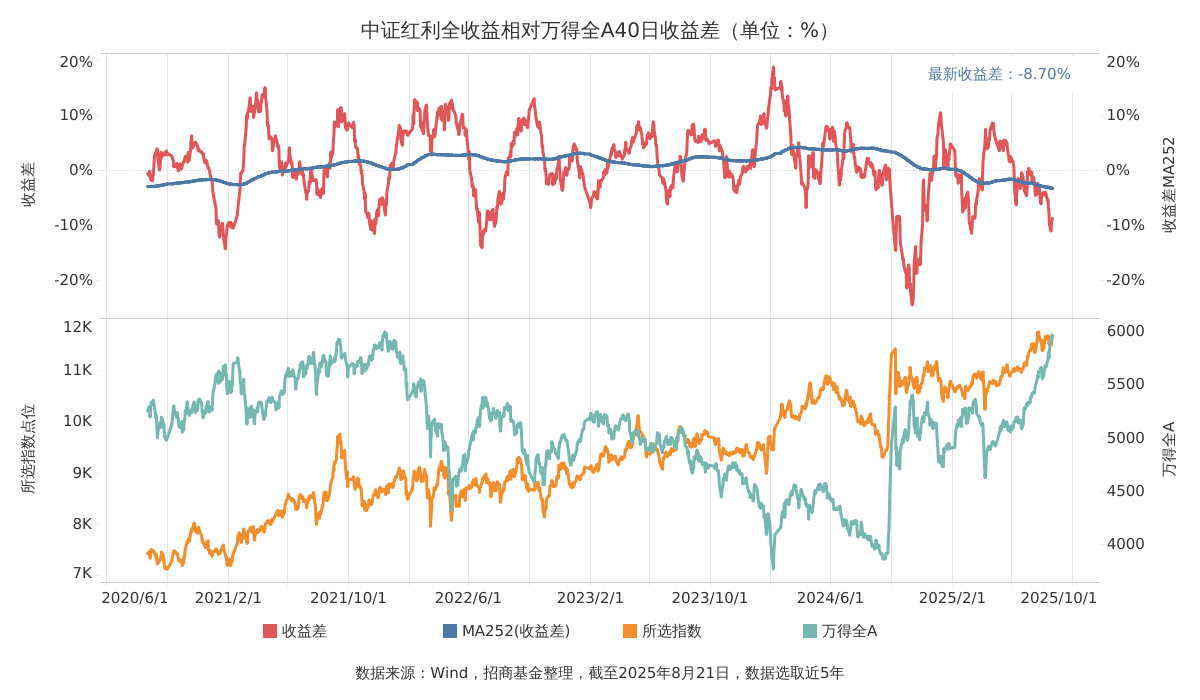
40日收益差逼近-9%,红利板块配置价值或逐步凸显,中证红利ETF(515080)早盘持续溢价
Sou Hu Cai Jing· 2025-08-22 05:22
Core Viewpoint - The A-share market is experiencing a rally driven by growth sectors like semiconductors, with the Shanghai Composite Index nearing 3,800 points, marking a ten-year high, while the CSI Dividend Index shows a decline due to a "seesaw effect" in capital flow [1] Group 1: Market Performance - As of August 21, the difference in 40-day returns between the CSI Dividend Total Return Index and the Wind All A Index was -8.70%, approaching its lowest point of the year, indicating potential value in dividend assets [1] - The CSI Dividend ETF (515080) saw a decline of 0.69% at midday, yet it continued to trade at a premium, with nearly 90 million yuan in capital inflow over the past five days [3] Group 2: Dividend Trends - By August 21, 160 listed companies had announced mid-term dividend plans for 2025, with 23 announcements made on the evening of August 20, including major constituents of the CSI Dividend Index like Shuanghui Development and Sinopec [5] - The trend of dividend announcements reflects the financial health and core competitiveness of companies, particularly in stable cash flow sectors such as food and beverage, coal, steel, and petrochemicals [5] Group 3: Investment Strategy - Analysts suggest that the market may continue a slow bull trend, with dividend stocks serving as a stable base in a low-interest-rate environment, while new sectors could be targeted for growth [5] - If the market shows signs of overheating, it is advised to take profits, while a deterioration in trading structure may warrant a shift back to dividend and other low-position stocks [5]