科技

Search documents
星德胜科技(苏州)股份有限公司关于以集中竞价交易方式首次回购公司股份的公告
Shang Hai Zheng Quan Bao· 2025-11-21 18:46
登录新浪财经APP 搜索【信披】查看更多考评等级 证券代码:603344 证券简称:星德胜 公告编号:2025-041 星德胜科技(苏州)股份有限公司 关于以集中竞价交易方式首次回购公司股份的公告 星德胜科技(苏州)股份有限公司(以下简称"公司")于2025年8月28日召开第二届董事会第十次会 议,审议通过了《关于以集中竞价交易方式回购股份方案的议案》,同意公司以自有资金通过集中竞价 交易方式从二级市场回购公司股份,用于员工持股计划或股权激励。本次回购资金总额不低于人民币 1,500万元(含),不超过人民币3,000万元(含),回购股份价格不超过人民币39元/股,回购股份期限 为自公司董事会审议通过回购股份方案之日起12个月内。 本次回购股份符合相关法律法规的规定及公司回购股份方案的要求。 三、其他事项 本公司董事会及全体董事保证本公告内容不存在任何虚假记载、误导性陈述或者重大遗漏,并对其内容 的真实性、准确性和完整性承担法律责任。 重要内容提示: ■ 一、回购股份的基本情况 具体内容详见公司于2025年8月30日在上海证券交易所网站(www.sse.com.cn)披露的《关于以集中竞 价方式回购股份的方案》 ...
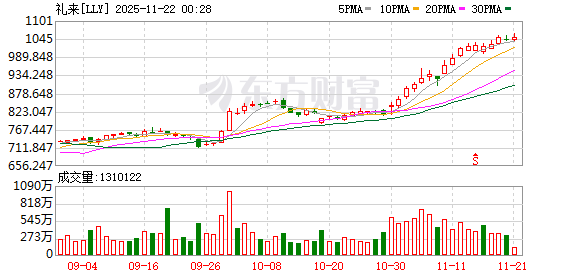
今夜 又见证历史!礼来市值盘中突破1万亿美元 成为首家市值达到1万亿美元的医疗保健公司
Zhong Guo Ji Jin Bao· 2025-11-21 16:28
Market Performance - US stock market showed mixed performance on November 21, with Dow Jones rising over 220 points, while Nasdaq experienced volatility and S&P 500 saw a slight increase [3] - A dovish signal from a high-ranking Federal Reserve official helped the market recover slightly from the slump in AI stocks, increasing bets on a potential interest rate cut in December [3] - The probability of a 25 basis point rate cut in December has risen to over 70%, up from 39.1% the previous day [3] Federal Reserve Insights - Federal Reserve official Williams indicated that current monetary policy is still moderately tight but less so than before recent actions, suggesting room for further adjustments to bring the policy stance closer to neutral [5] - Investors are hopeful that a more accommodative monetary policy could stimulate the weak economy and provide support for historically high valuations in tech stocks [5] Stock Movements - Despite a significant rally earlier in the week, major indices are expected to record substantial weekly declines, with S&P 500 down over 2%, Dow Jones nearly 3%, and Nasdaq about 3% [5] - Some investors view the recent pullback as a normal correction rather than a signal of a larger downturn, with sentiment indicators shifting from optimism to extreme fear [6] Eli Lilly's Milestone - Eli Lilly became the first healthcare company to surpass a market capitalization of $1 trillion, driven by increasing investor interest in its weight loss drugs [7] - The company's stock rose 1.7%, reaching a market cap of approximately $1 trillion, making it the second company outside the tech sector to achieve this milestone [7] - Eli Lilly's GLP-1 class drugs, used for treating obesity and diabetes, are expected to dominate a market projected to reach $95 billion by 2030 [7] Stock Performance and Market Share - Eli Lilly's stock has increased by 37% this year and is projected to rise by 32% in 2024, positioning it as a potential leader in the global weight loss drug market [8] - The company reported that its GLP-1 drugs hold nearly 58% market share in the obesity treatment segment, showcasing impressive market capture in a short time [9]


[11月21日]指数估值数据(全球资产大跌,A股回到4.4星;港股指数估值表更新;抽奖福利)
银行螺丝钉· 2025-11-21 12:56
Market Overview - The market has experienced a significant decline, returning to a rating of 4.4 stars [1] - The CSI All Share Index has reverted to its early September levels [2] - All market caps have seen declines, with small-cap stocks experiencing the largest drop [3] - Value style stocks have declined less than growth style stocks, which have shown greater volatility [4] - The ChiNext Index has dropped over 4% [5] - Hong Kong stocks have also shown volatility, with technology stocks down 3% [6][7] Global Market Dynamics - The Nasdaq opened up 2% but closed down 2%, with intraday adjustments of 4-5% [10][11] - The Nasdaq had reached overvalued levels recently, marking the first instance of overvaluation this year, followed by an 8% correction [12][13] - Global market fluctuations have been influenced by the volatility in US stocks, with South Korean stocks down over 3% and Japanese stocks down over 2% [14][15] - A-shares have shown relatively smaller fluctuations compared to global markets [16] Asset Class Performance - Recently, both gold and bonds have also seen declines, with gold down 7.5% from its recent peak [17][18] - The recent downturn in the stock market has not led to a typical safe-haven performance from bonds or gold, indicating a simultaneous decline across asset classes, a rare occurrence [20][21] - This situation is often associated with liquidity crises, similar to events in 2013 and early 2020 [22][23] Federal Reserve Outlook - The company anticipates further interest rate cuts from the Federal Reserve, as the current dollar interest rates remain high [25] - The total scale of US national debt has reached $38 trillion, with annual interest expenses exceeding $1 trillion [26] - The pressure from interest payments necessitates a reduction in rates and refinancing [27] - There may be several months to half a year between rate cuts [29] - If the Fed does not cut rates in December, there may be concerns about liquidity in the following months [32][34] Market Liquidity and Volatility - The current liquidity tightness is unusual, as typically one asset class would rise while others fall [35] - In times of liquidity crises, investors tend to sell long-term risk assets for short-term liquidity, increasing correlations among asset classes [39][40] - Small-cap stocks, growth stocks, and cryptocurrencies are particularly sensitive to liquidity conditions [41] - The ChiNext Index saw a significant rise of over 50% in Q3, followed by a correction of over 15% in Q4 [43][44] - The company has adjusted its portfolio to reduce volatility by taking profits from overvalued growth stocks [45] Future Market Expectations - Investors should not be overly concerned about the current liquidity tightness, as it typically lasts a few weeks to a couple of months [47] - As liquidity conditions improve, different asset classes are expected to rise again [48] - The ongoing rate-cutting cycle by the Federal Reserve suggests potential buying opportunities during market dips [49]

UK stocks set for sharp weekly losses as tech, Fed concerns hit markets
Reuters· 2025-11-21 12:50
Core Viewpoint - London's main stock indexes experienced a significant decline on Friday, driven by concerns over technology valuations and the Federal Reserve's hawkish stance, leading to anticipated weekly losses [1] Group 1: Market Performance - The decline in London's stock indexes indicates a broader market reaction to rising concerns regarding tech valuations [1] - The Federal Reserve's hawkish stance has contributed to the volatility in global markets, impacting investor sentiment [1] Group 2: Sector-Specific Insights - Defence shares saw a decrease amid indications of potential progress toward peace in Ukraine, suggesting a shift in investor focus [1]

华尔街太乐观?先锋集团警示:美联储降息幅度将远低于预期!
Jin Shi Shu Ju· 2025-11-21 07:38
Core Viewpoint - Vanguard predicts that the Federal Reserve's rate cuts will be fewer than Wall Street expects, driven by strong economic growth fueled by significant spending in the artificial intelligence sector [2]. Economic Growth Forecast - Vanguard expects the U.S. economic growth rate to be 1.9% this year, accelerating to 2.25% by 2026, based on the assumption of continued rapid growth in AI infrastructure spending [3]. - AI capital expenditures have increased by approximately 8% this year, with expectations to maintain similar levels next year, supporting growth without triggering inflation [3]. Federal Reserve Rate Cuts - Vanguard's fixed income head, Sara Devereux, anticipates only one to two more rate cuts from the Federal Reserve, contrasting with market expectations of three to four cuts by the end of 2026 [2]. - The Fed may reach a "neutral" interest rate by mid-next year, where borrowing costs neither accelerate nor decelerate economic growth [2]. Market Sentiment and Risks - Despite Vanguard's optimistic outlook on AI spending, there is a prevailing anxiety among investors regarding the tech sector, as evidenced by a 7% drop in the Nasdaq Composite Index this month [3]. - Concerns have arisen over corporate bond prices due to the issuance of large amounts of debt by major tech companies, which may impact corporate bond prices in the coming months [3][4]. Credit Market Positioning - Vanguard maintains an overweight position in credit, although the current level of overweight is below the average for the entire cycle, indicating tight valuations and significant supply [4]. - Recent bankruptcies in the subprime auto loan sector are viewed as isolated incidents rather than indicative of broader market troubles [4].
海外股市震荡致短期扰动 A股中长期向好趋势未改
Zhong Guo Jing Ying Bao· 2025-11-21 06:39
Core Viewpoint - The recent volatility in global markets has led to a significant short-term impact on A-shares, but the long-term bullish trend remains intact [1][2][3]. Short-term Disturbances - The fluctuations in the U.S. Federal Reserve's policy expectations have caused sharp movements in the U.S. dollar and treasury yields, leading to rapid capital shifts between developed and emerging markets, which in turn affects A-shares [2]. - A-shares are expected to oscillate within the range of 3950-4060 points in the short term, with a balanced market style [2]. - Concerns over the valuation bubble in U.S. tech stocks have led to a sell-off, which may suppress the performance of A-share technology stocks [2][3]. Long-term Value of A-shares - Despite the short-term pressures from overseas market fluctuations, A-shares have shown resilience, with key indices experiencing less than 3% volatility since October, significantly lower than indices like the Nasdaq [3]. - The strong resilience of A-shares is viewed as a positive signal for long-term investment, supported by ongoing technological upgrades and industrial transformation [3]. - Continuous support for hard technology and high-end manufacturing, along with sustained inflows of medium to long-term capital, enhances the long-term bullish narrative for A-shares [3][4]. Future Market Performance - Positive drivers for the A-share market are expected to persist through 2025, including advancements in innovation sectors like AI, supportive policies for private enterprises, fiscal expansion, and ample liquidity in a loose monetary environment [4].
平安资管黄家乐:港股迎重估机遇 建议“杠铃策略”配置
2 1 Shi Ji Jing Ji Bao Dao· 2025-11-21 04:55
Core Insights - The 2025 Bay Area Wealth Conference highlighted new investment opportunities in the Hong Kong stock market amid China's asset revaluation, with a recommendation for investors to adopt a "barbell strategy" that balances high-dividend stocks for stability and growth stocks for potential returns [1][2]. Group 1: Market Overview - The Hong Kong stock market shows significant valuation advantages, with the Hang Seng Index's dividend yield at 3.04% and a forecasted price-to-earnings ratio of 11.19, lower than major global indices [1]. - The AH share premium index is at a high level, indicating a valuation discount of 20%-30% for Hong Kong stocks compared to A-shares [1]. Group 2: Investment Strategy - The "stable" end of the barbell strategy focuses on high-dividend stocks, which historically perform better during declining interest rates and have low correlation with global indices, thus effectively diversifying risk [1]. - The "growth" end emphasizes the potential of Hong Kong growth stocks, particularly in technology and semiconductors, driven by external factors like the U.S. Federal Reserve's interest rate cuts and easing export restrictions on chips [1][2]. Group 3: Sector Analysis - Key sectors for growth include new consumption, innovative pharmaceuticals, and technological innovation, with AI technology transforming drug development and enhancing efficiency [2]. - The new consumption sector is experiencing a shift in consumer attitudes, leading to the rise of new brands that leverage cultural empowerment and product innovation to capture market share [2]. - The Hang Seng Technology Index has a price-to-earnings growth (PEG) ratio of 0.85, indicating that valuations are below growth rates, suggesting promising growth potential [2]. Group 4: Market Dynamics - There is an increasing enthusiasm from overseas funds for Chinese assets, with an expected influx of over $140 billion if global active funds allocate to Chinese assets [2]. - The momentum of southbound capital inflows into Hong Kong stocks remains strong, particularly in sectors like retail, pharmaceuticals, and media [2][3].
港股开盘再度走低,资金近期密集流入港股科技ETF
Xin Lang Cai Jing· 2025-11-21 02:27
Group 1 - Recent focus on the unlocking of restricted shares in the Hong Kong stock market, with significant declines observed in stock prices, such as a drop of 8.75% for CATL's H-shares [1] - Upcoming unlocks for companies including Sanhua Intelligent Control and Hengrui Medicine, with Hai Tian Flavor Industry scheduled for December, potentially exerting pressure on stock prices [1] - The Hang Seng Technology Index has experienced a correction of over 18% since its peak after the National Day holiday, indicating a broader market trend [1] Group 2 - Continuous inflow of funds into the Hang Seng Technology/ Hong Kong Technology/ Hong Kong Stock Connect Internet sectors, with the Hong Kong Technology ETF (159751) seeing a net inflow of 50.63 million yuan over four days [1] - The average daily net inflow for the Hong Kong Technology ETF reached 12.66 million yuan, highlighting investor interest [1] - Institutional investors are expected to have reduced pressure for profit-taking in November and December, leading to a neutral upward expectation for the index despite economic meeting forecasts [1] Group 3 - The CSI Hong Kong Stock Connect Technology Index (931573) includes top-weighted stocks such as Alibaba, Tencent, and SMIC, with the top ten stocks accounting for 66.81% of the index [2]



估值修复+龙头引领,港股科技结构性机会凸显
Mei Ri Jing Ji Xin Wen· 2025-11-21 01:26
Core Viewpoint - The Hong Kong stock market's technology sector is characterized by "valuation-driven + leading companies leading the way," becoming the core engine of a structural bull market, with the Hang Seng Technology Index showing a 30% increase primarily driven by risk premium [1] Group 1: Valuation and Performance - The current price-to-earnings ratio of the technology sector is at a near 10-year low, indicating a significant valuation advantage compared to similar companies in the US stock market [1] - Leading companies, particularly Tencent and Alibaba, have significantly contributed to the index's performance, with these two giants accounting for over 45% of the index's increase [1] Group 2: Contribution of Leading Companies - If the top 20 leading stocks are included, their contribution to the index rises to over 70% [1] - Tencent's AI service revenue has seen a year-on-year growth of 120%, while Alibaba's AI-related business maintains a triple-digit growth rate [1] Group 3: Investment Environment - In an environment characterized by "abundant funds + asset scarcity," technology leaders with brand barriers and technological advantages are becoming rare high-return assets, attracting continuous capital focus [1]
突然跳水!近500点大跌!
天天基金网· 2025-11-21 01:07
Market Overview - The three major U.S. stock indices closed lower, with the Dow Jones down 0.84% at 45,752.26 points, the S&P 500 down 1.56% at 6,538.76 points, and the Nasdaq down 2.15% at 22,078.05 points [5][4]. - Major technology stocks also experienced declines, with the "Big Seven" tech companies index falling by 1.74% [11][10]. Individual Stock Performance - Cisco dropped 3.76%, Boeing fell 3.37%, and Nvidia decreased by 3.15%, leading the decline in the Dow components [8][9]. - Among the "Big Seven" tech stocks, Nvidia fell 3.15%, Amazon dropped 2.49%, and Tesla decreased by 2.21% [13][14]. Chinese Stocks - Chinese stocks also saw a general decline, with the Nasdaq Golden Dragon China Index down 3.26% and the Wind Chinese Technology Leaders Index down 2.72% [16][15]. - Notable individual stock movements included a nearly 19% drop for Canadian Solar and over 14% for Xinyi Technology [18]. Economic Data and Federal Reserve Outlook - Following the release of new economic data, traders increased their bets on a potential interest rate cut by the Federal Reserve, although a rate cut in December is still not expected [20][21]. - The U.S. non-farm payrolls increased by 119,000 in September, significantly above the market expectation of 50,000, while the unemployment rate rose to 4.4%, the highest since October 2021 [21][23]. Federal Reserve's Financial Stability Concerns - Federal Reserve officials highlighted three major financial stability risks: high asset valuations, the expansion and complexity of private credit markets, and potential disruptions in the Treasury market due to hedge fund activities [24][23]. - The Fed's assessment indicates that asset valuations across various markets, including stocks and real estate, are high relative to historical benchmarks [24]. - The growth of private credit has doubled over the past five years, raising concerns about its implications for financial stability [25]. - Hedge funds' holdings of U.S. Treasury securities have increased from approximately 4.6% in Q1 2021 to 10.3% in Q1 2023, which could lead to market pressures if these positions are significantly reduced [25][26].