零售业

Search documents
反内卷改善企业预期!短期因素造成制造业PMI环比微降
证券时报· 2025-07-31 05:47
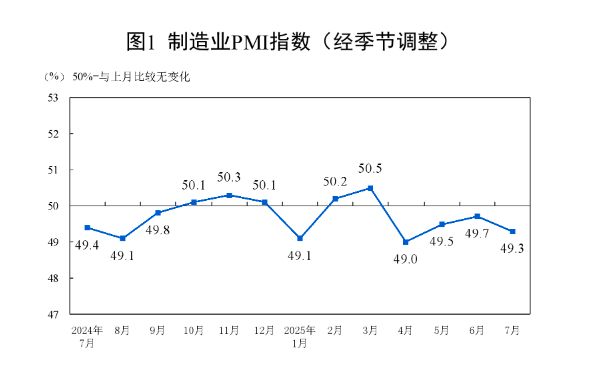
Core Viewpoint - The manufacturing PMI for July is reported at 49.3%, a decrease of 0.4 percentage points from the previous month, primarily influenced by seasonal production slowdowns and adverse weather conditions [1][5][6]. Group 1: Manufacturing Sector Analysis - The manufacturing PMI reflects a contraction, but the underlying economic recovery remains solid, with equipment manufacturing and high-tech manufacturing PMIs continuing to expand [3][7]. - Large enterprises are maintaining stable expansion, acting as a stabilizing force in the economy [3][7]. - The rebound in the major raw material purchasing price index indicates a positive shift in business expectations due to anti-involution measures [10][12]. Group 2: Non-Manufacturing Sector Insights - The non-manufacturing business activity index stands at 50.1%, showing a slight decline but remaining above the critical point, indicating ongoing activity in the sector [2][14]. - Summer consumption is beginning to show positive effects, with significant increases in retail and travel activities, although the accommodation and catering sectors remain below the critical point [14][15][16]. Group 3: Future Economic Outlook - The implementation of policies aimed at expanding domestic demand is expected to support stable economic growth and quality improvement in the second half of the year [8][17]. - Analysts predict that the positive impact of summer consumption will continue into August, contributing to a gradual increase in investment and consumption activities [16][17].


反内卷改善企业预期!短期因素造成制造业PMI环比微降
Zheng Quan Shi Bao· 2025-07-31 05:45
Core Points - The manufacturing PMI for July is reported at 49.3%, a decrease of 0.4 percentage points from the previous month, primarily influenced by seasonal production slowdowns and adverse weather conditions [1][3] - The non-manufacturing business activity index and the composite PMI output index are at 50.1% and 50.2%, respectively, both showing a decline but remaining above the critical point [1][3] - Economic recovery fundamentals remain solid, with the equipment manufacturing and high-tech manufacturing PMIs continuing to expand, indicating ongoing structural optimization [1][3] Manufacturing Sector - The manufacturing PMI's decline is attributed to traditional production off-seasons and extreme weather events, leading to a weaker demand side [2][3] - Despite the overall PMI decline, production activities in manufacturing are still expanding, particularly in the equipment and high-tech sectors, which are crucial for economic growth [3][5] Price Indices - Among the 13 sub-indices of the manufacturing PMI, the purchasing price index and the ex-factory price index have risen, indicating improved market conditions in certain sectors [5] - The main raw material purchasing price index has risen to 51.5%, marking the first increase above the critical point since March, suggesting a potential recovery in material costs [5] Non-Manufacturing Sector - The non-manufacturing business activity index is at 50.1%, reflecting a slight decline, but summer consumption is beginning to show positive effects in retail, travel, and entertainment sectors [7][9] - Retail activity is increasing, with the retail business activity index rising above the critical point, indicating strong consumer purchasing intentions [8] Future Outlook - The implementation of policies aimed at expanding domestic demand, such as "two new" and "two heavy" initiatives, is expected to support stable economic expansion and quality improvement in the second half of the year [1][9] - The positive impact of summer consumption is anticipated to continue into August, contributing to economic recovery [9]
制造业PMI季节性回落至49.3%,下阶段走势如何
Di Yi Cai Jing Zi Xun· 2025-07-31 03:29
Economic Overview - The manufacturing Purchasing Managers' Index (PMI) for July is reported at 49.3%, a decrease of 0.4 percentage points from the previous month, indicating a slight contraction in manufacturing activity [1] - The non-manufacturing business activity index stands at 50.1%, also down by 0.4 percentage points, reflecting a slowdown in growth [1] - The composite PMI output index is at 50.2%, down 0.5 percentage points, but still above the critical point, suggesting overall expansion in business activities [1] Manufacturing Sector Insights - The new orders index for manufacturing is at 49.4%, a decline of 0.8 percentage points, indicating a tightening in market demand [3] - The new export orders index is reported at 47.1%, down 0.6 percentage points, further highlighting weak demand [3] - Despite the demand weakness, the production index remains at 50.5%, indicating continued expansion in manufacturing activities for the third consecutive month [3] - The raw material purchase price index has risen to 51.5%, an increase of 3.1 percentage points, suggesting a recovery in raw material prices [3] Price Trends - The ex-factory price index for manufactured goods is at 48.3%, up 2.1 percentage points, marking the second-highest point this year [3] - The basic raw materials sector is driving the stabilization and recovery of market prices, with the purchase price index rising over 7 percentage points to 52% [4] Business Confidence and Expectations - The production and business activity expectation index is at 52.6%, an increase of 0.6 percentage points, indicating improved confidence among manufacturing enterprises [4] - Large enterprises maintain a PMI of 50.3%, while medium-sized enterprises show improvement with a PMI of 49.5%, and small enterprises have a PMI of 46.4%, indicating varying levels of economic health across different company sizes [4] Non-Manufacturing Sector Performance - The non-manufacturing business activity index is at 50.1%, reflecting a slowdown but still within the expansion range [8] - The construction sector's business activity index is at 50.6%, down 2.2 percentage points, indicating a slowdown due to seasonal weather impacts [8] - Consumer spending during the summer shows positive trends, with retail and postal service indices rising above 50% and 60%, respectively, indicating strong consumer purchasing intentions [9] Future Outlook - The construction sector is expected to rebound post-rainy season, with infrastructure activities projected to continue steady growth [8][9] - The overall economic foundation remains solid, with expectations for continued stable expansion and quality improvement in the second half of the year, supported by ongoing macroeconomic policies [5]
上半年深圳GDP增5.1% 进出口降幅收窄
Nan Fang Du Shi Bao· 2025-07-30 23:15
Economic Performance - Shenzhen's GDP for the first half of 2025 reached 18322.26 billion yuan, with a year-on-year growth of 5.1% [1] - The primary industry added value was 10.33 billion yuan, growing by 2.8%; the secondary industry added value was 6505.56 billion yuan, increasing by 3.3%; and the tertiary industry added value was 11806.37 billion yuan, rising by 6.1% [1] Industrial and Service Sector Growth - The city's industrial added value for large-scale enterprises grew by 4.3%, with manufacturing increasing by 4.2% and electricity, heat, gas, and water production and supply growing by 11.8% [2] - High-tech product output saw significant growth, with civil drones, industrial robots, and 3D printing equipment increasing by 59.0%, 38.0%, and 35.8% respectively [2] - The service sector's added value was 11806.37 billion yuan, with a year-on-year growth of 6.1%, driven by finance (10.9%), transportation and warehousing (9.0%), and information technology services (8.1%) [2] Investment Trends - Fixed asset investment in Shenzhen decreased by 10.9%, with real estate development down by 15.1% but infrastructure investment up by 7.7% and industrial technology renovation investment soaring by 47.1% [3] - Investment in information transmission, software, and IT services grew by 47.7%, while transportation and warehousing investment rose by 32.5% [3] Consumer Market Insights - The total retail sales of social consumer goods reached 4948.68 billion yuan, with a year-on-year growth of 3.5% [3] - Online retail sales through the internet increased by 19.4%, indicating a strong trend towards e-commerce [3] Trade and Financial Sector - The total import and export volume for the first half of the year was 21675.45 billion yuan, a decrease of 1.1%, with exports down by 7.0% and imports up by 9.5% [4] - By the end of June, the balance of deposits in financial institutions reached 141600.14 billion yuan, growing by 5.7% [4] Cross-Border E-commerce Development - The Google Cross-Border E-commerce Acceleration Center in Shenzhen officially commenced operations, enhancing the cross-border e-commerce ecosystem in the region [6] - The center aims to provide comprehensive services for cross-border e-commerce companies, supporting their global business expansion [6]
鲍威尔压制降息预期,美股回落
Wind万得· 2025-07-30 22:47
Core Viewpoint - The Federal Reserve has not yet decided on policy adjustments for September, leading to a cooling of market expectations for interest rate cuts in 2023 [1][3]. Market Performance - The S&P 500 index rose 0.4% intraday but closed down 0.12% at 6362.90 points; the Dow Jones Industrial Average fell 171.71 points, or 0.38%, to 44461.28 points; the Nasdaq Composite slightly increased by 0.15% to 21129.67 points [1][2]. - The Chinese Golden Dragon Index dropped 1.82% to 7413.12 points, while the Nasdaq 100 futures rose by 0.89% to 23661.75 points [2]. Federal Reserve Meeting Insights - The Federal Reserve maintained the federal funds rate range, aligning with market expectations, but emphasized the need for further evaluation of tariffs' impact on inflation and the economy [3]. - Powell's comments were interpreted as hawkish, reducing the likelihood of a 25 basis point rate cut in September from 64% to 46% according to CME FedWatch [3][4]. - The meeting saw dissent from two Fed governors advocating for a rate cut, indicating internal disagreements on policy timing [8]. Economic Data - The U.S. second-quarter GDP grew by 3%, significantly above the expected 2.4%, with a total GDP of $236,853 billion [11]. - The core PCE price index for the second quarter rose by 2.5%, while the overall PCE index increased by 2.1%, below the expected 2.9% [11]. - July's ADP employment numbers showed an increase of 104,000 jobs, surpassing the expected 75,000 [12]. Market Reactions - Following Powell's remarks, consumer stocks, particularly those sensitive to interest rates, experienced declines, reflecting concerns over potential valuation adjustments if rate cuts do not materialize [9]. - The market's response to the Fed's decision was relatively mild, as many participants had already anticipated the direction of interest rates [5]. Future Outlook - Analysts express concerns about the potential overheating of the market, despite recent highs, suggesting that the rapid sell-off and rebound may not indicate overheating but rather a recovery [16].

南宁百货: 广西五坤律师事务所关于南宁百货大楼股份有限公司2025年第二次临时股东大会的法律意见书
Zheng Quan Zhi Xing· 2025-07-30 16:25
本法律意见书仅供见证公司本次股东大会相关事项的合法性之 目的使用,不得用作任何其他目的。 本所及经办律师依据《证券法》《律师事务所从事证券法律业 务管理办法》和《律师事务所证券法律业务执业规则》等规定及本 法律意见书出具日以前已经发生或者存在的事实,严格履行了法定 职责,遵循了勤勉尽责和诚实信用原则,进行了充分的核查验证, 法律意见书 保证本法律意见所认定的事实真实、准确、完整,所发表的结论性 意见合法、准确,不存在虚假记载、误导性陈述或者重大遗漏,并 承担相应法律责任。 广西五坤律师事务所 关于南宁百货大楼股份有限公司 法律意见书 WK-G-[2025]-003-03 广西南宁市青秀区金湖路 59 号地王国际商会中心 46 楼 4607-4612 Room 4607-4612, 46/F, Nanning King's International Merchant Center, Qingxiu district,No.59 Jinhu Road, Nanning, Guangxi, China 法律意见书 广西五坤律师事务所 关于南宁百货大楼股份有限公司 法律意见书 致:南宁百货大楼股份有限公司 根据《中 ...

美股前瞻 | 三大股指期货齐涨 美联储今夜决议料鹰派维稳,微软、Meta盘后公布财报
Zhi Tong Cai Jing· 2025-07-30 15:54
Market Overview - US stock index futures are all up before the market opens, with Dow futures rising by 0.08%, S&P 500 futures up by 0.20%, and Nasdaq futures increasing by 0.28% [1] - European indices show mixed results, with Germany's DAX up by 0.20%, UK's FTSE 100 down by 0.25%, France's CAC40 up by 0.37%, and the Euro Stoxx 50 up by 0.21% [2][3] - WTI crude oil prices increased by 0.10% to $69.28 per barrel, while Brent crude oil rose by 0.07% to $71.73 per barrel [3][4] Economic Data - The ADP employment report for July showed an increase of 104,000 jobs, exceeding market expectations of 75,000, marking the largest increase since March [5] - The Federal Reserve is expected to maintain a hawkish stance during its upcoming meeting, with Jerome Powell's speech being closely monitored for hints of potential rate cuts in September [5] Cryptocurrency Policy - The White House is set to release the first cryptocurrency policy report since the Trump administration, which will outline the government's stance on key issues affecting the digital asset industry [6][7] Company Earnings and Forecasts - Microsoft is expected to report a 13.88% year-over-year revenue increase to $73.71 billion for Q4, driven by strong demand in cloud computing and AI infrastructure [9] - Meta is anticipated to report Q2 revenue of $44.55 billion, a 14% increase year-over-year, but faces scrutiny over maintaining a 40% profit margin amid significant AI investments [10] - United Microelectronics Corporation (UMC) reported Q2 revenue of $2.01 billion, a 14.9% year-over-year increase, but fell short of market expectations [11] - Visa's Q3 revenue reached a record $10.2 billion, a 14% increase year-over-year, with adjusted EPS of $2.98, exceeding analyst expectations [11] - Starbucks reported Q3 revenue of $9.456 billion, a 3.8% year-over-year increase, but same-store sales declined by 2% [12] - UBS reported Q2 net profit of $2.4 billion, surpassing market expectations, with strong inflows in its wealth management division [13] - Rio Tinto's half-year profit fell to $4.81 billion, the lowest in five years, due to declining iron ore prices amid oversupply concerns [14] - GlaxoSmithKline (GSK) reported better-than-expected profits for Q2, driven by strong sales of its shingles vaccine and other key products [15] - Booking Holdings reported Q2 revenue of $6.8 billion, a 16% year-over-year increase, but provided a cautious outlook for Q3 [16] - New Oriental reported a net profit of $372 million for the fiscal year, a 20.1% increase year-over-year [17] Upcoming Economic Events - Key economic data releases include the ADP employment change, Q2 GDP initial estimate, and pending home sales index [18][19][20] - The Federal Reserve's FOMC meeting and interest rate decision are scheduled, along with a press conference by Jerome Powell [22]



陈茂波:香港营商环境优势凸显 金融市场亮眼、创科产业快速发展
智通财经网· 2025-07-30 14:06
Economic Outlook - The Hong Kong economy is expected to maintain growth in the second half of the year, following a 3.1% growth in Q1 and a positive outlook for Q2 [7][18] - The government is actively supporting industries undergoing transformation, particularly in funding and digital upgrades for local retail and dining sectors [8][20] Investment and Business Environment - International investor confidence in Hong Kong is rising, with the Hang Seng Index increasing by 27% this year after an 18% rise last year [4] - The number of companies registered in Hong Kong from overseas has increased by 10% year-on-year, with 84 key enterprises expected to invest approximately HKD 500 billion, creating 20,000 jobs [4][5] Real Estate and Office Space - The government is not selling commercial land to allow the market to absorb existing office space, while also encouraging private entities to purchase office properties [2][13] - There has been significant demand for office space from multinational financial institutions, particularly in wealth and asset management sectors [2][14] Retail and Consumer Trends - Retail sales have shown signs of recovery, with a 2.4% increase reported in May after 14 months of decline [8] - The number of visitors to Hong Kong has increased significantly, with a double-digit growth rate in international tourists during the first half of the year [6][9] Talent Acquisition - Approximately 500,000 applications have been received for talent importation programs, with 330,000 approved and around 220,000 individuals having arrived in Hong Kong [5][20] Financial Sector Stability - Hong Kong's banking sector remains robust, with a capital adequacy ratio of approximately 21%, significantly above the global standard of 8% [15][20] - The overall banking system is characterized by strong liquidity and prudent provisioning for potential bad debts [15]
A股公告精选 | 年内首只10倍牛股上纬新材(688585.SH)遭停牌核查
智通财经网· 2025-07-30 11:39
Group 1 - Company Shenzhou New Materials has experienced multiple instances of abnormal stock trading fluctuations and will be suspended from trading starting July 31, 2025, for up to three trading days [1] - The stock price of Shenzhou New Materials has increased over 1288% this year, making it the first tenfold stock of 2025 [1] - Company Yangtze Power plans to invest approximately 26.6 billion yuan in the construction of the Gezhouba shipping capacity expansion project, with funding sourced from its own funds [2] - Yonghui Supermarket intends to raise no more than 3.992 billion yuan through a private placement of A-shares for store upgrades and logistics improvements [3] Group 2 - Chipsea Technology is planning to issue H-shares and apply for listing on the Hong Kong Stock Exchange to enhance its international strategy and competitiveness [4] - Zhongwang Software is facing a copyright infringement lawsuit from Autodesk in a California federal court, with the amount in dispute yet to be determined [5] - Jinchengzi is planning to acquire 55% of the equity of Changchun Samit Optoelectronics Technology Co., Ltd., and will suspend trading starting July 31, 2025, for up to ten trading days [6] - Nanxin Pharmaceutical is in the process of planning the acquisition of a domestic pharmaceutical technology asset group, with significant uncertainty regarding whether it constitutes a major asset restructuring [7] Group 3 - Huaheng Biological is preparing to issue H-shares and list on the Hong Kong Stock Exchange to advance its global strategy [9] - Sanchao New Materials is planning a change in company control and will suspend trading starting July 31, 2025, for up to two trading days [10] - Digital Certification's controlling shareholder will change to Beijing Data Group following a transfer of state-owned shares [11] - Hongxiang Co., Ltd.'s actual controller has been placed under residential surveillance, but this will not affect the company's normal operations [12]




永辉超市:7月30日召开董事会会议
Mei Ri Jing Ji Xin Wen· 2025-07-30 11:35
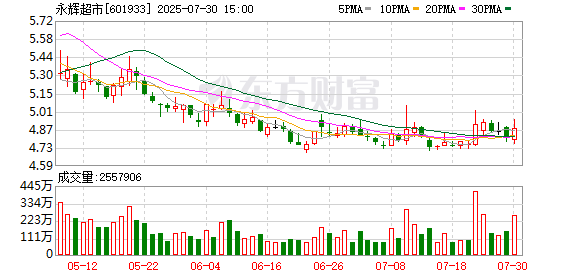
永辉超市(SH 601933,收盘价:4.88元)7月30日晚间发布公告称,公司第六届第四次董事会会议于 2025年7月30日在公司左海总部六楼会议室以现场结合通讯方式召开。会议审议了《关于公司2025年度 向特定对象发行A股股票方案的议案》等文件。 (文章来源:每日经济新闻) 2024年1至12月份,永辉超市的营业收入构成为:零售业占比94.37%,服务业占比5.63%。 ...