
咖啡

Search documents
赵江平大使出席布隆迪首批输华咖啡豆发运仪式
Shang Wu Bu Wang Zhan· 2025-08-02 15:47
Group 1 - The event marked the shipment of Burundi's first batch of coffee beans to China, benefiting from a 100% zero-tariff treatment [1] - The cooperation aligns with the upcoming China-Africa Cooperation Forum in September 2024 and the Burundi Investment Roundtable in December [1] - The coffee industry is highlighted as a significant source of foreign exchange and a key pillar for achieving Burundi's national development vision for 2040 and 2060 [1] Group 2 - The ceremony was attended by over 50 representatives, including officials from the Burundi government and Chinese enterprises [1] - The Director of the Agricultural Planning Department praised the close collaboration between the governments and enterprises of China and Burundi [1] - Local mainstream media reported on the successful conclusion of the event as the trucks departed [1]


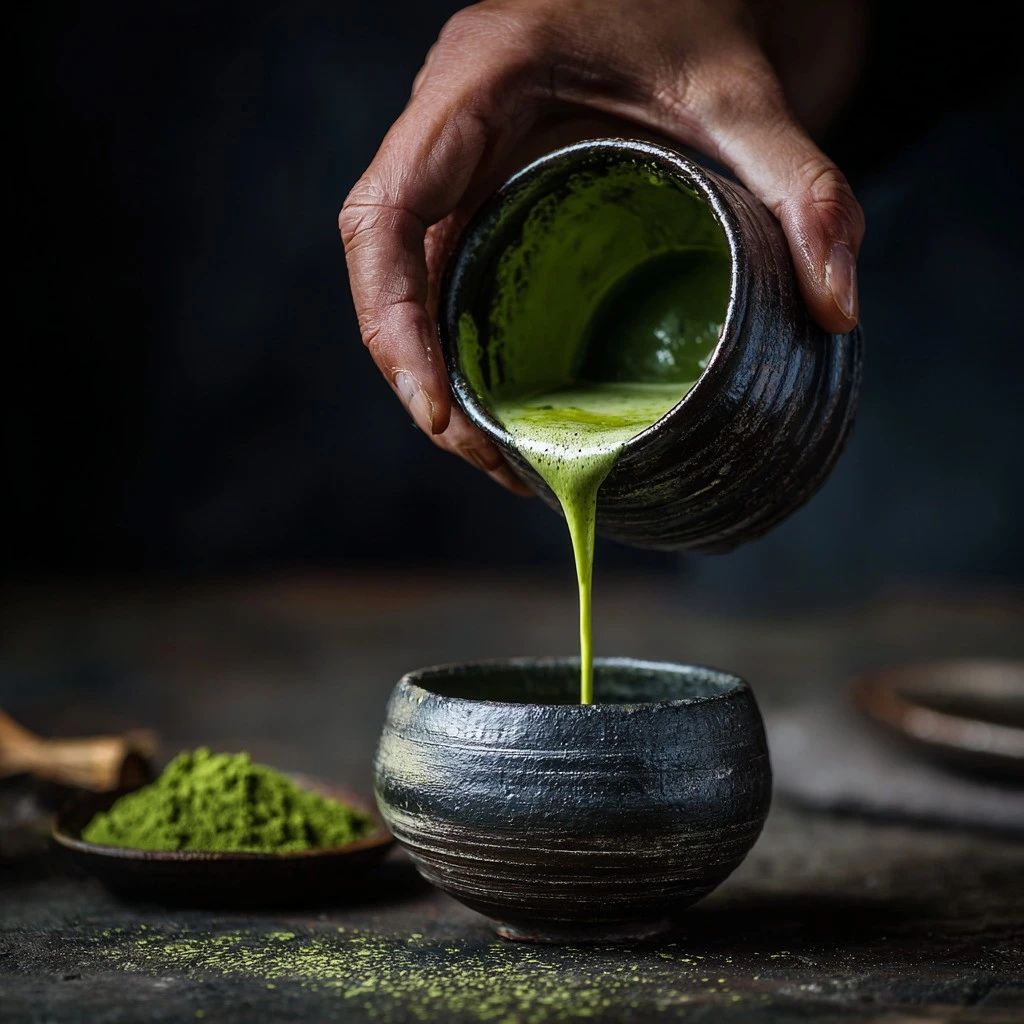
喜茶爆单,抹茶“杀疯”,中国抹茶会是下一个Labubu吗?
创业邦· 2025-08-02 10:07
Core Viewpoint - The article discusses the recent surge in popularity of matcha products, particularly highlighting the impact of BLACKPINK member's social media post on HEYTEA's "Triple Thick Matcha," which led to a significant increase in global orders and sales [4][6][10]. Group 1: Market Trends - There has been a notable increase in matcha product launches across various brands, with HEYTEA introducing multiple matcha beverages and other brands like Nayuki and Cha Bai Dao also releasing popular matcha items [7][21]. - The Asia-Pacific region accounted for 57.76% of the global matcha market in 2023, with China and Japan recognized as historical centers for matcha production [9][33]. - Matcha's association with Japan persists, despite its origins in China, as consumers increasingly discover the historical roots of matcha in regions like Jing Mountain, Hangzhou [30][32]. Group 2: HEYTEA's Response - Following the social media post, HEYTEA's sales of the "Triple Thick Matcha" increased by over 500% in cities like Shanghai and Hangzhou within a day [12]. - HEYTEA's global stores quickly adapted by launching promotional activities, including a buy-one-get-one-free offer for matcha drinks, although this led to shortages in matcha supplies [16][20]. - The brand's marketing strategy included creating artist-customized versions of the matcha drink to attract fans and enhance engagement [16][14]. Group 3: Regional Production Insights - China has become the largest producer and consumer of matcha globally, with production concentrated in regions like Jing Mountain, Guizhou, and Hubei [33][40]. - Jing Mountain's matcha production is expected to exceed 5,000 tons by 2025, with significant investments in local tea development [34][36]. - Guizhou's matcha production surpassed 1,200 tons last year, and the region is recognized for its modern matcha processing facilities [40]. Group 4: Branding and Market Positioning - The article emphasizes the need for "Chinese matcha" to establish a stronger brand identity to compete with Japanese matcha products [48]. - Successful examples from other regions, such as the rapid growth of Liuzhou's snail noodles, illustrate the potential for local specialties to gain national recognition through effective branding and marketing strategies [51]. - The article suggests that enhancing product visibility, leveraging local heritage, and creating engaging marketing campaigns can help elevate the status of Chinese matcha in the global market [55].
聊聊咖啡和大蒜,两者的演进关系
Hu Xiu· 2025-08-02 03:35
Group 1 - The article discusses the evolving relationship between coffee and garlic as metaphors for cultural and commercial value, highlighting how northern garlic comedy has gained significant influence over the years [2][6][49] - It emphasizes that the distinction between coffee and garlic is not strictly biological but rather a result of cultural and commercial evolution, where both can innovate and create value [5][6][49] - The article outlines the historical evolution of coffee, detailing its transformation from a low-end agricultural product to a high-value commodity through standardization and branding efforts, particularly by Starbucks [10][12][15][22] Group 2 - The article also examines the evolution of bookstores, particularly the example of Tsutaya in Japan, which transitioned from a rental store to a cultural space that integrates coffee, enhancing its commercial appeal [26][30][32] - It discusses the concept of "reverse garlic innovation" in the coffee industry, exemplified by brands like Luckin Coffee, which focus on low-cost offerings while sacrificing experiential value [33][34][43] - The article concludes that there is a spectrum between coffee and garlic, with both having their merits and drawbacks, and emphasizes the importance of understanding the underlying commercial values of each approach [45][48][51]

从卖咖啡到卖“解决方案”
Jing Ji Ri Bao· 2025-08-02 00:36
Core Insights - The company has successfully transitioned from coffee OEM to establishing its own brand within three years, leveraging technological innovation and a full industry chain layout to overcome regional limitations [1][2] Group 1: Technological Innovation - The core of the company's coffee product success lies in technological breakthroughs, particularly the self-developed vacuum freeze-drying technology at -40 degrees Celsius, which preserves 90% of the coffee bean flavor and allows for 3-second cold water solubility [1] - The flexible production line can handle 10 types of coffee beans simultaneously, catering to diverse customer needs [1] Group 2: Market Positioning and Strategy - The company has established a direct sourcing supply chain with Ethiopia, capitalizing on the Belt and Road Initiative, and currently produces over 80% of China's freeze-dried coffee powder sourced from Ethiopian beans [2] - The annual production capacity of freeze-dried coffee powder has reached 1,000 tons, with an annual output value exceeding 500 million yuan [2] - The company has implemented a dual-track strategy of online and offline sales, launching its own brand on e-commerce platforms in 2022, achieving a repurchase rate of over 40% during the "Double 11" shopping festival [2] Group 3: Service-Oriented Transformation - The company is shifting from providing single freeze-dried powder to offering customized "coffee solutions," including specific packaging and roasting levels tailored to clients in the restaurant and new tea beverage sectors [3] - Future plans include transforming OEM business into "technology output," integrating high-quality African raw materials with manufacturing technology from Henan, and establishing a model of "African raw materials - Henan manufacturing - global sales" [3]
汇川实业突破发展瓶颈—— 从卖咖啡到卖“解决方案”
Jing Ji Ri Bao· 2025-08-01 21:59
Core Insights - The company has successfully transitioned from coffee OEM to establishing its own brand within three years, leveraging technological innovation and a full industry chain layout to overcome regional limitations [1][2] - The founder highlighted the competitive advantage of combining Chinese manufacturing with East African raw materials, emphasizing the high cost-performance ratio of their products [1][2] - The company has developed a comprehensive "coffee solution" approach, moving beyond just providing freeze-dried coffee powder to offering customized solutions for clients, enhancing its service offerings [3] Company Overview - Established in 2019, the company focuses on sourcing Ethiopian coffee beans and has built a direct procurement supply chain in collaboration with local producers [2] - The company produces over 1,000 tons of freeze-dried coffee powder annually, with more than 80% of domestic Ethiopian freeze-dried coffee powder being produced by them [2] - The annual revenue from OEM services exceeds 500 million yuan, indicating strong market presence and operational scale [2] Product and Market Strategy - The company has implemented a dual-track strategy, launching its own brand on e-commerce platforms in 2022, which has quickly gained market traction due to high cost-performance and diverse flavors [2] - The company emphasizes a "value war" over a "price war," focusing on comprehensive cost control to enhance product competitiveness [2] - During the "Double 11" shopping festival, the repurchase rate for their freeze-dried coffee powder exceeded 40%, showcasing strong customer loyalty [2] Future Direction - The company aims to transform its OEM business into a "technology output" model, integrating high-quality African raw materials with manufacturing capabilities in Henan [3] - The vision includes not only selling coffee but also providing comprehensive "coffee solutions" to clients, enhancing the overall service proposition [3]
特朗普对巴西关税新政引发连锁反应:美国农产品期货市场受冲击
Guan Cha Zhe Wang· 2025-08-01 15:38
Group 1: Agricultural Market Impact - The U.S. government has imposed a 40% tariff on Brazilian products, raising the total tariff to 50%, which includes orange juice [1] - This tariff has led to a significant drop in orange juice futures prices, while coffee futures prices surged by 3.5% [1] - As of July 29, Brazil's coffee exports for the month were only 2.4 million bags, compared to 3.8 million bags in July 2024, indicating a potential supply issue [1] Group 2: Coffee Market Dynamics - The U.S. coffee industry relies heavily on imports, with domestic production accounting for only about 1% of consumption, making Brazilian coffee crucial due to its affordability and variety [2] - The U.S. is the largest market for Brazilian coffee, accounting for approximately 16% of exports, and also the largest market for Brazilian orange juice, making up about 40% of exports [2] - Analysts suggest that there is a possibility of coffee being included in the tariff exemption list, which could alleviate market anxiety [2][3] Group 3: Corporate Governance Changes - Zhang Rui was removed from her position as an independent non-executive director at Nayuki Tea due to concerns about her ability to dedicate sufficient time and attention to her role [3] - Zhang Rui has also been serving as an independent director at Guosen Securities, where she attended all meetings in 2024, but failed to attend two consecutive meetings in 2025 [4] - Guosen Securities announced her removal as an independent director following her absence from meetings, as per company regulations [4] Group 4: New Product Launches - The new tea brand Tianlala has launched a Lychee series of drinks, featuring four new products that combine lychee with various flavors to cater to diverse consumer preferences [5] - The visual design of the Lychee series emphasizes a light pink color scheme, reflecting a blend of traditional Eastern aesthetics and modern beverage trends [5] - The brand aims to create an immersive consumer experience by integrating cultural elements and interactive features into the product launch [5] Group 5: Corporate Leadership Changes - Starbucks Coffee Shanghai has undergone a leadership change, with Tan Buay Beng stepping down as chairman and being succeeded by Shen Can [6] - The company, established in March 2000, is fully owned by Starbucks Coffee Holdings and engages in various business activities including restaurant management [6]


巴西懵了,刚准备反击美,结果特朗普开后门,近700种商品获豁免
Sou Hu Cai Jing· 2025-08-01 15:36
Group 1 - The U.S. announced a punitive tariff of up to 50% on Brazilian imports, targeting Brazil's growing influence in the BRICS nations and challenging the U.S. dollar system [1][3] - Brazil's government responded strongly, claiming the U.S. actions were an infringement on its sovereignty and vowed to retaliate based on the Economic Equivalence Act [3] - A surprising twist occurred when a long list of exemptions was included in the executive order, allowing nearly 700 products, which accounted for 44.6% of Brazil's exports to the U.S., to avoid the additional tariffs [3][6] Group 2 - The U.S. has maintained a trade surplus with Brazil, with total trade nearing $81 billion in 2024 and a cumulative surplus of approximately $410 billion over the past 15 years [6] - Brazil is not just a resource exporter but also a significant market for U.S. industrial goods and services, making the trade relationship highly interdependent [6][10] - The exempted products include critical items such as aircraft, orange juice, and iron ore, which are essential to U.S. industries and supply chains [6][8] Group 3 - The U.S. coffee market, heavily reliant on Brazilian imports, reacted sharply to the tariff threats, with coffee futures prices rising significantly [8] - Brazilian diplomats and business leaders focused their efforts on U.S. interest groups that would be adversely affected by a trade war, leading to a strong internal lobbying effort [10] - The final outcome was a compromise where the high tariffs served as a political statement while the exemptions addressed the economic realities faced by U.S. businesses [10]

茶咖日报|特朗普对巴西关税新政引发连锁反应:美国农产品期货市场受冲击
Guan Cha Zhe Wang· 2025-08-01 15:22
Group 1: Agricultural Market Impact - The U.S. government has imposed a 40% tariff on Brazilian products, raising the total tariff to 50%, which includes orange juice [1] - This tariff has led to a significant drop in orange juice futures prices and a rise in coffee prices, with orange juice futures hitting a limit down and coffee futures increasing by 3.5% [1] - As of July 29, Brazil's coffee exports for the month were only 2.4 million bags, compared to 3.8 million bags in July 2024, indicating a potential supply issue [1] Group 2: Coffee Market Dynamics - The U.S. coffee industry relies heavily on imports, with domestic production accounting for only about 1% of consumption, making Brazilian coffee crucial due to its affordability and variety [2] - The U.S. is the largest market for Brazilian coffee, accounting for approximately 16% of exports, and also the largest market for Brazilian orange juice, making up about 40% of exports [2] - Analysts suggest that coffee may eventually be included in the tariff exemption list, as there is ongoing lobbying from Brazilian coffee exporters [2][3] Group 3: Corporate Governance Changes - Zhang Rui has been removed from her position as an independent non-executive director of Nayuki Tea due to concerns about her ability to dedicate sufficient time and attention to her role [3] - Zhang Rui has also been dismissed from her role at Guosen Securities after missing multiple board meetings, which is against the company's regulations [4] Group 4: New Product Launches - The new tea brand Tienlala has launched a lychee series of drinks, featuring four new products that combine lychee with various flavors to cater to diverse consumer preferences [5] - The visual design of the lychee series emphasizes a light pink color scheme, reflecting a blend of traditional Eastern aesthetics and modern beverage trends [5] Group 5: Corporate Leadership Changes - Starbucks Coffee Shanghai has undergone a leadership change, with Tan Buay Beng stepping down as chairman and being succeeded by Shen Can [6]

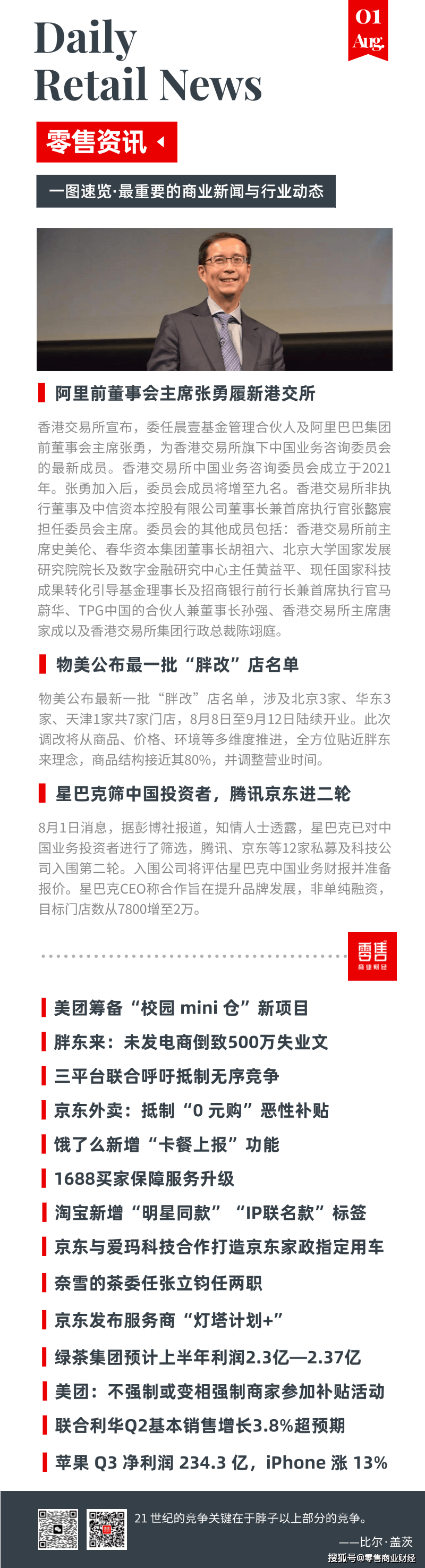
阿里前董事会主席张勇履新港交所;物美公布最一批“胖改”店名单
Sou Hu Cai Jing· 2025-08-01 12:25
Group 1 - Alibaba's former chairman Zhang Yong has been appointed as a new member of the Hong Kong Stock Exchange's China Business Advisory Committee, increasing the committee's membership to nine [6] - The committee was established in 2021 and is chaired by Zhang Jianchen, the non-executive director of the Hong Kong Stock Exchange [6][7] Group 2 - Wumart has announced the latest batch of "Fat Transformation" stores, involving seven locations across Beijing, East China, and Tianjin, set to open between August 8 and September 12 [8] - The transformation will focus on multiple dimensions including product offerings, pricing, and store environment, aiming to align closely with the Fat Donglai concept [8] Group 3 - Starbucks is reportedly screening investors for its China business, with Tencent and JD.com among the twelve companies advancing to the second round [10] - The collaboration aims to enhance brand development rather than merely seeking financing, with a target to increase store count from 7,800 to 20,000 [10] Group 4 - Meituan is preparing a new instant retail project called "Campus Mini Warehouse," targeting university campuses with small warehouses for high-frequency items [11] - The project will adopt a platform model, recruiting partners for warehouse and delivery services, prioritizing those with campus experience [11] Group 5 - The Green Tea Group expects a profit of approximately 230 million to 237 million yuan for the first half of 2025, a year-on-year increase of about 32% to 36% [22] - Adjusted net profit is anticipated to be around 247 million to 254 million yuan, reflecting a growth of 38% to 42% compared to the previous year [22] Group 6 - Unilever reported a 3.8% increase in underlying sales growth for Q2, exceeding expectations, with a slight decline in sales in the Chinese market [25] - The company is undergoing multiple transformations, including the planned spin-off of its ice cream business in November [25] Group 7 - Apple reported a net profit of $23.43 billion for Q3 2025, a 9% year-on-year increase, with revenue reaching $94.04 billion, up 9.6% [27] - iPhone revenue grew by 13% to $44.58 billion, and service revenue also increased by 13% to $27.42 billion, both exceeding market expectations [27]
蜜雪想再造一个“蜜雪
Jing Ji Guan Cha Wang· 2025-08-01 11:34
Core Insights - The article discusses the rapid expansion of the coffee brand Lucky Coffee, which aims to reach 10,000 stores by 2025, having already established 7,000 stores as of July 2023. The competitive landscape has changed significantly since the establishment of its parent company, Mixue Ice City, which also had a similar growth trajectory [1][2][3]. Expansion Strategy - Lucky Coffee has lowered the franchise entry barriers, offering a support policy that reduces the first-year franchise fee to 17,000 yuan. In key provinces and high-potential locations, franchise fees and management costs are waived. In major cities, total subsidies can reach up to 34,000 yuan per store [2][3]. - The company has doubled its market personnel to over 400 to accelerate store openings, with each market team responsible for 1,000 to 3,000 stores [2][3]. Historical Context - Lucky Coffee was incubated by Mixue Group in 2017 and became an independent brand after a full acquisition in 2020. The initial goal was to replicate the success of Mixue Ice City, which had reached 7,000 stores at that time [3][4]. - The brand's vision focuses on providing high-quality, affordable coffee globally, which led to significant price reductions for its products [3][4]. Market Positioning - Lucky Coffee initially targeted third to fifth-tier cities, filling a market gap where few chain coffee shops existed. This strategy positioned it among the top three brands in terms of store count by 2020 [7]. - The competitive landscape has intensified, with major players like Luckin Coffee and Kudi rapidly expanding their presence in the market [8][9]. Financial Performance - In 2022, Lucky Coffee experienced rapid growth, increasing its store count from 465 to 2,301, driven by the introduction of popular products and effective marketing strategies [6]. - The average single-cup price is around 7 yuan, providing a competitive edge against price wars initiated by rivals [8][9]. Supply Chain and Operational Efficiency - Lucky Coffee has adopted cost-saving measures, such as using semi-automatic coffee machines instead of more expensive fully automatic ones, which helps keep franchise costs lower [12]. - The brand benefits from a shared supply chain with Mixue Group, enhancing operational efficiency and reducing costs [15][16]. Future Outlook - The coffee market in China is expected to grow significantly, with per capita coffee consumption projected to increase. Lucky Coffee aims to leverage this growth potential to expand its store network further [15]. - Despite the competitive pressures, Lucky Coffee believes it has a strong foundation due to its backing from Mixue Group and its established supply chain [16].