
卫星产业

Search documents
20万颗卫星引爆资本市场,中国技术集团持续发力航天产业
Sou Hu Wang· 2026-01-12 01:28
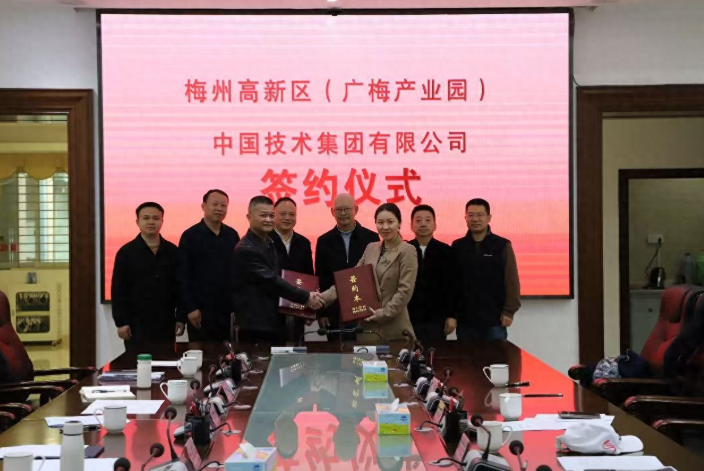
Core Viewpoint - China's application for over 200,000 satellite frequency and orbit resources has elevated the issue to a national strategic level, intensifying global competition for space resources [1] Group 1: Industry Overview - The low Earth orbit (LEO) can theoretically accommodate about 60,000 satellites, with approximately 10,824 satellites currently in orbit as of May 12, 2025, resulting in a utilization rate of about 18.0% [1] - The U.S. Federal Communications Commission (FCC) has approved SpaceX's plan to deploy an additional 7,500 Gen 2 Starlink satellites, building on its existing 8,000 satellites [1] - Various entities, including traditional telecom operators like China Mobile and China Telecom, are now involved in satellite internet, indicating a rapid integration into the national information infrastructure [1] Group 2: Company Developments - The satellite industry is expected to experience a boom, encompassing satellite manufacturing, rocket launches, and ground equipment operation services, with the satellite industry ETF (159218) showing strong performance [2] - China has initiated several national satellite constellation projects, including the "GW Constellation" and "Qianfan Constellation," aiming to deploy thousands of satellites over the next decade [2] - China Technology Group (01725.HK) is involved in the planning of the "Jin Zijin Constellation," which aims to provide comprehensive solutions for smart cities and various applications such as disaster prevention and agricultural monitoring [2][3] Group 3: Technological Innovations - The "Jin Zijin Constellation" aims to create a hybrid low-orbit high-frequency satellite constellation that integrates optical remote sensing and synthetic aperture radar, providing all-weather monitoring services [3] - The satellites in the "Jin Zijin Constellation" are equipped with advanced optical cameras and utilize commercial off-the-shelf (COTS) products, enhancing remote sensing capabilities while reducing power consumption [5] - The satellite manufacturing and control centers of China Technology Group are currently located in Hong Kong, with plans to relocate to Guangzhou, leveraging regional advantages [5] Group 4: Strategic Collaborations - China Technology Group has signed a strategic cooperation memorandum with Meizhou High-tech Zone to promote a national-level zero-carbon park project, focusing on satellite structure factories and related industrial chains [7]

资金加仓ETF!成交突破3000亿元
Xin Lang Cai Jing· 2026-01-11 23:26
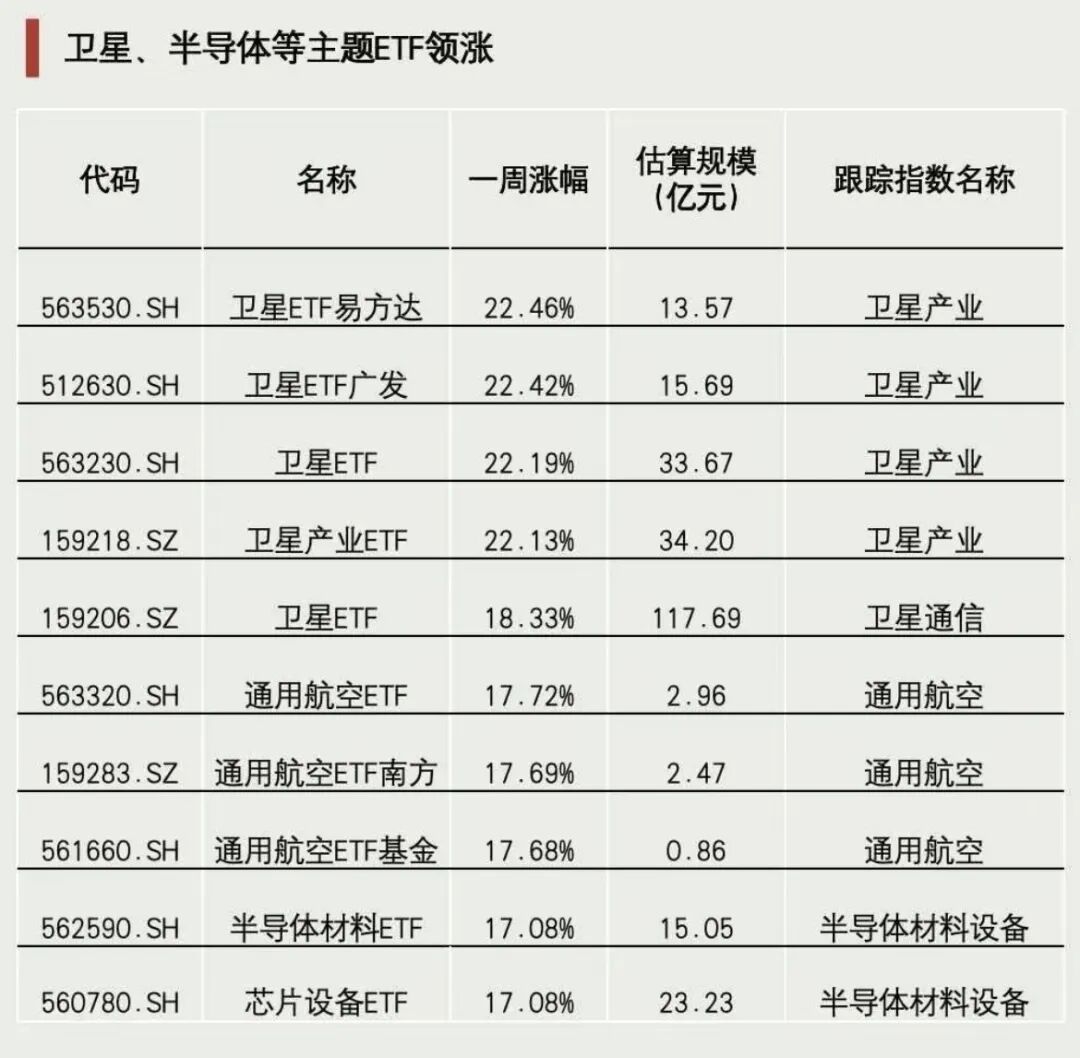
Core Insights - The satellite and semiconductor equipment sectors have shown remarkable performance in the first week of the year, with the China Securities Satellite Industry Index rising nearly 23% [1][9]. - Various ETFs related to the satellite industry have also experienced significant gains, with many exceeding 20% [1][11]. ETF Performance - The top-performing ETFs include: - E Fund Satellite ETF (563530) with a weekly increase of 22.46% and an estimated scale of 13.57 billion [2][12]. - Other notable ETFs include: - GF Satellite ETF (512630) at 22.42% [2]. - Satellite Industry ETF (159218) at 22.13% [2]. - Semiconductor Material ETF (562590) and Chip Equipment ETF (560780) both at 17.08% [2][12]. Fund Inflows - Significant capital inflows were observed, with the GF China Hong Kong Stock Connect Non-Bank Financial Theme ETF leading with over 3.78 billion in net inflows [4][15]. - The E Fund Securities Insurance ETF (512070) also performed well, attracting 2.19 billion in net inflows [4][14]. Trading Volume - The trading volume for broad-based indices was robust, with the ETF tracking the China Securities A500 Index surpassing 300 billion in total trading volume [6][16]. - The E Fund A500 ETF (159361) alone had a trading volume of 33.6 billion [6][16]. Market Outlook - The market is expected to continue favoring technology growth and core assets, with a positive macroeconomic environment supporting this trend [7][17]. - The focus on major growth indices like the China Securities A500 and CSI 300 is recommended due to their stable earnings expectations and historical valuation [8][18].

资金加仓!成交突破3000亿元
Zhong Guo Zheng Quan Bao· 2026-01-11 23:09
Group 1 - The satellite and semiconductor equipment sectors saw significant ETF gains in the first week of the year, with the China Securities Satellite Industry Index rising nearly 23% [1][3] - Multiple satellite industry ETFs, including E Fund's Satellite ETF (563530), outperformed with gains exceeding 20% [1][3] - The semiconductor equipment sector also performed strongly, with ETFs like E Fund's Semiconductor Equipment ETF (159558) and Semiconductor Materials ETF (562590) seeing increases of over 17% [3] Group 2 - The first week of the year witnessed substantial capital inflows into various ETFs, particularly in the satellite, non-ferrous metals, and semiconductor sectors, with the E Fund's non-bank financial theme ETF leading with over 3.7 billion yuan in net inflows [1][6] - The total trading volume for ETFs tracking the China Securities A500 Index surpassed 300 billion yuan, indicating robust market activity [1][8] - The Hong Kong technology sector also attracted significant investment, with ETFs tracking the Hang Seng Technology Index collectively seeing over 5.6 billion yuan in net inflows [6][8] Group 3 - The performance of various thematic ETFs, including those in media, military industry, and innovative pharmaceuticals, showed gains exceeding 13%, reflecting a broad recovery in market risk appetite [4][5] - The E Fund's Satellite ETF (563530) had an estimated scale of 1.357 billion yuan, while other satellite ETFs also reported substantial asset sizes [4] - The overall market sentiment is shifting positively, with expectations for continued growth in technology and core assets, supported by favorable macroeconomic conditions [9]
卫星产业站上风口 相关ETF持续“吸金”
Shang Hai Zheng Quan Bao· 2026-01-11 21:52
Group 1 - The satellite industry is experiencing strong performance, with related ETFs attracting significant capital inflows, indicating substantial mid-to-long-term investment value due to policy support, technological breakthroughs, and market demand [1][2] - As of January 7, 2025, the Yongying Satellite ETF and the China Merchants Satellite Industry ETF have each received over 1 billion yuan in net inflows this year, while the Fortune Satellite ETF and the E Fund Satellite ETF have attracted 965 million yuan and 385 million yuan respectively [1] - The total net inflows for the Yongying Satellite ETF since Q4 2025 amount to 5.257 billion yuan, with the China Merchants Satellite Industry ETF and the Fortune Satellite ETF receiving 1.627 billion yuan and 1.22 billion yuan respectively [1] Group 2 - The strong performance of the satellite sector is attributed to multiple factors, including key technological breakthroughs, clear national strategies, sustained industrial demand, and active market recognition [2] - The Ministry of Industry and Information Technology supports new models like "mobile direct satellite" applications, aiming for over 10 million satellite communication users by 2030 and issuing satellite internet licenses to multiple operators [2] - The commercial space sector is expected to see a surge in IPOs following the revision of the fifth set of standards on the Sci-Tech Innovation Board, which includes commercial aerospace [2] Group 3 - Institutions are particularly focused on companies' future strategies in the commercial aerospace sector, with companies like Unisoc highlighting their advancements in products for this strategic area [3] - The successful launch of the Zhuque-3 rocket is seen as a critical solution to the long-standing issue of insufficient heavy-lift capacity in China's commercial aerospace, potentially accelerating satellite communication network deployment [3] - The satellite industry is anticipated to enter a new development phase driven by strong policy support and ongoing industrial progress, presenting mid-to-long-term investment opportunities [3]


主题投资大放异彩 卫星主题ETF“霸榜”
Zhong Guo Zheng Quan Bao· 2026-01-11 20:49
Group 1 - The A-share market experienced a strong start in the first trading week of 2026, supported by improved macro expectations and ample liquidity, with major indices trending upwards [1] - The satellite and semiconductor equipment sectors led the market, with the satellite ETF tracking the China Satellite Industry Index achieving a weekly increase of 22.46%, indicating strong investor interest in these strategic emerging industries [1][2] - Multiple ETFs related to semiconductor materials and equipment also saw significant gains, with several products exceeding a 17% weekly increase, reflecting optimism driven by domestic control and global semiconductor cycle recovery [2] Group 2 - Despite the impressive performance of thematic ETFs, investors also focused on balanced allocations through broad-based indices and Hong Kong assets, with the Guangfa CSI Hong Kong Stock Connect Non-Bank Financial ETF seeing a net inflow of over 3.7 billion yuan, highlighting interest in the Hong Kong financial sector [2][3] - The overall market saw significant trading activity, with the total trading volume of ETFs tracking the CSI A500 index surpassing 300 billion yuan, indicating high investor engagement in this representative index of China's new economy [3] - Technology growth and core assets emerged as focal points for many public fund institutions, with expectations for continued strength in the technology sector driven by breakthroughs in AI, humanoid robots, and innovative pharmaceuticals [4]
中国商业航天迎“质变元年”卫星ETF规模开年接近翻倍
Zheng Quan Shi Bao· 2026-01-11 18:01
Core Viewpoint - The satellite industry chain has shown remarkable performance since the beginning of 2026, with significant growth in commercial aerospace, space stations, and Beidou navigation sectors, leading to substantial increases in satellite ETFs and related products [1][3]. Group 1: Market Performance - As of January 9, 2026, the China Satellite Industry Index has increased by 64.99% over the past month, while the National Commercial Satellite Communication Industry Index has risen by over 50% [1]. - Multiple satellite ETFs have seen performance increases exceeding 60% in the same timeframe, with total assets under management for satellite-related ETFs and linked products reaching 23.76 billion yuan, nearly doubling from 12.11 billion yuan at the end of 2025 [1]. - The Yongying National Commercial Satellite Communication Industry ETF has become the first satellite ETF to exceed 10 billion yuan in scale, currently standing at 11.769 billion yuan [1]. Group 2: Product Overview - There are currently four satellite industry indices in the market, with two having tracking products. The total scale of ETFs and linked products related to satellite investment exceeds 23.7 billion yuan [2]. - The Yongying National Commercial Satellite Communication Industry ETF is the only product tracking the National Commercial Satellite Communication Industry Index, while the China Satellite Industry Index has ten tracking products from various fund companies, including five ETFs [2]. Group 3: Industry Outlook - Fund managers anticipate that 2026 will be a pivotal year for the acceleration of China's commercial aerospace industry, with high entry barriers, strong policy support, and clear order visibility in midstream sectors like rocket launches and satellite manufacturing [3][4]. - The successful launch of the Zhuque-3 rocket marks a significant resolution to the long-standing issue of insufficient launch capacity, with various rocket models set to conduct frequent launches and recovery tests in the coming months [4]. - Satellite communication is expected to serve as the foundational technology for 6G communication and support applications in autonomous driving, low-altitude economy, IoT, and space computing [4]. Group 4: Investment Considerations - The commercial aerospace sector is currently experiencing a convergence of industry, policy, and capital, leading to rapid development [5]. - The focus for selecting relevant listed companies should be on "technical barriers + competitive advantages + order visibility," prioritizing firms with core technologies, strong competitive capabilities, and stable order acquisition [6].
中国商业航天迎“质变元年” 卫星ETF规模开年接近翻倍
Zheng Quan Shi Bao· 2026-01-11 16:54
Core Viewpoint - The satellite industry chain has shown remarkable performance since the beginning of 2026, with significant growth in commercial aerospace, space stations, and Beidou navigation sectors, leading to substantial increases in satellite ETFs and related products [1][3]. Group 1: Market Performance - As of January 9, 2026, the China Satellite Industry Index has increased by 64.99% over the past month, while the National Commercial Satellite Communication Industry Index has risen by over 50% [1]. - Multiple satellite ETFs have seen performance increases exceeding 60% in the same timeframe, with total assets under management for satellite-related ETFs and linked products reaching 23.76 billion yuan, nearly doubling from 12.11 billion yuan at the end of 2025 [1]. - The Yongying National Commercial Satellite Communication Industry ETF has become the first satellite ETF to exceed 10 billion yuan in scale, currently standing at 11.769 billion yuan [1]. Group 2: Product Overview - There are currently four satellite industry indices in the market, with two having tracking products. The total scale of ETFs and linked products related to satellite investments exceeds 23.7 billion yuan [2]. - The Yongying National Commercial Satellite Communication Industry ETF is the only product tracking the National Commercial Satellite Communication Industry Index, with a total scale of 11.998 billion yuan across three products [2]. - The China Satellite Industry Index has ten tracking products, with five ETFs, two of which exceed 3 billion yuan in scale: the China Securities Satellite Industry ETF (3.42 billion yuan) and the Fortune China Securities Satellite Industry ETF (3.367 billion yuan) [2]. Group 3: Industry Outlook - Fund managers anticipate that 2026 will be a pivotal year for the acceleration of China's commercial aerospace industry, driven by high entry barriers, strong policy support, and clear order visibility in midstream sectors like rocket launches and satellite manufacturing [3][4]. - The recent successful launch of the Zhuque-3 rocket marks a significant resolution to the long-standing issue of insufficient launch capacity, with various rocket models set to conduct frequent launches and recovery tests in the coming months [4]. - Satellite communication is expected to serve as the foundational technology for 6G communication and support applications in autonomous driving, low-altitude economy, IoT, and space computing [4]. Group 4: Investment Considerations - The commercial aerospace sector is currently experiencing a convergence of industry, policy, and capital, indicating rapid development ahead [5]. - The focus for selecting relevant listed companies should be on "technical barriers + competitive advantages + order fulfillment," prioritizing firms with core technologies, strong competitive capabilities, and stable order visibility [6]. - Key indicators for observation include the proportion of R&D expenses, progress on research and matching projects, order visibility, and product gross margin levels [6].
财信证券宏观策略周报(1.12-1.16):顺势做多,科技优先-20260111
Caixin Securities· 2026-01-11 14:06
Group 1 - The report suggests a bullish outlook for the A-share market, driven by a slow bull market expectation, seasonal market movements, and global market synchronization, indicating a favorable investment window from mid-December 2025 to early March 2026 [4][7] - The report emphasizes the importance of focusing on technology growth sectors, particularly those that have previously underperformed but have catalysts for growth, in light of valuation expansion and liquidity easing [4][7] - Key investment areas include commercial aerospace, satellite industries, AI applications, humanoid robots, domestic AI computing power, and sectors benefiting from price increases such as storage chips, consumer electronics, non-ferrous metals, and chemicals [4][13][15] Group 2 - Recent government policies aimed at boosting domestic demand include optimizing service industry loans and implementing interest subsidies for personal consumption loans, which are expected to significantly enhance consumer demand [7][8] - Domestic prices are showing a mild upward trend, with the Consumer Price Index (CPI) rising by 0.2% month-on-month in December, driven by increased consumer spending during the holiday season [8][9] - The report highlights the distinction between "anti-involution" and monopoly, indicating that price increases and profit margins are key factors in differentiating the two concepts, with ongoing reforms expected to support price recovery in certain industries [10][12] Group 3 - The report notes that the U.S. Federal Reserve's interest rate cut expectations have been compressed, with a low probability of rate cuts in January 2026, but a cumulative reduction of about 50 basis points is anticipated throughout the year [11] - The technology sector is experiencing structural inflation characteristics, with new economic sectors showing price increases while traditional sectors remain weak, indicating a divergence in price trends [12] - The report maintains that the A-share market is likely to enter a new bullish phase, encouraging the acquisition of quality A-share assets, particularly in the non-ferrous metals and technology growth sectors [13][15]
卫星ETF鹏华(563790)涨超5.8%,商业航天迎来密集催化
Xin Lang Cai Jing· 2026-01-09 07:36
Group 1 - The commercial aerospace industry is experiencing rapid growth, driven by favorable policies and significant investments, such as Guangzhou's plan to become a global hub for commercial aerospace by 2035 and the establishment of a 5.2 billion yuan rocket recovery base in Hangzhou [1] - The commercial rocket industry is entering a golden development period, transitioning from initial development to rapid iteration, with key components including propulsion systems, rocket structures, and control systems expected to benefit from increased demand [1] - As reusable rocket technology matures, liquid rocket engines will be increasingly reused, leading to sustained benefits for rocket structures and control systems, highlighting investment opportunities in these areas [1] Group 2 - The China Satellite Industry Index (931594) has seen a strong increase of 5.93%, with notable stock performances from companies such as Xinke Mobile (688387) up 20.00% and Zhenlei Technology (688270) up 18.43% [2] - The Satellite ETF Penghua (563790) closely tracks the China Satellite Industry Index, which includes 50 companies involved in satellite manufacturing, launching, communication, navigation, and remote sensing, reflecting the overall performance of the satellite industry [2] - As of December 31, 2025, the top ten weighted stocks in the China Satellite Industry Index account for 63.64% of the index, with major players including China Satellite (600118) and Aerospace Electronics (600879) [2]
卫星产业ETF、卫星ETF易方达、卫星ETF、卫星ETF鹏华、卫星ETF广发涨超4%,卫星产业链持续爆发
Ge Long Hui· 2026-01-09 06:42
Core Viewpoint - The satellite industry is experiencing significant growth, driven by multiple favorable developments and the launch of large-scale satellite projects in China [1][3]. Group 1: Industry Developments - The Shanghai Composite Index has surpassed 4100 points, indicating positive market sentiment [1]. - Satellite industry ETFs, including those from E Fund, Penghua, and GF, have seen gains of over 4%, reflecting strong investor interest [1]. - The industry is characterized by a comprehensive investment matrix that includes upstream technology, midstream network scaling, and downstream applications [1]. Group 2: Major Projects and Contracts - Blue Arrow Aerospace has signed a formal launch service contract with China Star Network and Yuanxin Satellite, aiming to provide batch launch services [1]. - The "GW Constellation" project plans to deploy approximately 12,992 satellites, with 10% of the satellites expected to be launched within five years [1]. - The "Qianfan Constellation" aims to deploy around 15,000 satellites, with 108 satellites already in orbit [1]. Group 3: Government Initiatives - Guangzhou is promoting the gathering of talent, capital, and enterprises in the commercial aerospace sector, aiming to build a complete commercial aerospace ecosystem [2]. - The city has issued a plan to accelerate the construction of advanced manufacturing, supporting satellite constellation projects that align with national strategies [2]. - A new rocket production base in Hangzhou is set to have an annual capacity of 25 rockets, with a total investment of 5.2 billion yuan [2]. Group 4: Global Competition and Resource Allocation - Satellite spectrum and orbital resources are scarce and allocated based on a "first-come, first-served" principle, intensifying global competition for space resources [3]. - As of May 2025, approximately 10,824 satellites are in low Earth orbit, with a utilization rate of about 18% [3]. - The U.S. leads in the number of operational spacecraft, holding 75.94% of the global total, while China accounts for approximately 9.43% [3].