智能手机

Search documents
手机平均内存8.4GB创新高 华为居首达到12GB
Xin Lang Cai Jing· 2026-02-27 10:36
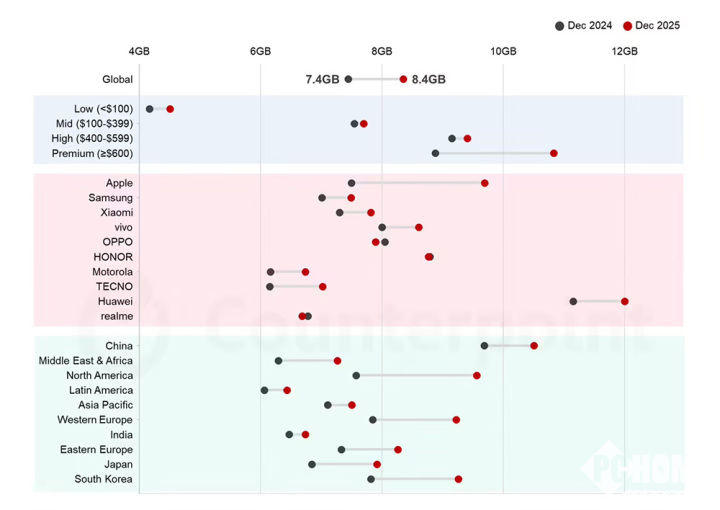
Core Insights - The global average smartphone memory reached 8.4GB RAM in December 2025, an increase of 0.6GB RAM from 7.8GB RAM in December 2024, marking a new high for average smartphone memory [1][5][7] Group 1: Market Trends - Flagship smartphones priced over $600 saw a significant increase in average memory from around 9GB RAM to nearly 11GB RAM, with new models typically featuring 12GB RAM [1][5] - Mid-range smartphones priced between $400 and $599 have not shown significant memory improvement, remaining below 10GB RAM, while entry-level models under $100 have average memory capacities of less than 6GB RAM [1][5] Group 2: Brand Performance - Huawei leads the market with an average memory of 12GB RAM, achieving the first widespread adoption of this memory level [4][7] - Apple follows in second place with an average memory of less than 10GB RAM, while Samsung and Xiaomi have average memory below 8GB RAM due to their large volume of mid to low-end models [4][7] - Vivo has shown significant improvement, indicating better market performance in the mid to high-end segment [4][7] Group 3: Regional Insights - The Chinese smartphone market has the highest average memory capacity, being the only market to exceed 10GB RAM, followed by North America, Europe, and South Korea, all of which have average memory exceeding 8GB RAM [4][7] Group 4: Cost Pressures - Despite the increase in average memory capacity, the cost of memory is rising sharply, with the memory cost for the iPhone 17 Pro Max exceeding 10% of total cost, up from 8% for the iPhone 12 Pro Max [4][8] - For high-end models with 16GB to 24GB RAM and 512GB to 1TB storage, memory costs could account for over 20% of total costs [5][8] - The rising memory costs will pressure manufacturers to make adjustments, potentially leading to price increases and downgrades in other components such as cameras and displays [5][8]



CounterPoint:2025年12月全球手机平均内存8.4GB创新高
Feng Huang Wang· 2026-02-27 09:27
Core Insights - The report by CounterPoint Research indicates that the global average smartphone memory (DRAM) is projected to reach 8.4GB by December 2025, marking a historical high [1] - In the high-end smartphone market (priced over $600), the average memory capacity is expected to be around 11GB, with 12GB rapidly becoming the standard configuration for high-end devices to support intensive multitasking and local execution of large language models (LLM) [1] Company Performance - Apple and Huawei are identified as the key drivers of memory growth in the smartphone market [1] - Apple's average smartphone memory has reached approximately 10GB, largely due to the upgrade of the iPhone 17 Pro series to 12GB, as the company shifts from relying on software optimization to adopting high-capacity, high-speed memory for local AI model performance [1] - Huawei leads in average memory capacity with 12GB, as its flagship models are now equipped with 12GB to 16GB of memory, solidifying its market share in the high-end segment in China [1]

吉利投资魅族或已失败,Flyme能否担当重任?
Sou Hu Cai Jing· 2026-02-27 09:10
Core Viewpoint - Meizu's mobile business is set to terminate, with a formal exit from the market in March 2026, highlighting the challenges faced by Geely Holdings in integrating Meizu into its broader automotive and consumer electronics ecosystem [1][2]. Group 1: Business Performance and Strategy - Geely acquired Meizu in 2022 with the intention of creating a "mobile-vehicle-home" ecosystem, but the mobile business has contracted significantly, with market share dropping below 1% and continuous losses reported [2][5]. - In 2025, Meizu's mobile sales plummeted to 980,000 units, a decline of over 40% year-on-year, resulting in a loss of 1.23 billion yuan, marking seven consecutive years of losses [2][6]. - The mobile business's operational challenges have led to a "death spiral" of declining sales, high costs, and increasing losses, with an average loss of 1,255 yuan per device sold [2][9]. Group 2: Financial Metrics - Geely's financial report for the first three quarters of 2025 shows a net profit of 13.11 billion yuan, while Meizu's ongoing losses have become a significant drag on overall performance [3]. - The smartphone market in China saw a slight decline in shipments, with major brands like Huawei, Apple, Vivo, Xiaomi, and OPPO capturing over 80% of the market share, leaving little room for smaller brands like Meizu [5][6]. Group 3: Supply Chain and Cost Issues - Meizu lacks bargaining power in the supply chain, facing component costs that are 15%-30% higher than leading brands, compounded by fixed expenses in R&D, channels, and marketing [9]. - The rising costs of smartphone components, including a 75% increase in memory prices in 2025, have severely impacted Meizu's profitability, leading to the cancellation of new product launches [6][9]. Group 4: Future Prospects - With the cessation of hardware development, Flyme is positioned as Meizu's core asset, with plans to transition it from a mobile OS to a smart cockpit system, aiming to leverage software capabilities to compensate for hardware losses [9][11]. - The future of Meizu is bifurcated into two potential paths: a successful transformation into a software service provider or a decline into a support role within Geely's automotive strategy, risking the loss of brand identity [12][13].

魅族回应传闻:将暂停国内手机新产品自研硬件项目 集中资源到Flyme软件
Mei Ri Jing Ji Xin Wen· 2026-02-27 08:39
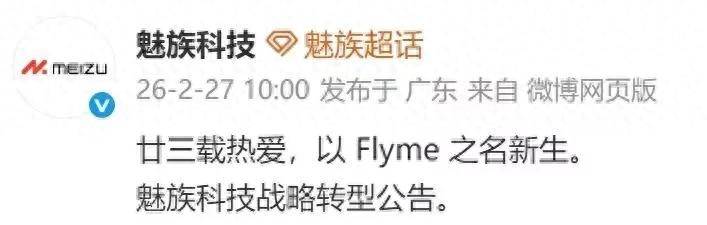
Core Viewpoint - Meizu is undergoing a strategic transformation, pausing the development of new domestic smartphone hardware projects to focus resources on the Flyme software ecosystem, amidst intense competition and rising memory prices in the smartphone market [1][2]. Group 1: Company Strategy - Meizu has announced a pause in the development of new domestic smartphone hardware, while actively seeking third-party hardware partnerships [1][2]. - The company aims to transition from a hardware-centric model to an AI-driven software product model, emphasizing the Flyme open ecosystem [2]. - Meizu's FlymeAuto has achieved a significant milestone with over 2.26 million units installed in 2025, aiming for 3 million units in collaboration with Geely in 2026 [3]. Group 2: Market Context - The global memory chip market has seen unprecedented price increases, with DRAM and NAND flash prices expected to rise by 386% and 207% respectively in 2025 [2]. - Major smartphone brands, including OPPO and OnePlus, are planning price adjustments due to rising component costs, indicating a challenging market environment [2]. - Meizu's market position has declined, now categorized under "Others" in the smartphone segment, highlighting the competitive pressures faced [3]. Group 3: Corporate Background - Meizu was founded in 2003 and launched its first MP3 product the same year, followed by its first smartphone, the M8, in 2009 [3]. - In July 2022, a strategic investment by Hubei Xingji Times Technology Co., which acquired a 79.09% stake in Meizu, marked a significant shift in control and management [3]. - Geely's chairman has expressed a vision for the integration of smart automotive and smartphone industries, aiming for a seamless user experience across devices [4].
人工智能疯狂抢占全球存储芯片,推高智能手机价格至历史新高
Xin Lang Cai Jing· 2026-02-27 08:34
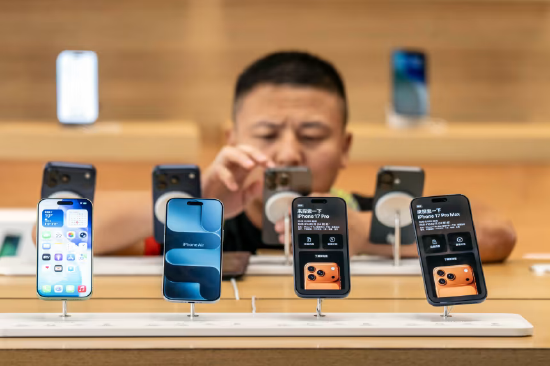
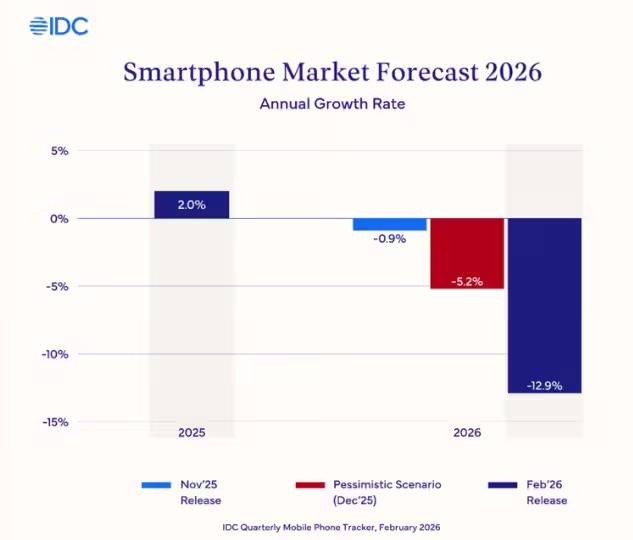
作者:斯蒂芬妮・杨、韦恩・张 一份最新报告指出,由人工智能引发的全球存储芯片短缺,已对智能手机行业造成 "海啸般冲击",将 手机价格推至历史新高。 波士顿科技分析机构国际数据公司(IDC)的报告称,存储元器件短缺状况持续恶化,预计今年将导致 部分手机厂商倒闭,智能手机价格也将创下历史新高。 IDC 移动设备研究主管弗朗西斯科・杰罗尼莫在周四发布的报告中表示: "我们正在经历的并非短期供应紧张,而是一场源自存储供应链的海啸式冲击,其涟漪效应正蔓延至整 个消费电子行业。" 报告预计: 这场半导体危机的根源,是人工智能的爆发式增长,以及随之而来的数据中心建设热潮 —— 而数据中 心高度依赖存储芯片。 需求暴涨之下,亚洲各大存储芯片巨头纷纷转向供应 AI 行业,留给笔记本电脑、游戏机、手机等消费 电子的产能所剩无几。 IDC 高级研究总监纳比拉・波帕尔在同一份报告中称: "简而言之,厂商和消费者都回不到过去的常态了。" 存储芯片告急 智能手机平均售价今年将上涨 14%,达到523 美元的历史最高点 厂商将无法再生产售价低于 100 美元的手机 2026 年智能手机销量将暴跌 12.9%,至11.2 亿部,为十多年来最 ...


魅族科技战略转型:暂停国内手机自研
Zhong Guo Jing Ying Bao· 2026-02-27 08:29
Core Viewpoint - Meizu Technology announced a strategic transformation, pausing the development of new domestic smartphone hardware and shifting focus towards AI-driven software products, while existing business operations remain unaffected [1] Group 1: Strategic Shift - The company will actively seek partnerships with third-party hardware providers as part of its new direction [1] - This marks a significant shift from a hardware-centric model to a software-focused approach, emphasizing the importance of the Flyme software ecosystem [1] Group 2: Market Challenges - The domestic smartphone market has become increasingly competitive, leading many brands to scale back their strategies [1] - Rising memory prices have severely impacted the commercialization of new products, with Meizu canceling the launch of the Meizu 22 Air due to these challenges [1] Group 3: Company Sentiment - The decision to pause hardware development was described as difficult, reflecting the company's commitment to its users and the legacy of its smartphones [1]
IDC:2026全球智能手机市场将下滑12.9%,存储芯片短缺成核心诱因
Sou Hu Cai Jing· 2026-02-27 07:02
Core Insights - The global PC and smartphone markets are expected to face significant declines in 2026, with smartphone shipments projected to drop by 12.9% and PC shipments by 11.3% due to supply shortages and rising prices of DRAM and NAND flash memory [1][3][5] Group 1: Market Predictions - The smartphone market is anticipated to experience a severe downturn, with a 6.8% year-over-year decline in Q1 2026, leading to an overall annual decline of 12.9% in shipments [5] - The PC market is also forecasted to see an 11.3% decline in shipments for the entire year of 2026, although revenue is expected to grow by 1.6% due to an increase in average selling prices (ASP) [3][5] Group 2: Supply Chain and Pricing Dynamics - Manufacturers are adopting aggressive stocking strategies in response to anticipated price increases in storage chips by the end of 2025, resulting in a temporary surge in shipments for both PCs and smartphones [3] - Despite the short-term relief from increased shipments, the long-term impact of storage chip shortages will persist, delaying a substantial market rebound until 2028 [3][5] Group 3: Industry Trends and Challenges - The demand for high-end storage chips driven by AI computing is reshaping the distribution of global semiconductor capacity, highlighting vulnerabilities in the supply chains of smaller manufacturers [7] - The phenomenon of rising average prices alongside weakening demand signals a critical warning for the industry, indicating that reliance on price increases without technological innovation may ultimately harm market demand [7]
魅族暂停国内手机新品自研硬件
Ge Long Hui· 2026-02-27 06:17
Core Viewpoint - Meizu Technology officially announced the suspension of its domestic smartphone hardware self-research projects and is seeking partnerships with third-party hardware providers, while existing operations will remain unaffected [1]. Group 1: Company Strategy - Meizu is undergoing a comprehensive strategic transformation, shifting from a hardware-centric model to a software-driven approach focused on AI products [1]. - The company aims to build a sustainable business model based on the Flyme open ecosystem [1].
魅族手机业务实质性停摆,计划2026年3月正式退出市场引发行业震动
Jing Ji Guan Cha Wang· 2026-02-27 05:50
Core Viewpoint - Meizu's mobile business is facing unprecedented challenges, with plans to exit the market by March 2026, leading to widespread concern about the brand's future [2] Group 1: Business Status - Meizu's mobile business has entered a substantial halt, with the new Meizu 23 series product launch being canceled and the team facing large-scale layoffs [2] - The company announced a pause on domestic hardware R&D projects and is seeking third-party hardware partners while ensuring existing business remains unaffected [2] - The continuous rise in memory prices has made the normal commercialization of new products impossible, contributing to the decline of Meizu's mobile business [2] Group 2: Historical Context - Meizu was once a leader in the domestic music player market and successfully transitioned to smartphones with the launch of the M8 in 2007 [3] - The rise of competitors like Huawei and Xiaomi gradually eroded Meizu's market share, leading to strategic missteps such as the 2014 launch of the Meilan brand, which did not receive adequate internal support [3] - Meizu's attempts to focus on the high-end market and adopt a "product sea" strategy in 2016 to expand offline channels did not yield the expected results, leading to increased costs without corresponding sales [3] Group 3: Recent Developments - In 2018, Meizu introduced the "Only Fine" strategy to return to a "small but beautiful" model, but sales plummeted to 5.51 million units, a 74% drop [4] - Despite being acquired by Geely's Xingji Times in 2022, the mobile business failed to reverse its downward trend, with market share dropping below 1% by 2025 [4] - Frequent changes in the executive team and employee turnover have further destabilized the company, with many former employees leaving [4] Group 4: Future Prospects - Although the mobile business is set to exit the market, Meizu's FlymeAuto vehicle system will continue to operate independently, gaining interest from car manufacturers like Geely's Zeekr [5] - Some employees have transitioned to roles within Geely's ecosystem, indicating a potential shift in focus for the brand [5] - The decline of Meizu's mobile business highlights the necessity for continuous innovation and strategic planning in a competitive market [5]
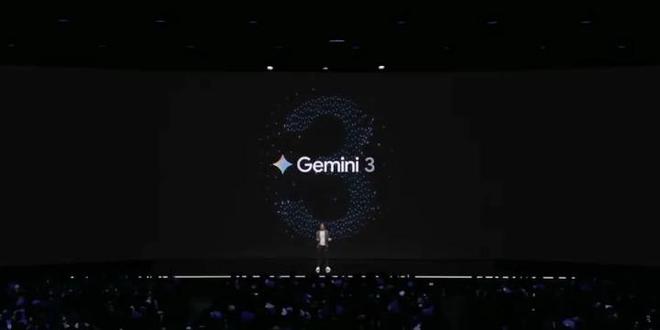
谷歌的“豆包手机”来了?
Guan Cha Zhe Wang· 2026-02-27 05:20
Core Insights - Samsung officially launched the Galaxy S26 series at the Galaxy Unpacked 2026 event, but the highlight was Google's introduction of the Gemini AI agent, which can automate complex tasks like ordering food and hailing rides in the background [1][3]. Group 1: Gemini AI Features - Gemini AI represents a significant evolution in Android, transforming the mobile assistant from merely answering questions to actively completing tasks for users [3]. - The AI can handle multi-step tasks seamlessly, such as processing a pizza order from a group chat by analyzing preferences and executing the order through various applications without user intervention [3][5]. - Initial supported scenarios for Gemini include ride-hailing (e.g., Uber), food delivery (e.g., DoorDash, Grubhub), and grocery shopping, with users able to activate it using natural language commands [3][5]. Group 2: Technical Mechanisms - Gemini operates through a "secure virtual window" mechanism, isolating AI operations within a sandbox environment to ensure user security while executing tasks [5][6]. - It employs a GUI Agent technology that allows the AI to understand and interact with application interfaces, enabling it to perform tasks without needing pre-defined API integrations [5][6]. - The AI's multi-step reasoning and planning capabilities allow it to create execution plans for complex tasks, ensuring it can adapt to various scenarios and handle unexpected situations [6]. Group 3: Market Context and Competition - The capabilities of Gemini AI closely mirror those demonstrated by ByteDance's Doubao mobile assistant just three months prior, indicating a competitive landscape in mobile AI technology [8][9]. - Doubao's early market entry and successful demonstration of similar functionalities have positioned it as a strong competitor in the mobile assistant space [9][10]. - The collaboration between Apple and Google to integrate Gemini into Siri indicates a broader industry consensus on the importance of mobile AI assistants, with significant financial backing for this initiative [10][11]. Group 4: Future Outlook - The introduction of Gemini AI is expected to enhance productivity by reducing app-switching and manual coordination for users, particularly in enterprise settings [12]. - The market for AI-enabled smartphones is projected to grow significantly, with an estimated 147 million units expected to ship in China by 2026, representing a 31.6% year-on-year increase [12]. - Samsung plans to release the Gemini AI feature in a beta version on March 11, 2026, with initial availability in the U.S. and South Korea, aiming to double the number of devices supporting Gemini to 800 million [12][13].