运输

Search documents
中通快递-W盘中涨超4% 小摩将目标价由187港元上调至197港元
Xin Lang Cai Jing· 2025-11-26 01:56
Group 1 - Zhongtong Express-W (02057) saw its stock price increase by 3.41% to HKD 160.80, with a trading volume of HKD 86.08 million as of the report [1] - During the "Double 11" shopping festival from October 20 to November 21, Zhongtong ranked first in comprehensive assessment indicators across various platforms, leading in reverse order volume and timely pickup rates [1] - The company achieved an overall increase of 0.76% in signing and delivery rates through data-driven strategies and end-terminal collaboration [1] - Zhongtong maintained its leading position in "Double 11" business volume for ten consecutive years, with a notable 19.5% year-on-year growth in rural express delivery [1] Group 2 - JPMorgan's report indicates that Zhongtong Express-W will continue to be a preferred stock in the transportation industry over the next 3 to 6 months, raising its target price for H-shares from HKD 187 to HKD 197, maintaining an "Overweight" rating [1] - The target price for Zhongtong Express (ZTO.US) in the US market was also increased from USD 24 to USD 25, with the same "Overweight" rating [1] - Morgan Stanley cited Zhongtong's management comments on anti-involution policies reshaping the competitive landscape, shifting the industry focus from quantity-driven growth to quality and profitability [2] - Zhongtong is benefiting from current industry developments, expanding market share while demonstrating robust profit performance [2]
凝聚先锋力量,共绘物流新篇!2025“寻找金牌代言人”颁奖典礼圆满收官 | 头条
第一商用车网· 2025-11-25 12:44
Core Viewpoint - The "Finding Gold Medal Spokesperson" event aims to promote cost reduction and efficiency enhancement in the automotive and transportation industries while advocating for more humanistic care, highlighting the contributions of industry leaders and their stories [1][9][10]. Event Overview - The event has been held for seven consecutive years, with increasing industry influence, and the 2025 edition was launched in the second half of 2025, involving months of visits and selections [3][9]. - The event was attended by various experts, scholars, and media representatives from logistics, passenger transport, and vehicle manufacturing sectors, marking the announcement of the 2025 "Gold Medal Spokesperson" [4][10]. Industry Impact - The event serves as a platform to amplify the voices of transportation professionals who often remain unnoticed, thereby enhancing their recognition and attracting new talent to the industry [6][9]. - The "Finding Gold Medal Spokesperson" event has significantly raised social awareness of the transportation industry, showcasing the dedication and contributions of its workers [9][10]. Award Recipients - The two "Gold Medal Spokespersons" for 2025 are "Efficient Transportation Spokesperson" Nie Wei and "Green Power Spokesperson" Gao Feng, both of whom have made significant contributions to their respective fields [12][15]. - Nie Wei, a truck driver from Jiangxi, has driven over 100,000 kilometers, demonstrating the reliability of the Shaanxi Automobile Delong G300 light truck [12][15]. - Gao Feng, president of a new energy technology company, emphasizes the importance of reliable power systems and has established a green transportation system tailored to industry characteristics [12][14]. Future Aspirations - The event organizers aim to continue enhancing the event's influence and authority, encouraging more industry professionals to share their stories and contribute to the industry's development [11][15]. - The ongoing commitment to recognizing and promoting exemplary figures in the transportation sector is expected to foster a stronger collaborative force for the industry's advancement towards intelligence, sustainability, and efficiency [11][15].


小摩:中通快递-W(02057)受惠政策顺风 升目标价至197港元 予“增持”评级
智通财经网· 2025-11-25 07:22
Group 1 - Morgan Stanley reports that ZTO Express (02057) will continue to be a preferred stock in the transportation industry over the next 3 to 6 months, raising the target price for its H-shares from HKD 187 to HKD 197 with a "Buy" rating [1] - The target price for ZTO Express (ZTO.US) in the US market has been increased from USD 24 to USD 25, maintaining the "Buy" rating [1] - The management of ZTO Express indicated that anti-involution policies are fundamentally reshaping the competitive landscape, shifting the industry focus from quantity-driven growth to quality and profitability [1] Group 2 - ZTO Express is benefiting significantly from current industry developments, continuing to expand its market share while demonstrating robust profit performance [1]
大行评级丨摩根大通:中通快递受惠于当前行业发展 H股目标价升至197港元
Ge Long Hui· 2025-11-25 03:19
Core Viewpoint - JPMorgan's research report indicates that ZTO Express will continue to be a preferred stock in the transportation industry over the next 3 to 6 months, raising its target price for H-shares from HKD 187 to HKD 197 and for US shares from USD 24 to USD 25, maintaining a "Buy" rating [1] Group 1 - ZTO Express is benefiting from the current industry development, showing a clear increase in market share while demonstrating robust profit performance [1] - The management's recent comments highlight that anti-involution policies are fundamentally reshaping the competitive landscape, shifting the industry focus from quantity-driven growth to an emphasis on quality and profitability [1]
日本21万亿救市,“饮鸩止渴”?
Sou Hu Cai Jing· 2025-11-25 02:43
Core Viewpoint - Japan's economy is facing significant challenges, including a return to negative growth due to external factors such as U.S. tariff policies impacting key industries like automotive, compounded by long-standing structural issues and short-term political risks [1][3][8]. Economic Growth and External Demand - In Q3, Japan's real GDP decreased by 1.8% on an annualized basis, marking a return to negative growth since Q1 2024, primarily driven by a sharp contraction in external demand, which contributed -0.2 percentage points to economic growth [1]. - The U.S. increased tariffs on Japanese goods, particularly raising automotive tariffs from 2.5% to 15%, severely impacting Japan's automotive industry and creating a vicious cycle of order declines and economic recession [1][3]. Domestic Demand and Consumer Behavior - Domestic demand remains weak, with inflation and declining real wages leading to reduced consumer spending. Personal consumption, which accounts for over half of Japan's economy, saw a slight increase of 0.1% quarter-on-quarter, while private residential investment fell by 9.4% [3][8]. - The deterioration of Japan-China relations, exacerbated by controversial statements from Prime Minister Fumio Kishida, has led to travel warnings from China, potentially costing Japan between $11.5 billion to $14 billion in tourism revenue, further dragging down GDP growth by 0.29 to 0.36 percentage points [3][5]. Government Response and Economic Stimulus - In response to the economic crisis, the Kishida government approved a ¥21.3 trillion (approximately $135.4 billion) economic stimulus plan aimed at addressing rising prices and boosting investment in sectors like semiconductors and AI. However, this plan relies heavily on fiscal expansion and monetary easing without addressing structural economic reforms [5][7]. - The government's debt, which stands at about 263% of GDP, raises concerns about the sustainability of increased spending, potentially leading to higher long-term interest rates and further pressure on government finances [7][8]. Structural Issues and Long-term Outlook - Japan's economy is hindered by deep-rooted structural issues, including an aging population (29% aged 65 and older), declining labor force, and reduced competitiveness in key industries like automotive, which has lagged in the transition to electric vehicles [8]. - The reliance on external markets exposes Japan's economy to risks, as evidenced by the impact of U.S. tariffs and geopolitical tensions. Analysts suggest that Japan's economy may continue to fluctuate around the growth line without effective reforms, and the current fiscal stimulus may only provide temporary relief without addressing fundamental issues [8].
日本经济难突重围
Sou Hu Cai Jing· 2025-11-24 22:29
Economic Overview - Japan's economy has entered a negative growth phase again, with a GDP decline of 1.8% year-on-year in Q3, primarily due to a sharp contraction in external demand [2] - The contribution of external demand to Japan's economic growth in Q3 was -0.2 percentage points, exacerbated by increased tariffs on Japanese goods, particularly automobiles [2] - Domestic demand remains weak, with personal consumption showing only a slight increase of 0.1% quarter-on-quarter, while residential investment fell by 9.4% [2] Government Response - The Japanese government, led by Prime Minister Fumio Kishida, has approved an economic stimulus plan worth 21.3 trillion yen (approximately 135.4 billion USD) to address rising prices and boost investment in sectors like semiconductors and AI [3] - The stimulus plan relies heavily on fiscal expansion and monetary easing, without addressing necessary structural reforms in the economy [3][4] Structural Challenges - Japan's government debt has reached approximately 263% of GDP, limiting the effectiveness of further spending and increasing long-term interest rates [4] - The aging population, with 29% aged 65 and above, is contributing to labor shortages and a shrinking consumer market [4] - Japan's automotive industry is struggling to adapt to the global shift towards electric vehicles, missing opportunities in the transition to new energy sources [4] Market Impact - Tensions in Sino-Japanese relations, exacerbated by controversial statements from the Japanese Prime Minister, have led to a significant decline in tourism revenue, estimated to be between 11.5 billion to 14 billion USD, impacting GDP growth by 0.29 to 0.36 percentage points [3] - The stock market has reacted negatively, particularly in the retail and transportation sectors, as civil exchanges between China and Japan are postponed or canceled [3] Long-term Outlook - Analysts suggest that Japan's economy may continue to fluctuate around the growth line without achieving effective growth, as the current fiscal stimulus may only provide short-term relief [5] - A genuine recovery will require institutional reforms and technological innovation rather than reliance on short-sighted policies or external confrontations [5]

龙洲股份:全资及控股子公司为其5000万元贷款提供担保
Xin Lang Cai Jing· 2025-11-24 07:53
Core Viewpoint - Longzhou Co., Ltd. plans to apply for a working capital loan of 50 million yuan from the Bank of Communications Longyan Branch, supported by guarantees from its wholly-owned subsidiaries and a controlling subsidiary [1] Financial Performance - As of September 30, 2025, Longzhou Co., Ltd. reported revenue of 1.825 billion yuan and a net profit attributable to shareholders of -95.6357 million yuan [1] - The total amount of external guarantees provided by the company and its controlling subsidiaries is 2.126 billion yuan, which accounts for 182.86% of the audited net assets attributable to shareholders for 2024 [1]

云南银沙建材有限公司成立 注册资本100万人民币
Sou Hu Cai Jing· 2025-11-22 11:55
天眼查App显示,近日,云南银沙建材有限公司成立,法定代表人为陈银凤,注册资本100万人民币, 经营范围为许可项目:第三类医疗设备租赁;第三类医疗器械经营;药品零售;道路货物运输(不含危 险货物);房地产开发经营。(依法须经批准的项目,经相关部门批准后方可开展经营活动,具体经营 项目以相关部门批准文件或许可证件为准)一般项目:木材加工;木材销售;建筑用木料及木材组件加 工;竹制品销售;竹制品制造;建筑材料销售;人造板销售;水泥制品销售;电线、电缆经营;建筑用 钢筋产品销售;建筑防水卷材产品销售;再生资源销售;五金产品批发;建筑装饰材料销售;消防器材 销售;金属制品销售;化工产品销售(不含许可类化工产品);服装辅料销售;日用杂品销售;塑料制 品销售;劳动保护用品销售;特种劳动防护用品销售;针纺织品及原料销售;服装服饰批发;日用品销 售;日用陶瓷制品销售;卫生洁具销售;厨具卫具及日用杂品批发;化妆品批发;安防设备销售;家用 电器销售;智能仪器仪表销售;仪器仪表销售;电子产品销售;计算机软硬件及辅助设备批发;网络设 备销售;移动通信设备销售;医护人员防护用品批发;第二类医疗设备租赁;第一类医疗器械销售;第 一类医疗 ...
一家酒店1000人取消预定?日本前首相鸠山引用论语批评高市
Zhong Guo Xin Wen Wang· 2025-11-20 12:08
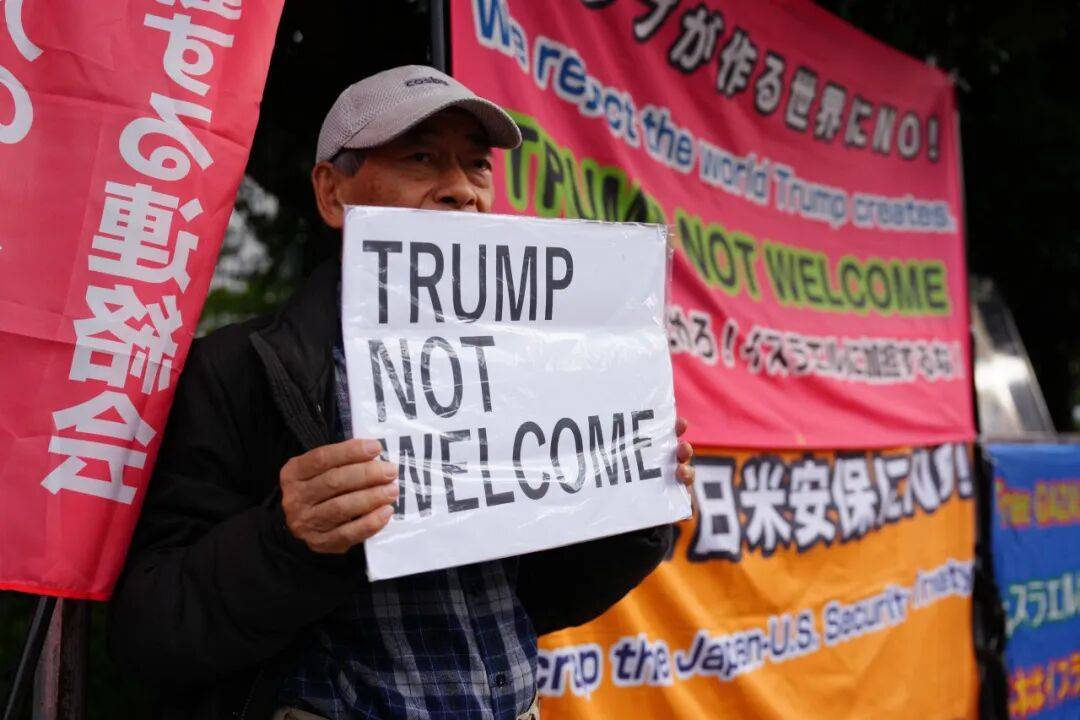
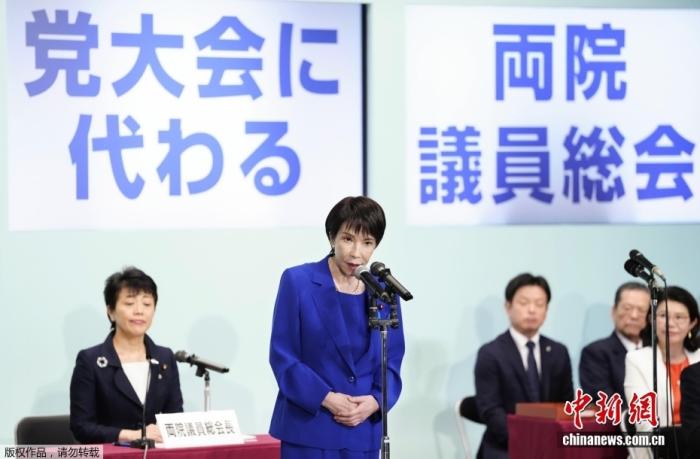
Core Viewpoint - The remarks made by Japanese Prime Minister Kishi Sanae have led to widespread criticism and a potential economic crisis in Japan, with significant backlash from both the public and former political leaders [3][4][5]. Group 1: Economic Impact - A hotel reportedly experienced 1,000 cancellations due to the fallout from Kishi's comments, indicating a direct negative impact on the hospitality sector [3]. - Japan's economy is under pressure, with a reported 1.8% year-on-year decline in real GDP for Q3 2025, marking a return to negative growth since Q1 2024 [5]. - Concerns are rising among investors regarding the deteriorating fiscal situation of the Japanese government, particularly affecting sectors closely tied to inbound consumption, such as retail, transportation, and hospitality, leading to significant stock declines [5]. Group 2: Public and Political Reaction - Former Prime Minister Yukio Hatoyama criticized Kishi's statements for straying from the principle that the Taiwan issue is a domestic matter for China, suggesting that the relationship between Japan and China has reached a critical low point [3][6]. - Protests have erupted in front of the Japanese Parliament, with citizens demanding Kishi retract her statements and apologize to China, reflecting public discontent with her leadership [4]. - Social media users are calling for Kishi to either sincerely apologize to China or resign, highlighting the perceived severity of her missteps [5][6].
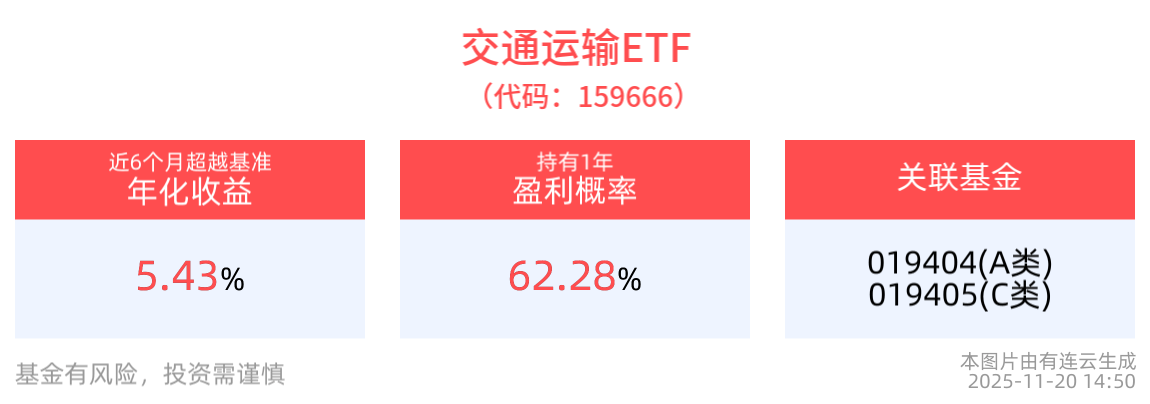
交通运输ETF(159666)近6个月超越基准年化收益达5.43%
Sou Hu Cai Jing· 2025-11-20 07:26
Core Viewpoint - The Transportation ETF (159666) has shown a slight decline of 0.29% as of November 20, 2025, with a recent price of 1.02 yuan, while it has increased by 1.68% over the past month [2]. Performance Summary - The Transportation ETF has achieved a net value increase of 17.73% over the past two years [2]. - The highest single-month return since inception was 15.82%, with the longest consecutive monthly gain being 4 months and a maximum gain of 11.93% [2]. - The average monthly return during rising months is 3.16%, with a total annual profit percentage of 100.00% and a historical one-year profit probability of 62.28% [2]. - Over the last six months, the ETF has outperformed its benchmark with an annualized return of 5.43% [2]. - The Sharpe ratio for the past month is reported at 1.78 [2]. Liquidity and Trading Activity - The ETF had a turnover rate of 7.64% during the trading session, with a total transaction volume of 6.1092 million yuan [2]. - The average daily trading volume over the past month was 9.4084 million yuan [2]. Risk and Drawdown Analysis - The maximum drawdown over the past six months was 4.93%, with a relative benchmark drawdown of 0.04% [2]. - The recovery time after drawdown was 68 days [2]. Fee Structure - The management fee for the Transportation ETF is 0.50%, and the custody fee is 0.10% [3]. Tracking Accuracy - The tracking error for the Transportation ETF over the past two years is 0.051% [3]. Index Composition - The ETF closely tracks the CSI All Share Transportation Index, which categorizes companies into various industry levels, providing a comprehensive performance analysis tool [3]. - As of October 31, 2025, the top ten weighted stocks in the index include China Railway High-speed (601816), SF Express (002352), and COSCO Shipping Holdings (601919), collectively accounting for 48.47% of the index [3]. Top Holdings - The top ten stocks and their respective weightings are as follows: - China Railway High-speed (601816): 8.89% - SF Express (002352): 8.46% - COSCO Shipping Holdings (601919): 7.87% - Daqin Railway (601006): 6.20% - Shanghai Airport (600009): 3.46% - China Eastern Airlines (600115): 3.09% - Southern Airlines (600029): 2.84% - YTO Express (600233): 2.75% - Air China (601111): 2.58% - China Merchants Energy Shipping (601872): 2.50% [5].