电信

Search documents
广州发布22条举措支持服务贸易和数字贸易高质量发展
Nan Fang Ri Bao Wang Luo Ban· 2025-04-21 07:58
4月17日,广州市政府常务会议审议通过《广州市关于以高水平开放推动服务贸易和数字贸易高质量发 展的若干措施》(下称《若干措施》),提出稳步扩大制度型开放、促进资源要素跨境高效便捷流动等 6个方面22项措施,深化服务贸易和数字贸易领域改革、开放、创新、合作。 为深化服务业对外开放,《若干措施》提出落实全国版、自贸区版跨境服务贸易负面清单,加强粤港澳 大湾区开放措施与跨境服务贸易负面清单工作衔接,紧密对接CEPA服务贸易协议,进一步放宽电信、 医疗、教育等服务领域外商投资准入条件,争创国家服务贸易创新发展示范区。 聚焦专业人才跨境流通,《若干措施》要求深入开展外籍"高精尖缺"人才认定标准试点,开展外国人来 华工作便利化试点,拓展境外职业资格(工种)认可清单,支持外国人才来穗创新创业。此外,《若干 措施》鼓励符合条件的外资机构参与财富管理、绿色金融等方面投融资,促进跨境投融资便利化。 在发展壮大新兴服务贸易方面,广州将引进高品质国际会展,打造一批有国际影响力的会展品牌;扩大 教育、医疗、文化、体育等生活性服务贸易供给,开展外商独资医院试点,积极引进境外高水平教育资 源,引进举办ITF赛事、ATP赛事等国际赛事,促进 ...
服务业扩大开放!金融、医疗等多领域明确155项试点任务
券商中国· 2025-04-21 07:17
Group 1 - The article discusses the introduction of the "Comprehensive Pilot Work Plan for Accelerating the Expansion of Service Industry Opening" by the State Council, which outlines 155 pilot tasks across various dimensions such as key service sector openings and industrial innovation development [1][2][3] - Key areas of focus include enhancing the opening of important industry sectors, improving element guarantees for foreign talent, and strengthening legal protections for foreign-related legal services [3][4] - The plan aims to promote the compatibility of rules and standards in critical business areas such as data cross-border flow, intellectual property, and carbon management, while also establishing a risk prevention and regulatory coordination system [3][4] Group 2 - In the telecommunications sector, the plan proposes removing foreign investment restrictions on application stores and internet access services, encouraging the development of data annotation industries, and supporting the overseas expansion of gaming businesses [4] - In the healthcare sector, it supports foreign doctors opening clinics, short-term practice for foreign medical professionals, and the establishment of foreign-funded nursing schools [4] - In the financial sector, the plan encourages the exploration of international factoring business, cross-border fund operations in RMB, and the issuance of green bonds by qualified leasing companies [4]


A股收评:沪指涨0.45% 两市成交额重回万亿元
news flash· 2025-04-21 07:11
Core Viewpoint - The A-share market showed a positive trend on April 21, with major indices closing higher and trading volume exceeding 1 trillion yuan, indicating a robust market performance [1] Market Performance - The Shanghai Composite Index rose by 0.45%, the Shenzhen Component Index increased by 1.27%, and the ChiNext Index gained 1.59% [1] - Over 4,300 stocks experienced price increases, reflecting broad market participation [1] Sector Performance - Gold-related stocks performed strongly, with notable gains including a 20% limit-up for Xiaocheng Technology, and limit-up performances from Fuchun Environmental Protection, Chifeng Gold, and Sichuan Gold [1] - Other sectors that saw significant gains included paper-making and internet industries [1] - In contrast, sectors such as highways, banking, real estate, and telecommunications experienced declines [1] Trading Volume - The total trading volume of the two markets surpassed 1 trillion yuan, indicating a return to high trading activity levels [1]
服务业扩大开放 金融、医疗等多领域明确155项试点任务
Yang Shi Xin Wen Ke Hu Duan· 2025-04-21 07:06
Group 1 - The State Council introduced the "Work Plan for Accelerating the Comprehensive Pilot Work of Expanding the Opening-up of the Service Industry," outlining 155 pilot tasks across various dimensions such as key service sector openings and industrial innovation development [1][3] - The plan emphasizes the importance of improving element guarantees, including visa exemptions, permanent residency, payment facilitation, and professional qualification recognition to ease the entry and practice of foreign talent [3][4] - It aims to enhance the compatibility of rules and standards in critical business areas such as cross-border data flow, standard formulation, intellectual property, and commercial encryption [3][4] Group 2 - In the telecommunications sector, the plan proposes to remove foreign ownership limits on application stores and internet access services, and encourages the development of data labeling industries and a data trading market [4] - In the healthcare sector, it supports foreign doctors opening clinics, short-term practice for foreign medical professionals, and the establishment of foreign-funded nursing colleges [4] - In the financial sector, it promotes the exploration of international factoring business and supports cross-border capital operations in RMB by multinational companies [4] - In the trade and tourism sector, it allows foreign investment in travel agencies for outbound tourism and supports pilot projects for traditional classic car bonded display and custody in Tianjin [4] - In the transportation sector, it supports cooperation in container shipping and explores new models for exporting new energy vehicles and power batteries [4]
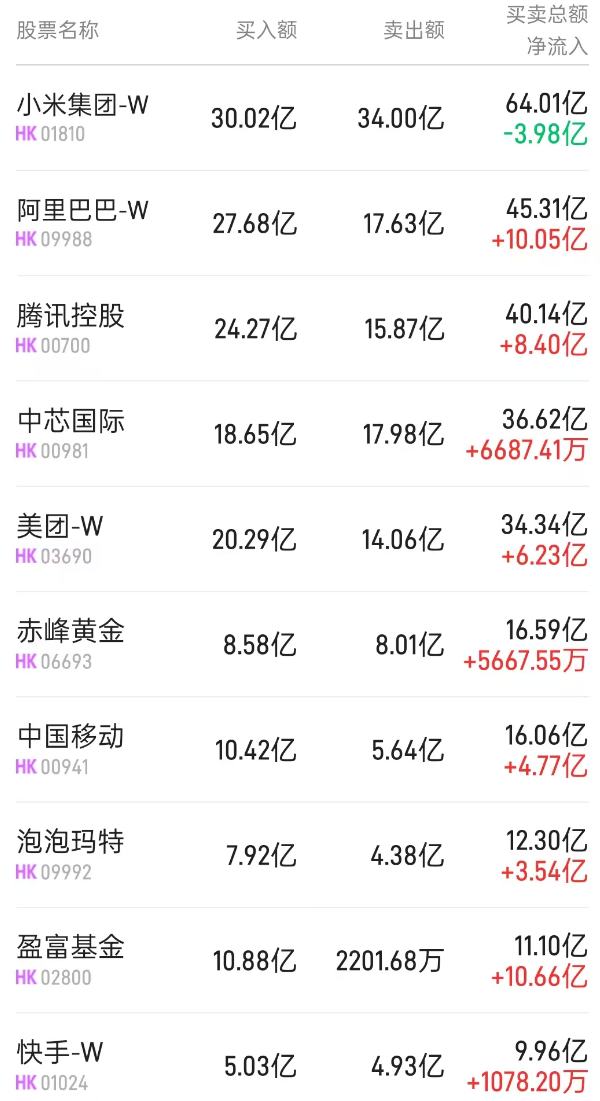
北水动向|北水成交净买入78.94亿 内资继续加仓盈富基金(02800) 全天抛售小米(01810)超9亿港元
智通财经网· 2025-04-16 09:55
Summary of Key Points Core Viewpoint - The Hong Kong stock market experienced significant net inflows from Northbound trading, with a total net buy of 78.94 billion HKD on April 16, 2023, indicating a positive sentiment towards certain stocks amidst easing trade tensions and potential policy support from the Chinese government [1][4]. Group 1: Northbound Trading Activity - Northbound trading saw a net buy of 80.41 billion HKD through the Shanghai Stock Connect and a net sell of 1.47 billion HKD through the Shenzhen Stock Connect [1]. - The most bought stocks included the Tracker Fund of Hong Kong (02800), Alibaba-W (09988), and China Mobile (00941) [1]. - The most sold stocks were Xiaomi Group-W (01810), SMIC (00981), and Xpeng Motors-W (09868) [1]. Group 2: Stock-Specific Transactions - Xiaomi Group-W had a net sell of 9.46 billion HKD, attributed to its recent fundraising activities and a delay in its investor day [6]. - Alibaba-W saw a net buy of 10.05 billion HKD, reflecting strong investor interest despite market volatility [2]. - Tencent Holdings (00700) and Meituan-W (03690) also received net buys of 8.40 billion HKD and 6.23 billion HKD, respectively, indicating confidence in their business models [2][5]. Group 3: Market Sentiment and Economic Outlook - Analysts suggest that the reduction in trade tensions and potential domestic policy support could bolster the Hong Kong stock market's resilience in the medium to long term [4]. - The impact of the U.S.-China trade war on Chinese internet companies is expected to be limited, with estimates suggesting less than a 0.5% effect on online consumption [5]. - The gold market is also showing strength, with COMEX gold prices surpassing 3,300 USD per ounce, benefiting companies like Chifeng Jilong Gold Mining (06693) [6].





高盛:2025科技泡沫破裂 25 周年:经验与教训报告
欧米伽未来研究所2025· 2025-04-10 17:04
Core Viewpoint - The article discusses the historical context of the tech bubble of 2000 and compares it to the current state of technology stocks, particularly focusing on the "Magnificent 7" tech giants, while highlighting the lessons learned and potential risks ahead. Group 1: Historical Context of the Tech Bubble - The late 1990s saw an unprecedented surge in internet commercialization, leading to a massive influx of capital and a dramatic rise in tech stock valuations, with the Nasdaq index increasing fivefold from 1995 to early 2000 [2] - The peak of the tech bubble was characterized by extreme valuations, with the Nasdaq's P/E ratio reaching 200, and individual stocks like Qualcomm soaring by 2619% in 1999 [3] - The bubble burst in March 2000, resulting in a loss of over 34% in the Nasdaq index within a month and a subsequent decline of nearly 80% by October 2002, leading to significant investor losses and company bankruptcies [4] Group 2: Current Tech Landscape - The current tech environment, particularly around AI, is marked by high investment enthusiasm, but the market conditions differ fundamentally from those in 2000, particularly in terms of valuation and underlying business strength [4][5] - The "Magnificent 7" tech giants are seen as mature companies with strong earnings, cash flows, and established business models, contrasting with the speculative nature of many companies during the 2000 bubble [8][9] Group 3: Risks Facing Current Tech Giants - High market concentration poses a risk, as the "Magnificent 7" account for over 20% of the total market capitalization of global indices, meaning their performance significantly impacts the overall market [10][11] - Excessive capital expenditure in AI and related infrastructure could lead to diminishing returns, similar to the over-investment seen in the telecom sector during the previous tech boom [13][14] - New competitors, including those from emerging markets, pose a threat to established tech giants, as history shows that market leadership can shift rapidly with technological advancements [14][15] Group 4: Future Investment Strategies - Investors are advised to adopt a cautious and diversified approach in the tech sector, recognizing the cyclical nature of technology development and the importance of fundamental analysis [16][17] - Emphasizing diversification across different segments and industries can help mitigate risks and capture broader growth opportunities [16] - Maintaining awareness of innovation trends is crucial, as advancements in AI, cloud computing, and other technologies will continue to shape the economic landscape [17]





高盛:2025科技泡沫破裂 25 周年:经验与教训报告
欧米伽未来研究所2025· 2025-04-10 17:04
" 欧米伽未来研究所 " 关注科技未来发展趋势,研究人类向欧米伽点演化过程中面临的重大机遇与挑战。将不定期推荐和发布世界范围重要科技研究进 展和未来趋势研究。( 点击这里查看欧米伽理论 ) 2025年的春天,距离那场席卷全球的互联网科技泡沫宣告破灭,已经过去了整整二十五年。那是一个狂热与梦想交织的时代,也是一个幻灭与阵 痛并存的时代。当年的硝烟早已散尽,但历史的钟摆似乎又一次摆向了相似的位置——科技股,尤其是以美国"七巨头"(Magnificent 7)为代表 的科技巨头,在经历了近年来的辉煌增长后,于2025年初也遭遇了显著回调。这不禁让人发问:我们是否又站在了新一轮泡沫的边缘?历史会简 单地重演吗?高盛集团在科技泡沫破裂25周年之际发布了一份深度报告,试图剖析两次科技浪潮的异同,并从中汲取经验教训。本文将基于这份 报告,带您回顾那段波澜壮阔的历史,审视当下的科技格局,并展望未来的机遇与风险。 第一章:那一场席卷全球的狂热与幻灭 二十世纪末,互联网的商业化浪潮以前所未有的力量席卷全球。一个全新的、充满无限可能的数字世界展现在人们面前。".com"成为了时代的 最强音,似乎只要与互联网沾边,就意味着拥有了点石 ...
麦肯锡全球并购报告:并购浪潮终于到来?
麦肯锡· 2025-04-09 07:52
Core Viewpoint - The global M&A market is expected to recover by 2025, with improved transaction returns, although geopolitical and policy barriers may pose challenges [1][2]. Group 1: Optimistic M&A Outlook - The macroeconomic environment is more favorable compared to previous years, with resilient global economic performance and stable employment rates [2]. - Companies seeking M&A have strong balance sheets and significant cash reserves, estimated at approximately $7.5 trillion in idle cash on non-financial balance sheets [2]. - There is a backlog of demand for M&A as companies shift focus from organic growth to strategic acquisitions, particularly in sectors like banking, life sciences, oil and gas, technology, and advanced manufacturing [2]. Group 2: Strategic M&A Approaches - Leading M&A participants often adopt a programmatic acquisition strategy, conducting multiple small to medium-sized acquisitions annually, resulting in a median excess shareholder total return of 2.3% [3]. - The political landscape and regulatory changes following significant elections in 2024 are expected to reshape market operations, necessitating strategic adjustments by companies [3]. Group 3: Role of Private Equity - Private equity is anticipated to be a significant driver of M&A market growth in 2025, with over $2 trillion in uninvested capital globally [4]. - The average holding period for private equity exits reached a historical high of 8.5 years in 2024, indicating a need for investors to seek returns [4]. - The private equity sector has seen substantial growth, with assets increasing by 34% from 2020 to 2023, reaching $28 trillion, nearly matching the total growth of public funds [4]. Group 4: Challenges Ahead - The M&A market in 2025 faces challenges from geopolitical instability, trade policy changes, and regulatory decisions, which could impact economic growth and M&A activity [5][6]. - Increased regulatory scrutiny, particularly in the U.S., may complicate transaction processes, requiring more comprehensive disclosures and potentially extending preparation times for complex deals [6]. Group 5: 2024 M&A Market Performance - In 2024, the global M&A transaction value for deals over $25 million grew by 12% to $3.4 trillion, with the number of transactions increasing by 8% to 7,784 [7]. - The average transaction value rose by 4% to $443 million, although mega-deals (over $10 billion) decreased by 6% to $664 billion [7]. - Mid-sized transactions (between $1 billion and $10 billion) became the most favored type, increasing their share of global M&A activity from 41% in 2023 to 46% in 2024 [7]. Group 6: Regional M&A Activity - In the Americas, M&A activity returned to pre-pandemic levels, with a 12% increase in transaction value to $1.8 trillion and a 9% increase in transaction volume to 2,763 [10]. - European participants focused on enhancing resilience amid economic challenges, with a 15% increase in transaction value to $845 billion in 2024 [11]. - The Asia-Pacific region saw a 10% increase in M&A transaction value to $797 billion, although it remained below pre-pandemic levels, with notable structural changes in the market [12]. Group 7: Future M&A Strategies - Companies can enhance their M&A capabilities by adopting AI for transaction screening, expanding their search for potential targets beyond traditional methods [15]. - Focusing on smaller acquisitions can mitigate risks and accelerate the M&A process, especially in uncertain environments [16]. - Strengthening due diligence processes is crucial for maximizing value from transactions, with AI tools aiding in efficiency [17]. - Companies should aim to realize comprehensive synergies beyond cost savings, including revenue and portfolio synergies [18]. - Improving integration methods is essential, with leading participants leveraging AI to streamline the process and ensure alignment with value creation goals [20].

资产配置周报(2025-4-5):重回缩表-2025-04-05
Huaxin Securities· 2025-04-05 12:58
Report Industry Investment Rating No relevant content provided. Core Viewpoints of the Report - The overall economic situation shows that the debt - to - GDP ratio of the real - economic sector will decline, and the fiscal policy front - loading will end around the end of March and early April. The stock - bond ratio is trending towards bonds, and the value style is more dominant. The recommended investment portfolio includes 30 - year Treasury bond ETF, Shanghai Composite 50 Index, and CSI 1000 Index. The recommended industries are mainly A + H dividend - type stocks in sectors such as banking, telecommunications, and oil and petrochemicals [2][7][24] - The Chinese economy is in a marginal de - leveraging process. The growth rate of the real - economic sector's debt will decline, and the asset side is expected to operate stably. The investment strategy should focus on the allocation of assets with stable returns and appropriately take on high - risk assets to obtain high returns [22] Summary by Directory 1. National Balance Sheet Analysis - **Liability Side**: In February 2025, the debt growth rate of the real - economic sector was 8.4%, slightly lower than expected. It is expected to rebound to around 8.6% in March and then decline. The government's debt growth rate is expected to reach a high point around the end of March and early April and then decline. By the end of the year, the debt growth rate of the real - economic sector is expected to drop to around 8%, and that of the government sector to around 12.6% [2][18][19] - **Fiscal Policy**: Last week, the net increase of government bonds was 495.5 billion yuan, higher than the plan. This week, it is planned to have a net reduction of 435.7 billion yuan. The fiscal policy front - loading started around mid - January and will basically end around the end of March and early April [3][19] - **Monetary Policy**: Last week, the money market showed a marginal relaxation. The yield of the one - year Treasury bond closed at 1.48% at the weekend, and the term spread between the ten - year and one - year Treasury bonds narrowed to 24 basis points. The asset side may operate stably in the future, and it is necessary to observe whether the nominal economic growth rate of about 5% will become the central target for the next 1 - 2 years [4][20] 2. Stock - Bond Cost - Effectiveness and Stock - Bond Style - The stock - bond market continued the trend of a weak stock market and a strong bond market last week, with the value style remaining dominant. The yields of short - and long - term bonds declined significantly. Although there may be short - term fluctuations, the stock - bond cost - effectiveness is trending towards bonds, and the equity style is gradually shifting to value. This week, the recommended investment portfolio includes 30 - year Treasury bond ETF (20% position), Shanghai Composite 50 Index (60% position), and CSI 1000 Index (20% position) [7][23][24] - Since 2016, China has entered a period of marginal contraction of the national balance sheet. The investment strategy should focus on the allocation of stable - return assets and appropriately take on high - risk assets. The stock - bond cost - effectiveness is biased towards bonds, and specific allocation strategies are proposed for stocks and bonds [22] 3. Industry Recommendation 3.1 Industry Performance Review - This week, the A - share market declined with shrinking trading volume. Among the Shenwan primary industries, public utilities, agriculture, forestry, animal husbandry, and fishery, pharmaceutical biology, beauty care, and banking had the largest increases, while automobile, power equipment, household appliances, non - ferrous metals, and electronics had the largest decreases [31] 3.2 Industry Crowding and Trading Volume - As of April 3, the top five crowded industries were electronics, machinery and equipment, computer, power equipment, and pharmaceutical biology, while the bottom five were comprehensive, beauty care, coal, building materials, and oil and petrochemicals. The trading volume of the entire A - share market decreased this week, with non - bank finance, banking, pharmaceutical biology, beauty care, and retail trade having the largest increases in trading volume, and national defense and military industry, coal, oil and petrochemicals, power equipment, and non - ferrous metals having the largest decreases [34][36] 3.3 Industry Valuation and Profitability - This week, among the Shenwan primary industries, the PE (TTM) of social services, computer, public utilities, retail trade, and national defense and military industry increased the most, while that of comprehensive, automobile, household appliances, power equipment, and non - bank finance decreased the most. Industries with high profit forecasts in 2024 and relatively low current valuations compared to history include banking, insurance, oil and petrochemicals, non - ferrous metals, transportation, food and beverage, liquor, household appliances, telecommunications, and consumer electronics [39][40] 3.4 Industry Prosperity - In terms of external demand, there were mixed trends. The global manufacturing PMI declined in March, and the CCFI index decreased. However, the port throughput increased, and the export growth rates of South Korea and Vietnam rose. In terms of domestic demand, the second - hand housing price increased slightly, and quantity indicators showed mixed trends. The capacity utilization rate of ten industries rebounded in March, and the automobile trading volume was at a historically high level [44] 3.5 Public - Fund Market Review - In the fourth week of March (March 24 - 28), most active public - fund equity funds underperformed the CSI 300. As of March 28, the net asset value of active public - fund equity funds was 3.56 trillion yuan, slightly lower than 3.66 trillion yuan in Q4 2024 [59] 3.6 Industry Recommendation - In the de - leveraging cycle, the stock - bond cost - effectiveness is only slightly biased towards equities, and the value style is more likely to be dominant. The recommended A + H dividend portfolio includes 20 A + H stocks, and the A - share portfolio includes 20 A - share stocks, mainly concentrated in industries such as banking, telecommunications, oil and petrochemicals, and transportation [9][64]
大事不妙,李嘉诚疑似转移资产,官方三部门发声定性,长和必输无疑
Sou Hu Cai Jing· 2025-04-03 15:55
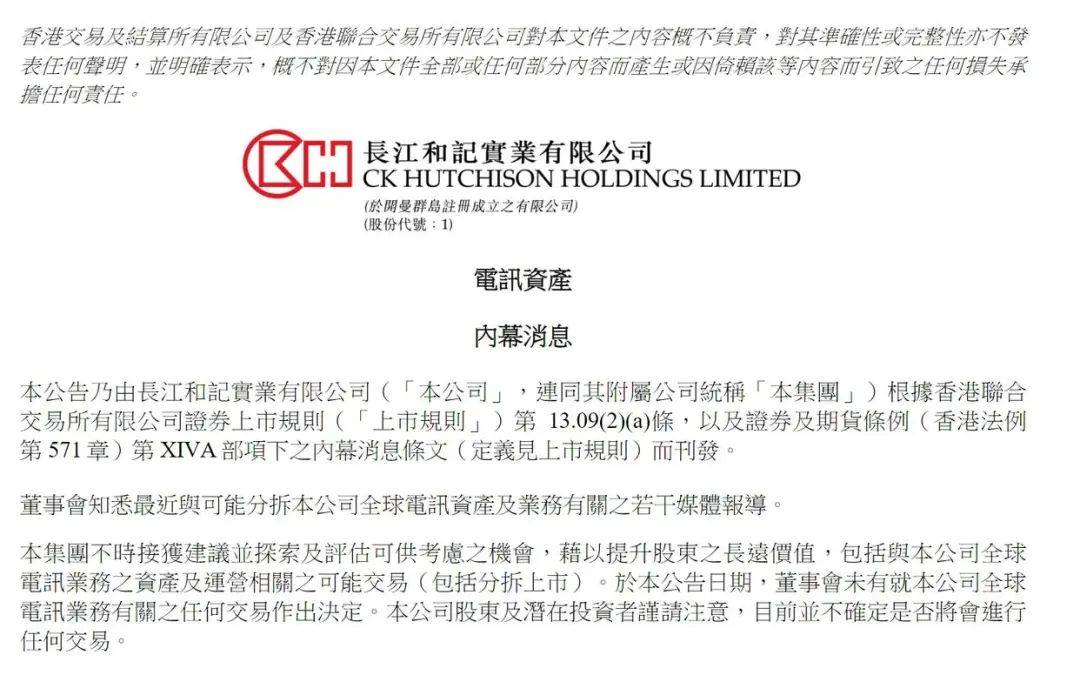
Group 1 - The core issue revolves around the $22.8 billion port deal between CK Hutchison Holdings and BlackRock, which has been delayed due to antitrust and national security reviews initiated by China's State Administration for Market Regulation [1][3] - The ports involved, Balboa and Cristobal, control 6% of global trade and are crucial for 21% of Chinese shipping, making the deal a significant geopolitical concern [3] - The Chinese government has expressed strong opposition to the deal, indicating it could harm China's legitimate interests, thus setting a political tone for the situation [3][6] Group 2 - CK Hutchison's response to the situation reveals underlying anxiety, as the company denied rumors of splitting its telecom assets but left room for future actions, interpreted as a strategy for risk isolation [5] - The company's stock fell by 3.54% following the announcement of the review, resulting in a market value loss of HKD 78.1 billion, and its projects in mainland China faced cooperation freezes [5] - Internal family divisions have emerged, with the second son, Li Ka-shing's son, distancing himself from CK Hutchison, indicating a pessimistic outlook on the situation [5] Group 3 - The regulatory scrutiny has expanded beyond the transaction itself to CK Hutchison's global asset structure, creating a dilemma where the company risks triggering severe consequences if it proceeds or defaults on the deal [6] - BlackRock, managing $10 trillion in assets, faces a dual challenge as it is involved in significant investments in China while also being perceived as a geopolitical player in this transaction [7] Group 4 - In response to U.S. containment strategies, China is accelerating the development of alternative trade routes, such as ports in Peru and Brazil, which could divert 30% of the cargo volume from the Panama Canal [8] - The ongoing U.S.-China tensions, particularly in the semiconductor sector, highlight the potential repercussions of the port deal, with significant implications for U.S. companies if China escalates its response [9] Group 5 - The situation reflects the broader challenges faced by multinational capital in a de-globalizing world, where business decisions intersect with national interests and responsibilities [10]