
生猪养殖

Search documents
资本赋能产业升级 豫企军团提质焕新
Sou Hu Cai Jing· 2025-10-08 22:15
Core Viewpoint - The capital market in Henan province has played a crucial role in enhancing the quality and efficiency of local enterprises during the "14th Five-Year Plan" period, facilitating technological upgrades and strategic industry improvements [1][2]. Group 1: Capital Market Development - The number of A-share listed companies in Henan increased from 87 at the end of 2020 to 112, with 13 companies listed on the Beijing Stock Exchange, leading the central six provinces [2]. - Since 2021, Henan enterprises have consistently raised over 100 billion yuan in bond financing annually, with the total bond issuance reaching 4,958 billion yuan, doubling since 2021 [2]. - The average cost of bond issuance has decreased to 2.66%, down 212 basis points from its peak [2]. Group 2: Industry Upgrades and Innovations - Leading companies like Muyuan Foods have leveraged capital markets for significant growth, with revenues projected to rise from 56.3 billion yuan in 2020 to 137.9 billion yuan by 2024 [3]. - Muyuan Foods has invested in R&D for smart farming and disease prevention, supported by a 300 million yuan technology innovation bond issued in May [3]. - The company has filed a total of 2,276 patents, with 138 new patents granted in 2024 alone [3]. Group 3: Financial Performance and Returns - By August 2025, the number of A-share listed companies in Henan with a market value exceeding 10 billion yuan reached 35, doubling from the previous year [6]. - Nearly 80% of listed companies reported profits in the first half of the year, with total revenues exceeding 100 billion yuan for 13 companies, and a combined net profit of 447.95 billion yuan, up 39.83% year-on-year [6]. - Companies like Shuanghui Development and Muyuan Foods have significantly increased their dividend payouts, with Shuanghui distributing 22.52 billion yuan in cash dividends in 2025 [7]. Group 4: Financial Tools and Services - The Zhengzhou Commodity Exchange has listed 27 futures and 20 options, capturing 35.03% of the national futures market share [8]. - The exchange has attracted 2.2 trillion yuan in settlement funds and has introduced seven products for foreign traders [8]. - Over 700 enterprises have received risk management services from Henan's futures companies, with agricultural insurance and futures business covering goods worth 39.14 billion yuan [10]. Group 5: Policy Support and Future Directions - The Henan government has implemented policies to support mergers and acquisitions, aiming to enhance traditional industries and foster emerging sectors [11][12]. - The "14th Five-Year Plan" has seen the issuance of various REITs to support infrastructure and promote digital and green transformations [11]. - The province aims to deepen cooperation with major stock exchanges to facilitate more companies in listing and financing [12].
资本市场助力河南“十四五”经济高质量发展 资本赋能产业升级 豫企军团提质焕新
Zheng Quan Shi Bao· 2025-10-08 17:40
Core Insights - The capital market in Henan province has played a crucial role in enhancing the quality and efficiency of local enterprises during the "14th Five-Year Plan" period, transitioning from quantity accumulation to quality improvement [1][2] - The number of A-share listed companies in Henan has increased from 87 at the end of 2020 to 112, leading the central region of China [2] - Major companies like Muyuan Foods and Shuanghui Development have leveraged capital markets to solidify their industry positions and drive technological advancements [2][3] Capital Empowerment - The number of A-share listed companies in Henan has grown rapidly, with 13 companies listed on the Beijing Stock Exchange, making it the leader among six central provinces [2] - From 2021 onwards, Henan enterprises have consistently raised over 100 billion yuan through bond financing, with the total bond stock reaching 495.8 billion yuan, doubling since 2021 [2] - The average cost of bond issuance has decreased to 2.66%, down 212 basis points from its peak [2] - Since 2022, 18 listed companies in Henan have engaged in mergers and acquisitions, with 12 occurring in 2025 alone, involving over 30 billion yuan [2] Industry Development - Muyuan Foods has seen its revenue grow from 56.3 billion yuan in 2020 to 137.9 billion yuan in 2024, driven by significant investments in technology and innovation [3] - The company has filed 2,276 patents, with 138 granted in 2024 alone, reflecting its commitment to R&D [3] - The capital market has supported the development of high-end materials companies like DuPont and Longbai Group, which have invested over 10 billion yuan in technology upgrades [4][5] Performance and Returns - By August 2025, the number of A-share listed companies in Henan with a market value exceeding 10 billion yuan reached 35, doubling from the previous year [5] - Nearly 80% of listed companies reported profits in the first half of the year, with total revenue and net profit hitting record highs [5] - R&D investment among listed companies in Henan has increased, with an overall R&D intensity of 5.57% in 2024, up 2.5 percentage points year-on-year [5] Financial Tools and Services - The Zhengzhou Commodity Exchange has become a significant player in the futures market, with 27 futures and 20 options listed, capturing 35.03% of the national market share [7] - The exchange has attracted 107 futures institutions and 2.2 trillion yuan in settlement funds [7] - The province has also implemented various financial initiatives, including private equity funds and REITs, to support the development of local enterprises [9][10] Policy Support - The Henan provincial government has introduced policies to support mergers and acquisitions, aiming to enhance traditional industries and foster emerging sectors [10] - The government plans to deepen cooperation with major stock exchanges to facilitate more companies in listing and financing [10]


十一猪价显著下跌,仔猪肥猪养殖同亏,关注产能去化进程:农林牧渔周观点(2025.9.29-2025.10.8)-20251008
Shenwan Hongyuan Securities· 2025-10-08 13:27
Investment Rating - The report suggests a positive outlook on the pig farming industry, indicating a potential for value reassessment of quality pig farming companies due to the "anti-involution" process and policy support [2][3]. Core Insights - The report highlights that the pig farming industry is experiencing a significant downturn, with both fat and piglet farming facing losses, prompting a potential acceleration in capacity reduction [2][3]. - It emphasizes the importance of focusing on quality pig farming companies, as they are expected to see a reassessment of their value amidst the ongoing industry changes [2][3]. - The report anticipates that the current pig cycle is nearing its downward end, making it an opportune time for left-side positioning in investments [2][3]. Summary by Sections Market Performance - The Shenyuan Agricultural Index increased by 0.2%, while the Shanghai and Shenzhen 300 Index rose by 2.0% [2][3]. - The top five performing stocks included Hualu Biological (6.0%), Honghui Fruits and Vegetables (4.1%), and Wancheng Group (3.7%) [2][3]. Pig Farming - The report notes that during the holiday period, pig prices have accelerated their decline, with the national average price for external three yuan pigs at 11.61 yuan/kg, down 0.67 yuan/kg from the previous week [2][3]. - The average self-breeding and self-raising farming cost is estimated between 12.5-13.0 yuan/kg, indicating that the industry is facing comprehensive losses [2][3]. - The report suggests that the current losses in pig farming will likely lead to an accelerated elimination of inefficient production capacity [2][3]. Chicken Farming - For white feathered chickens, prices have shown some recovery, with the average sales price for commodity chicks at 3.27 yuan/chick, up 5.48% week-on-week [2][3]. - The report advises monitoring the performance of related companies as the third-quarter earnings are expected to show a turning point [2][3]. Pet Food - In August, online sales of pet food reached approximately 2.4 billion yuan, reflecting an 11% year-on-year increase [2][3]. - The report highlights the performance of specific companies, such as Guibao Pet, which saw a 19% increase in GMV [2][3].

数百亿市场从天而降!对欧盟猪肉反倾销的意外有收获?
Xin Lang Cai Jing· 2025-10-05 10:02
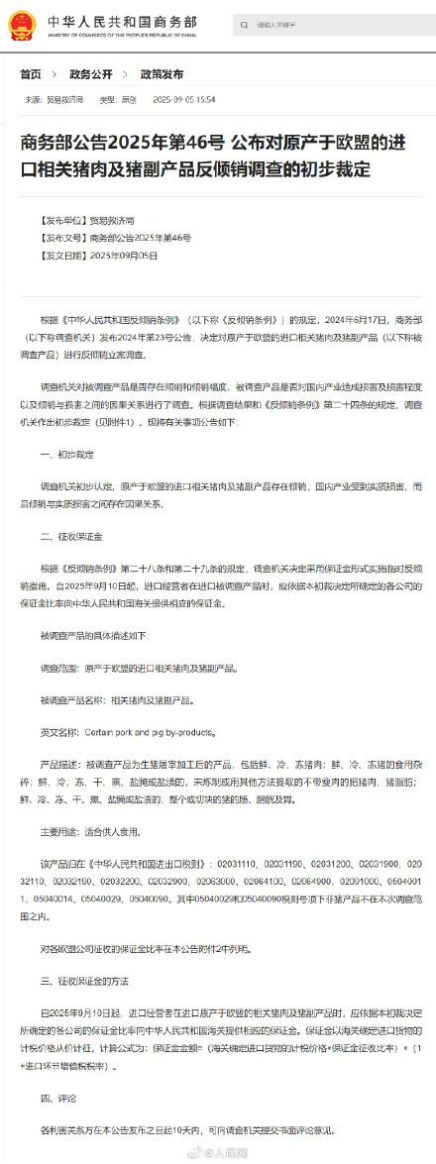
Core Viewpoint - The Chinese Ministry of Commerce has announced preliminary anti-dumping measures against EU imports of pork and pork by-products, imposing a deposit ranging from 15.6% to 62.4%, which is seen as a protective measure for the domestic pig industry [1][6] Group 1: Market Impact - The EU is the largest exporter of pork to China, with exports expected to account for 47% of its total exports to China in 2024, valued at 4 billion euros [2] - The anti-dumping measures are projected to reduce EU pork exports to China by 30% to 50% by 2025 [2] - The reduction in EU pork supply will create a market space of approximately 8 to 10 billion RMB annually for the domestic pork industry [5][9] Group 2: Domestic Industry Conditions - Domestic pork prices have been declining, with the average price of lean pork dropping below 17 RMB/kg, a year-on-year decrease of over 30% [6] - The influx of low-priced EU pork has severely impacted local profit margins, particularly for by-products like pig ears and feet, which are priced about 60% lower than domestic products [6] - The anti-dumping measures aim to create a fairer trading environment, providing stability for domestic producers and improving price expectations for small and medium-sized farms [6][9] Group 3: Opportunities for Improvement - The market space created by the anti-dumping measures will depend on the domestic industry's ability to enhance competitiveness through quality improvement and efficiency [7] - The industry should focus on standardized and large-scale farming, improving pork quality and production efficiency [7] - Slaughter and processing companies need to enhance cold chain logistics and optimize product structures to meet consumer trends [7] Group 4: Policy Support - The government is implementing various policies to stabilize pig production and market supply, including promoting standardized farming and increasing frozen pork reserves [9] - By 2026, the self-sufficiency rate of pork by-products is expected to rise to 85%, reducing reliance on imports [9] - The anti-dumping measures provide a critical adjustment window for the domestic pig industry, allowing for a shift from quantity expansion to quality enhancement [9]

在猪周期里躲牛市?
虎嗅APP· 2025-09-30 12:51
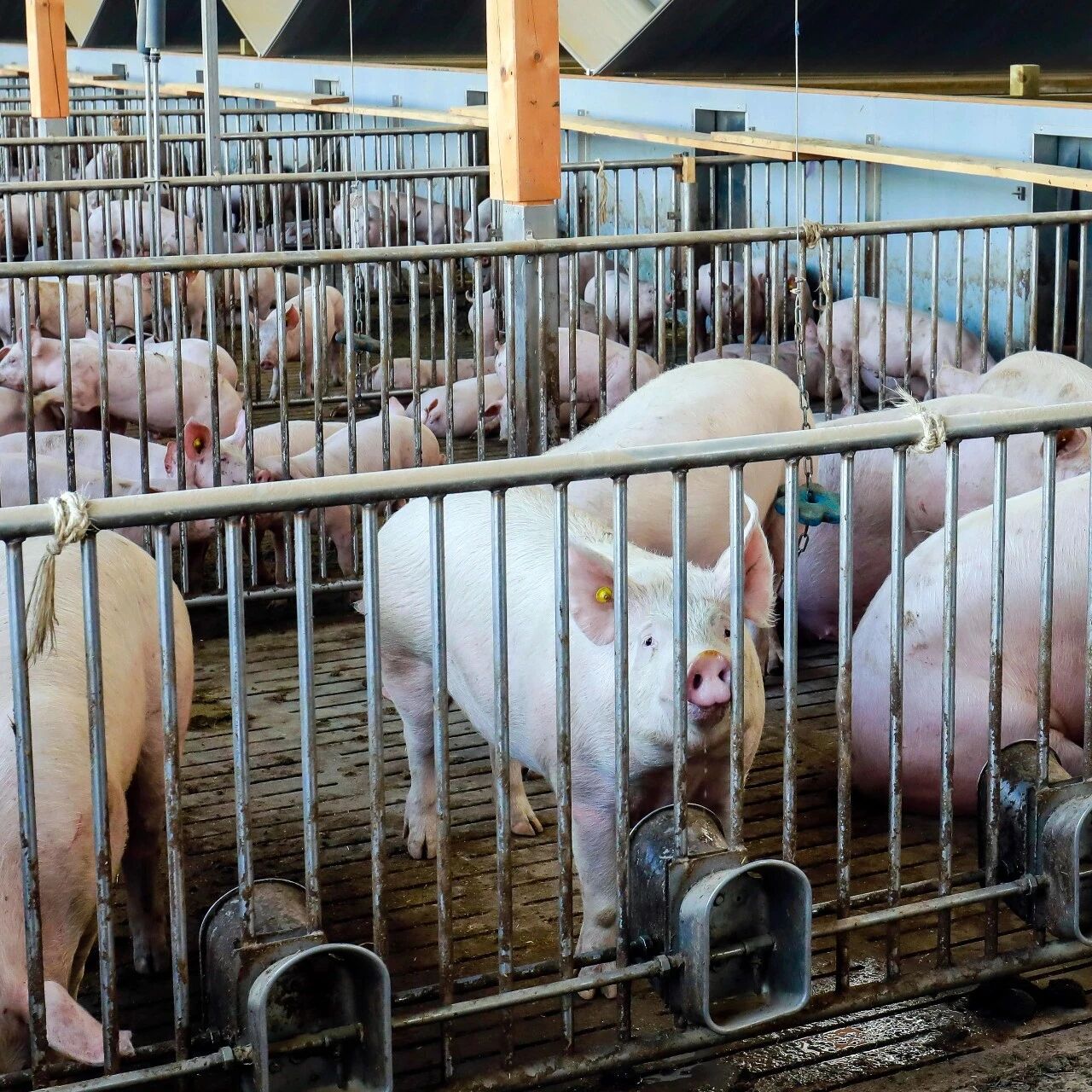
Core Viewpoint - The article discusses the current state of the pork industry, highlighting that while major pork companies are reporting impressive profits, the capital market remains skeptical, leading to many pork stocks being undervalued or stagnant. The profits are primarily driven by cost reductions rather than price increases or expansion, indicating a lack of long-term growth potential [4][6]. Group 1: Industry Performance - Major pork companies like Muyuan Foods reported a net profit of 10.53 billion yuan, a year-on-year increase of 1169.77%, while Wens Foodstuff achieved a net profit of 3.475 billion yuan, up 159.12% [4]. - Despite these profits, many pork stocks are trading at low levels, with some being labeled as "zombie stocks" that fail to capitalize on market uptrends [4]. Group 2: Supply and Demand Dynamics - The profits reported by these companies are attributed to the decline in prices of key raw materials like corn and soybean meal, along with improved production efficiency, rather than an increase in demand or prices [6]. - The industry is facing a significant oversupply issue, with the number of breeding sows at 40.42 million, exceeding the normal holding capacity by 3.6% as of July 2025 [7]. Group 3: Policy and Market Response - The Chinese government has mandated a reduction of 1 million breeding sows by January 2026 among the top 25 pork producers, aiming to address the oversupply issue [7][9]. - However, the effectiveness of these policies is questioned, as smaller producers may not comply, leading to a potential mismatch in supply reduction efforts [10][13]. Group 4: Financial Viability and Future Outlook - The article notes that the self-breeding model in the pork industry has been profitable since May 2024, but as of September 2025, it has started to incur losses, with an average loss of 24.44 yuan per pig [18]. - The average price of pork has dropped to approximately 12.6 yuan per kilogram, while the average cost of production is around 12.8 yuan per kilogram, indicating that further price declines could lead to cash flow losses and necessitate capacity reductions [18][20]. Group 5: Efficiency and Competitive Landscape - The industry's production efficiency has improved significantly, with the number of weaned piglets per breeding sow increasing by 36% from January 2021 to January 2025 [22]. - Despite a reduction in the number of breeding sows, the overall supply of pork may remain high due to increased efficiency, which could continue to suppress pork prices [20][24]. Group 6: Investment Considerations - The article suggests that investors should focus on three key dimensions when evaluating pork companies: total cost, growth rate, and market valuation [26]. - A table summarizing the 2026 output targets, growth rates, and market valuations of 16 listed pork companies is provided, indicating a diverse landscape where no single company presents a perfect investment opportunity [27].

农林牧渔行业报告(2025.9.22-2025.9.28):“反内卷”下,8月能繁存栏下降
China Post Securities· 2025-09-30 09:53
Investment Rating - The industry investment rating is "Outperform" [2] Core Views - The agricultural sector has significantly underperformed the market, with the agricultural index declining by 1.97% last week, ranking 21st among 31 primary industries [5][14] - The pig farming sector is facing downward price pressure, with the average price of live pigs at 12.28 CNY/kg as of September 28, down 0.41 CNY/kg from the previous week [6][18] - The "anti-involution" policies have been reinforced, which are expected to benefit pig prices in the coming year, with a potential upward trend anticipated in the second half of 2026 [7][21] Summary by Sections Market Review - The agricultural sector continues to decline, with the agricultural index down 1.97%, while the broader market indices, such as the CSI 300, increased by 1.07% [14] - All sub-sectors within agriculture experienced declines, with the planting sector seeing the largest adjustments [17] Livestock Industry Chain Tracking Pig Farming - Prices continue to decline, with significant supply pressure expected in the second half of 2025 due to increased production capacity since May 2024 [6][18] - The average loss for self-bred pigs has increased to approximately 74 CNY per head, while the loss for purchased piglets is around 237 CNY per head [19] - The number of breeding sows has decreased slightly, indicating a potential for accelerated capacity reduction in the future [20] Broiler Chicken - The price of broiler chicken chicks remains stable at 3.5 CNY per chick, while the price of broiler chickens is 3.37 CNY per jin, leading to a loss of 2.2 CNY per chick [8][29] - The update of grandparent stock has significantly decreased, with a reduction of 17.66% compared to the same period last year [29] Planting Industry Chain Tracking - Sugar prices have adjusted to 5855 CNY/ton, down 50 CNY/ton from the previous week [33] - The price of imported soybeans has decreased, with Brazilian soybeans at 3941 CNY/ton and U.S. soybeans at 4502 CNY/ton, both showing a decline of around 1% [33] - Corn prices have slightly decreased to 2323 CNY/ton, down 2 CNY/ton from the previous week [33]
研报掘金丨华鑫证券:维持牧原股份“买入”评级,养殖成本优势持续增强
Ge Long Hui· 2025-09-30 06:27
Core Viewpoint - The report from Huaxin Securities indicates that Muyuan Foods has a leading advantage in breeding scale and cost in the industry, which will help the company further consolidate its position as an industry leader [1] Summary by Category Sales Performance - In the first half of 2025, the company sold 46.91 million pigs, representing a year-on-year increase of 44.8% [1] - The breakdown of sales includes 38.39 million commercial pigs, 8.29 million piglets, and 225,000 breeding pigs, with year-on-year changes of +32.5%, +168.1%, and -27.9% respectively [1] Revenue Generation - The revenue from pig farming reached 75.45 billion yuan, reflecting a year-on-year growth of 34.7% [1] Competitive Advantage - The company maintains a leading breeding scale and continues to enhance its cost advantages, which strengthens its market competitiveness in the meat sector [1] - The affordable pricing of pork is expected to contribute to significant growth in the company's meat business [1]
2019-2025年9月中旬生猪(外三元)市场价格变动统计分析
Chan Ye Xin Xi Wang· 2025-09-30 03:43
Core Insights - The report by Zhiyan Consulting highlights a significant decline in the market price of live pigs (External Three Yuan) in China, with a year-on-year decrease of 32.29% and a month-on-month decrease of 5.11% as of mid-September 2025 [1] Price Trends - The market price for live pigs reached 13 yuan per kilogram in mid-September 2025, marking a notable drop compared to previous years [1] - The highest recorded price in the last five years was 35.5 yuan per ton in mid-September 2020 [1] - A statistical chart detailing the price fluctuations of live pigs from 2019 to mid-September 2025 is referenced, indicating a trend of decreasing prices [1]

罗牛山涨2.04%,成交额5519.69万元,主力资金净流入49.14万元
Xin Lang Cai Jing· 2025-09-30 02:26
Core Viewpoint - The stock of Luoniushan has shown a slight increase recently, with a market capitalization of 7.473 billion yuan, despite a year-to-date decline of 2.26% [1] Group 1: Stock Performance - On September 30, Luoniushan's stock rose by 2.04%, reaching 6.49 yuan per share, with a trading volume of 55.1969 million yuan and a turnover rate of 0.75% [1] - The stock has experienced a 4.17% increase over the last five trading days, a 3.34% increase over the last 20 days, and a 4.17% increase over the last 60 days [1] Group 2: Financial Performance - For the first half of 2025, Luoniushan reported a revenue of 1.084 billion yuan, a year-on-year decrease of 42.86%, and a net profit attributable to shareholders of -6.7171 million yuan, a decrease of 102.45% [2] Group 3: Shareholder Information - As of September 19, the number of shareholders for Luoniushan was 91,100, a decrease of 2.98% from the previous period, with an average of 12,633 circulating shares per person, an increase of 3.07% [2] - As of June 30, 2025, major shareholders include the Guotai Zhongzheng Livestock Breeding ETF, which increased its holdings by 533,200 shares, and the Southern Zhongzheng 1000 ETF, which increased its holdings by 1,636,500 shares [3]

天域生物涨2.03%,成交额3515.99万元,主力资金净流出45.03万元
Xin Lang Cai Jing· 2025-09-30 02:13
Company Overview - Tianyu Biological Technology Co., Ltd. is located in Yangpu District, Shanghai, and was established on June 21, 2000, with its listing date on March 27, 2017 [2] - The company's main business includes landscape greening engineering design, construction and maintenance, municipal public engineering construction, environmental comprehensive governance, river and lake pollution control, soil pollution control, and seedling planting and sales [2] - The revenue composition of the main business is divided into segments: 281.96%, 114.96%, and 34.31% [2] - Tianyu Biological is classified under the Shenwan industry as agriculture, forestry, animal husbandry, and fishery - pig farming, and is associated with concepts such as pork, characteristic towns, ecological landscaping, energy conservation and environmental protection, and micro-cap stocks [2] Financial Performance - As of June 30, the number of shareholders for Tianyu Biological is 20,200, a decrease of 2.00% from the previous period, with an average of 14,363 circulating shares per person, an increase of 2.04% [2] - For the first half of 2025, the company achieved operating revenue of 412 million yuan, a year-on-year decrease of 2.62%, while the net profit attributable to the parent company was 10.82 million yuan, a year-on-year increase of 73.68% [2] Stock Performance - On September 30, Tianyu Biological's stock price increased by 2.03%, reaching 9.05 yuan per share, with a trading volume of 35.16 million yuan and a turnover rate of 1.36%, resulting in a total market value of 2.626 billion yuan [1] - Year-to-date, the stock price has risen by 12.42%, with a 2.72% increase over the last five trading days, a 10.37% increase over the last 20 days, and a 21.31% increase over the last 60 days [1] - The company has appeared on the "Dragon and Tiger List" three times this year, with the most recent appearance on September 16, where the net buying on that day was 1.1632 million yuan, with total buying of 86.5781 million yuan, accounting for 16.99% of total trading volume, and total selling of 85.4149 million yuan, accounting for 16.76% of total trading volume [1] Dividend Information - Since its A-share listing, Tianyu Biological has distributed a total of 34.54 million yuan in dividends, with no dividends distributed in the last three years [3]
