服装

Search documents
IPO雷达|坦博尔赴港IPO被证监会要求补充材料:经营合规性、数据安全性、募资用途
Sou Hu Cai Jing· 2025-11-30 08:16
Core Viewpoint - The China Securities Regulatory Commission (CSRC) has requested Tambor Group to provide additional information regarding compliance, data security, foreign investment access, and the use of raised funds as part of its application for listing in Hong Kong [1][4] Group 1: Company Overview - Tambor Group is a leading professional outdoor apparel brand in China, recognized for its high-quality products designed for various outdoor activities and urban scenarios [2] - As of 2024, Tambor is the fourth largest domestic professional outdoor apparel brand in China, with a product system that includes 687 SKUs across three main series: top outdoor, sports outdoor, and urban light outdoor [2] Group 2: Financial Performance - The company's revenue for the six months ending June 30 for the years 2022 to 2025 is approximately 732 million RMB, 1.021 billion RMB, 1.302 billion RMB, and 658 million RMB respectively [2] - The net profit for the same periods is approximately 85.77 million RMB, 139 million RMB, 107 million RMB, and 35.93 million RMB respectively [2] - The overall gross profit margin has shown a positive trend, with figures of 50.2%, 56.5%, 54.9%, 59.8%, and 54.2% during the reporting period [3] - However, the net profit margin has been declining, with rates of 11.7%, 13.6%, 8.2%, and 5.5% over the same period [3]
美邦服饰:公司董事庄欢跃辞职
Mei Ri Jing Ji Xin Wen· 2025-11-30 07:47
Group 1 - Meibang Apparel announced the resignation of Ms. Zhuang Huanyue from her positions as a director and a member of the strategic committee due to personal reasons, effective immediately, and she will not hold any positions in the company thereafter [1] Group 2 - The global chip industry is experiencing significant turmoil, highlighted by the emergence of Google's TPU chip, which is seen as a potential threat to Nvidia, leading to a substantial market value loss of 4 trillion yuan for Nvidia [1] - The competitive landscape is intensifying as Google and Meta are reportedly collaborating on significant projects, raising concerns about Nvidia's market dominance and its "moat" being breached [1]

李光满:中国对美反击,直击美国命门!
Sou Hu Cai Jing· 2025-11-30 07:40
Core Points - The trade war initiated by the U.S. against China has escalated significantly, with both countries imposing tariffs on each other's goods, impacting global trade dynamics [1][3][5][7] - China's response to U.S. tariffs has been strategic and coordinated, targeting key industries such as energy, automotive, and high-tech sectors, demonstrating its resilience and ability to counteract U.S. measures [3][5][7] - The trade conflict has led to a shift in global supply chains, with companies increasingly looking towards ASEAN countries to mitigate risks associated with U.S.-China tensions [5][7] Summary by Category Tariff Measures - The U.S. imposed a 10% tariff on Chinese goods and 25% on Canadian and Mexican goods, which was later increased to 20% and then 34% [1][5] - China retaliated with tariffs on U.S. coal, LNG, and agricultural products, including a 10% to 15% tariff on U.S. soybeans, directly affecting American farmers [3][5] Strategic Responses - China implemented export controls on critical minerals essential for military and high-tech industries, impacting U.S. missile and chip production [3][5] - The Chinese government placed U.S. companies like PVH Group on an unreliable entity list, restricting their market access [3][5] Global Trade Impact - The trade war has resulted in a 1% reduction in global trade, with the most vulnerable countries suffering the most [5][7] - The conflict has highlighted the limitations of unilateral trade policies, as U.S. allies like the EU and Japan have not joined in the actions against China [7] Long-term Implications - The trade war reflects deeper issues within the U.S. economy, such as manufacturing hollowing out and rising debt, while underestimating China's strategic resilience [7] - The ongoing conflict is pushing the global economic landscape towards multipolarity, challenging the effectiveness of unilateralism [7]


波司登(03998):业绩表现符合预期,连续八年利润增长快于收入
Shenwan Hongyuan Securities· 2025-11-30 07:11
Investment Rating - The report maintains a "Buy" rating for the company [2] Core Insights - The company reported a 1.4% year-on-year increase in revenue to 8.93 billion RMB for the first half of FY2025/26, with a net profit growth of 5.3% to 1.19 billion RMB, indicating a consistent high-quality growth trend [7] - The company has achieved eight consecutive years of profit growth outpacing revenue growth since its strategic transformation in 2018, showcasing strong operational quality and resilience [7] - The main business segment, down jackets, showed robust growth with an 8.3% increase in revenue to 6.57 billion RMB, accounting for 73.6% of total revenue [7] - The company has a strong retail network expansion, with self-operated and franchise revenues growing by 6.6% and 7.9% respectively [7] Financial Data and Profit Forecast - Revenue projections for FY2024 to FY2028 are as follows: 23.21 billion RMB, 25.90 billion RMB, 28.47 billion RMB, 31.27 billion RMB, and 34.21 billion RMB, with corresponding growth rates of 38%, 12%, 10%, 10%, and 9% [6] - Net profit forecasts for the same period are: 3.07 billion RMB, 3.51 billion RMB, 3.90 billion RMB, 4.34 billion RMB, and 4.75 billion RMB, with growth rates of 44%, 14%, 11%, 11%, and 10% [6] - The company’s gross margin is projected to be around 57.5% to 59.6% over the forecast period [6] Operational Efficiency - The company has significantly improved its operational efficiency, with inventory turnover days reduced by 11 days to 178 days compared to the previous year [7] - Cash and cash equivalents reached approximately 3 billion RMB, with net cash increasing by 38.8% year-on-year to about 10.3 billion RMB [7]
2025国民消费创新案例展示
Ren Min Wang· 2025-11-30 07:11
Core Insights - The 2025 National Consumption Conference was held in Beijing, showcasing innovative consumption cases for 2025 [1] Company Innovations - Guizhou Zhenjiu focuses on quality and channel expansion to drive consumption growth [3] - Herbalife transitions from liquid nutrition to solid food with cake premix, promoting a blend of taste and health [3] - Weigang Dairy upgrades its formula and processes, venturing into new tea drinks [3] - Yilian integrates lotus culture with hyaluronic acid technology for innovative consumer experiences [3] - Aishurou emphasizes the transmission of "emotional value" for a clean and beautiful lifestyle [3] - TAIC introduces pure titanium home products, enhancing aesthetic living experiences [3] - Yalong Xiaoxiang explores new models for cultural relics through smart trade routes [3] Service Consumption - Pudong Development Bank Credit Card deepens customer engagement with running series to boost sports consumption [3] - Mars Petcare collaborates with Beijing Fashion Week to create a new fashion for pet owners [3] - Joy City empowers emotional connections through digital membership ecosystems [3] - Daguan Zhuanxin New Agricultural Market innovates highland agricultural product consumption scenarios with a three-tier product operation model [3] - Baiguoyuan enhances trust in consumption services with a "buy with confidence, return at will" policy [3] - Taikang focuses on elderly dental care needs with "Worry-Free Insurance" providing full-cycle services [3] - Koala AI Foreign Teacher leverages AI to enhance language learning experiences [3] - Vision Future utilizes AI digital technology to support a new ecosystem for live e-commerce [3] Brand Leadership - Zhanma transitions from a "traffic entry" to a "brand territory," enhancing brand influence [3] - Shuanghui Jian Song creates a new trend in self-care consumption with "clean formulas" [3] - Bright Dairy achieves brand upgrades from "national memory" to "trend symbols" through three-dimensional innovation [3] - Bosideng innovates technology in down jackets, balancing functionality and fashion [3] - Jinmailang Liangbai Kai strengthens health awareness in familiar water, promoting brand philosophy [3] - Mead Johnson Blue Zhen adheres to research innovation, using milk fat globule membrane to support high-quality industry development [3] - Hengjie explores new paths for domestic brands with the "Renew China Tour" IP [3] - Seven Wolves introduces new business travel menswear, culturally empowering national consumption trends [3] - Guyu innovates the interaction between science and aesthetics, narrating brand stories through traditional culture [3] Product Reputation - Haizhilun anchors on popular drinking scenarios, continuing quality innovation to maintain classic reputation [4] - Feihe Star Flying Sail creates a "fresh nutrition system" for a new generation of baby food [4] - Guangzhou Restaurant Lychee Pastry connects with Cantonese food culture, offering a new paradigm for "Guangzhou gifts" [4] - Hongxing Erke Park Running Shoes focuses on national sports scenarios, driving innovative domestic consumption [4] - Xiaohutuxian·Xian15 upgrades classic products, enhancing quality and cultural experience [4] - Pigeon newborn bottles address feeding pain points, optimizing feeding methods [4] - Beishute's "plant-based" sanitary napkins provide comprehensive safety from source to end [4] - Mingyue Qingsong control lenses innovate optical technology for a more comfortable visual experience [4] - FreeSkin hand cream innovates services to create a "high quality-price ratio" trend for domestic products [4] - Dong'a Ejiao advances technology to promote the integration of primary, secondary, and tertiary industries, creating trendy quality domestic products [4] - Dili Group empowers agricultural product circulation with technology and services [4] - Atomy drives continuous product upgrades through a "boutique" strategy and technological innovation [4] Green Consumption - China Resources Double Crane targets "dual carbon" goals, offering low-carbon products for a green lifestyle [5] - Amcor's "green and eco-friendly actions" bring sustainable development into practice [5] - Meisi's "green bottle" ensures sustainable high-quality consumption [5] - Laitai Mootaa leverages technology and green empowerment to explore new consumption experiences [5] - IAM's core technology eliminates the need for replacement consumables, supporting green and safe breathing [5] - Procter & Gamble identifies new consumer needs, providing high-quality laundry liquids for a better life [5] - OgaHua's massage robots utilize AI to enhance comfort in daily living [5] - Banfish PalFish integrates smart home with traditional aesthetics through full-spectrum eye protection lamps [5] - Huangshi Group revitalizes water buffalo milk products to meet high-quality dairy consumption demands [5] - Lemon Republic creates a new beverage experience with "cloud mist lemon" juice soda [5]

羽绒服,大涨价!什么情况?
新华网财经· 2025-11-30 03:29
Core Viewpoint - The article discusses the rising prices of down jackets as the sales season begins, highlighting the impact of increased raw material costs and changing consumer behavior. Price Trends - In Nanjing, short down jackets with 90% white duck down start at 899 yuan, while long versions start at 1099 yuan, reflecting a price increase of approximately 20% from last year's 799 yuan for short jackets [1][3] - The price of 90% white duck down has risen from 40,000 yuan per ton last October to 55,000 yuan per ton this October, indicating a significant increase in raw material costs [12] Consumer Behavior - Despite price increases, demand remains strong, with sales in November showing a 10% year-on-year growth and single-day sales exceeding 30,000 yuan [3] - Consumers are increasingly turning to old clothing refurbishment services due to high prices, with refurbishment costs ranging from 300 to 400 yuan [7] Production and Supply Chain - In Liu'an, down jacket production is operating at full capacity, with companies hiring additional staff to meet rising orders [14] - The price of 90% white duck down has surged from around 400 yuan per kilogram to a peak of 560 yuan per kilogram in October [16] - In Changshu, a major down jacket production hub, companies report a significant increase in orders since July, with production expected to remain high until after the Spring Festival [19][21] Raw Material Supply Issues - The supply of duck down is decreasing due to reduced poultry farming, as farmers cut back on stock due to low prices for duck meat [31] - The price of 90% white duck down has increased by approximately 24% since its recent low, reaching 561.54 yuan per kilogram at the end of October [34]

波司登(03998.HK):中期业绩稳健 期待旺季销售带动FY2026亮眼表现
Ge Long Hui· 2025-11-29 21:45
Core Viewpoint - The company reported a revenue increase of 1.4% and a net profit increase of 5.3% for FY2026H1, indicating stable growth despite challenges in certain segments [1] Financial Performance - FY2026H1 revenue reached 8.93 billion and net profit was 1.19 billion, with a declared interim dividend of 0.063 HKD per share [1] - Gross margin improved slightly by 0.1 percentage points to 50.0%, while net profit margin increased by 0.5 percentage points to 13.3% [1] - The brand down jacket business saw an 8% revenue increase, driven by the main brand, while OEM business revenue decreased by 12% [1] Business Segment Analysis - **Brand Down Jacket Business**: Revenue increased by 8% to 6.57 billion, with a gross margin decrease of 2.0 percentage points to 59.1% due to changes in channel structure [1] - **Main Brand Performance**: The main brand's revenue grew by 8% to 5.72 billion, with a gross margin decrease of 1.5 percentage points to 64.8%. New product launches and quality upgrades are expected to drive future growth [2] - **OEM Business**: Revenue decreased by 2% to 0.4 billion, with a gross margin increase of 0.4 percentage points to 20.5%. The decline is attributed to changes in customer order patterns due to tariff policy expectations [3] Channel Performance - **Online Sales**: Increased by 2% to 1.38 billion, becoming an important channel for brand building and member marketing [3] - **Offline Sales**: Grew by 9% to 4.73 billion, with strategic focus on single-store operations and differentiated product offerings [3] - **Store Expansion**: The number of direct and distribution channels increased by 85 and 285 stores respectively, totaling 1,239 and 2,319 stores [3] Inventory Management - The company has implemented refined order management, resulting in a reduction of inventory turnover days by 11 days to 178 days [4] - The company maintains flexibility in inventory management through strategies like rapid replenishment and small batch production [4] Future Outlook - The company is expected to achieve approximately 10% revenue growth and faster net profit growth for FY2026, driven by product innovation and stable performance in the OEM business [4] - The company aims for sustained high-quality growth, with projected net profits of 3.899 billion, 4.386 billion, and 4.959 billion for FY2026 to FY2028 [5]
波司登(03998.HK):销售良性增长 库存管理优秀
Ge Long Hui· 2025-11-29 21:45
Core Insights - The company reported a 1.4% increase in revenue to 8.9 billion yuan and a 5.3% increase in net profit to 1.19 billion yuan for 1HFY26, meeting expectations [1] - The interim dividend declared is 6.3 Hong Kong cents per share, corresponding to a payout ratio of approximately 56% [1] Performance Review - The brand's down jacket business achieved a high-quality growth with an 8.3% revenue increase to 6.6 billion yuan, driven by a 6.6% increase in self-operated revenue to 2.4 billion yuan and a 7.9% increase in wholesale revenue to 3.7 billion yuan [1] - The main brand, Bosideng, also saw an 8.3% increase in revenue to 5.7 billion yuan [1] - The company successfully improved the sales proportion of new products and controlled discounts better than the same period last year [1] - The company optimized channel quality and expanded top-tier stores, leading to stable growth in comparable store sales [1] - Retail performance in the distribution channel was strong, laying a solid foundation for peak season sales [1] - The brand marketing strategy included a successful fashion show during Paris Fashion Week and collaborations with several high-end designers [1] Development Trends - The company is enhancing its "ice and snow" and "sports" genes, focusing on cost-effective down jackets [2] - The Ice洁 brand is undergoing a rebranding to position itself as a high-quality women's down jacket brand [2] - OEM business revenue declined by 11.7% to 2.04 billion yuan due to external factors, but recovery is expected as disturbances subside [2] - The company achieved efficient operations with profit growth outpacing revenue growth, and inventory decreased significantly by 20.3% [2] - The gross margin improved by 0.2 percentage points to 50.0%, and net profit margin increased by 0.5 percentage points to 13.3% [2] Profit Forecast and Valuation - The company maintains its EPS forecasts for FY26 and FY27 at 0.34 and 0.38 yuan, respectively [2] - The current stock price corresponds to 13 and 12 times the FY26 and FY27 P/E ratios, with a target price of 5.89 Hong Kong dollars, indicating a 17% upside potential [2]
波司登(03998.HK):2026上半财年归母净利润增长5% 品牌羽绒服引领增长
Ge Long Hui· 2025-11-29 21:45
Core Viewpoint - The company, a leading down jacket brand in China, reported a 1% revenue growth and a 5% increase in net profit for the first half of the 2025/26 fiscal year, indicating stable performance despite challenges in certain segments [1][4]. Financial Performance - Revenue for the first half of the 2025/26 fiscal year reached 8.93 billion yuan, a 1.4% increase year-on-year, while net profit grew by 5.3% to 1.19 billion yuan [1]. - The revenue breakdown shows brand down jackets increased by 8.3% to 6.57 billion yuan, while OEM processing and women's wear saw declines of 11.7% and 18.6%, respectively [1]. - The overall gross margin improved by 0.1 percentage points to 50.0%, with brand down jackets' gross margin slightly decreasing due to higher sales growth in lower-margin distribution channels [1]. Inventory and Cash Flow Management - The company effectively managed inventory, reducing it by 20.3% year-on-year, and decreased inventory turnover days by 11 days [2]. - Cash flow remained robust, allowing the company to maintain a stable dividend payout, with an interim dividend of 6.3 Hong Kong cents, a 5% increase from the previous year [2]. Strategic Initiatives - The company is focusing on brand leadership, deepening its core categories, and enhancing digital capabilities to drive high-quality growth [3]. - Collaborations with top international designers and the establishment of an AI-driven design database are aimed at improving product innovation and efficiency [3]. - Online revenue for brand down jackets grew by 2.4% year-on-year, while the company expanded its physical store presence, adding 85 self-operated and 285 distribution stores [3]. Market Outlook - The company anticipates a sales boost in the second half of the fiscal year, supported by strong performance in down jacket sales since October [4]. - Profitability is expected to continue improving, with net profit growth projected at 11.1%, 10.2%, and 10.0% for FY2026 to FY2028 [4]. - The target price is maintained at 5.1-5.5 Hong Kong dollars, reflecting a favorable valuation for a leading player in the down jacket market [4].
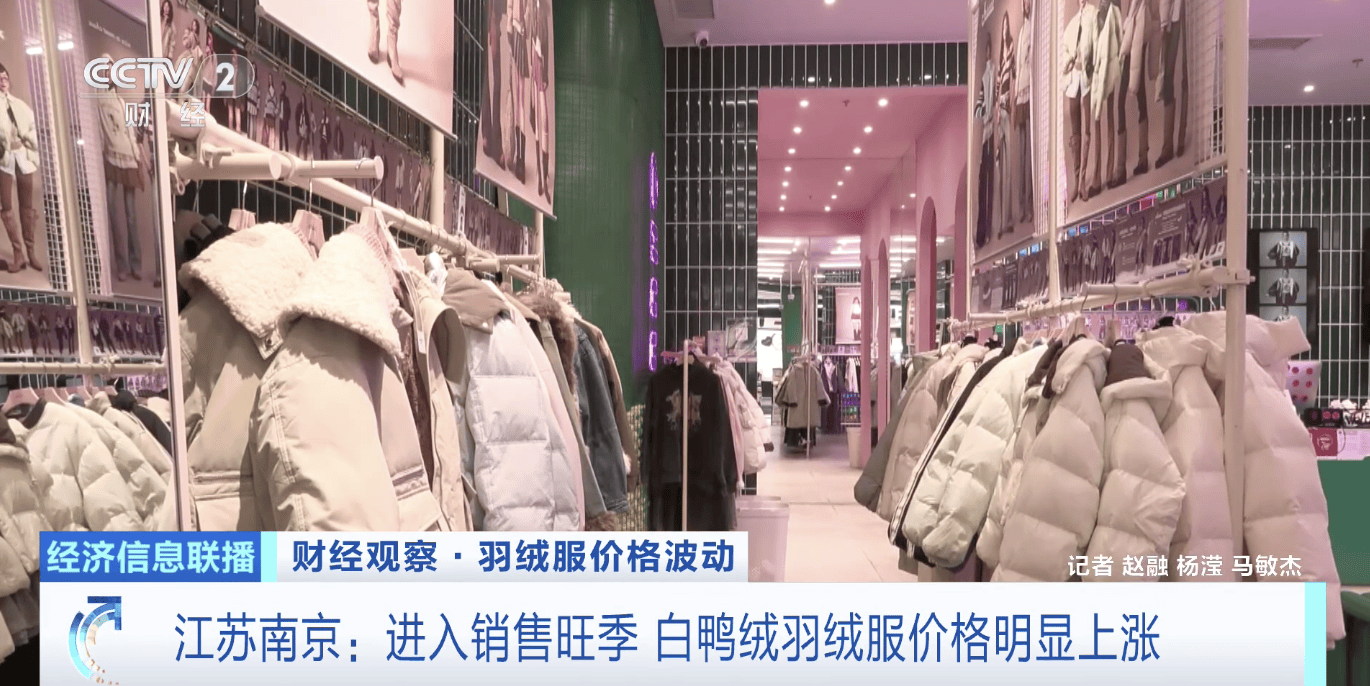
气温走低南京白鸭绒羽绒服热销,保暖厚款受青睐
Sou Hu Cai Jing· 2025-11-29 15:19
(央视财经《经济信息联播》)随着气温逐渐下降,羽绒服迎来销售旺季。今年羽绒服的价格如何? 走访中记者发现,随着羽绒服价格的上涨,也让不少消费者把目光投向了旧衣翻新业务。 在南京浦口区一家销售羽绒服的门店,记者看到,白鸭绒绒子含量90%的短款羽绒服售价899元起,白鸭绒绒子含量90%的长款羽绒服售价1099元起。 江苏南京某羽绒服门店负责人 武景琳:去年我们家短款的90%白鸭绒羽绒服价格大概在799元,今年短款(价格)对比去年涨幅大概在20%。 导购员表示,涨价未明显抑制消费需求,11月以来门店销量同比增长10%,周末单日销售额突破3万元。其中,绒子含量高、充绒量足的保暖厚款羽绒服最 受青睐,部分热门尺码已断货。 随后,记者又走访了商场内一些时尚运动品牌门店,这类门店销售的羽绒服以白鸭绒绒子含量80%-90%为主,充绒量根据款式不同在100-300克之间,价格 在1000元以上。 转载请注明央视财经 编辑:令文芳 ...