
动力电池

Search documents
宁德时代(300750):迈向应用创新 再造宁德时代-换电篇
Xin Lang Cai Jing· 2026-01-31 12:37
商用车:骐骥换电加码,构建八纵十横网络 电动重卡应该走换电还是超充,仍是目前产业有争议的问题,我们认为换电主要基于以下优势: 首先是补能效率换电更高,其次是经济性优势,换电模式的首次购车成本低,采用底置电池方案、电耗 具备优势,此外超充对电池寿命存在一定影响,换电生命周期成本更低。此外从远期愿景来看,重卡未 来将走向无人驾驶,公路交通未来也将绿色转型,都更加适配换电。 风险提示 1、换电车型销量不及预期风险;2、动力电池平均循环寿命不及预期;3、产业链价格大幅上涨影响经 济性;4、盈利预测不及预期。 迈向应用创新,再造宁德时代——换电篇站在2025 年展望国内动力市场,需求端国内电动化进入深水 区,仅剩的市场更加依托于更高性价比的解决方案、更广泛的基础设施建设;供给端电池企业的配套关 系进一步固化,宁德时代2024 年在高端乘用车的份额达到72%,整体则为45%,高端市场宁德时代的品 牌价值无疑,但低端市场再上层楼也需更多布局。从宁德时代近两年的战略方向看,动力、储能电池持 续的材料体系研发、极限制造创新仍是重点和基础,与之同时面向市场应用的集成产品、商业模式创新 有被更多的提及。从投资的角度看,锂电池需求的 ...

孚能科技(赣州)股份有限公司 2025年年度业绩预告
Zheng Quan Ri Bao· 2026-01-30 22:49
Group 1 - The company forecasts a net profit attributable to shareholders of the parent company for 2025 to be between -830 million and -580 million yuan [3] - The expected net profit attributable to shareholders after deducting non-recurring gains and losses is projected to be between -861.8 million and -611.8 million yuan [4] - The previous year's net profit attributable to shareholders was -332.06 million yuan, with a total profit of -448.15 million yuan for 2024 [6] Group 2 - The main reasons for the performance change include the ramp-up phase of two new production bases, leading to high fixed depreciation costs and low capacity utilization [8] - The company is increasing market development efforts and optimizing customer structure, which has a short-term impact on gross profit due to changes in customer settlement models and product updates [8] - The company is investing more in R&D for new products and technologies, including solid-state batteries [9] Group 3 - The reduction in domestic export tax rebates and increased U.S. tariffs on exports to China are negatively affecting the company's gross profit margin [10] - The company has made provisions for impairment on certain inventories and receivables based on a cautious approach [11]

孚能科技发预亏,预计2025年度净亏损5.8亿元至8.3亿元
Zhi Tong Cai Jing· 2026-01-30 13:39
Core Viewpoint - The company, Funeng Technology (688567.SH), forecasts a net profit attributable to shareholders of the parent company for 2025 to be between -830 million and -580 million yuan, indicating a significant loss due to various operational challenges and market conditions [1] Group 1: Performance Forecast - The expected net profit for 2025 is projected to be between -830 million and -580 million yuan [1] - The performance decline is attributed to the ramp-up phase of two new production bases, which incurs high fixed depreciation costs and has not yet achieved optimal capacity utilization [1] Group 2: Operational Challenges - The company is currently in the process of increasing market penetration and optimizing customer structure, which has short-term impacts on gross margins due to adjustments in customer settlement models and product updates [1] - Increased research and development investments in new products and technologies, such as solid-state batteries, are contributing to the financial strain [1] Group 3: External Factors - A reduction in domestic export tax rebates and increased U.S. tariffs on exports to China are negatively affecting the company's gross margin [1] - The company has adopted a cautious approach by impairing certain inventories and receivables, further impacting financial performance [1]
孚能科技:2025年预亏5.8亿元至8.3亿元
Ge Long Hui· 2026-01-30 08:33
本期业绩变化的主要原因:(一)公司两个新生产基地"赣州年产 30GWh 新能源电池项目(一期)"和"广州 年产 30GWh 动力电池生产基地项目(一期)"目前尚处于产能爬坡阶段,固定折旧摊销费用大,产能利用 率、设备效率及良品率还处于稳步提升阶段。(二)公司本年度加大市场开拓力度,培育市场新客户,推 动客户结构优化;同时客户结算模式调整、部分产品更新换代,短期内对毛利有一定影响。(三)公司持 续拓展新产品、新技术,固态电池等研发投入增加。(四)国内出口退税率降低,叠加美国对华出口关税 提升,影响公司毛利率。(五)基于谨慎性原则,公司对部分存货及应收款项计提减值。 格隆汇1月30日丨孚能科技(688567.SH)公布,经公司财务部门初步测算,预计2025年度实现归属于母公 司所有者的净利润为-8.3亿元到-5.8亿元。预计归属于母公司所有者扣除非经常性损益后的净利润 为-8.62亿元到-6.12亿元。 ...
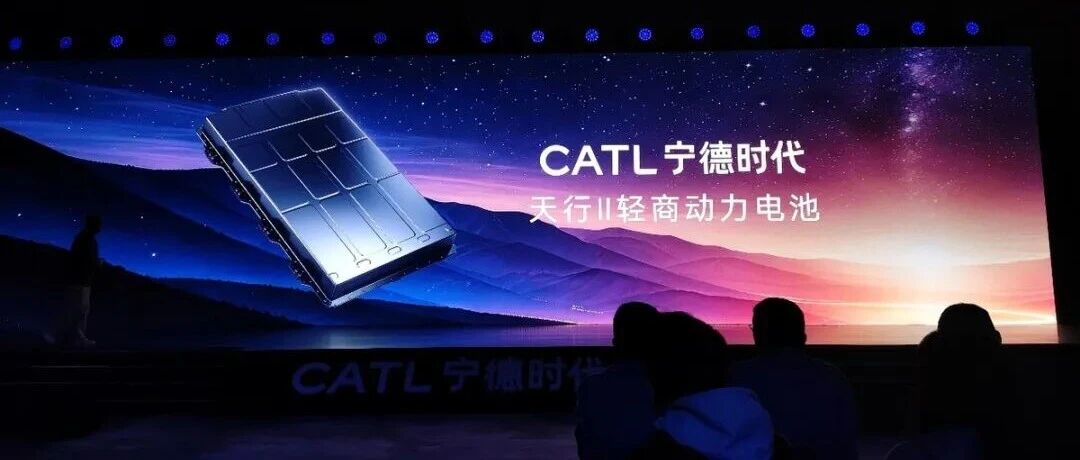
宁德时代轰出2026第一炮!-30℃钠电池、800公里续航!?
电动车公社· 2026-01-29 18:41
Core Viewpoint - The article emphasizes that 2025 will be a pivotal year for China's new energy vehicle (NEV) market, with significant growth in both passenger and commercial vehicle segments, highlighting the need for advancements in electric commercial vehicles to match the success of passenger vehicles [2][3][4]. Passenger Vehicle Segment - By 2025, the retail penetration rate of new energy passenger vehicles is projected to reach 54%, a 6.4 percentage point increase from 47.6% in 2024, marking a historic high [3]. - This indicates that new energy vehicles have become the preferred choice for consumers in the passenger vehicle market, relegating fuel vehicles to a minority status [4]. Commercial Vehicle Segment - In 2025, the sales of new energy commercial vehicles in China are expected to reach 871,000 units, accounting for 26.9% of total commercial vehicle sales [5]. - Despite a noticeable increase in penetration rates for new energy commercial vehicles starting from Q4 of the previous year, the electrification progress remains significantly behind that of passenger vehicles [5]. Challenges in Commercial Vehicle Electrification - The slow adoption of electric commercial vehicles is attributed to insufficient product capabilities, including issues such as short range, slow charging speeds, low energy efficiency, battery degradation in cold temperatures, and low resale value [10][11]. Innovations by CATL - On January 22, CATL launched the "Tiankang II Light Commercial Series" battery solutions, which include sodium batteries, long-range options, high/low-temperature fast charging, and battery swapping solutions tailored for new energy light commercial vehicles [13][14]. - The focus on light commercial vehicles is due to their potential for electrification, with recent months showing penetration rates above 30%, significantly higher than the overall industry [16]. Key Battery Technologies - The new "Tiankang II Light Commercial Series" includes several battery versions, such as ultra-fast charging, long-range, high-temperature, low-temperature, and battery swapping versions, each addressing specific pain points in the light commercial vehicle sector [18][19]. - The low-temperature version utilizes sodium-ion technology, which performs significantly better than lithium-ion batteries in cold conditions, maintaining over 92% capacity at -20°C and functioning at -30°C [30][32]. Safety and Performance - Sodium batteries exhibit superior safety, remaining functional even when punctured or cut, which allows for reduced protective measures and more efficient use of vehicle space [36][39]. - While sodium batteries currently have lower energy density compared to lithium batteries, ongoing engineering efforts aim to close this gap [40][42]. Market Impact - The introduction of the "Tiankang II Light Commercial Series" is expected to usher in a "no barriers" era for electrification in the light commercial vehicle market, enhancing product capabilities and attracting more users to adopt electric commercial vehicles [68]. - The operational cost savings from switching to electric vehicles are substantial, with electric light trucks potentially saving up to 32,000 yuan annually compared to fuel vehicles, not including maintenance cost reductions [86][87]. Broader Implications - The reduction in logistics operational costs will ultimately benefit consumers through lower delivery fees, reflecting a more efficient use of resources across various industries [90][91].

欣旺达在韩再遭诉讼,专利与质量双重围剿下溃败在即?
3 6 Ke· 2026-01-29 13:24
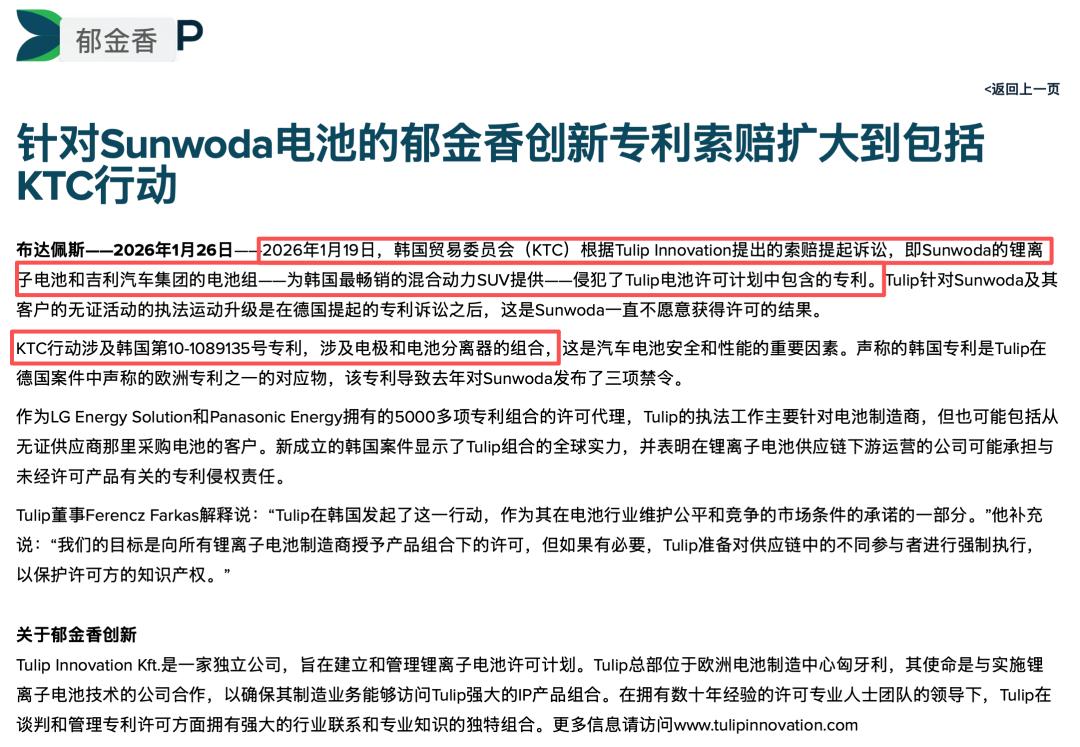
Core Viewpoint - The patent alliance "Tulip Innovation," formed by LG Energy and Panasonic, has initiated a patent infringement lawsuit against Xinwanda in South Korea, claiming that Xinwanda's lithium-ion battery cells and battery packs for Geely's popular hybrid SUV violate a specific patent related to electrode and separator technology [1][4]. Group 1: Patent Infringement and Legal Challenges - The lawsuit in South Korea is part of a broader strategy similar to previous actions taken in Germany, targeting core battery technologies that are critical for energy, safety, and lifespan [4][7]. - Xinwanda has previously faced three defeats and sales bans in Germany regarding the same patent, indicating the strength of the patent barriers established by the alliance [4][7]. - The lawsuit poses risks not only to Xinwanda but also to its customers, as the involved battery technology is used in Geely's hybrid SUV sold in South Korea, potentially affecting market prospects [7][11]. Group 2: Domestic Quality Issues and Financial Implications - Xinwanda is also facing a domestic lawsuit from Geely's Weirui company, claiming damages of 2.313 billion RMB due to serious quality issues with battery cells supplied between 2021 and 2023 [4][11]. - The quality issues have led to significant vehicle recalls, with estimates suggesting that tens of thousands of vehicles may be affected, aligning with the compensation amount sought [11][15]. - The financial impact of the 2.313 billion RMB claim is severe, potentially consuming 90% of Xinwanda's net profit for 2023 and 2024, with insufficient reserves to cover such liabilities [15][16]. Group 3: Industry Implications and Strategic Reflections - Xinwanda's situation serves as a warning for the industry, highlighting the risks of prioritizing cost over quality, as aggressive pricing strategies may compromise essential safety and reliability standards [20][24]. - The dual challenges of patent infringement and quality issues are forcing a reevaluation of supplier assessments, emphasizing the need for robust quality systems and independent patent strategies [20][24]. - The case of Xinwanda illustrates the complexities of international expansion for Chinese companies, where legal and technical challenges are becoming increasingly intertwined [20][24].

道氏技术:董事、总经理张翼计划减持公司股份不超过约50万股
Mei Ri Jing Ji Xin Wen· 2026-01-28 12:07
每经头条(nbdtoutiao)——从极寒测试到万套装车!半固态电池今年有望搭载多款新车:各大厂商摩 拳擦掌,动力电池技术迎来迭代年 每经AI快讯,道氏技术1月28日晚间发布公告称,持有广东道氏技术股份有限公司股份约201万股的公 司董事、总经理张翼先生计划在自本公告披露之日起15个交易日后的3个月内,以集中竞价的方式减持 公司股份不超过约50万股。 (记者 张明双) ...

宁德时代参与发布全球首个电池循环行动路线图
Guan Cha Zhe Wang· 2026-01-28 10:17
Core Insights - The report titled "Leading the Future of Circular Economy: Unlocking the Value of Battery and Key Minerals Circular Economy" was released by the Ellen MacArthur Foundation with support from over 30 participants including companies like CATL and Jaguar Land Rover, providing an actionable roadmap for the circular development of global power batteries [1] Group 1: Circular Economy Actions - The report emphasizes the need to shift from "minor repairs" and "end-of-life management" to a systemic redesign for scaling up the battery circular economy [1] - Five leadership actions are proposed: design for circularity, optimize transport and energy systems, scale up circular business models, co-invest in regional circular infrastructure, and promote efficient operation of circular systems [1] Group 2: CATL's Position and Goals - CATL, as the world's largest power battery supplier, aims for a battery installation volume of 333.57 GWh by 2025, a slight decrease of 1.69% year-on-year, while maintaining a market share of 43.42% in China, which is more than double that of the second-largest competitor, BYD [3] - The company plans to transform all battery factories into zero-carbon facilities by the end of 2025 and aims for value chain carbon neutrality by 2035 [3] Group 3: Recycling and Innovation - CATL has achieved a recycling rate of 99.6% for nickel, cobalt, and manganese, and 96.5% for lithium [3] - The company is developing sodium-ion batteries to reduce reliance on scarce minerals like lithium, with lifecycle carbon emissions potentially reduced by up to 60% compared to lithium batteries, targeting large-scale application by 2026 [3] Group 4: Infrastructure and Data Governance - CATL promotes battery-as-a-service models through initiatives like "Chocolate Battery Swap" and "Qiji Battery Swap," addressing fragmented recycling channels for retired batteries [4] - The company has established over 1,300 battery swap stations and formed the "Chocolate Battery Swap Alliance" with over 100 partners to enhance centralized management and large-scale recycling of battery assets [4] - As a board member of the Global Battery Alliance, CATL is piloting a "battery passport" to improve supply chain transparency and traceability [4]
头部份额走低 商用车驱动增长——2025动力电池格局异动
Huan Qiu Wang· 2026-01-28 09:58
Core Insights - The sales of power batteries in China reached 1200.9 GWh in the previous year, marking a year-on-year growth of 51.8%, significantly outpacing the 29% growth of new energy vehicles [2] - The rapid development of new energy commercial vehicles and battery swapping markets is driving the growth of the power battery industry, while the average battery capacity of new energy passenger vehicles has slightly decreased [2][3] - By 2025, the cumulative installed capacity of power batteries in China is expected to reach 769.7 GWh, with lithium iron phosphate batteries accounting for 81.2% of the total installed capacity [2][5] Power Battery Market Dynamics - The average battery capacity for pure electric passenger vehicles is projected to decrease from approximately 55.6 kWh in 2024 to 55 kWh in 2025, influenced by the growth of plug-in hybrid and range-extended vehicles, which have lower battery capacities [3] - Electric trucks, which have higher battery capacities, are a significant factor in the overall growth of battery sales, as they are viewed as production tools with high requirements for driving range [3][4] - The market share of leading battery manufacturers, CATL and BYD, is declining, with CATL's share down by 1.67% and BYD's by 3.17% in 2025, as second-tier manufacturers gain ground [7][8] Lithium Iron Phosphate Battery Trends - Lithium iron phosphate batteries have regained dominance in the power battery market, with their installed capacity share increasing to 81.2% by 2025, up from 74.4% in 2024 [5][6] - The cost advantage of lithium iron phosphate batteries is a key factor in their increasing adoption, especially among mid-range electric passenger vehicles [5][6] - Technological advancements have improved the low-temperature performance and energy density of lithium iron phosphate batteries, narrowing the gap with ternary lithium batteries [6] Export and Market Impact - In 2025, approximately 1.65 million pure electric vehicles (BEVs) are expected to be exported, accounting for 64% of new energy vehicle exports, with a year-on-year growth of 66% [4] - The export of plug-in hybrids (PHEVs) is also significant, with an expected volume of 970,000 units, representing a 2.3-fold increase [4] Battery Swapping Market Growth - The battery swapping market is entering a rapid growth phase, with the market size projected to increase from 40 billion yuan in 2021 to 166 billion yuan by 2025, reflecting a compound annual growth rate of 37.1% [10] - Companies like NIO and CATL are strong supporters of the battery swapping model, with NIO establishing a comprehensive network of battery swapping stations [10] Raw Material Price Impact - Rising raw material prices are a significant concern for battery manufacturers, as the cost pressures may not be fully passed on to vehicle manufacturers due to long-term supply agreements [11]
动力源:预计2025年年度净利润为-2.9亿元到-2.7亿元
Sou Hu Cai Jing· 2026-01-28 09:41
Core Viewpoint - The company is expected to report a net loss of between -290 million to -270 million yuan for the year 2025, continuing its trend of losses compared to the previous year [1] Financial Performance - The company's operating revenue is projected to decline by approximately 150 million yuan [1] - The decline in revenue is attributed to a complex international economic situation, interruptions in international business, and the impact of layoffs on production and operations [1] - Although there was a recovery in product delivery starting in the second half of the year, the overall annual revenue is still expected to decrease compared to last year [1] Business Adjustments - The company is actively adjusting its business structure and optimizing personnel allocation [1] - As a result of these adjustments, the management expenses related to severance benefits have increased by approximately 11 million yuan [1]
