商业服务

Search documents
惠誉下调北美企业评级展望至“恶化”,预警高关税或引发通胀与消费萎缩双压
智通财经网· 2025-06-11 23:52
Group 1 - Fitch Ratings has downgraded the growth outlook for North American non-financial companies for 2025, changing the rating outlook from "stable" to "negative" [1] - The downgrade is attributed to the potential impact of high tariff policies by the U.S. government, which may trigger a new wave of inflation and weaken consumer purchasing power, creating dual pressure on economic operations [1] - The downgrade affects several consumer-oriented sectors, including retail, alcoholic beverages, food services, global automotive manufacturing, and oil and gas extraction [1] Group 2 - Fitch notes that companies are struggling to maintain operational data through price increase strategies, contrasting with the previous inflation cycle of 2022-2023, where strong employment and fiscal stimulus supported consumer markets [1] - The agency predicts that if consumers cannot absorb price increases from tariffs, companies will be forced to adopt unconventional operational strategies, such as cost-cutting and delaying capital expenditures to maintain cash flow [1] - Despite the downgrade, Fitch maintains its basic judgment that the U.S. economy will not experience a technical recession in 2025-2026, but highlights that regulatory policy uncertainty is eroding economic growth momentum [1] Group 3 - In terms of industry rating differentiation, Fitch maintains a "stable" outlook for software technology services and business services, citing digital transformation demand as a stable support for related companies [2] - The aerospace and defense industry received an upgrade, driven by the recovery of the global civil aviation market leading to increased aircraft orders and sustained defense budget investments from major economies [2]
如何办理个体工商户营业执照?需满足哪些申请条件?
Sou Hu Cai Jing· 2025-06-05 21:08
个体户营业执照关键信息审核步骤 1. 核验执照真实性: 1. 细读核心登记事项: 1. 确认执照有效性: 在日常经营或合作中,核实个体户营业执照的真伪和有效性是至关重要的。一张合法有效的执照,既是企业运营资格的证明,也是预防和规避风险的第一道 防线。掌握正确的审核方法,可以有效避免合作风险和法律纠纷。 为何需严格审核个体户营业执照? 首先,是为了规避法律风险。若合作方使用伪造或失效的执照,可能导致合同失效,自身权益受损,甚至承担连带责任。其次,保障交易安全,确认合作方 具有合法经营资格。此外,明确责任主体,个体户经营者需以个人或家庭财产承担无限责任,核实执照信息有助于锁定最终责任人。最后,符合监管要求, 特定行业(如食品、特种设备)需核实前置许可是否齐备。 本文由[网站名称]原创发布,旨在传播准确、专业的商业知识。具体操作请以最新法规及当地登记机关要求为准。 文章来源:https://baike.huochengrm.cn/post/15847.html 官方平台查询:通过国家企业信用信息公示系统(www.gsxt.gov.cn)查询执照信息的登记状态和基本信息。 观察物理特征:注意执照纸张、国徽、公章及二维 ...


关税阴云笼罩美国:经济活动普遍降温 通胀压力持续攀升
Xin Hua Cai Jing· 2025-06-05 05:03
Overall Economic Activity - Economic activity in the U.S. is generally experiencing a slight to moderate decline, with half of the regions reporting a downturn, while three regions are stable and three show slight growth [2][3] - Manufacturing activity is broadly contracting, and consumer spending is mixed, with retail and dining sectors showing weakness, although some categories like automobiles are seeing increased demand due to tariff expectations [2][3] - The housing market is sluggish, with new home construction slowing down and existing home sales remaining flat, while inventory pressures are rising [2][3] Labor Market - Employment conditions are relatively stable, with most regions reporting flat employment rates, although some sectors like manufacturing and construction are seeing layoffs or hiring freezes [4] - Wage growth is moderate, with over 70% of businesses adopting a cautious approach to future hiring, and many have prepared for potential layoffs [4][11] - Job openings have unexpectedly increased, but the number of voluntary resignations has dropped significantly, indicating weakened confidence in the job market [11][12] Inflation and Pricing - Prices have been rising at a moderate pace, with tariffs exerting upward pressure on costs and prices, leading manufacturers to raise prices or reduce profits [5][6] - The real estate market remains stable, but new construction activities are either flat or slowing down due to uncertainty and high costs [6] - Service industries are facing limitations in pricing power, with some businesses delaying price adjustments to maintain demand [5][6] Regional Economic Highlights - Boston reports slight declines in consumption and housing prices, with businesses delaying hiring due to tariffs [7] - Atlanta sees growth in the energy sector, particularly LNG exports, while manufacturing is noticeably declining [8] - San Francisco's technology and financial services remain stable, but retail is shrinking, and the agricultural and real estate markets are softening [9] Policy and Economic Outlook - The intertwining of tariff disputes and interest rate cut expectations is creating a dual challenge for the U.S. economy, with markets anticipating at least two rate cuts within the year [14][15] - Recent data has led to increased speculation about the Federal Reserve's potential rate cuts, with a significant probability now assigned to cuts occurring in September or earlier [14] - The uncertainty surrounding tariffs and geopolitical risks continues to weigh on economic outlooks, with many regions maintaining a cautious stance [9][10]
美国就业数据爆冷,美联储降息倒计时开始?
Sou Hu Cai Jing· 2025-06-05 04:34
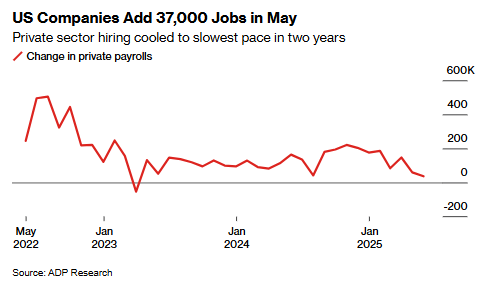
Group 1 - The core point of the article highlights a significant decline in U.S. employment data for May, with only 37,000 new jobs added in the private sector, far below the expected 114,000 and previous month's 62,000 [1][3] - The ADP report indicates a loss of momentum in hiring, with employers adopting a cautious approach to recruitment and wage increases [1][3] - Economic uncertainty, including slowing growth and unresolved inflation issues, is causing businesses to hesitate in hiring and expanding investments [3][5] Group 2 - Certain sectors, such as leisure and hospitality, and financial activities, show slight growth, but overall hiring trends in education, healthcare, business services, manufacturing, and transportation are stagnant or declining [5] - Wage growth is stagnating, with employees who switch jobs seeing a 7% increase in salary, while those who remain in their positions only see a 4.5% increase, indicating a trend where loyalty may not be rewarded [5][7] - The market is anxiously awaiting the upcoming non-farm payroll data, as poor results could pressure the Federal Reserve to consider interest rate cuts [5][7] Group 3 - The article raises questions about the effectiveness of potential interest rate cuts in stimulating economic growth, especially if companies are already cutting back on spending [7] - The current economic environment is characterized by fragility and uncertainty, necessitating careful management by the Federal Reserve [7] - The employment data reflects broader economic concerns, with implications for consumer finances, employment, mortgage rates, and retirement benefits [7]

5月“小非农”跌至近两年冰点 连续两月远逊预期
Zhi Tong Cai Jing· 2025-06-04 13:12
Group 1 - U.S. corporate hiring activity has slowed to its lowest level in nearly two years, with job cuts observed in sectors such as business services, education, and healthcare, indicating a continued weakening in labor demand [1][2] - According to ADP Research, private sector employment increased by only 37,000 jobs last month, falling short of all economists' predictions in a survey, marking the second consecutive month of significant underperformance [1][2] - The current job market is under dual pressure: a noticeable slowdown in hiring speed and an extended time for unemployed individuals to find new jobs, with economists expecting more signs of cooling in the labor market in the coming months [2][3] Group 2 - Following the data release, stock index futures and U.S. Treasury yields fell, while President Trump reiterated calls for Federal Reserve Chairman Powell to lower interest rates in response to the current situation [3][4] - Despite the hiring slowdown, wage growth remains strong, with a 7% increase for job switchers and a 4.5% increase for retained employees, according to the ADP report, which covers over 25 million U.S. private sector employees [4] - The upcoming U.S. government employment report for May is expected to show a slowdown in non-farm employment growth compared to the strong performance in April, while the unemployment rate is anticipated to remain stable [4]
JOLTS数据爆了!美国4月职位空缺飙升,释放了什么信号?
Sou Hu Cai Jing· 2025-06-04 04:13
Group 1 - The U.S. job market shows unexpected strength with April JOLTS job openings at 7.391 million, surpassing market expectations of 7.1 million [1][3] - The ratio of job openings to unemployed individuals is currently at 1.0, indicating a balance between supply and demand, similar to pre-pandemic levels [3] - The healthcare, social work, and business services sectors contributed significantly to the increase in job openings, while education sectors are experiencing layoffs [3] Group 2 - April hiring reached a new high of 5.6 million, but layoffs also increased to 1.79 million, the highest since October of the previous year, indicating a volatile job market [5] - The number of voluntary resignations decreased from 3.35 million to 3.2 million, suggesting that workers are hesitant to leave their jobs [5] - Economists predict that the upcoming non-farm payroll report will show a decrease in new jobs to 125,000, while the unemployment rate is expected to remain stable at 4.2% [7] Group 3 - The Federal Reserve is maintaining interest rates in the 4.25%-4.5% range, with potential rate cuts not expected until September [7] - There are concerns regarding the reliability of the JOLTS data due to a low sampling rate, which is only half of what it was a few years ago [7][8] - The job market is described as a "Rashomon" scenario, with conflicting interpretations of the data from different sources [8]

本周有两场高校毕业生专场招聘会
Zheng Zhou Ri Bao· 2025-06-04 00:28
Group 1 - The Zhengdong New District is hosting a job fair on June 7, 2023, aimed at attracting college graduates for employment and entrepreneurship to support high-level development in the area [1] - The job fair will cover various industries including electronic communication, business services, education and training, manufacturing, biomedicine, cultural media, food, agriculture, real estate, insurance finance, and logistics, offering nearly 3,500 job positions [1] - Over 40 companies have registered to participate in the job fair, including Guangzhou Yuehao Food, Shanghai Zihe Information, and Jiangsu Kepu Textile [1] Group 2 - A separate job fair organized by the Erqi District Human Resources and Social Security Bureau will take place on June 5, 2023, targeting recent graduates and unemployed youth [2] - The event will feature over 6,800 job openings in key areas such as new media operations, management trainees, e-commerce, technical engineering, administration, design, accounting, law, computer science, and human resources management [2] - The job fair will include a recruitment area, an exhibition area for companies, and mobile options for resume submission to enhance job matching and face-to-face recommendations for job seekers [2]
大湾区企业品牌峰会暨产品对接会(广州站)邀您共赴品牌盛会
Sou Hu Cai Jing· 2025-05-26 06:27
Core Insights - The Greater Bay Area Enterprise Brand Summit and Product Matching Conference will be held on July 12, 2025, in Guangzhou, aiming to enhance brand influence and market competitiveness among enterprises in the region [2][3] - The summit will gather industry leaders to discuss brand development, market expansion, and technological innovation, promoting collaborative growth within the Greater Bay Area [2] Event Details - Date and Time: July 12, 2025, from 09:00 to 17:30 [3] - Location: National County Cultural Technology Industry Bay Innovation Center, 3rd Floor, Zhongzhou Center, Haizhu District, Guangzhou [3] - Scale: Expected attendance of 1,500 to 3,000 for the exhibition and 100 for the forum [3] - Participants: Brand merchants, trade merchants, source manufacturers, and industry association members [3] Highlights of the Event - High-level dialogues will feature industry elites sharing insights on brand building, market expansion, and technological innovation [5][6] - Experts will provide in-depth analysis on macroeconomics, policy regulations, and consumer trends, offering strategic guidance for enterprises [6] - Roundtable forums will allow representatives from participating companies to interact with guests and discuss opportunities and challenges in brand development within the Greater Bay Area [6] Showcase of Achievements - The event will present innovative brand cases from the Greater Bay Area, highlighting achievements in product design, marketing strategies, and user experience [7] - Cutting-edge technologies such as artificial intelligence, big data, and the Internet of Things will be showcased, demonstrating their applications in brand building [7] - Successful market expansion cases from Greater Bay Area brand enterprises will be reviewed, sharing experiences and strategies for market development [7] Collaboration Opportunities - One-on-one business negotiations will be facilitated to help participating companies connect with upstream and downstream resources [8] - Project roadshows will be organized for quality projects to be presented, along with cooperation signing ceremonies to promote project implementation [8] - Industry resources will be integrated from associations, financial institutions, and media to provide comprehensive support for enterprises [9] Policy Interpretation - Policy experts will provide authoritative interpretations of relevant policies in the Greater Bay Area, assisting enterprises in understanding policy benefits and formulating development strategies aligned with policy directions [10] - A policy consultation segment will be available for enterprises to ask questions, with experts addressing specific inquiries [10]

北交所策略专题报告:北交所排队企业整体高质量,关注2025打新机会
KAIYUAN SECURITIES· 2025-05-25 08:39
Group 1 - The overall quality of companies waiting for listing on the Beijing Stock Exchange (BSE) is high, with an average net profit of 89.67 million yuan for 94 companies, significantly higher than the average of 42.11 million yuan for 266 listed companies [3][15][17] - The average subscription rate for companies that raised over 200 million yuan is 0.14%, compared to 0.06% for those that raised less than 200 million yuan, indicating a correlation between fundraising size and subscription success [14][21] - The expected new stock subscription yield for 2025 is estimated to be between 4.8% and 10.80%, based on various assumptions regarding market conditions and investor participation [20][21] Group 2 - The BSE 50 index experienced a decline of 3.68% this week, closing at 1370.04 points, following a previous high of 1500 points, indicating potential volatility in the market [4][25][29] - The overall price-to-earnings (PE) ratio for BSE A-shares has decreased to 48.45X, with 53.79% of companies having a PE ratio exceeding 45X, suggesting a high valuation environment [22][26][27] - The five major industries on the BSE, including high-end equipment and information technology, have varying PE ratios, with information technology at 92.82X, indicating sector-specific valuation disparities [32][34] Group 3 - The average first-day price increase for newly listed companies from January 1, 2024, to May 23, 2025, is 303.91%, with the highest recorded increase being 731.41% for Tongguan Mining [44] - The IPO review process is active, with two companies awaiting approval and two newly accepted for review, reflecting ongoing market activity [5][42] - The report highlights the importance of focusing on companies with stable performance and reasonable valuations, particularly those classified as "little giants" in their respective sectors [39][41]
奥联服务资产结构失衡:过半为贸易应收款项,成长性亮红灯|IPO观察
Sou Hu Cai Jing· 2025-05-16 09:48
Core Viewpoint - Aolian Service Group Co., Ltd. has submitted a prospectus for an IPO in Hong Kong, but faces challenges due to a significant increase in trade receivables, which now constitute over half of its assets, negatively impacting its profitability quality [2][10][13]. Financial Performance - Aolian Service reported revenues of 342.42 million RMB, 430.74 million RMB, and 475.45 million RMB for the years 2022, 2023, and 2024, respectively, with net profits of 27.41 million RMB, 34.24 million RMB, and 44.63 million RMB, indicating continuous growth [2][3]. - The company’s trade receivables increased from 80.96 million RMB in 2022 to 182.70 million RMB in 2024, with a compound annual growth rate of 50.22%, significantly outpacing revenue growth of 17.84% during the same period [10][12]. Business Segments - Aolian Service's primary revenue sources are business and urban space services, which generated sales of 24.71 million RMB, 30.18 million RMB, and 30.73 million RMB, accounting for 72.2%, 70.1%, and 64.6% of total revenue, respectively [3][4]. - Community living services, while generating lower revenue, have higher profitability, with gross profits of 28.65 million RMB, 38.79 million RMB, and 51.47 million RMB compared to business and urban space services [5][6]. Customer Retention and Project Acquisition - The renewal rate for community living services has been declining, dropping from 91.1% in 2022 to 73.3% in 2024, indicating potential challenges in maintaining customer loyalty [6]. - The number of new projects acquired in business and urban space services decreased from 92 in 2022 to 56 in both 2023 and 2024, suggesting a weakening ability to secure new contracts [4][5]. Supplier Relationships - Aolian Service's largest shareholder is Hongtu Group, which holds 79.2% of the company, and the largest supplier has shifted to Aolian Development Group, which was not among the top five suppliers in 2022 [7][8]. Cash Flow and Profitability - The net cash flow from operating activities has been consistently low, with values of 2.99 million RMB, -9.74 million RMB, and 14.73 million RMB for the years 2022, 2023, and 2024, respectively, indicating that cash generation from operations has not kept pace with net profits [13].