
航空运输业

Search documents
东京股市震荡收跌
Xin Hua Wang· 2025-11-04 08:10
Core Viewpoint - The Tokyo stock market experienced a decline on November 4, with both major indices closing lower due to profit-taking by investors concerned about a potential short-term overheating of the market [1] Market Performance - The Nikkei 225 index closed down by 1.74%, while the Tokyo Stock Exchange Price Index fell by 0.65% [1] - The Nikkei index decreased by 914.14 points, ending at 51497.20 points; the Tokyo Stock Exchange index dropped by 21.69 points, closing at 3310.14 points [1] Sector Performance - Most of the 33 industry sectors on the Tokyo Stock Exchange saw declines, with the marine transportation, information and communication, and service sectors experiencing the largest drops [1] - Conversely, the airline transportation, glass and ceramic products, and petroleum and coal products sectors were among the top gainers [1]
海南免签政策升级,外国游客占入境过夜游客总数超八成
Hai Nan Ri Bao· 2025-11-04 01:16
Core Insights - Hainan's visa-free policy has been upgraded, leading to over 80% of overnight visitors being foreign tourists [5][6][7] - The introduction of new international flight routes, including a direct route from Frankfurt to Sanya, enhances Hainan's connectivity with Europe [3][6] Group 1: Visa-Free Policy Impact - From January to September, Hainan received 822,600 foreign tourists, accounting for 84.46% of total overnight visitors, with a year-on-year growth of 27.7% [5][7] - The visa-free entry has become the primary method for foreign tourists visiting Hainan, supported by various visa policies including bilateral and unilateral exemptions [6][7] Group 2: Flight Connectivity - A total of 31 international flights entered Hainan on a single day, with 17 flights arriving at Meilan International Airport and 14 at Sanya Phoenix International Airport [6] - Hainan has opened 79 international passenger routes, significantly increasing its attractiveness to foreign visitors through the combination of visa-free entry and direct flights [7] Group 3: Infrastructure Enhancements - Meilan International Airport has expanded its fast-track channels to 24, improving the efficiency of international passenger processing [7] - The implementation of a "smart processing platform" at the border control has reduced passenger verification time by nearly half, allowing for a throughput of 200 passengers per hour during peak times [7]


制造业PMI为何超季节性回落?:——2025年10月PMI点评
EBSCN· 2025-10-31 12:32
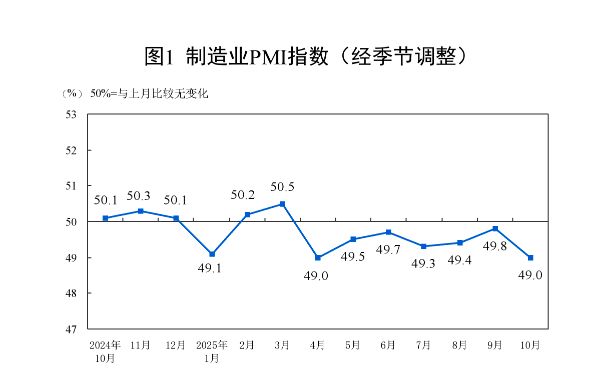
Manufacturing Sector - The manufacturing PMI for October 2025 is reported at 49.0%, a significant decrease of 0.8 percentage points from the previous month, which is notably higher than the seasonal average decline of 0.4 percentage points observed from 2020 to 2024[2][5] - The production index fell by 2.2 percentage points to 49.7%, while the new orders index decreased by 0.9 percentage points to 48.8%[5][15] - The new export orders index dropped to 45.9%, down 1.9 percentage points, marking the second-lowest level since the introduction of high tariffs in April 2025[5][20] - Small enterprises experienced a notable decline in PMI, falling 1.1 percentage points to 47.1%, while large enterprises' PMI decreased to 49.9%[6] Non-Manufacturing Sector - The non-manufacturing PMI for October 2025 is at 50.1%, slightly up from 50.0% in the previous month, driven by holiday consumption[2][28] - The service sector showed improvement, with indices for transportation, retail, and entertainment exceeding 60%, indicating strong performance in consumer-related services[28] - The construction PMI fell to 49.1%, but new orders and business activity expectations increased, suggesting a potential recovery in infrastructure activities[34] Economic Outlook - The report highlights that the construction sector may benefit from the introduction of 500 billion yuan in new policy financial tools and an additional 200 billion yuan in special bond issuance, which could support infrastructure investment[4][34] - The overall economic environment remains cautious due to external trade uncertainties and domestic demand stability, particularly in high-energy-consuming industries[16][20]
月度经济观察·10月份多领域数据出炉 经济继续保持平稳增长态势明显
Yang Shi Wang· 2025-10-31 05:36
Core Insights - The Purchasing Managers' Index (PMI) for China's manufacturing sector in October is reported at 49%, a decrease of 0.8 percentage points from the previous month, influenced by seasonal factors and external conditions [1][2] - Despite the decline in PMI, new momentum and consumer goods manufacturing are showing steady growth, with key sectors like equipment manufacturing and high-tech manufacturing remaining in the expansion zone [2][4] Manufacturing Sector - The equipment manufacturing price index reached a new high since June 2024, while the high-tech manufacturing price index hit a new high since 2025, indicating positive price changes in the manufacturing sector [4] - The production index and new orders index for key manufacturing sectors are operating around 51%, reflecting a stable expansion [2] Non-Manufacturing Sector - The non-manufacturing business activity index for October is at 50.1%, a slight increase of 0.1 percentage points from the previous month, maintaining levels above 50 since 2025 [7] - The service sector shows strong performance, particularly in contact-based services related to travel, shopping, and entertainment, with indices for railway and air transport exceeding 60% [6] Investment and Economic Outlook - There are signs of accelerated construction activities related to infrastructure investment, with the civil engineering business activity index rising above 55%, and new orders index increasing to over 49% [9] - The business activity expectation index for non-manufacturing is at 56.1%, indicating a positive outlook for the sector, supported by fiscal and monetary policy collaboration [9]
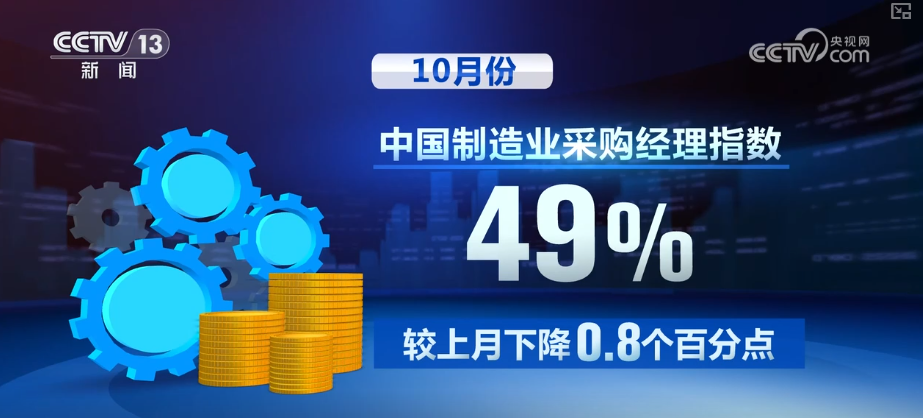
10月制造业采购经理指数为49%,制造业短期波动仍有趋稳基础
Bei Ke Cai Jing· 2025-10-31 03:36
Group 1: Manufacturing Sector - The manufacturing Purchasing Managers' Index (PMI) decreased to 49% in October, down 0.8 percentage points from the previous month, indicating a slowdown in production activities [1][2] - Various sub-indices, including production, new orders, and export orders, showed declines ranging from 0.1 to 2.6 percentage points, reflecting weakened demand and production activities across enterprises of all sizes [2][3] - The overall economic imbalance of supply exceeding demand continues to develop, leading to increased downward pressure on the economy, necessitating stronger macroeconomic policy adjustments [3] Group 2: Non-Manufacturing Sector - The non-manufacturing business activity index rose slightly to 50.1%, with several sub-indices, such as inventory and input prices, showing increases between 0.2 and 1.1 percentage points [1][4] - The new orders index remained stable compared to the previous month, indicating steady operational activities in the non-manufacturing sector, supported by holiday consumption [4][5] - Significant increases were observed in sectors like transportation, retail, and construction, with business activity indices exceeding 60%, suggesting a positive trend in investment and consumption-related activities [5]
制造业PMI回落至49%,“反内卷”带动价格改善
Di Yi Cai Jing Zi Xun· 2025-10-31 03:10
Core Insights - The manufacturing PMI in October decreased to 49.0%, down 0.8 percentage points from the previous month, indicating a decline in manufacturing activity after two months of growth [1] - The non-manufacturing business activity index rose to 50.1%, up 0.1 percentage points, remaining in the expansion zone, driven by holiday effects [1] Manufacturing Sector - The manufacturing production index fell to 49.7%, a decrease of 2.2 percentage points, indicating a slight slowdown in production activities [4] - The new export orders index dropped to 45.9%, down 1.9 percentage points, marking the second-lowest point of the year, reflecting tightening export demand [5] - The procurement volume index decreased to 49%, down 2.6 percentage points, indicating a contraction in purchasing activities after two months of expansion [5] Business Performance by Company Size - Large enterprises' PMI fell to 49.9%, while medium-sized enterprises' PMI decreased to 48.7%, and small enterprises' PMI dropped to 47.1%, indicating pressure across all company sizes [6] - Despite the decline, large enterprises maintained stable supply and demand, while medium and small enterprises faced more significant challenges [6] Price Trends - The manufacturing sector experienced positive price changes, with the equipment manufacturing purchase price index and factory price index rising for three consecutive months [6] - The consumer goods manufacturing purchase price index fell to below 50%, while the factory price index increased, indicating reduced cost pressures and stabilized sales prices [7] Non-Manufacturing Sector - The non-manufacturing business activity index showed signs of recovery, with significant activity in sectors closely related to consumer travel, such as transportation and hospitality, driven by holiday effects [10] - The business activity expectation index remained high at 56.1%, indicating strong confidence among service sector enterprises regarding future development [10]
10月份中国非制造业商务活动指数为50.1%
Yang Shi Xin Wen· 2025-10-31 01:32
Core Insights - China's non-manufacturing business activity continues to stabilize, with demand remaining relatively steady, driven by holiday consumption and an acceleration in infrastructure investment activities [1][2] Group 1: Business Activity Index - In October, the non-manufacturing business activity index was 50.1%, a slight increase of 0.1 percentage points from the previous month, maintaining above 50% for the year [1] - The service industry, particularly contact-based services related to travel, shopping, and entertainment, performed well, with indices for railway transport, air transport, and cultural entertainment exceeding 60% [1] Group 2: Market Expectations - The service industry business activity expectation index remained above 55%, indicating strong confidence among service enterprises regarding industry development [1] - The non-manufacturing business activity expectation index rose to 56.1%, an increase of 0.4 percentage points from the previous month, reflecting positive changes in investment and consumption-related activities [2] Group 3: Infrastructure Investment - There are signs of accelerated activity in construction related to infrastructure investment at the beginning of the fourth quarter, with the civil engineering business activity index rising above 55%, an increase of over 5 percentage points [1] - The new orders index for construction activities rose to over 49%, with a nearly 2 percentage point increase [1]
今年前三季度广州GDP同比增长4.1%,增速继续回升
Sou Hu Cai Jing· 2025-10-30 08:32
Core Insights - Guangzhou's GDP for the first three quarters of 2025 reached 23,265.65 billion yuan, showing a year-on-year growth of 4.1% at constant prices [1] - The economic recovery in Guangzhou is accelerating, with GDP growth improving from 3.8% in the first half of the year to 4.1% in the first three quarters [2] Economic Performance - The primary industry added value was 197.94 billion yuan, growing by 4.2% - The secondary industry added value was 5,564.37 billion yuan, with a growth of 2.7% - The tertiary industry added value was 17,503.34 billion yuan, increasing by 4.6% [1] - The industrial added value for large-scale enterprises grew by 1.4%, an increase of 0.7 percentage points compared to the first half of the year [2] Investment Trends - Fixed asset investment in Guangzhou grew by 1.3%, up by 0.5 percentage points from the first half of the year - Industrial investment surged by 9.6%, while infrastructure investment rose by 2.2% - Real estate development investment increased by 2.4%, driven by urban renewal projects - Investment in the automotive manufacturing sector grew by 15.8%, with a notable 38.6% increase in automotive parts manufacturing investment [2] Contribution to GDP - The tertiary sector contributed over 80% to the city's GDP growth - The financial sector, buoyed by an active securities market, achieved a 6.1% increase in added value, contributing significantly to the overall GDP growth [2] Transportation and Logistics - The total passenger volume for the first three quarters reached 254 million, with a year-on-year growth of 6.5% - Air and rail transport saw passenger volume increases of 2.4% and 0.9%, respectively - Cargo transport also showed stability, with a total cargo volume of 700 million tons, growing by 2.4% [3] Economic Outlook - The overall economic performance in Guangzhou is characterized by steady progress and quality improvement - However, challenges remain, including external uncertainties and structural issues in supply and demand - Future strategies will focus on stabilizing existing economic activities, expanding new investments, and enhancing quality to foster high-quality development [3]
中免集团、白云机场成立免税品公司注册资本4500万元
Xin Lang Cai Jing· 2025-10-22 04:30
Core Viewpoint - The establishment of China Duty Free Group Baiyun Airport Duty-Free Goods (Guangzhou) Co., Ltd. indicates a strategic expansion in the duty-free retail sector, with a registered capital of 45 million RMB and a diverse range of business operations [1]. Company Information - The company was founded on October 20, 2025, and is currently in a state of existence [1]. - The legal representative is Li Jia, and the company is registered under the unified social credit code 91440100MAEXW3136J [1]. - The registered address is located at the T3 main building of Guangzhou Baiyun International Airport [1]. Business Scope - The business operations include the sale of pre-packaged food, health food, infant formula, cosmetics, electronic products, and various retail categories such as clothing, daily necessities, and duty-free goods [1]. - The company also engages in the sale of jewelry, toys, sports equipment, and tobacco products [1]. Shareholding Structure - The ownership structure consists of China Duty Free Group Co., Ltd. holding 51% and Guangzhou Baiyun International Airport Co., Ltd. holding 49% [1].

中免集团、白云机场成立免税品公司 注册资本4500万元
Mei Ri Jing Ji Xin Wen· 2025-10-22 03:54
Core Insights - A new company named China Duty-Free (Guangzhou) Co., Ltd. has been established, with a registered capital of 45 million RMB [1] - The company is co-owned by China Duty-Free Group Co., Ltd. (51% stake) and Guangzhou Baiyun International Airport Co., Ltd. (49% stake) [1] Company Information - The legal representative of the company is Li Jia [2] - The company is registered with a unified social credit code of 91440100MAEXW3136J and is currently in a state of existence [2] - The business scope includes the sale of food, cosmetics, electronic products, and various retail activities [2] Shareholder Structure - China Duty-Free Group Co., Ltd. holds a 51% stake, while Guangzhou Baiyun International Airport Co., Ltd. holds a 49% stake in the new company [2]