软件

Search documents
AI裁员即暴涨?晨星抨击:重新部署员工比单纯“砍掉”更能释放价值
Hua Er Jie Jian Wen· 2026-02-27 07:32
Core Viewpoint - Companies are increasingly using AI as a narrative for layoffs and cost-cutting, which the market is quickly pricing as a positive, but this may overshadow the more significant value of AI in enhancing productivity through employee redeployment rather than merely reducing headcount [1][2][4] Group 1: AI and Layoffs - Companies like Wisetech Global and Block have announced significant layoffs (30% and over 40% of their workforce, respectively), leading to stock price increases of 11% and 23% following these announcements [1][3] - Morningstar analyst Lochlan Halloway notes that the market seems focused on what AI might destroy rather than what it can create, suggesting that layoffs are being framed as a direct result of AI rather than a genuine technological transformation [1][2] Group 2: Market Reactions and Investor Sentiment - The stock market's reaction to layoffs indicates a strong investor preference for narratives around cost reduction through AI, with short-term cost-cutting often being more readily translated into profit expectations than discussions of productivity and growth [3][5] - Morningstar emphasizes the need for investors to differentiate between cost-cutting framed by AI narratives and sustainable productivity improvements achieved through organizational and role reconfiguration [5][6] Group 3: Future Implications of AI - Halloway argues that companies can leverage AI to enhance productivity not by eliminating jobs but by redeploying employees to higher-value roles, thus unlocking additional output from AI [4] - The upcoming earnings season will see increased scrutiny on how AI impacts companies' balance sheets and operational quality, moving beyond layoffs as the sole visible indicator of efficiency gains [6]
平安证券(香港)港股晨报-20260227
Ping An Securities Hongkong· 2026-02-27 07:27
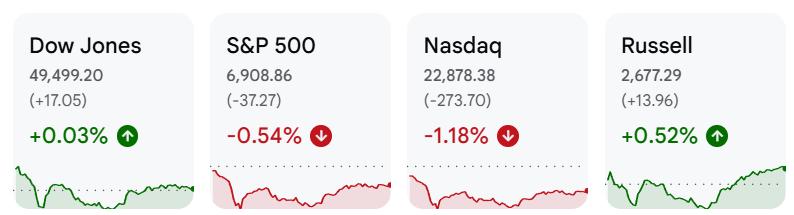
Market Overview - The Hong Kong stock market experienced a decline, with the Hang Seng Index closing at 23,831 points, down 145 points or 0.61% [1] - The Hang Seng Technology Index fell by 2.87% to 5,109.33 points, while the Hang Seng China Enterprises Index decreased by 2.44% to 8,814.29 points [1][5] - The total market turnover was HKD 259.28 billion, an increase from the previous day's HKD 236.76 billion [5] US Market Performance - The US stock market showed mixed results, with the Dow Jones rising by 0.03%, while the S&P 500 and Nasdaq fell by 0.54% and 1.18% respectively [2] - Notable declines were observed in major tech stocks, with Nvidia dropping over 5% and Tesla falling more than 2% [2] Investment Opportunities - The report emphasizes the potential for growth in sectors supported by the "self-reliance in technology" policy, particularly in artificial intelligence, semiconductors, and industrial software [3] - There is a recommendation to focus on sectors benefiting from the "expanding domestic demand" policy, including sports apparel and non-essential service consumption [3] - The report highlights the continued value of Hong Kong stocks centered on Chinese assets, suggesting attention to state-owned enterprises with low valuations and high dividends [3] Sector Performance - In the Hong Kong market, local real estate, software, and 5G concept sectors saw significant declines, while gold stocks performed well [1] - Within the Hang Seng Index, notable stock movements included a 10.8% drop for Zhongsheng Holdings and a 7.5% decline for WuXi Biologics [1][5] - The report indicates a significant focus on the technology sector, particularly in light of recent policy changes aimed at enhancing domestic capabilities in computing and communication [3]
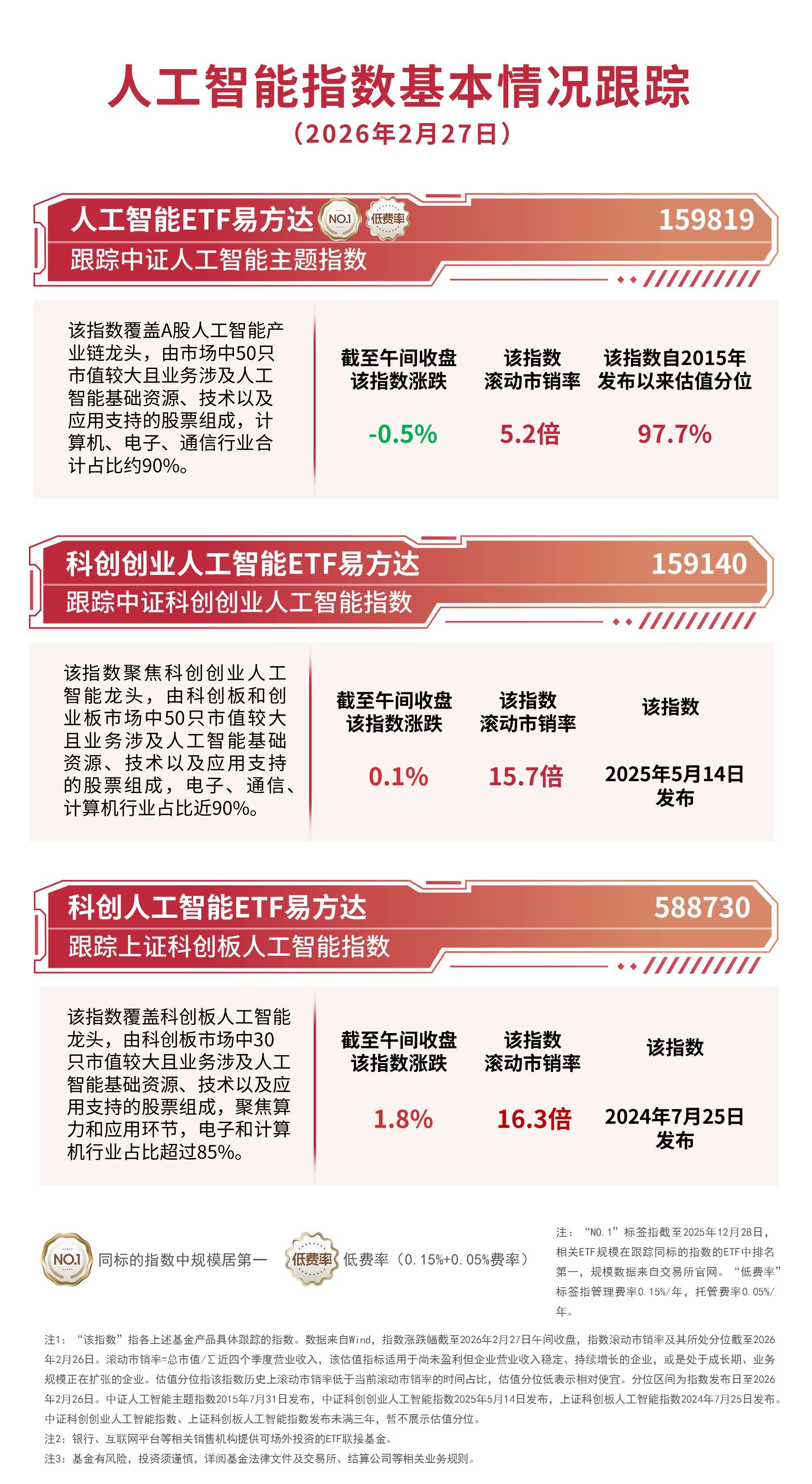
AI产业链方向震荡分化,软件板块走强,科创人工智能ETF易方达(588730)标的指数涨近2%
Sou Hu Cai Jing· 2026-02-27 04:39
Core Viewpoint - The AI industry chain is experiencing mixed performance, with the software sector showing strength, as indicated by the rise in relevant indices and significant capital inflow into AI-focused ETFs [1][5]. Group 1: Index Performance - The Shanghai Stock Exchange Sci-Tech Innovation Board Artificial Intelligence Index increased by 1.8% [1]. - The CSI Artificial Intelligence Theme Index decreased by 0.5% [1]. - The CSI Sci-Tech Innovation and Entrepreneurship AI Index saw a slight increase of 0.1% [1]. Group 2: ETF Inflows - The E Fund AI ETF (588730) attracted over 80 million yuan in the last four trading days [1]. - This ETF tracks the Shanghai Stock Exchange Sci-Tech Innovation Board AI Index, which consists of 30 large-cap stocks involved in AI foundational resources, technology, and application support [5]. Group 3: Sector Composition - The indices focus on leading companies in the AI sector, with nearly 90% of the stocks in the indices coming from the electronics, communications, and computer industries [3]. - The E Fund AI ETF emphasizes computing power and application segments, with over 85% of its holdings in the electronics and computer sectors [5].

贝恩资本警告:AI叠加债务高峰 软件行业贷款违约率或升至两位数
Jin Rong Jie· 2026-02-27 03:45
Group 1 - Bain Capital warns that the disruptive impact of artificial intelligence (AI) is expanding, and the software industry faces a risk of loan default rates soaring to double digits as debt repayment peaks approach [1] - Angelo Rufino, head of Bain Capital's North America and European special situations departments, predicts that software industry default rates could rise to the high single digits to low double digits, compared to an expected overall leveraged loan default rate of only 5% in the U.S. this year [1] - Wall Street is increasingly alerting that AI productivity tools will not only impact the software industry but may also reshape financial services and asset management [1] Group 2 - Rufino believes that despite many software service companies having stable subscription revenues and offering practical products at low costs, the rise of AI will limit their pricing power, affecting enterprise valuation multiples and making debt refinancing more challenging [2] - He states that the credit cycle will force the market to readjust capital structures to match the profitability of these business models, leading to refinancing difficulties for many companies [2] - However, Rufino also notes that the software industry's crisis is unlikely to escalate into a systemic credit market issue, as the overall credit market is not expected to see a significant rise in default rates [2]
散户又“梭哈”?华尔街恐慌抛售,散户却疯狂抄底
Jin Shi Shu Ju· 2026-02-27 03:01
Group 1 - Wall Street is experiencing a sell-off in software stocks due to concerns over AI's disruptive potential, while retail investors are buying in, pushing trading activity to near historical highs despite the S&P Composite 1500 Software and Services Index dropping nearly 20% year-to-date [1] - Retail investors are particularly favoring Microsoft (MSFT.O), ServiceNow (NOW.N), and AppLovin (APP.O) amidst fears that new AI products could replace services offered by companies like Salesforce (CRM.N) and Adobe (ADBE.O) [1] - Panic trading has intensified following a report from Citrini Research suggesting that AI could trigger widespread economic disruption, with Nassim Taleb warning of a potential wave of bankruptcies in the software industry [1] Group 2 - The sell-off in software stocks is viewed as excessive, with current valuation levels considered attractive by some analysts [2] - Retail investors continue to buy during each dip, as evidenced by record levels of buying in Nvidia (NVDA.O) despite a 5.5% drop, marking its worst day since April 2025 [2] - Analysts suggest that retail investors may be rediscovering undervalued opportunities in a market heavily influenced by AI news, with significant buying activity observed in various tech stocks and ETFs [2]
“别人恐惧我贪婪“!“Citrini恐慌”标记市场底部,看好反弹的对冲基金已出手
Zhi Tong Cai Jing· 2026-02-27 02:54
管理着20亿澳元资产的GCQ基金自身也面临着挑战,其部分重仓股表现不佳拖累了业绩。例如,瑞典 房产门户网站Hemnet Group的股价较其2025年的高点下跌了超过70%。 即便如此,该基金有望在2月份创下月度资金净流入的纪录,此前1月份已吸引了5000万澳元。其分销团 队和泰南本人都在鼓励客户利用软件股价格低廉的机会趁机布局。 泰南表示:"最大程度的扰动发生在上周。"他补充称,这轮软件股抛售是"我见过的最不合逻辑的市场 抛售之一"。 GCQ还加倍押注了房产门户网站,买入了英国的Rightmove PLC和SMG瑞士市场集团,并在早些时候因 股价下跌减持后,又增持了Hemnet的股份。 一家总部位于悉尼的对冲基金表示,软件股的抛售潮已经见底,并已趁着此次下跌行情,买入了价值约 2亿澳元(合1.43亿美元)的科技股。 GCQ基金管理公司抛售了其部分表现最佳的持仓股,包括欧洲奢侈品公司,转而将资金投入了那些遭 受重创的软件股。该公司首席投资官道格·泰南透露,近几周来,他们瞄准了微软、会计软件公司Intuit 以及科技巨头SAP。 在一系列来自Anthropic等初创公司的更新加剧了市场对软件行业短期前景的疑虑之 ...
AI 狂潮下的末日预演:Citrini 报告引发的全球经济焦虑与应对之道
3 6 Ke· 2026-02-27 02:50
Group 1 - The report by Citrini Research warns of a potential global economic crisis triggered by the "over-success" of AI, which could surpass the impact of the 2008 financial crisis [1][3] - The concept of "Ghost GDP" is introduced, indicating that nominal GDP growth may not translate to increased purchasing power or social welfare, leading to a potential economic downturn due to overproduction and underconsumption [2][11] - The report outlines a four-stage scenario of crisis development, starting with the software industry facing pressure due to AI applications, leading to a cycle of layoffs and further AI investment [3][4] Group 2 - In the crisis escalation phase of 2027, AI becomes a default configuration in businesses, leading to significant job losses in white-collar sectors, particularly in industries like tourism, insurance, and finance [5][6] - The financial system begins to show cracks in the second half of 2027, with private credit markets experiencing distress due to the downturn in the SaaS industry, leading to a liquidity crisis [7] - By 2028, the crisis culminates in a global economic collapse, with significant declines in housing markets and consumer spending, and a projected unemployment rate of 10.2% [8][9] Group 3 - Following the report's release, global markets experienced significant volatility, with a notable drop in stock prices, particularly in tech sectors, as investors reacted to the perceived risks associated with AI [9][10] - The report has sparked a debate among economists and investors, with some viewing it as a necessary warning about the risks of AI, while others criticize its extreme assumptions and potential for alarmism [10][12][13] Group 4 - The report suggests a multi-layered response strategy to mitigate the potential crisis, including macroeconomic policy adjustments, corporate transformations, individual skill development, and global cooperation on AI governance [16][17][18] - Companies are encouraged to shift from a cost-cutting approach to a collaborative model that integrates AI with human labor, focusing on enhancing value creation rather than merely reducing workforce [19] - Individuals are advised to develop skills that are difficult for AI to replicate, emphasizing the importance of lifelong learning and adaptability in the evolving job market [20]
未知机构:每日复盘226科技股带领美股连涨两日英伟达盘后一度涨3后回落加密货-20260227
未知机构· 2026-02-27 02:45
Summary of Key Points from Conference Call Records Industry and Company Overview - **Technology Sector**: The technology sector, particularly driven by Nvidia's strong performance, has seen a resurgence in investor interest, leading to a two-day rally in U.S. stocks, with the Nasdaq rising by 1% and software ETFs increasing by 3% [1][1]. - **Cryptocurrency Market**: Bitcoin experienced a significant increase of nearly 8%, approaching $70,000, indicating a rebound in the cryptocurrency market [1][1]. - **Real Estate Market**: New policies in Shanghai aimed at loosening restrictions for non-local homebuyers and increasing public housing loan limits have been introduced, which may impact the real estate sector positively [2][2]. Core Insights and Arguments - **Nvidia's Earnings**: Nvidia's earnings report exceeded expectations, leading to a temporary increase in its stock price by approximately 3.5% before a slight pullback [1][1]. - **Lithium Market**: Zimbabwe's immediate suspension of exports for unprocessed minerals and lithium concentrates is expected to elevate lithium carbonate prices, with related stocks experiencing a surge [5][5]. - **Gas Turbine Demand**: The partnership between Weichai Power and Generac has led to an upward revision of data center business guidance, indicating increased demand for gas turbines in North America due to power shortages [7][7]. Other Important but Potentially Overlooked Content - **Market Trends**: The A-share market continued to rise with a trading volume of 2.48 trillion yuan, reflecting strong investor sentiment, particularly in cyclical resource stocks such as chemicals, non-ferrous metals, and steel [2][2]. - **Environmental Regulations**: The release of a new air quality standard in China tightening PM2.5 concentration limits may impact industries related to air quality management and pollution control [4][4]. - **Stablecoin Performance**: Circle's fourth-quarter performance exceeded expectations, resulting in a 35% stock price increase, highlighting the potential for stablecoins to become a focal point in the market [7][7].

美股板块轮动,软件股逼空反弹,奈飞为何盘后大涨?
3 6 Ke· 2026-02-27 02:33
Core Viewpoint - The U.S. stock market is experiencing a clear divergence, with the Dow Jones slightly up, the Nasdaq down nearly 1.2%, and the Russell 2000 index rising about 0.5%, indicating a rotation of funds away from concentrated tech stocks [1] Group 1: Market Dynamics - The core variable dragging down the Nasdaq is Nvidia, which reported strong earnings but saw its stock drop over 5% post-announcement, suggesting a "buy the rumor, sell the news" scenario rather than a fundamental reversal [2] - Retail investors have significantly increased their net buying of Nvidia, while institutional investors have reduced their positions, indicating a misalignment that may amplify short-term volatility [3] - The overall performance of the tech giants is weaker than the broader S&P 500, suggesting that the issue is not industry weakness but rather a natural adjustment after excessive concentration [5] Group 2: Fund Flow and Sector Rotation - The Russell 2000 index's rise contrasts with the Nasdaq, reflecting a shift of funds from high-valuation tech stocks to relatively undervalued small-cap stocks [5] - This style switch typically occurs in two phases: when long-term industry trends change and when short-term fund structures become overly crowded [6] - The current market is closer to the second phase, indicating a redistribution of risk rather than a systemic risk release [7] Group 3: Sector-Specific Insights - The software sector is experiencing extreme positioning, with short positions at a seven-year high and long positions at a seven-year low, making it highly sensitive to positive news [8] - The market is not uniformly bearish; rather, there is an increasing divergence between bulls and bears, leading to an imbalanced position structure [10] - Despite pressure on the tech sector, some individual stocks are performing strongly, indicating that funds are reassessing profit quality and valuation alignment [11][12] Group 4: Company-Specific Developments - Netflix's stock surged about 10% after it decided to abandon its acquisition of Warner Bros. Discovery, signaling a shift in its capital allocation strategy [15] - The decision to halt the acquisition, which was valued at approximately $82.7 billion, alleviates market concerns regarding regulatory risks and competitive pressures [19] - The resumption of Netflix's stock buyback program is seen as a sign of management's confidence in future cash flows and valuation, potentially indicating a 15%-25% upside in stock price [22][24]

避险情绪升温 资金涌入资产密集型股票规避AI颠覆风险
Huan Qiu Wang· 2026-02-27 02:19
【环球网财经综合报道】据Financial Times等外媒报道,近期受人工智能颠覆风险担忧影响,全球股市出现结构分 化,投资者纷纷减持高风险轻资产板块,转向公用事业、能源、材料等拥有实物资产的资产密集型股票寻求避险。 近期,标普500软件子指数跌至2025年4月美国关税政策以来最低水平,不到一个月内板块总市值蒸发1.2万亿美元。 市场对AI工具可能颠覆行业的担忧持续发酵,软件板块首当其冲,并波及财富管理、保险等领域。 瑞银衍生品策略主管格里·福勒表示,过去15年有效的轻资产、知识产权驱动模式当前最为脆弱,市场避险焦点转向 以实物资产为支撑的业务模式。低利率时代结束、利率走高持续压制轻资产估值,国防、基础设施等资本密集领域 投资力度提升,进一步推动资金转向。 与之形成鲜明对比,标普500公用事业子指数同期上涨超10%,能源股涨幅达到22%,在多年跑输轻资产科技股后, 重资产板块重新获得资金青睐。 高盛欧洲策略师表示,资产密集型企业具备难以复制、建设周期长的特点,对人工智能带来的颠覆性风险具备更强 抵御能力,可称之为具备防御属性的"光环股"。 个股方面,Intuit、AppLovin、Gartner、Workd ...