
铝冶炼

Search documents
报告显示,2024年我国城镇新建绿色建筑面积16.9亿平方米
Xin Jing Bao· 2025-09-13 08:38
Core Insights - The report presented by the Minister of Ecology and Environment highlights China's commitment to addressing climate change and achieving carbon peak and neutrality goals, with significant advancements in green building and energy transition [1][2][3] Group 1: Green Building Development - In 2024, the area of newly constructed green buildings in urban areas is projected to reach 1.69 billion square meters, accounting for 97.9% of the total new urban construction area [2] - The government is actively promoting high-quality development in green buildings and construction [2] Group 2: Energy Transition - By June 2025, the installed capacity of non-fossil energy is expected to reach 2.22 billion kilowatts, representing 60.9% of the total installed capacity [2] - The government is enhancing the clean and efficient use of fossil energy, implementing coal power reforms, and steadily increasing natural gas production and utilization [2] Group 3: New Energy Production - Since the start of the 14th Five-Year Plan, the production of photovoltaic components and lithium batteries has increased by 3.7 times and 6.4 times, respectively [2] - China has maintained its position as the global leader in the production and sales of new energy vehicles for ten consecutive years [2] Group 4: Carbon Market Development - The national carbon market has been progressively improved, with the inclusion of the steel, cement, and aluminum industries, covering over 60% of national carbon emissions [2] - As of June 2025, the cumulative trading volume of carbon emission allowances in the national carbon market is 670 million tons, with a transaction value of 45.93 billion yuan [2] Group 5: Climate Change Adaptation - The report outlines the implementation of the National Climate Change Adaptation Strategy 2035, focusing on climate-resilient urban development and enhancing disaster prevention and response capabilities [3] - The government aims to integrate climate change adaptation requirements into land use planning at all levels [3] Group 6: Legal and Policy Framework - There is a commitment to improve legal policies to support climate change response, including the development of specialized laws and the revision of energy conservation laws [3][4] - The government plans to enhance carbon emission regulatory enforcement and establish mechanisms to combat data fraud in the carbon market [3]
沪铝 下方支撑转强
Wen Hua Cai Jing· 2025-09-12 02:08
Core Viewpoint - The domestic electrolytic aluminum supply is stabilizing while demand remains resilient, driven by the transition from off-peak to peak season and the continued high demand for aluminum as a substitute for copper [1][2]. Supply Side Stability - The domestic electrolytic aluminum industry operates at over 95% capacity, with seasonal production cuts diminishing due to improved power supply from renewable energy projects [1]. - Although there are expansion plans in overseas markets like Indonesia, challenges such as inadequate power infrastructure slow down the release of new capacity, resulting in limited overall supply growth [1]. Demand Resilience - The market is transitioning from a low-demand season to a peak season, with recovery in downstream processing rates and increasing orders in sectors like photovoltaics and automotive [2]. - Despite previous concerns about weakening export demand, aluminum product exports show strong resilience, with a shift from initial processing products to deep-processing products [2]. Low Inventory Support - The ongoing decline in alumina prices is unlikely to significantly drag down aluminum prices due to strong support from bauxite prices and expected reductions in bauxite export volumes as the rainy season approaches [3]. - Both domestic and overseas aluminum ingot inventories are at historically low levels, which, combined with the upcoming peak season, is expected to lead to further inventory depletion and support a bullish price outlook for aluminum [3].
绿电点亮新“铝途”:中铝集团达茂旗120万千瓦新能源项目全容量并网
Xin Hua Wang· 2025-09-11 12:24
Core Viewpoint - The successful full-capacity grid connection of the 1.2 million kilowatt renewable energy project by Baotou Aluminum Industry marks a significant step for China Aluminum Group in its green and low-carbon transformation journey [1][2]. Group 1: Project Overview - The project involves a comprehensive "source-network-load-storage integration" system, which includes self-supplied thermal power, off-site renewable energy, direct supply of green electricity to the park, distributed photovoltaics, the grid, energy storage, and electrolytic aluminum load [1]. - The total investment in the project exceeds 5 billion yuan, comprising 1 million kilowatts of wind power and 200,000 kilowatts of solar power, along with smart energy control systems and related storage facilities [1]. Group 2: Environmental Impact - The project is expected to generate an average annual electricity output of approximately 3.5 billion kilowatt-hours, saving 1.249 million tons of standard coal and reducing carbon dioxide emissions by about 3 million tons each year [2]. - By adopting a "self-generated and self-used" model, the project provides stable and clean green electricity to Baotou Aluminum, significantly lowering electricity costs and enhancing the company's market competitiveness [2]. Group 3: Future Plans - China Aluminum Group plans to leverage the full-capacity grid connection of the renewable energy project as an opportunity to advance its green initiatives, focusing on low-carbon, low-cost operations, and digital transformation [2]. - The company aims to continuously optimize its industrial layout and structure, promoting the deep integration of green energy with the smelting industry [2].

铝月报:旺季临近,震荡偏强-20250905
Wu Kuang Qi Huo· 2025-09-05 13:24
Report Industry Investment Rating No relevant content provided. Core Viewpoints - In August, aluminum prices showed a high - level oscillating trend. The spread of SHFE aluminum continued to narrow, and the spot market showed obvious regional differentiation, with the East China region relatively stronger. The LME market's Cash/3M shifted to a premium structure. - Fundamentally, the social inventory of domestic electrolytic aluminum continued to accumulate, and the operating capacity of electrolytic aluminum increased slightly. Demand showed structural differentiation, the proportion of molten aluminum rebounded, and the production scheduling data of home appliances indicated a weak expectation for "Golden September". The production schedules of air - conditioners, refrigerators, and washing machines all decreased year - on - year. - Overall, aluminum prices oscillated between macro expectations and fundamental realities. The enhanced overseas interest - rate cut expectation provided support, but the continued domestic inventory accumulation and the weak improvement in terminal demand restricted the upward price space. This month, focus on the fulfillment of peak - season demand and the inventory trend. If the inventory shows an inflection point, aluminum prices are expected to rise further. The operating range of the main SHFE aluminum contract this month is expected to be 20,300 - 21,400 yuan/ton; the operating range of LME 3M aluminum is expected to be 2,540 - 2,720 US dollars/ton [12]. Summary by Directory 1. Monthly Assessment and Strategy Recommendation - Supply: As of the end of August, the domestic operating capacity of electrolytic aluminum was about 44 million tons, with a slight increase due to the commissioning of some electrolytic aluminum replacement projects. The output was 3.733 million tons, a year - on - year increase of 1.22%. In September, the operating capacity of electrolytic aluminum is expected to continue to increase slightly [12]. - Inventory & Spot: At the end of August, the domestic social inventory of aluminum ingots was 610,000 tons, a month - on - month increase of 85,000 tons, and the inventory accumulation continued. The bonded - area inventory was 99,000 tons, a month - on - month decrease of 7.4%. The domestic aluminum rod inventory was 143,000 tons, a month - on - month decrease of 14,000 tons. The LME inventory was 481,000 tons, a month - on - month increase of 3.9%. The spot basis of aluminum ingots both at home and abroad strengthened during the month [12]. - Imports and Exports: In July 2025, China exported 542,000 tons of unwrought aluminum and aluminum products, a month - on - month increase of over 50,000 tons. The cumulative export volume from January to July was 3.462 million tons, a year - on - year decrease of 8%. In August, the loss of domestic aluminum spot imports widened month - on - month [12]. - Demand: According to Aizhe Consulting's research, the weekly downstream operating rate rebounded at the end of August, but the operating rates of each sector varied. Most processing plants increased production, and there were signs of improvement in the demand side. With the arrival of the traditional peak season in September, consumption may continue to improve [12]. 2. Futures and Spot Market - Futures: In August, SHFE aluminum oscillated at a high level, rising 250 yuan/ton during the month with the center of gravity shifting upward, and LME aluminum rose 2.11% [22]. - Term Spread: In August, the spread of SHFE aluminum continued to decline [27]. - Spot Basis: In August, the aluminum ingot spot in the East China region changed from a short - term premium to a discount, and the discounts in the South China and Central China regions widened [30]. - Regional Premium and Discount Spread: In August, the East China spot strengthened relatively [33]. - LME Premium and Discount: In August, the LME market's Cash/3M changed from a discount to a premium [39]. 3. Profit and Inventory - Electrolytic Aluminum Smelting Profit: In August, the average smelting profit of primary aluminum was 4,284.2 yuan/ton, a month - on - month decrease of 3.8% compared with July and a year - on - year increase of 104.5% [44]. - Electrolytic Aluminum Inventory: At the end of August, the domestic social inventory of aluminum ingots was 610,000 tons, a month - on - month increase of 85,000 tons, and the inventory accumulation continued, a year - on - year decrease of 24.5%. The bonded - area inventory was 99,000 tons, a month - on - month decrease of 7.4% and a year - on - year increase of 126.1%. The LME inventory was 481,000 tons, a month - on - month increase of 3.9% [47][53]. - Aluminum Rod Inventory: At the end of August, the domestic aluminum rod inventory was 143,000 tons, a month - on - month decrease of 14,000 tons. The combined inventory of aluminum ingots and aluminum rods continued to accumulate [50]. - LME Inventory Structure: The proportion of aluminum from India in the LME aluminum ingot inventory increased, significantly squeezing the proportion of Russian aluminum [57]. 4. Cost Side - Bauxite Price: In August, the prices of domestic and overseas bauxite were stable [65]. - Alumina Price: In August, the domestic alumina price decreased by 45 yuan/ton, and the import price decreased by 15 US dollars/ton [70]. - Electrolytic Aluminum Smelting Cost: In August, the anode price remained flat, and the thermal coal price increased by 24 yuan/ton during the month [75]. 5. Supply Side - Alumina: In August, the monthly output of alumina was 7.738 million tons, an increase of 88,000 tons compared with July and a year - on - year increase of 7.16% [80]. - Electrolytic Aluminum: As of the end of August, the domestic operating capacity of electrolytic aluminum was about 44 million tons, with a slight increase due to the commissioning of some electrolytic aluminum replacement projects. The output was 3.733 million tons, a year - on - year increase of 1.22%. In September, the operating capacity of electrolytic aluminum is expected to continue to increase slightly [83]. - Aluminum Water Ratio: In August, the domestic aluminum water ratio rebounded by 1.3%. The ingot - casting volume of electrolytic aluminum decreased by 10.4% year - on - year and 4.68% month - on - month to about 931,000 tons. As downstream consumption enters the peak season, it is estimated that the aluminum water ratio will continue to rebound in September [86]. - Provincial Output of Electrolytic Aluminum: In August, the output of each province remained basically unchanged compared with July. The output in Shandong decreased by 18,700 tons, and the output in Yunnan increased by 28,000 tons [89]. 6. Demand Side - Downstream Operating Rate: In August, the output of Chinese aluminum rods was 1.5345 million tons, a month - on - month increase of 4% and a year - on - year increase of 2.1%. The capacity utilization rate was 59%, a month - on - month increase of 1.9%. In July, the operating rates of aluminum profiles, plate - strip - foil, primary aluminum - based alloy ingots, and aluminum rods decreased month - on - month. The operating rate of recycled aluminum alloy enterprises was weak in the off - season in July. In August, the price difference between aluminum ingots and aluminum alloys decreased by 504 yuan/ton to 424 yuan/ton [95][104][108]. - Terminal Demand: According to the production scheduling reports of three major white - goods released by Industry Online, in September 2025, the production schedule of household air - conditioners was 10.75 million units, a decrease of 12.0% compared with the actual output of the same period last year; the production schedule of refrigerators was 8.21 million units, a decrease of 6.3% compared with the actual output of the same period last year; the production schedule of washing machines was 8.11 million units, a decrease of 1.1% compared with the actual output of the same period last year. The demand expectation related to home appliances was still weak. Currently, the real - estate data was also weak, the automobile production and sales were acceptable, the photovoltaic installation decreased, and the related demand also faced pressure [112]. 7. Imports and Exports - Aluminum Ingot and Primary Aluminum Imports: In July 2025, China imported 248,200 tons of primary aluminum, a month - on - month increase of 29.07% and a year - on - year increase of 91.19%. The cumulative import volume from January to July was 1.4975 million tons, a year - on - year increase of 10.99%. In August, the loss of aluminum ingot spot imports widened. In July, the aluminum ingot imports mainly came from Russia, Indonesia, India, Australia, Malaysia, etc., with 190,834 tons from Russia, accounting for 77% [117][120]. - Aluminum Product Exports: In July 2025, China exported 542,000 tons of unwrought aluminum and aluminum products, a month - on - month increase of over 50,000 tons. The cumulative export volume from January to July was 3.462 million tons, a year - on - year decrease of 8% [123]. - Recycled Aluminum Imports: In July 2025, the import volume of recycled aluminum was 160,000 tons, a month - on - month increase of 4,000 tons and a year - on - year increase of 18.7%. The import volume in the first seven months was 1.173 million tons, a year - on - year increase of 8.4% [123]. - Bauxite and Alumina Imports and Exports: In July 2025, China imported 20.063 million tons of bauxite, with the imported ore accounting for 77.7%. The cumulative imported bauxite from January to July was 123.31 million tons. In July, China exported 229,000 tons of alumina, a month - on - month increase of 34.2% and a year - on - year increase of 9.0%. The cumulative alumina export from January to July was 1.57 million tons [126].
我国碳市场领域第一份中央文件印发 全国碳市场建设迈入新阶段
Ren Min Ri Bao· 2025-09-05 00:48
Core Viewpoint - The issuance of the "Opinions on Promoting Green and Low-Carbon Transition and Strengthening National Carbon Market Construction" marks the first central document in China's carbon market sector, aiming to provide a more comprehensive institutional guarantee and stronger capability support for the national carbon market construction [1] Group 1: Carbon Market Development - The national carbon market consists of a mandatory carbon emissions trading market and a voluntary carbon emissions trading market, which operate independently but are interconnected through a quota clearing mechanism [2] - As of August 22, 2023, the mandatory carbon market has seen a cumulative transaction volume exceeding 680 million tons, with a transaction value of 47.41 billion yuan, while the voluntary carbon market has recorded a cumulative transaction of 2.49 million tons, valued at 210 million yuan [2] - The "Opinions" outline a timeline and roadmap for the development of the national carbon market, aiming for full coverage of key emission sectors by 2027 and a transparent voluntary carbon market by 2030 [3] Group 2: Quota Management and Distribution - The establishment of a clear and transparent carbon emissions quota management system is essential for the healthy operation of the national carbon trading market [4] - The quota distribution system will balance emission reduction targets with economic costs and will gradually implement total quota control for stable emission industries by 2027 [5] Group 3: Voluntary Carbon Market and Data Quality - The development of the national voluntary carbon emissions trading market is emphasized, focusing on key areas for carbon peak and neutrality, and establishing a methodology system for voluntary reduction projects [6] - Continuous enhancement of data quality management is crucial, with measures including monthly verification of key emission data and the use of big data and blockchain for risk monitoring [6] Group 4: Market Mechanism and Financial Integration - The construction of the national carbon market is a complex system project that requires a problem-oriented and goal-oriented approach, enhancing the reliability of data and inclusivity of industries [7] - The ecological environment department plans to explore green financial products related to carbon emissions rights and certified voluntary reduction amounts, which will help improve financing channels for key emission units [8] Group 5: Management and Compliance - Strict regulation of carbon emissions verification and enhancement of the responsibility of key emission units for carbon accounting and reporting are necessary [9] - Comprehensive supervision of carbon emissions data quality will be enforced to combat fraudulent activities [9]
从“起步”到“扩围” 全国碳市场明确路线图
Ren Min Wang· 2025-08-28 01:35
Core Insights - The national carbon market in China has achieved a cumulative trading volume of 680 million tons and a transaction value of 47.41 billion yuan as of August 22 this year, indicating a significant step in utilizing market mechanisms to address climate change and promote green transformation [1] - The recent issuance of the "Opinions on Promoting Green and Low-Carbon Transformation and Strengthening the Construction of the National Carbon Market" outlines a long-term vision for a more effective, vibrant, and internationally influential carbon market [2] Group 1: Market Development - The carbon market is recognized as a crucial policy tool for addressing climate change and facilitating economic transformation [2] - The establishment of both mandatory and voluntary carbon markets in 2021 and 2024 respectively marks a significant evolution in China's carbon market framework [2] - The new policy signals a shift from short-term pilot projects to a long-term, stable mechanism for green and low-carbon transformation [2] Group 2: Regulatory Changes - The Ministry of Ecology and Environment plans to expand the coverage of the mandatory carbon market based on industry development, pollution reduction contributions, and carbon emission characteristics [3] - A transparent carbon emission quota management system will be established, transitioning from intensity control to total control over time [3] - The distribution of quotas will shift from entirely free to a combination of free and paid allocations, gradually increasing the proportion of paid allocations [3] Group 3: Industry Impact - The steel, cement, and aluminum industries will be included in the mandatory carbon market this year, effectively managing over 60% of national carbon emissions [3] - The new regulations will require companies to report greenhouse gas emissions, leading to significant changes in how businesses operate [3] - The carbon market is expected to create opportunities for industries such as energy, high-energy-consuming sectors, new energy vehicles, and green technology services, fostering a positive cycle of internalizing emission costs and enhancing green investments [3] Group 4: International Engagement - The goal of building a more effective and internationally influential carbon market suggests a need for deeper participation in global climate governance [5] - The construction of a unified national market is essential for future international linkages [5] - A systematic approach is necessary to balance the development of mandatory and voluntary markets, as well as to coordinate related policies and market mechanisms [5]
鼎胜新材: 江苏鼎胜新能源材料股份有限公司关于出售参股公司股权的公告
Zheng Quan Zhi Xing· 2025-08-24 16:16
Transaction Overview - Jiangsu Dingsheng New Energy Materials Co., Ltd. plans to sell 0.5714% equity in Kai Man Aluminum (Sanmenxia) Co., Ltd. to Jiaozuo Wanfang Aluminum Industry Co., Ltd. through a share issuance at a price of 5.39 CNY per share, resulting in the acquisition of 34,061,376 shares without cash payment [1][2] - The transaction has been approved by the company's board and does not require shareholder approval, nor does it constitute a related party transaction or a major asset restructuring [1][2] Financial Details - The total assessed value of 100% equity in Sanmenxia Aluminum is 3,213,600,000 CNY, with the agreed transaction price being 3,213,000,000 CNY [2][7] - The transaction is based on a fair valuation process, with an assessment report indicating an 82% appreciation in value [7] Counterparty Information - Jiaozuo Wanfang Aluminum Industry Co., Ltd. has a registered capital of 119,219,939.94 CNY and operates in aluminum smelting and processing [3][4] - The company has a solid credit status and is not listed as a dishonest executor [5] Impact on the Company - The transaction will not change the consolidation scope of the company’s financial statements and is expected to have no adverse effects on its main business, cash flow, or asset status [8] - There will be no management changes or personnel adjustments resulting from this transaction [8]


明泰铝业: 明泰铝业关于出售参股公司股权的公告
Zheng Quan Zhi Xing· 2025-08-24 16:13
Transaction Overview - The company plans to sell its 2.50% stake in Cayman Aluminum (Sanmenxia) Co., Ltd. to Jiaozuo Wanfang Aluminum Co., Ltd. through a share issuance [1][2] - The share issuance price is set at 5.39 CNY per share, with the company expected to receive 149,025,974 shares in return, valuing its stake at approximately 80,325 million CNY [2][6] - This transaction does not constitute a related party transaction or a major asset restructuring [1][2] Board Approval and Regulatory Process - The company's board approved the sale at the fourth meeting of the seventh board session held on August 22, 2025 [2] - The transaction requires approval from Jiaozuo Wanfang's shareholders, the stock exchange, and registration approval from the China Securities Regulatory Commission [3][8] Financial Information of the Transaction Counterparty - Jiaozuo Wanfang Aluminum Co., Ltd. has total assets of approximately 845,098.73 million CNY and total liabilities of 195,392.01 million CNY as of April 30, 2025 [4] - The company reported a net profit of 25,969.59 million CNY for the same period [4] Transaction Target Overview - The target company, Cayman Aluminum (Sanmenxia) Co., Ltd., has total assets of approximately 3,719,168.28 million CNY and net assets of 1,853,337.44 million CNY as of April 30, 2025 [6] - The company reported a net profit of 215,505.44 million CNY for the same period [6] Valuation and Pricing - The valuation of the target company was determined to be 3,213,600.00 million CNY, with an agreed transaction price of 3,213,000.00 million CNY [2][7] - The pricing was based on the average stock price over the previous 120 trading days, adjusted for any corporate actions [7] Impact on the Company - The transaction will not involve cash payment and is not expected to affect the company's consolidated financial statements or its main business operations [7] - There will be no changes in management, personnel arrangements, or land leasing as a result of this transaction [7]

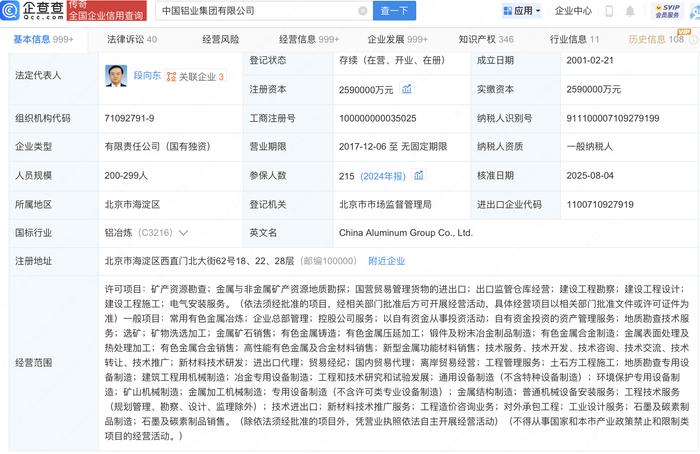
中国铝业集团公司增资至259亿
Qi Cha Cha· 2025-08-07 06:51
Group 1 - China Aluminum Group Co., Ltd. has increased its registered capital from 25.2 billion RMB to 25.9 billion RMB, marking an increase of 700 million RMB [1][2] - The company has undergone changes in several key personnel, with 14 members including Liu Xiangmin, Zhong Jun, and others exiting [2] - Established in 2001, the company is involved in mineral resource exploration, geological exploration of metal and non-metal resources, and the import and export of goods under state trade management [1][2] Group 2 - The company operates under the industry standard of aluminum smelting (C3216) and is classified as a general taxpayer [2] - The registered address of the company is located in Haidian District, Beijing [2] - The company has a workforce of approximately 215 employees and is categorized as a limited liability company wholly owned by the state [2]

三大行业将迎首次碳排放配额分配和履约清缴
Zhong Guo Chan Ye Jing Ji Xin Xi Wang· 2025-07-30 22:23
Group 1 - The core viewpoint is that the national carbon emissions trading market will expand to include the steel, cement, and aluminum smelting industries, with a total annual carbon emissions quota and distribution plan to be publicly solicited soon [1] - The expansion is expected to add 1,500 key emission units to the national carbon market, covering an additional greenhouse gas emission volume of approximately 3 billion tons of CO2 equivalent, which will enable effective control of over 60% of national carbon emissions [1] - Currently, the national carbon emissions trading market covers 2,200 key emission units in the power generation industry, managing over 5 billion tons of CO2 emissions, which accounts for about 40% of the national total [1] Group 2 - The steel, cement, and aluminum smelting industries are significant contributors to carbon emissions, accounting for over 20% of the national total CO2 emissions [1] - The Ministry of Ecology and Environment emphasizes the need for enterprises to strengthen their awareness of responsibilities and improve data quality management in accordance with the "Interim Regulations on Carbon Emission Trading Management" [1] - The Ministry plans to accelerate the improvement of the national carbon market, promoting more high-emission industries to enter the carbon market while combining free and paid quota distribution methods to enhance market vitality [2]