
国防军工

Search documents
【盘中播报】沪指跌0.50% 医药生物行业跌幅最大
Zheng Quan Shi Bao Wang· 2025-11-17 03:34
Market Overview - The Shanghai Composite Index decreased by 0.50% as of 10:29 AM, with a trading volume of 672.89 million shares and a turnover of 951.88 billion yuan, representing a 2.13% decrease from the previous trading day [1] Industry Performance - The top-performing sectors included: - Defense and Military Industry: Increased by 2.21% with a transaction amount of 404.44 billion yuan, led by Jianglong Shipbuilding which rose by 20.01% [1] - Computer: Increased by 0.83% with a transaction amount of 597.57 billion yuan, led by Haixia Innovation which rose by 15.13% [1] - Oil and Petrochemicals: Increased by 0.57% with a transaction amount of 76.18 billion yuan, led by Unified Shares which rose by 10.00% [1] - The sectors with the largest declines included: - Pharmaceutical and Biological: Decreased by 1.69% with a transaction amount of 680.11 billion yuan, led by Yao Yigou which fell by 7.34% [2] - Electric Power Equipment: Decreased by 1.39% with a transaction amount of 1,442.13 billion yuan, led by Xidian New Energy which fell by 9.98% [2] - Non-Bank Financial: Decreased by 1.26% with a transaction amount of 182.80 billion yuan, led by Northeast Securities which fell by 2.97% [2]
军工板块三季度归母净利润同比增长73.2%!军工ETF龙头(512680)盘中涨超2%,外部环境不确定性带动国际军贸需求增长
Xin Lang Cai Jing· 2025-11-17 03:09
Group 1 - The A-share military industry sector experienced a significant surge, with companies like Great Wall Military and Jianglong Shipbuilding seeing substantial gains, indicating strong market interest and potential growth in the sector [1] - The military industry is benefiting from the "14th Five-Year Plan" completion and preparations for the "15th Five-Year Plan," with key drivers including high-end military trade, state-owned enterprise reforms, and large-scale AI deployment [1] - The upcoming launch of China's reusable rocket "Zhuque-3" is expected to lower launch costs and accelerate the development of domestic satellite internet constellations, marking a milestone for commercial aerospace [1][2] Group 2 - The military sector reported a notable increase in performance, with net profit reaching 24.453 billion yuan in the first three quarters of 2025, a 17.29% increase year-on-year [2] - The third quarter alone saw a net profit of 8.927 billion yuan, reflecting a significant 73.2% year-on-year growth, indicating a positive trend in quarterly performance [2] - The military ETF index showed strong performance, with a 2.10% increase on November 17, 2025, and a 12.88% rise over the past six months, highlighting investor confidence in the sector [2][3] Group 3 - The leading military ETF reached a scale of 7.571 billion yuan as of November 14, 2025, with a substantial increase in shares by 70.4 million over the past two weeks [3] - The ETF has seen continuous net inflows, with a peak single-day inflow of 41.8467 million yuan, totaling 1.25 billion yuan in net inflows recently, indicating strong investor interest [3] Group 4 - Investors can access military ETF opportunities through various off-market connection classes, providing additional avenues for investment in the military sector [4]
人气飙升!国防军工领市大涨,512810放量溢价,实时成交大超上日全天!
Xin Lang Ji Jin· 2025-11-17 02:32
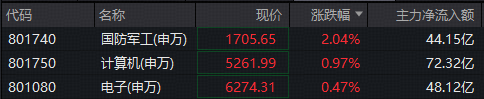
11月17日早盘,国防军工板块跳空高开后持续领涨全市场! 消息面,近日地缘局势不确定性加剧。日本首相日前公然发表挑衅言论。此外,俄乌冲突持续,11月14 日凌晨俄罗斯再次对乌克兰发起新一轮大规模空袭。 基本面上,申万宏源证券从业绩角度指出,季度报表已显示出逐季改善趋势。进入四季度,预计"十五 五"相关订单有望逐步落地,叠加军贸催化,国防军工行情或将再次上行。 【投国防军工,选"512八一0"】代码有"八一"的国防军工ETF(512810)同时是融资融券+互联互通标 的,是一键投资国防军工核心资产的高效工具,覆盖"商业航天 + 低空经济 + 可控核聚变 + 大飞机 + 深 海科技 + 军用AI "等诸多热门主题。 数据来源于沪深交易所、公开资料等。 | ( | 名称 | 现价 | 涨跌幅 ▼ | 主力净流入额 | | --- | --- | --- | --- | --- | | 801740 | 国防军工(申万) | 1705.65 | 2.04% | 44.15 Z | | 801750 | 计算机(申万) | 5261.99 | 0.97% | 72.32亿 | | 801080 | 电子(申万) | 6 ...

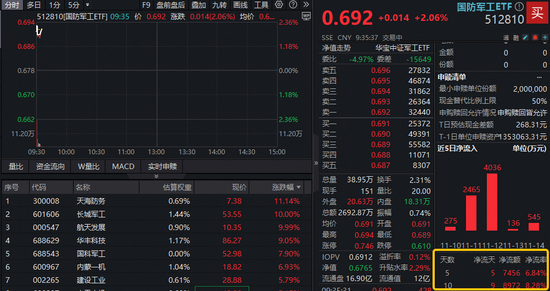
地缘局势不确定性加剧,国防军工ETF跳空高开逾2%!长城军工、航天发展一字涨停!
Xin Lang Ji Jin· 2025-11-17 01:43
【投国防军工,选"512八一0"】代码有"八一"的国防军工ETF(512810)同时是融资融券+互联互通标 的,是一键投资国防军工核心资产的高效工具,覆盖"商业航天 + 低空经济 + 可控核聚变 + 大飞机 + 深 海科技 + 军用AI "等诸多热门主题。 数据来源于沪深交易所、公开资料等。 风险提示:国防军工ETF被动跟踪中证军工指数,该指数基日为2004.12.31,发布于2013.12.26。2020- 2024年分年度历史收益分别为:67.91%、14.28%、-25.74%、-11.02%、8.20%。指数成份股构成根据该 指数编制规则适时调整,其回测历史业绩不预示指数未来表现。以上个股均为标的指数成份股,仅作展 示,个股描述不作为任何形式的投资建议,也不代表管理人旗下任何基金的持仓信息和交易动向。基金 管理人评估的本基金的风险等级为R3-中风险,适宜平衡型(C3)及以上投资者,适当性匹配意见请以 销售机构为准。任何在本文出现的信息(包括但不限于个股、评论、预测、图表、指标、理论、任何形 式的表述等)均只作为参考,投资人须对任何自主决定的投资行为负责。另,本文中的任何观点、分析 及预测不构成对阅读者 ...

申万宏源:牛市1.0高点看26年春季 关注储能、存储、创新药与国防军工
智通财经网· 2025-11-16 22:53
Core Viewpoint - The report from Shenwan Hongyuan indicates that the current "Bull Market 1.0" is at a high point, with insufficient long-term cost-effectiveness in the technology sector. The technology structural bull market of 2025 is part of this phase, and a potential peak may occur in the spring of 2026 [1][2]. Group 1: Market Phases - The "Bull Market 1.0" is characterized by high resistance to further upward movement, with cyclical trends still in a "running ahead" phase. The conditions for the initiation of "Bull Market 2.0" are not yet complete [2][4]. - The current A-share AI industry chain is compared to previous market phases, indicating a state of "ongoing industry trend with small fluctuations and long-term low cost-effectiveness." Future movements are expected to be divided into "high-level oscillation" and "adjustment" phases [2][3]. Group 2: High-Level Oscillation Phase - In the high-level oscillation phase, it becomes increasingly difficult to earn valuation gains, and new industry catalysts or sustained high growth in performance are less likely to lead to upward breakthroughs. This phase typically lasts at a quarterly level [3][4]. - The adjustment phase is usually triggered by intermediate disturbances in industry trends, which do not signify the end of the structural bull market but may lead to reasonable adjustments [3][4]. Group 3: Investment Opportunities - Short-term opportunities in technology growth are expected to arise from small rebounds, focusing on sectors with new catalysts and significant industry space, particularly in energy storage and storage solutions [4][5]. - The report emphasizes the importance of focusing on Alpha logic in both cyclical and technology investments, with a particular interest in sectors like basic chemicals, industrial metals, innovative pharmaceuticals, and national defense [5]. Group 4: 2026 Outlook - The spring of 2026 is anticipated to be a potential peak, but it is unlikely to represent the highest point of the entire bull market. The market is expected to face three challenges: long-term low cost-effectiveness in technology, intermediate disturbances in industry trends, and the conditions for "Bull Market 2.0" not being mature yet [4][5]. - The report suggests that the A-share market will continue to see mid-term gains from cyclical improvements, asset allocation shifts towards equities, and China's increasing global influence [5].

无人僚机攻击-11公开亮相,朱雀三号可回收火箭即将首飞,关注新质战斗力
Orient Securities· 2025-11-16 15:25
投资建议与投资标的 风险提示:军品订单和收入确认不及预期;研发进度及产业化不及预期;竞争格局及份 额波动风险;产品价格下降风险等。 国家/地区 中国 行业 国防军工行业 报告发布日期 2025 年 11 月 16 日 | 罗楠 | 执业证书编号:S0860518100001 | | --- | --- | | | luonan@orientsec.com.cn | | | 021-63326320 | | 冯函 | 执业证书编号:S0860520070002 | | | fenghan@orientsec.com.cn | | | 021-63326320 | 国防军工行业 行业研究 | 行业周报 无人僚机攻击-11 公开亮相,朱雀三号可回 收火箭即将首飞,关注新质战斗力 核心观点 | 核心观点:关注新质战斗力及商业航天 4 | | --- | | 1.1 智能化驱动作战模式升级,无人僚机未来市场广阔 4 | | 1.2 "朱雀三号"即将首飞,未来规模化星座组网计划有望加速 4 | | 1.3 继续看好内需新质战斗力、军贸等方向 4 | | 风险提示 5 | | 附录:行情走势与主要新闻公告 6 | | 2. ...
北交所策略专题报告:北交所开市四周年:专精特新“沃土”深耕不辍,打造新质生产力“新引擎”
KAIYUAN SECURITIES· 2025-11-16 12:44
Group 1 - The report highlights that the Beijing Stock Exchange (BSE) has evolved from a "testing ground" to a main battleground for specialized and innovative enterprises, with 282 listed companies and a total market capitalization of 900.835 billion yuan as of November 14, 2025 [2][12][14] - Among the listed companies, 254 are classified as specialized and innovative "little giants," accounting for 90.07% of the total, with 152 being national-level little giants [2][33] - The report identifies key industry chains within the BSE, including smart connected new energy vehicles, hydrogen energy, new materials, innovative pharmaceuticals, and artificial intelligence [2][38] Group 2 - The BSE's market performance shows a decline in the North BSE 50 index, which reported 1,514.20 points, with a TTM PE ratio of 71.80X, while the specialized and innovative index reported 2,500.55 points with a TTM PE of 80.59X [3][62][66] - The average market capitalization of BSE companies is lower than that of the ChiNext and STAR Market, with the average market cap at 31.94 million yuan compared to 126.11 million yuan and 175.43 million yuan respectively [22][23] - The report notes that the liquidity of the BSE has improved, with the turnover rate now higher than that of the STAR Market and slightly above the ChiNext [41][42][47] Group 3 - The report indicates that the IPO review process is active, with two companies approved and three pending approval, reflecting a steady increase in the number of companies entering the market [3][28] - The report emphasizes the growing interest from public funds in the BSE, with 39 public institutions investing in BSE stocks by mid-2025, marking a significant increase in both the number of institutions and the amount invested [45][46] - The BSE is expected to enhance its index system and introduce the North BSE 50 ETF, which could further improve liquidity and attract more institutional investors [50][51]
中信建投:继续看多黄金 港股情绪指数抬升
Zheng Quan Shi Bao Wang· 2025-11-16 12:15
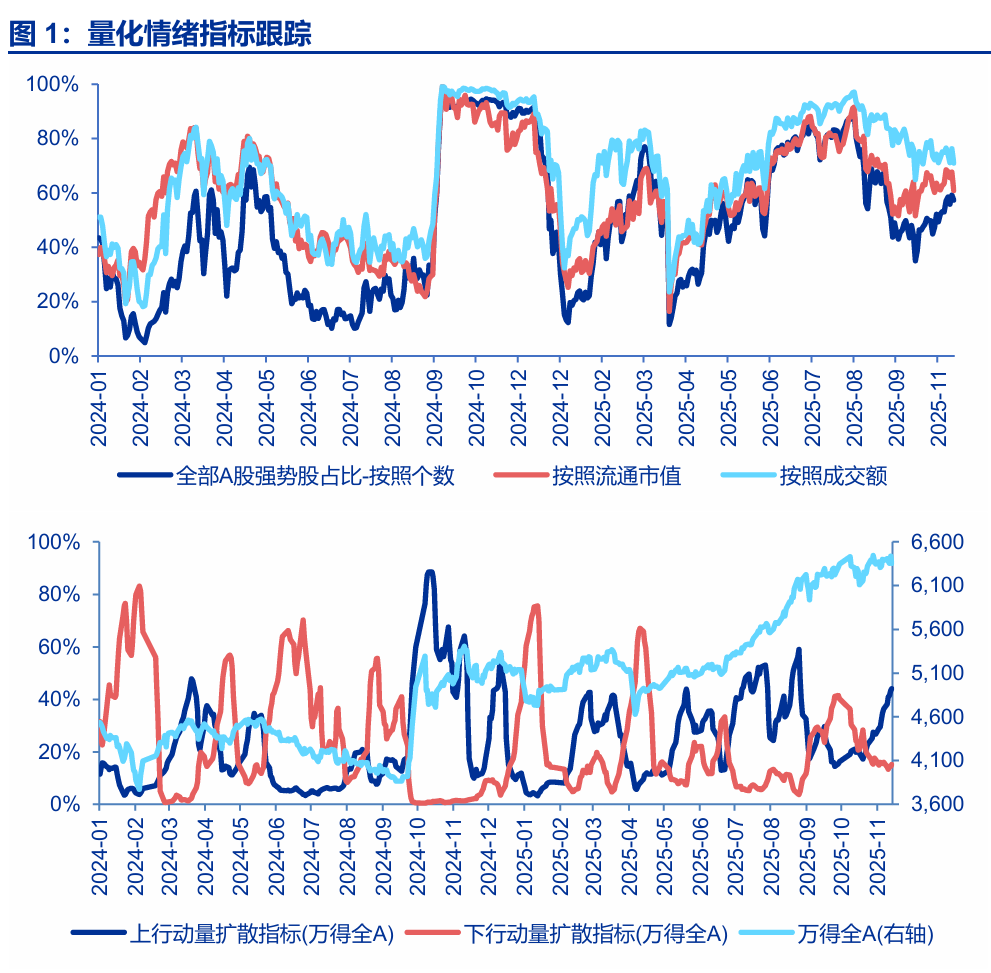
Group 1 - The A-share sentiment index is declining while the Hong Kong stock sentiment index is rising, indicating a shift in market sentiment [1] - The VIX for the Shanghai Stock Exchange 50, CSI 300, CSI 500, and CSI 1000 has decreased, suggesting a more stable market environment [1] - Institutions are currently focusing on sectors such as basic chemicals, defense and military, automotive, textile and apparel, non-bank financials, and media, while interest in the telecommunications sector has decreased [1] Group 2 - There has been an increase in institutional attention towards the "petroleum and petrochemicals," "coal," "steel," "light manufacturing," and "non-bank financial" sectors over the past week [1] - Many industries are approaching the threshold of crowded indicators, indicating potential liquidity and consistency among constituent stocks [1] - For the long term, the company is optimistic about the relative returns of electric power and utilities, basic chemicals, electric equipment and new energy, electronics, and computers by November 2025 [1] Group 3 - The VIX for gold, silver, copper, and crude oil has risen, with a long-term bullish outlook on gold [1]

中信建投:看好电力及公用事业、基础化工、电力设备及新能源、电子和计算机的相对收益
Di Yi Cai Jing· 2025-11-16 12:12
Group 1 - The current institutional focus is on the basic chemical, defense, automotive, textile and apparel, non-bank financial, and media industries, while the telecommunications sector has seen a decline in institutional attention [1] - In the past week, there has been an increase in institutional interest in the "petroleum and petrochemical," "coal," "steel," "light manufacturing," and "non-bank financial" sectors [1] - Many industries are currently at the threshold of triggering congestion indicators (liquidity, consistency of constituent stocks) [1] Group 2 - The relative returns for electric power and utilities, basic chemicals, electric equipment and new energy, electronics, and computers are expected to be favorable by November 2025 [1] - The VIX for gold, silver, copper, and crude oil has risen, and the medium to long-term outlook for gold remains bullish [1]
申万宏源:科技“性价比不足”,顺周期“逻辑有断点”,“牛市2.0”条件不具备,现在是“牛市1.0”高位震荡
Hua Er Jie Jian Wen· 2025-11-16 09:51
Core Viewpoint - The current A-share market is in the high position of "Bull Market 1.0," with insufficient long-term cost-effectiveness in the technology sector and logical breaks in the cyclical market. Conditions for the initiation of Bull Market 2.0 are not yet complete [1] Group 1: Market Conditions - The A-share AI industry chain is in a state of "long-term low cost-effectiveness" similar to previous years in various sectors, indicating a high-level consolidation phase followed by an adjustment phase [2] - The high-level consolidation phase typically lasts at a quarterly level, and adjustments are triggered by mid-level disturbances in the industry trend, but this does not signify the end of the industry trend [2] Group 2: Cyclical Market Analysis - The recent cyclical market is characterized by short-term price increases and expectations of PPI turning positive by mid-2026, but there is significant divergence regarding the pace of PPI improvement [3] - The cyclical market is approaching a differentiation phase as cost-effectiveness decreases, and the sustainability of price increases becomes more critical [3] Group 3: Future Challenges - By spring 2026, the A-share market may face three major challenges: the technology sector's long-term low cost-effectiveness, a critical verification period for demand, and immature conditions for the transition to Bull Market 2.0 [4][5] - The market is expected to experience a two-stage bull market, with the first stage being the structural bull market in 2025 and a potential peak in spring 2026 [4][6] Group 4: Investment Opportunities - In the current high-level consolidation phase, the focus should be on Alpha opportunities in both cyclical and technology sectors, with an emphasis on sectors with favorable supply-demand dynamics and high dividend yields [7] - Short-term opportunities in technology growth are expected to arise from small rebounds, particularly in sectors with new catalysts or significant industry space, such as energy storage and innovative pharmaceuticals [7]